
Plebeian Short-wing Grasshopper
Melanoplus plebejus
This record describes Melanoplus plebejus (species). Recorded family: Acrididae. Recorded order: Orthoptera.
Identification and Appearance
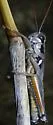
The overlapping, relatively pointed tegmina (not pointed in long-winged individuals), the relatively plain coloration (usually), bluish hind tibiae, plus the shape of the male cerci, with the male furculae being divergent, tiny and peg-like (southward) to short and pointed (northward), are all good clues to M. plebejus ' identity. Other traits include no lump under the mid-part of the thorax, and the male subgenital plate is rounded (not notched or pointed) posteriorly. M. lakinus is also similar, but occurs mostly further to the west. It tends to be a bit stockier of build, and more strongly (but also more variably) colored. The male subgenital plate is proportionately longer and more apically pointed, and the cerci are short, fat, rounded, with a dorsal lobe. Phoetaliotes nebrascensis is very similar, and may occur with M. plebejus . The head on P. nebrascensis is proportionately larger, and in males the cerci taper to a narrow, almost pointed tip. In M. plebejus the cerci narrow somewhat less toward a wider and more rounded tip, and are also somewhat spooned near the tip. Northward, M. plebejus (especially males) usually have the black bar behind the eyes onto the thorax more solid and even in shape, but southward (and often in females) this is often weaker, broken, and much as usually seen in P. nebrascensis . Like P. nebrascensis , M. plebejus is usually short-winged, but some individuals may be long-winged, making them easily confused with many similar-looking Melanoplus species . Long winged individuals should be identifiable by association with like-looking short-winged individuals, and by the rather plain coloration combined with relatively slender and big-headed proportions, along with the distinctive male abdominal terminalia. Tip of male abdomen
Classification
- Kingdom
- Animalia
- Phylum
- Arthropoda
- Class
- Insecta
- Order
- Orthoptera (Grasshoppers, Crickets, Katydids)
- Suborder
- Caelifera
- Family
- Acrididae (Short-horned Grasshoppers)
- Subfamily
- Melanoplinae
- Tribe
- Melanoplini
- Genus
- Melanoplus
Imported taxonomy record. Source availability varies; see the source references and editorial policy below.
Habitat and Range
Habitat
Seems to favor areas with short grass and weeds.
Geographic Range
Texas east of the arid parts and west of the moist forested parts, and northward into Oklahoma.
Seasonal Activity
Apparently overwinters as eggs, hatching in spring, but adults can be found year-round toward the south (seemingly most common in late summer).
Diet and Behavior
Diet: Apparently undocumented, but probably mostly assorted and varied dicot forbs.
Additional species information
Species notes from the sources
Etymology: Melanoplus cameronis was originally described as a subspecies of M. plebejus , but has more recently been treated as a distinct species. The occurance of apparently intermediate populations in southern Texas implies that they are probably best treated as subspecies, but until there is more information available, the treatment on BugGuide currently follows that of the Orthoptera Species Files Online .
About Grasshoppers, Crickets, Katydids: the wider group
Order-level background for Orthoptera, the group containing Melanoplus plebejus. Species-specific details appear above.
Group overview
Orthoptera includes ~28,000 described species of grasshoppers, crickets, and katydids. Desert locusts can form swarms covering 460 square miles containing up to 80 million individuals per square kilometer.
Ecological role of the group
Grasshoppers and crickets are a primary food source for birds, reptiles, and small mammals. Cricket farming is a growing industry - crickets require 12× less feed than cattle to produce the same amount of protein, using 2,000× less water.
Economic and practical significance of the group
A single large locust swarm can consume the same amount of food in one day as 35,000 people. The 2019-2021 East Africa locust crisis affected food security for 42 million people across multiple countries. Global crop losses from locusts can reach billions annually.
Recorded sources for this group: FAO, UN World Food Programme, research publications. Imported estimates may describe particular regions or reporting periods.
Photos of Plebeian Short-wing Grasshopper (5)
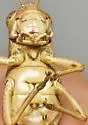
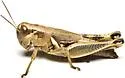
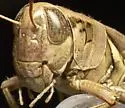
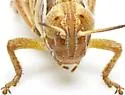
Photo credits: Contributed by David J. Ferguson; Additional contributions by Tyler Hedlund
Frequently Asked Questions About Plebeian Short-wing Grasshopper
What is Plebeian Short-wing Grasshopper?
Plebeian Short-wing Grasshopper (Melanoplus plebejus) is a species in the family Acrididae, within the order Orthoptera.
How do you identify Plebeian Short-wing Grasshopper?
The overlapping, relatively pointed tegmina (not pointed in long-winged individuals), the relatively plain coloration (usually), bluish hind tibiae, plus the shape of the male cerci, with the male furculae being divergent, tiny and peg-like (southward) to short and pointed (northward), are all good clues to M. plebejus ' identity. Other traits include no lump under the mid-part of the thorax, and the male subgenital plate is rounded (not notched or pointed) posteriorly. M. lakinus is also similar, but occurs mostly further to the west. It tends to be a bit stockier of build, and more strongly (but also more variably) colored. The male subgenital plate is proportionately longer and more apically pointed, and the cerci are short, fat, rounded, with a dorsal lobe. Phoetaliotes nebrascensis is very similar, and may occur with M. plebejus . The head on P. nebrascensis is proportionately larger, and in males the cerci taper to a narrow, almost pointed tip. In M. plebejus the cerci narrow somewhat less toward a wider and more rounded tip, and are also somewhat spooned near the tip. Northward, M. plebejus (especially males) usually have the black bar behind the eyes onto the thorax more solid and even in shape, but southward (and often in females) this is often weaker, broken, and much as usually seen in P. nebrascensis . Like P. nebrascensis , M. plebejus is usually short-winged, but some individuals may be long-winged, making them easily confused with many similar-looking Melanoplus species . Long winged individuals should be identifiable by association with like-looking short-winged individuals, and by the rather plain coloration combined with relatively slender and big-headed proportions, along with the distinctive male abdominal terminalia. Tip of male abdomen
Where is Plebeian Short-wing Grasshopper found?
| Feature | Details |
|---|---|
| Habitat | Seems to favor areas with short grass and weeds. |
| Range | Texas east of the arid parts and west of the moist forested parts, and northward into Oklahoma. |
What does Plebeian Short-wing Grasshopper eat?
The diet of the Plebeian Short-wing Grasshopper includes Apparently undocumented, but probably mostly assorted and varied dicot forbs..
When is Plebeian Short-wing Grasshopper active?
Plebeian Short-wing Grasshopper: seasonal activity - Apparently overwinters as eggs, hatching in spring, but adults can be found year-round toward the south (seemingly most common in late summer)..