
Arrowweed Grasshopper
Melanoplus herbaceus
This record describes Melanoplus herbaceus (species). Recorded family: Acrididae. Recorded order: Orthoptera.
Identification and Appearance
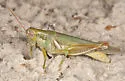
Similar to M. cinereus, M. bowditchi, & M. pictus , all of which might occur with it. Those species all favor Composite shrubs, but tend to be mostly in semi-arid to arid habitats, often sandy and usually dry in nature. They are usually grayish, brownish, or sometimes have lots of yellowish or blueish coloring. They are only rarely greenish, and then usually have spots on the tegmina and a relatively strong and contrasting pattern of dark brownish to blackish markings. There are minor differences in male genitalia, but females are very similar structurally. M. herbaceus is usually associated with riparian areas where there is permanent water, or at least permanent water shallow in the soils, and where mesic plants grow. The usual host plant is the Composite Pluchea sericea (Arrowweed). The insect is usually dull green, with the dark markings even greenish (grayish individuals do occur though). The male furculae are long, broad, truncated, and touch most of their length, and the cerci taper toward the tip, but are still rather wide and truncated at the tip. In related species either the furculae are long and slender, not touching much; or, the cerci are more slender with the tip narrow and rounded.
Classification
- Kingdom
- Animalia
- Phylum
- Arthropoda
- Class
- Insecta
- Order
- Orthoptera (Grasshoppers, Crickets, Katydids)
- Suborder
- Caelifera
- Family
- Acrididae (Short-horned Grasshoppers)
- Subfamily
- Melanoplinae
- Tribe
- Melanoplini
- Genus
- Melanoplus
Imported taxonomy record. Source availability varies; see the source references and editorial policy below.
Habitat and Range
Habitat
Moist areas (by southwestern standards) near marshes and watercourses mostly in hot desert areas.
Geographic Range
Southeastern California and southern Nevada to central New Mexico and western Texas, and south into northern Mexico.
Diet and Behavior
Diet: Perhaps restricted to Arrowweed - Pluchea sericea (Asteraceae); however, other closely related plants may be used as well.
About Grasshoppers, Crickets, Katydids: the wider group
Order-level background for Orthoptera, the group containing Melanoplus herbaceus. Species-specific details appear above.
Group overview
Orthoptera includes ~28,000 described species of grasshoppers, crickets, and katydids. Desert locusts can form swarms covering 460 square miles containing up to 80 million individuals per square kilometer.
Ecological role of the group
Grasshoppers and crickets are a primary food source for birds, reptiles, and small mammals. Cricket farming is a growing industry - crickets require 12× less feed than cattle to produce the same amount of protein, using 2,000× less water.
Economic and practical significance of the group
A single large locust swarm can consume the same amount of food in one day as 35,000 people. The 2019-2021 East Africa locust crisis affected food security for 42 million people across multiple countries. Global crop losses from locusts can reach billions annually.
Recorded sources for this group: FAO, UN World Food Programme, research publications. Imported estimates may describe particular regions or reporting periods.
Photos of Arrowweed Grasshopper (5)
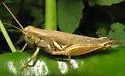
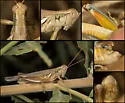
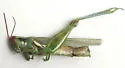
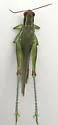
Photo credits: Contributed by Eric R. Eaton; Additional contributions by David Ferguson , metrioptera
Frequently Asked Questions About Arrowweed Grasshopper
What is Arrowweed Grasshopper?
Arrowweed Grasshopper (Melanoplus herbaceus) is a species in the family Acrididae, within the order Orthoptera.
How do you identify Arrowweed Grasshopper?
Similar to M. cinereus, M. bowditchi, & M. pictus , all of which might occur with it. Those species all favor Composite shrubs, but tend to be mostly in semi-arid to arid habitats, often sandy and usually dry in nature. They are usually grayish, brownish, or sometimes have lots of yellowish or blueish coloring. They are only rarely greenish, and then usually have spots on the tegmina and a relatively strong and contrasting pattern of dark brownish to blackish markings. There are minor differences in male genitalia, but females are very similar structurally. M. herbaceus is usually associated with riparian areas where there is permanent water, or at least permanent water shallow in the soils, and where mesic plants grow. The usual host plant is the Composite Pluchea sericea (Arrowweed). The insect is usually dull green, with the dark markings even greenish (grayish individuals do occur though). The male furculae are long, broad, truncated, and touch most of their length, and the cerci taper toward the tip, but are still rather wide and truncated at the tip. In related species either the furculae are long and slender, not touching much; or, the cerci are more slender with the tip narrow and rounded.
Where is Arrowweed Grasshopper found?
| Feature | Details |
|---|---|
| Habitat | Moist areas (by southwestern standards) near marshes and watercourses mostly in hot desert areas. |
| Range | Southeastern California and southern Nevada to central New Mexico and western Texas, and south into northern Mexico. |
What does Arrowweed Grasshopper eat?
The diet of the Arrowweed Grasshopper includes Perhaps restricted to Arrowweed - Pluchea sericea (Asteraceae); however, other closely related plants may be used as well..