
Thomas's Two-striped Grasshopper
Melanoplus thomasi
This record describes Melanoplus thomasi (species). Recorded family: Acrididae. Recorded order: Orthoptera.
Identification and Appearance
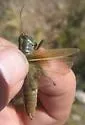
Moderately large for the genus, green, often bright bluish green, with two pale stripes along sides of top, and with bright red hind tibiae. M. bivittatus from the northeast and from near the West Coast may look similar, but are never so brightly and contrastingly patterned, and occur in different regions along with more normal brownish individuals of that species. Tip of male abdomen Very similar to and closely related to Melanoplus bivittatus , and perhaps merely a geographic subpsecies; however, currently treated as a distinct species, and internal male genitalia are different. Where the two occur fairly near to one another in Arizona and New Mexico, they seem to maintain their distinctness. However, it would be interesting to try breeding experiments between the two to learn more of their relationship to one another.
Classification
- Kingdom
- Animalia
- Phylum
- Arthropoda
- Class
- Insecta
- Order
- Orthoptera (Grasshoppers, Crickets, Katydids)
- Suborder
- Caelifera
- Family
- Acrididae (Short-horned Grasshoppers)
- Subfamily
- Melanoplinae
- Tribe
- Melanoplini
- Genus
- Melanoplus
Imported taxonomy record. Source availability varies; see the source references and editorial policy below.
Habitat and Range
Habitat
Mostly areas of rank herbaceous growth in places like washes, along waterways, in depressions, along roadsides, around irrigated fields, and often in yards. In moist years it often moves into temporarily more rank growth of desert shrubs and annuals.
Geographic Range
central New Mexico to south central Arizona and south across Trans Pecos Texas well into north central Mexico.
Diet and Behavior
Life History
Overwinters as eggs with adults from late spring to freezing weather. Usually most common about July through September, but rains can produce late or early hatchings and alter the season or create the false impression of two broods in one year.
About Grasshoppers, Crickets, Katydids: the wider group
Order-level background for Orthoptera, the group containing Melanoplus thomasi. Species-specific details appear above.
Group overview
Orthoptera includes ~28,000 described species of grasshoppers, crickets, and katydids. Desert locusts can form swarms covering 460 square miles containing up to 80 million individuals per square kilometer.
Ecological role of the group
Grasshoppers and crickets are a primary food source for birds, reptiles, and small mammals. Cricket farming is a growing industry - crickets require 12× less feed than cattle to produce the same amount of protein, using 2,000× less water.
Economic and practical significance of the group
A single large locust swarm can consume the same amount of food in one day as 35,000 people. The 2019-2021 East Africa locust crisis affected food security for 42 million people across multiple countries. Global crop losses from locusts can reach billions annually.
Recorded sources for this group: FAO, UN World Food Programme, research publications. Imported estimates may describe particular regions or reporting periods.
Photos of Thomas's Two-striped Grasshopper (5)
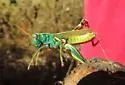
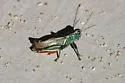
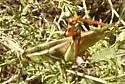
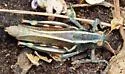
Photo credits: Contributed by Eric R. Eaton; Additional contributions by David Ferguson , Tyler Hedlund
Frequently Asked Questions About Thomas's Two-striped Grasshopper
What is Thomas's Two-striped Grasshopper?
Thomas's Two-striped Grasshopper (Melanoplus thomasi) is a species in the family Acrididae, within the order Orthoptera.
How big is Thomas's Two-striped Grasshopper?
Varying dramatically with environmental conditions (and reproductive condition of females)from about 25 to 50 mm, but averaging about 30 to 40 mm. Males are smaller, but often just as long because females tend to have shorter wings.
How do you identify Thomas's Two-striped Grasshopper?
Moderately large for the genus, green, often bright bluish green, with two pale stripes along sides of top, and with bright red hind tibiae. M. bivittatus from the northeast and from near the West Coast may look similar, but are never so brightly and contrastingly patterned, and occur in different regions along with more normal brownish individuals of that species. Tip of male abdomen
Where is Thomas's Two-striped Grasshopper found?
| Feature | Details |
|---|---|
| Habitat | Mostly areas of rank herbaceous growth in places like washes, along waterways, in depressions, along roadsides, around irrigated fields, and often in yards. In moist years it often moves into temporarily more rank growth of desert shrubs and annuals. |
| Range | central New Mexico to south central Arizona and south across Trans Pecos Texas well into north central Mexico. |
What is the life cycle of a Thomas's Two-striped Grasshopper?
Overwinters as eggs with adults from late spring to freezing weather. Usually most common about July through September, but rains can produce late or early hatchings and alter the season or create the false impression of two broods in one year.