
Tunica Spur-throat Grasshopper
Melanoplus tunicae
This record describes Melanoplus tunicae (species). Recorded family: Acrididae. Recorded order: Orthoptera.
Identification and Appearance
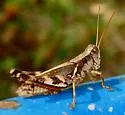
The name M. tunicae was applied to insects found at the southeast extreme of the distribution of M. ponderosus from Tennessee to the Gulf Coast in Mississippi and eastern Louisiana (west as far as Lafayette). The distinctions from M. ponderosus on one hand and M. alabamae on the other are not great, but they have never been associated with one another as subspecies. As compared to M. ponderosae , M. tunicae is a bit smaller, and a bit plainer in overall pattern, with the tops of the folded tegmina usually even in color and distinctly paler than the sides. It is a slightly more slender insect with the male cerci averaging smaller and slightly different in shape (less expanded apically). M. alabamae displaces M. tunicae to the southeast, and has the pattern more smooth, is a bit more slender in build, and has the cerci more angled on the lower side of the apical end. M. walshii is also similar, but smaller, more northern in distribushion, with shorter wings, and with narrower male cerci & larger furculae. It seems possible that M. tunicae, M. alabamae, M. walshii , and/or M. ponderosus could be parts of a continuum. This may connect with the also similar M. querneus and M. nigrescens to the east. These apparently related insects need more extensive sampling and study in the field. Male cercus
Classification
- Kingdom
- Animalia
- Phylum
- Arthropoda
- Class
- Insecta
- Order
- Orthoptera (Grasshoppers, Crickets, Katydids)
- Suborder
- Caelifera
- Family
- Acrididae (Short-horned Grasshoppers)
- Subfamily
- Melanoplinae
- Tribe
- Melanoplini
- Genus
- Melanoplus
Imported taxonomy record. Source availability varies; see the source references and editorial policy below.
Habitat and Range
Habitat
Stated in the original description as "scant undergrowth of lofty deciduous forests and particularly those growing on low flat ground".
Geographic Range
Tennessee to near the Gulf Coast in Mississippi and southeastern Louisiana. Reported from as far west as Lafayette.
Additional species information
Species notes from the sources
Etymology: The species name " tunicae " is derived from: "The Tunica, a tribe of of friendly Indians, are prominent in early French history of the lower Mississippi, in which region the present insect is found". [quote from the original description of the species]
About Grasshoppers, Crickets, Katydids: the wider group
Order-level background for Orthoptera, the group containing Melanoplus tunicae. Species-specific details appear above.
Group overview
Orthoptera includes ~28,000 described species of grasshoppers, crickets, and katydids. Desert locusts can form swarms covering 460 square miles containing up to 80 million individuals per square kilometer.
Ecological role of the group
Grasshoppers and crickets are a primary food source for birds, reptiles, and small mammals. Cricket farming is a growing industry - crickets require 12× less feed than cattle to produce the same amount of protein, using 2,000× less water.
Economic and practical significance of the group
A single large locust swarm can consume the same amount of food in one day as 35,000 people. The 2019-2021 East Africa locust crisis affected food security for 42 million people across multiple countries. Global crop losses from locusts can reach billions annually.
Recorded sources for this group: FAO, UN World Food Programme, research publications. Imported estimates may describe particular regions or reporting periods.
Photos of Tunica Spur-throat Grasshopper (5)
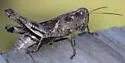
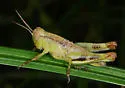
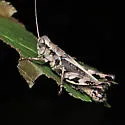
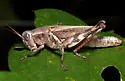
Photo credits: Contributed by David J. Ferguson; Additional contributions by Tyler Hedlund
Frequently Asked Questions About Tunica Spur-throat Grasshopper
What is Tunica Spur-throat Grasshopper?
Tunica Spur-throat Grasshopper (Melanoplus tunicae) is a species in the family Acrididae, within the order Orthoptera.
How do you identify Tunica Spur-throat Grasshopper?
The name M. tunicae was applied to insects found at the southeast extreme of the distribution of M. ponderosus from Tennessee to the Gulf Coast in Mississippi and eastern Louisiana (west as far as Lafayette). The distinctions from M. ponderosus on one hand and M. alabamae on the other are not great, but they have never been associated with one another as subspecies. As compared to M. ponderosae , M. tunicae is a bit smaller, and a bit plainer in overall pattern, with the tops of the folded tegmina usually even in color and distinctly paler than the sides. It is a slightly more slender insect with the male cerci averaging smaller and slightly different in shape (less expanded apically). M. alabamae displaces M. tunicae to the southeast, and has the pattern more smooth, is a bit more slender in build, and has the cerci more angled on the lower side of the apical end. M. walshii is also similar, but smaller, more northern in distribushion, with shorter wings, and with narrower male cerci & larger furculae. It seems possible that M. tunicae, M. alabamae, M. walshii , and/or M. ponderosus could be parts of a continuum. This may connect with the also similar M. querneus and M. nigrescens to the east. These apparently related insects need more extensive sampling and study in the field. Male cercus
Where is Tunica Spur-throat Grasshopper found?
| Feature | Details |
|---|---|
| Habitat | Stated in the original description as scant undergrowth of lofty deciduous forests and particularly those growing on low flat ground. |
| Range | Tennessee to near the Gulf Coast in Mississippi and southeastern Louisiana. Reported from as far west as Lafayette. |