
Nordic Mountain Grasshopper
Melanoplus frigidus
This record describes Melanoplus frigidus (species). Recorded family: Acrididae. Recorded order: Orthoptera.
Identification and Appearance
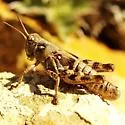
Few other species of Melanoplus occur in the same region. M. frigidus is fairly stocky in build, greenish, grayish, or light brownish with the usual dark bar reaching back from the eyes, but not to the rear of the pronotum; tegmina short but usually longer than pronotum, and often (not always) overlapping on top, acute apically; hind femur and abdomen banded dark; hind tibiae and under side of hind femur reddish.
Classification
- Kingdom
- Animalia
- Phylum
- Arthropoda
- Class
- Insecta
- Order
- Orthoptera (Grasshoppers, Crickets, Katydids)
- Suborder
- Caelifera
- Family
- Acrididae (Short-horned Grasshoppers)
- Subfamily
- Melanoplinae
- Tribe
- Melanoplini
- Genus
- Melanoplus
Imported taxonomy record. Source availability varies; see the source references and editorial policy below.
Habitat and Range
Habitat
In North America mostly (always?) in tundra areas.
Geographic Range
recorded in North America from Alaska, Yukon, Northwest Territories, and western Nunavut. Also northern Asia, and north and mountains of Europe.
Diet and Behavior
Life History
Overwinters as eggs, hatches in spring and matures quickly. Adults July and August.
Additional species information
Species notes from the sources
Etymology: Logically, based on geography, North American populations should be more related to east Russian than to west European populations, and may(?) be referable to subspecies kamtchatkae ; or, perhaps represent a distinct subspecies. North American treatments have not designated subspecies for North American populations.
About Grasshoppers, Crickets, Katydids: the wider group
Order-level background for Orthoptera, the group containing Melanoplus frigidus. Species-specific details appear above.
Group overview
Orthoptera includes ~28,000 described species of grasshoppers, crickets, and katydids. Desert locusts can form swarms covering 460 square miles containing up to 80 million individuals per square kilometer.
Ecological role of the group
Grasshoppers and crickets are a primary food source for birds, reptiles, and small mammals. Cricket farming is a growing industry - crickets require 12× less feed than cattle to produce the same amount of protein, using 2,000× less water.
Economic and practical significance of the group
A single large locust swarm can consume the same amount of food in one day as 35,000 people. The 2019-2021 East Africa locust crisis affected food security for 42 million people across multiple countries. Global crop losses from locusts can reach billions annually.
Recorded sources for this group: FAO, UN World Food Programme, research publications. Imported estimates may describe particular regions or reporting periods.
Frequently Asked Questions About Nordic Mountain Grasshopper
What is Nordic Mountain Grasshopper?
Nordic Mountain Grasshopper (Melanoplus frigidus) is a species in the family Acrididae, within the order Orthoptera.
How do you identify Nordic Mountain Grasshopper?
Few other species of Melanoplus occur in the same region. M. frigidus is fairly stocky in build, greenish, grayish, or light brownish with the usual dark bar reaching back from the eyes, but not to the rear of the pronotum; tegmina short but usually longer than pronotum, and often (not always) overlapping on top, acute apically; hind femur and abdomen banded dark; hind tibiae and under side of hind femur reddish.
Where is Nordic Mountain Grasshopper found?
| Feature | Details |
|---|---|
| Habitat | In North America mostly (always?) in tundra areas. |
| Range | recorded in North America from Alaska, Yukon, Northwest Territories, and western Nunavut. Also northern Asia, and north and mountains of Europe. |
What is the life cycle of a Nordic Mountain Grasshopper?
Overwinters as eggs, hatches in spring and matures quickly. Adults July and August.