
True Bugs, Cicadas, Hoppers, Aphids and Allies
Order Hemiptera
The True Bugs, Cicadas, Hoppers, Aphids and Allies (Order Hemiptera) includes 7,349 species across 120 families and 1,727 genera in our directory.
About True Bugs, Cicadas, Hoppers, Aphids and Allies
Hemiptera (true bugs) includes over 80,000 described species across cicadas, aphids, leafhoppers, shield bugs, and bed bugs. Aphids alone cost global agriculture an estimated $2.5 billion annually in crop losses.
Economic Impact
The brown marmorated stink bug (Halyomorpha halys) caused $37 million in apple crop losses in a single year in the U.S. Mid-Atlantic region. Bed bug infestations in the U.S. increased by 500% between 2001-2010, costing the hotel industry hundreds of millions annually.
Ecological Role
Many Hemiptera are essential food sources for birds and predatory insects. Cicadas provide massive nutrient pulses during emergence events - a single Brood X emergence can involve trillions of individuals across 15 states.
Families in Hemiptera (120)
Species in Hemiptera (7,349)
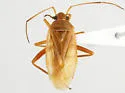
Pappus balli
Pappus balli
Identification: "Distinguished by the almost glabrous dorsum, by the long rostrum, by the reddish brown scutellum [and] inner corium, and by the reddish legs."
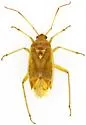
Pappus scutellatus
Pappus scutellatus
Identification: "Distinguished by the almost glabrous dorsum, by the reddish brown or brown triangular marks on the scutellum, and usually the brown longitudinal line between the calli on the pronotum."
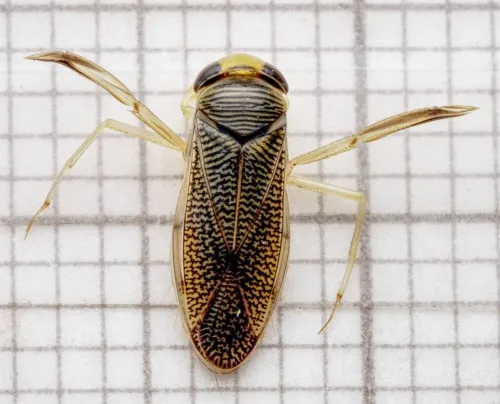
Paracorixa concinna
Paracorixa concinna
Length 7 to 8 mm. Hind tarsus with small dark mark at apex of inner edge, opposite similar mark on base of claw; corium sharply wrinkled longitudinally, light dorsal markings fragmented. Good photographs showing key identifying features required. Fou
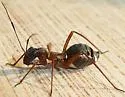
Paradacerla downesi
Paradacerla downesi
Identification: The diagnostic characters are the comparative length of AI and width of vertex and the posterior margin of the pronotum with a white border. --M.D. Schwartz, pers.comm. to =v= 20vii2021
Paragonatas divergens
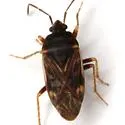
Paragonatas divergens
the most common lethaeine in the New World (O’Donnell 1986) yet unknown in the US until recently, although it has been intercepted numerous times on imported commodities in FL, TX, CA, and 5 other states (Dobbs & Brambila 2004)
Paramesus major
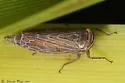
Paramesus major
Identification: Wider and blunter in the head than the native [i]Pasaremus[i]. --A.K.G. Hamilton
Paraphlepsius collitus
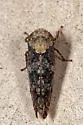
Paraphlepsius collitus
Identification: Vertex and thorax are largely ochreous, and contrast with the general grayish-brown hue of forewings. The dark markings on the forewings are intensified at the base and middle to form indefinite dark traverse bands.
Paraphlepsius dentatus
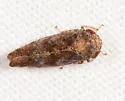
Paraphlepsius dentatus
Identification: Wider across the head and thorax than most congeners. P. luxuria is similar but occurs farther north & west of this coastal species. -K.G.A. Hamilton
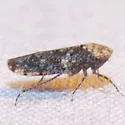
Paraphlepsius varispinus
Paraphlepsius varispinus
Identification: A bog-inhabiting species similar to P. collitus but rather darker. --K.G.A. Hamilton
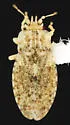
Parapiesma ceramicum
Parapiesma ceramicum
Identification: Paranotum anterior to calli with single series of areolae; lateral margins of pronotum sinuate, incurved at middle; pronotal similarly wide anteriorly and posteriorly, scarcely narrowed anteriorly; femora pale yellowish; third antenno
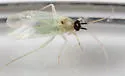
Paraproba capitata
Paraproba capitata
Identification: Recognized by the small size, pale greenish colour, black head , and by the fuscous to black first antennal segment .
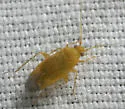
Parapsallus vitellinus
Parapsallus vitellinus
Identification: Recognized by relatively small size with average total length 3.26 mm, uniform orange coloration of dorsum, pale coloration of antennal segment 1, narrow dark band at base of antennal segment 2 with remainder of segment pale, and gene
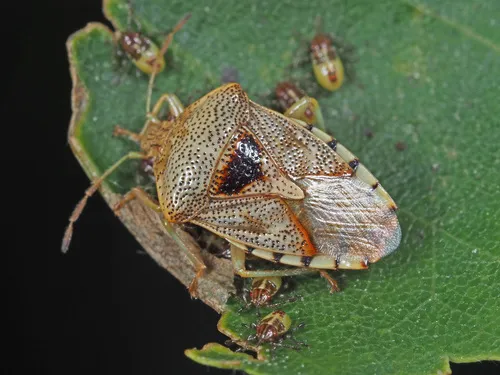
Parent Bug
Elasmucha grisea
Length 7-9 mm. A medium-sized red/brown shieldbug. There is usually an obvious black patch on the scutellum. This species overwinters as an adult, emerging and mating in the spring. The smaller male dies soon after, but the female survives for some t
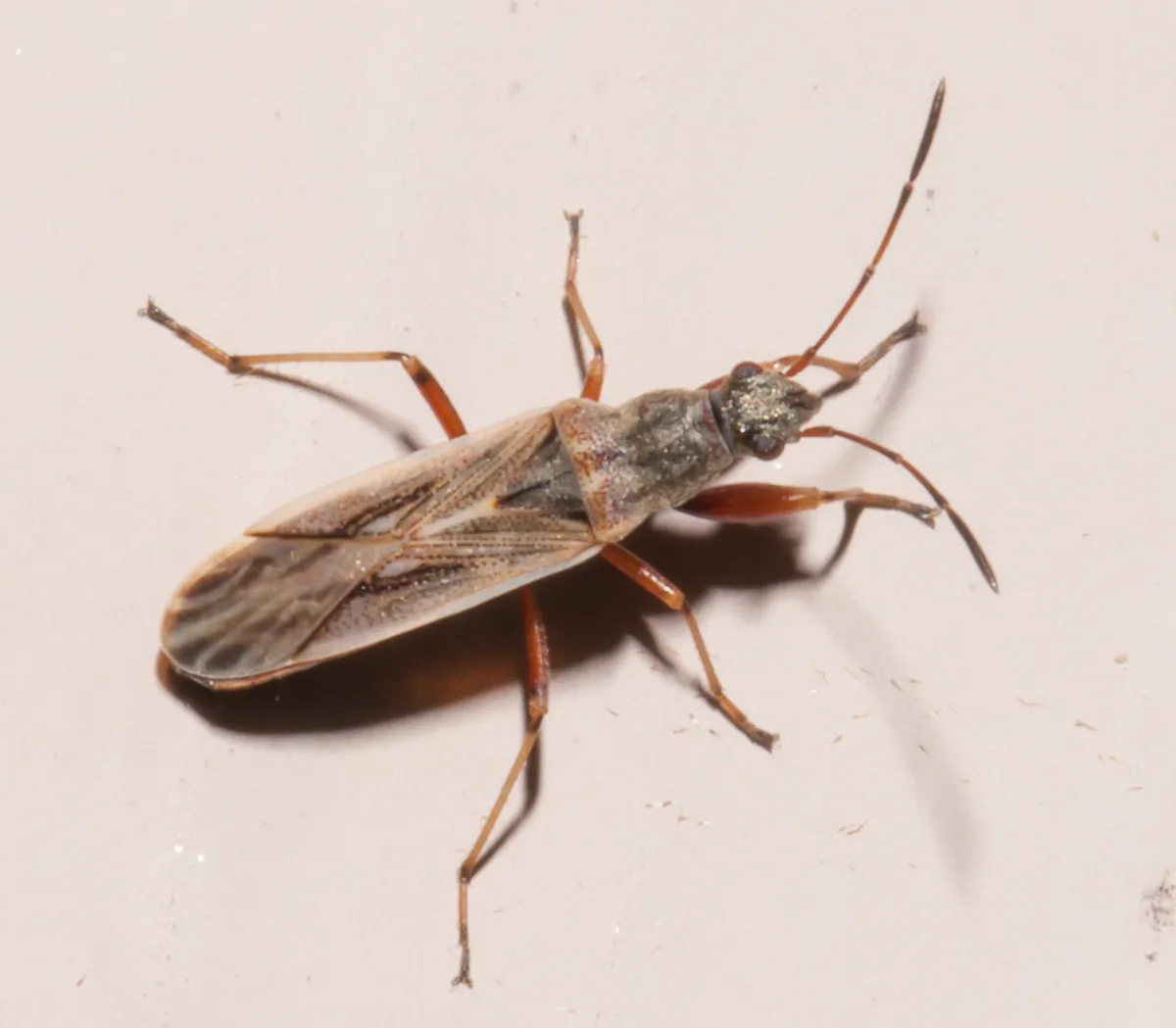
Paromius longulus
Paromius longulus
Identification: elongated parallel-sided seed bug with red legs and enlarged front femora, corium, clavis and posterior pronotal lobe generally paler, tan-colored vs. the remainder of the dorsum which is gray, dark off-parallel stripe through the mid
Parthenicus basicornis
Parthenicus basicornis
Identification: "Distinguished from related species by the brownish black first antennal segment , and by structure of the male claspers." (emphasis added) Type Locality: UT
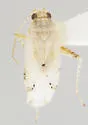
Parthenicus candidus
Parthenicus candidus
Identification: From Van Duzee's (1918) description: "Femora... marked with a few black points; [body] white, dotted with black; base of scutellum and thickened vein at base of membrane sanguineous; membrane white with two marginal spots and a few di
Parthenicus cuneotinctus
Parthenicus cuneotinctus
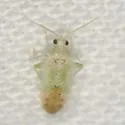
Identification: Hemelytra uniformly greenish (though paler green than in P. rufivenosus ), cuneus red ("roseate-red", i.e. pinkish, per orig. description), veins marked with red Type Locality: Ariz.
Parthenicus deleticus
Parthenicus deleticus
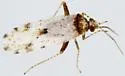
Identification: Similar to the vaccini complex of species, but hemelytra are milky white, without dark dots. Also, the second antennomere has only two small, dorsal spots.
Parthenicus juniperi
Parthenicus juniperi
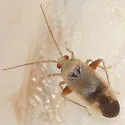
Identification: "General coloration pale testaceous, hemelytra often tinged with salmon pink, anterior 1/2 of pronotum tinged with greenish yellow, scutellum usually black or strongly infuscated," etc. (Henry 1982) Det. WonGun Kim, 2010
Parthenicus micans
Parthenicus micans
Identification: "Suggestive of oreades , but size smaller, distinguished by the uniformly silvery white, scale-like pubescence on clavus and corium, with golden scale-like hairs only at inner apical angles of corium" (Knight, 1925). The size differen
Parthenicus muchmorei
Parthenicus muchmorei
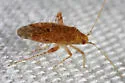
Identification: Pattern on membrane of hemelytra is unique.
Parthenicus pictus
Parthenicus pictus
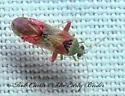
Type Locality: Santa Catalina Mts., Arizona, September 25, 1924 (A. A. Nichol)
Parthenicus psalliodes
Parthenicus psalliodes
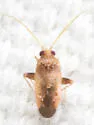
Identification: This species, known only from macropters, is very similar to P. cruentus in the overall pale background color, interspersed with numerous small red spots. It is distinguished by the generally larger size, uniformly dark or fumate heme
Parthenicus rubromaculosus
Parthenicus rubromaculosus
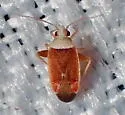
Identification: pale greenish, with dense red flecking on hemelytra
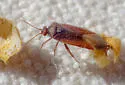
Parthenicus rufusculus
Parthenicus rufusculus
Identification: "Allied to psalliodes Reut., but size slightly larger; distinguished by the general fusco-reddish coloration." The females of this species and P. covilleae Van Duzee are virtually indistinguishable from each other. Males can be distin
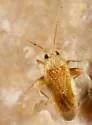
Parthenicus taxodii
Parthenicus taxodii
Identification: Distinguished from other species by the small size; uniformly yellow coloration, often with a faint orange tinge; silvery sericeous pubescence on the dorsum; and the pallid tibial spines lacking spots at the bases. Type Locality: Illi
Parthenicus vaccini
Parthenicus vaccini
Identification: This species is recognized by the overall gray to grayish-green coloration, with numerous fuscous spots on the dorsum, legs, and antennae; and the long rostrum that extends to near the base of the genital capsule. Males are always mac
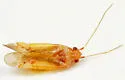
Parthenicus weemsi
Parthenicus weemsi
Identification: Distinguished from other species by the usually testaceous to golden-yellow color, with brown and/or red spots on the pronotum and the base and apex of the corium, and the numerous red spots on the legs. Darker specimens sometimes als
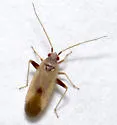
Parthenicus wheeleri
Parthenicus wheeleri
Identification: I am sure that this bug is Parthenicus wheeleri in Orthotylinae. According to Henry , P. wheeleri is distinguished by "the the pale testaceous dorsum (figs. 11, 12), occasionally with a few small red speckles on the head, pronotum, an
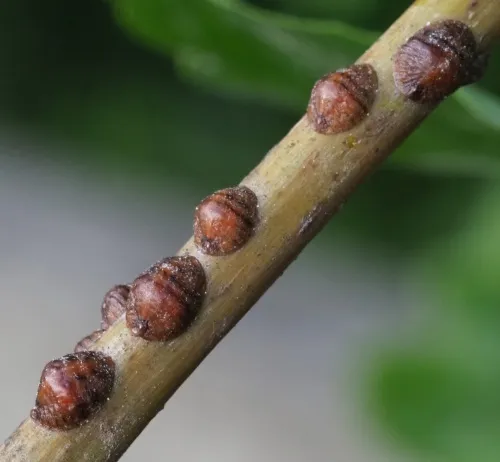
Parthenolecanium rufulum
Parthenolecanium rufulum
Female scales oval, convex, dull reddish brown; up to 6 mm long and 4 mm wide. Good close up photographs required please. Adults are most likely to be seen is summer and early autumn. Larvae can be found on the undersides of the leaves; for hibernati
Pasaremus concentricus
Pasaremus concentricus
A common leafhopper on Baltic rush (the brownish looking rush that grows in highway ditches all over the northern states).… Andy Hamilton, 11 August, 2009
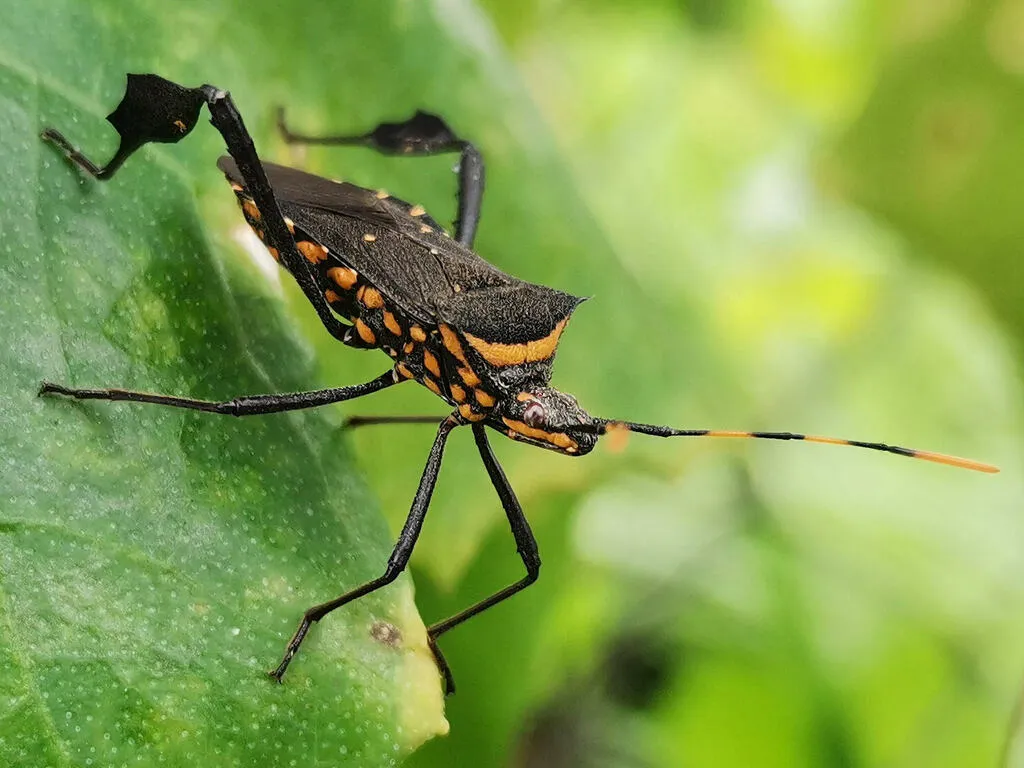
Passionvine Bug
Leptoglossus gonagra
Identification: Pronotum with narrow transverse arched yellow to red stripe extending to sharply spined humeral angles; abdominal venter with seven longitudinal yellow stripes; antennae black with yellow bands on last three segments. minor pest of ci
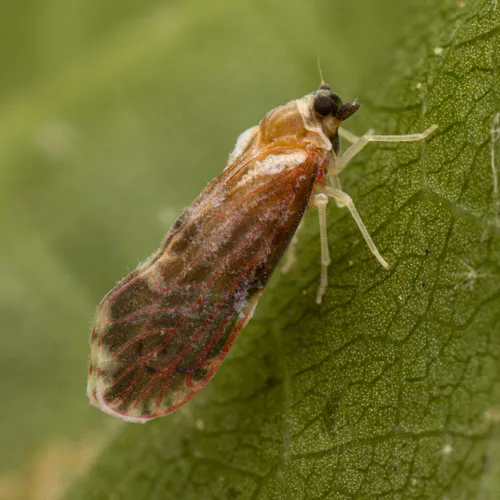
Patara vanduzei
Patara vanduzei
Identification: the smallest and darkest of our Derbidae; close to Cedusa ; ♀♀ more reddish (Dr Hamilton, 7.i.2009)
Pear Psylla
Cacopsylla pyricola
earliest record in our area: CT 1832; the only one of several European pear psyllids to have been introduced into North America
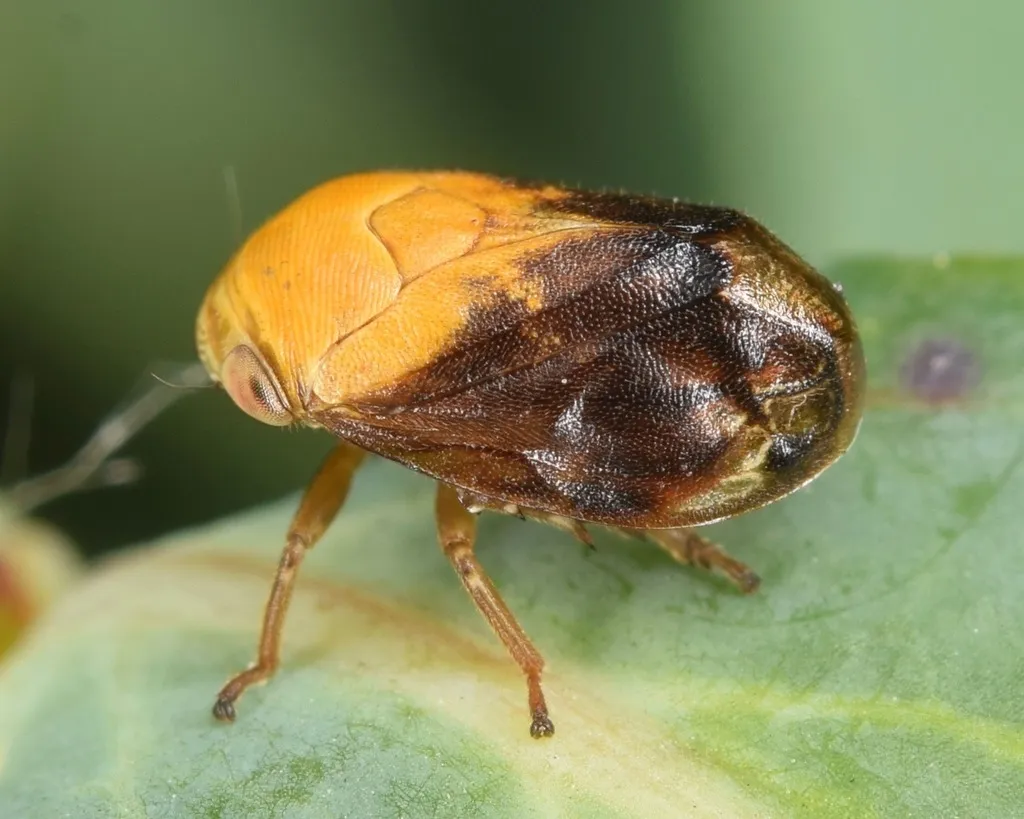
Pecan Spittlebug
Clastoptera achatina
sometimes contributes to twig dieback in the Midwest ( 4 )
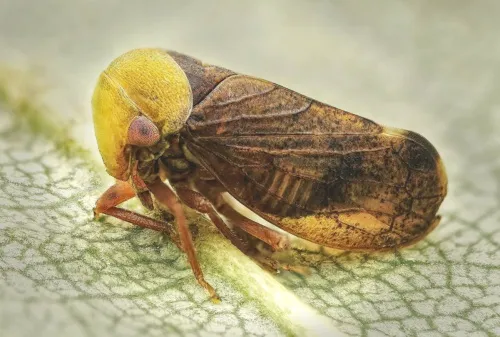
Pediopsis tiliae
Pediopsis tiliae
Length 5 to 6 mm. From above, the large yellow pronotum obscures most of the vertex. The face is plain yellow, without markings, and the wings are brown. Please provide photograph to support your record. Associated with Lime trees ( Tilia ), particul
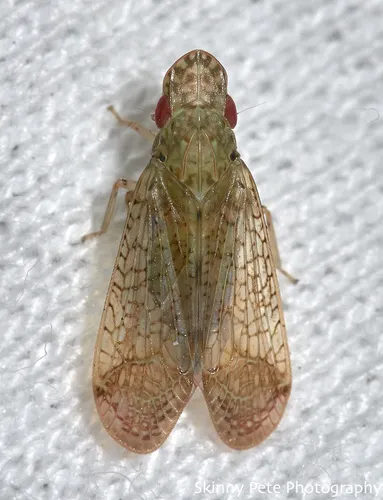
Pelitropis rotulata
Pelitropis rotulata
Identification: The flattened head is distinctive, as are the crossveins that define an oval space near the wing tips. [The nymphs are] recognizable by the bright red tail lights. [Dr Hamilton's comments here and here ] taken mostly at lights (someti
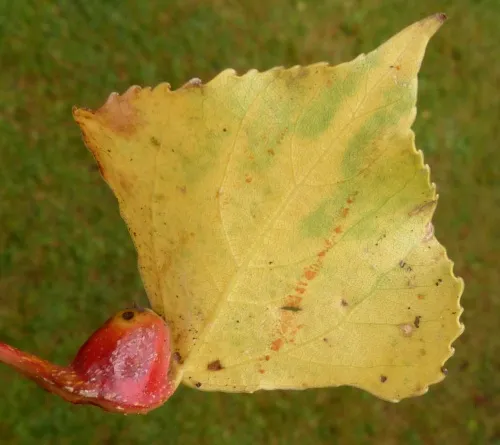
Pemphigus bursarius
Pemphigus bursarius
Pemphigus bursarius is an aphid which causes pouch galls to form in the petioles of the leaves in some species of Poplar. The galls are seen more often than the aphid, and are 15 x 6 to 8 mm and form on one side of the petiole opening in June to rele
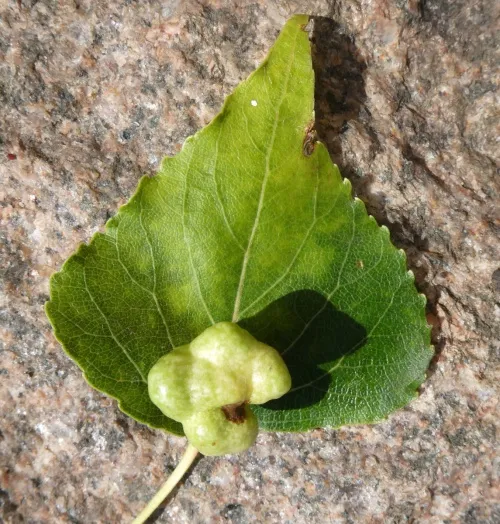
Pemphigus populi
Pemphigus populi
The aphid Pemphigus populi causes a green or greenish-yellow club-shaped gall to form on the leaves of Black Poplar and its hybrids such as Lombardy Poplar. The gall is found close to the base of the leaf. Mature Pemphigus populi alatae are greyish g
Pemphigus populicaulis
Pemphigus populicaulis
Causes twisted, subglobular galls with oblique openings at the base of cottonwood ( Populus ) leaf blades.
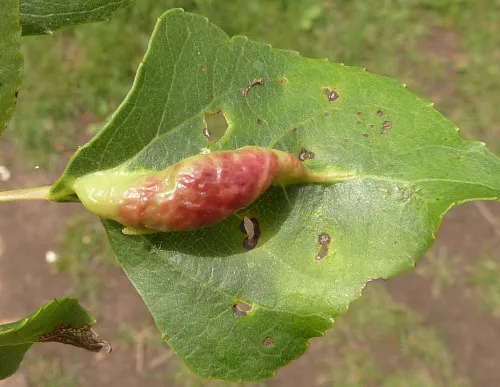
Pemphigus populinigrae agg.
Pemphigus populinigrae agg.
The fundatrices of the aphid Pemphigus populinigrae induce yellowish or dull reddish broad pouch-shaped galls on the midrib of the upperside of leaves of poplar (mainly Black Poplar and Lombardy Poplar). Mature galls are rounded and smooth on top and
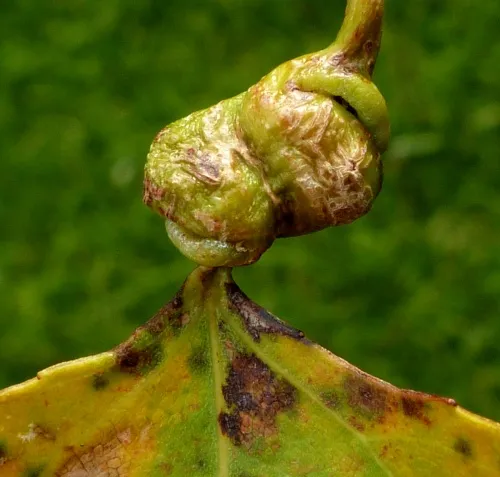
Pemphigus spyrothecae
Pemphigus spyrothecae
Pemphigus spyrothecae is an aphid that causes galls to form in the leaf petioles of its host trees. The galls are seen more often than the aphid. The galled petioles have 2-3 twists, which loosen up later in the year to release aphids through a slit
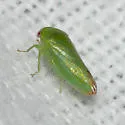
Penestragania apicalis
Penestragania apicalis
Identification: More wide-headed than P. alabamensis , which is found on the same host.
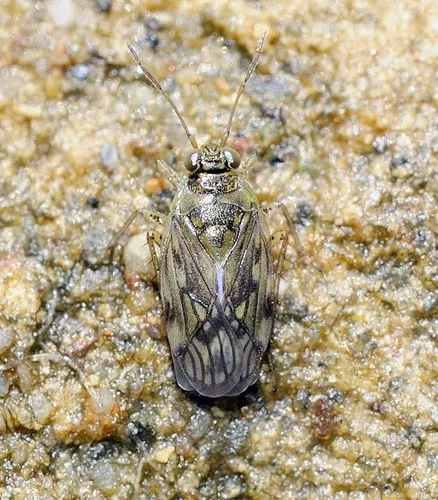
Pentacora sphacelata
Pentacora sphacelata
Identification: More or less dull luster, lack of erect hairs on dorsum, lack of erect black setae on lateral margin of pronotum.
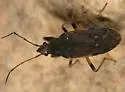
Perigenes constrictus
Perigenes constrictus
Perigenes constrictus (Perigenes constrictus) is a species in the family Rhyparochromidae, commonly known as dirt-colored seed bugs, belonging to the order Hemiptera (True Bugs, Cicadas, Hoppers, Aphids and Allies). It is classified within the subfam
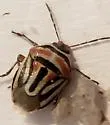
Perillus lunatus
Perillus lunatus
Identification: Marked with a narrow, black, lunate band on the pale-colored pronotum
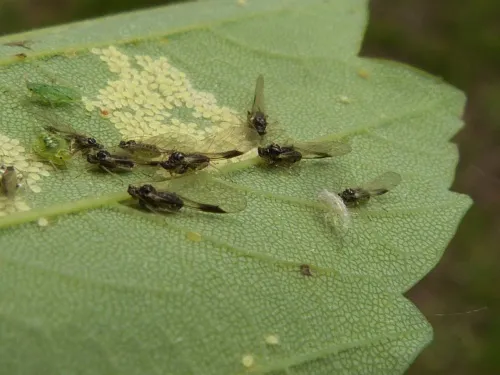
Periphyllus acericola
Periphyllus acericola
Aphid colonies occur on the undersides of sycamore leaves. Alates with closely spaced, black, abdominal cross-bars and black pterostigmata. White "dimorph" nymphs in dense groups. Please provide close-up images of the aphids and state the host specie
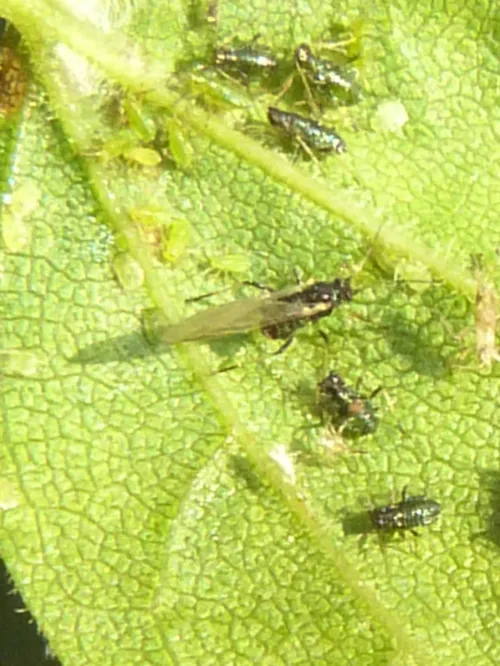
Periphyllus aceris
Periphyllus aceris
The alates (winged adults) have widely separated broad black bands on the abdomen which helps with identification. The alate body length is 3.2 to 4.5 mm. The apterae (wingless forms) are yellow-green and can be much more difficult to identify to spe
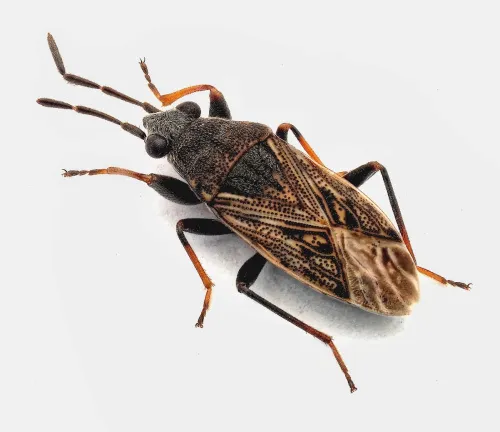
Peritrechus geniculatus
Peritrechus geniculatus
Length 5 to 6 mm. A difficult genus, with one or two small spines on the front femora. The 3rd antennal segment of Peritrechus geniculatus i s as thick as, or thicker than, the 1st segment. The front edge of the pronotum is dark. Other Peritrechus. P
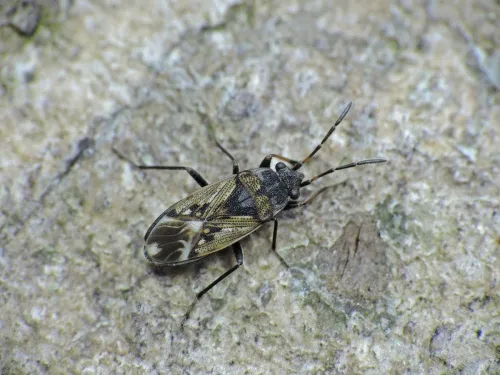
Peritrechus lundii
Peritrechus lundii
Peritrechus lundii is often associated with Stork's-bll, Erodium cicutarium . The front part of the pronotum has pale lateral keels. Antennae are black apart from the paler basal part of the 2nd segment. The wing membrane has a pale apical spot. Ther
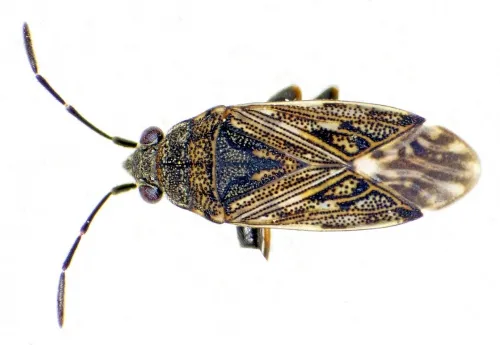
Peritrechus nubilus
Peritrechus nubilus
Length 5 to 6 mm. The 3rd antennal segment is thinner than the 1st. There is usually a pale spot at the base of the membrane, and there is a usually a narrow brown band at the front edge of the pronotum. Hind tibiae are largely dark, but may have a p
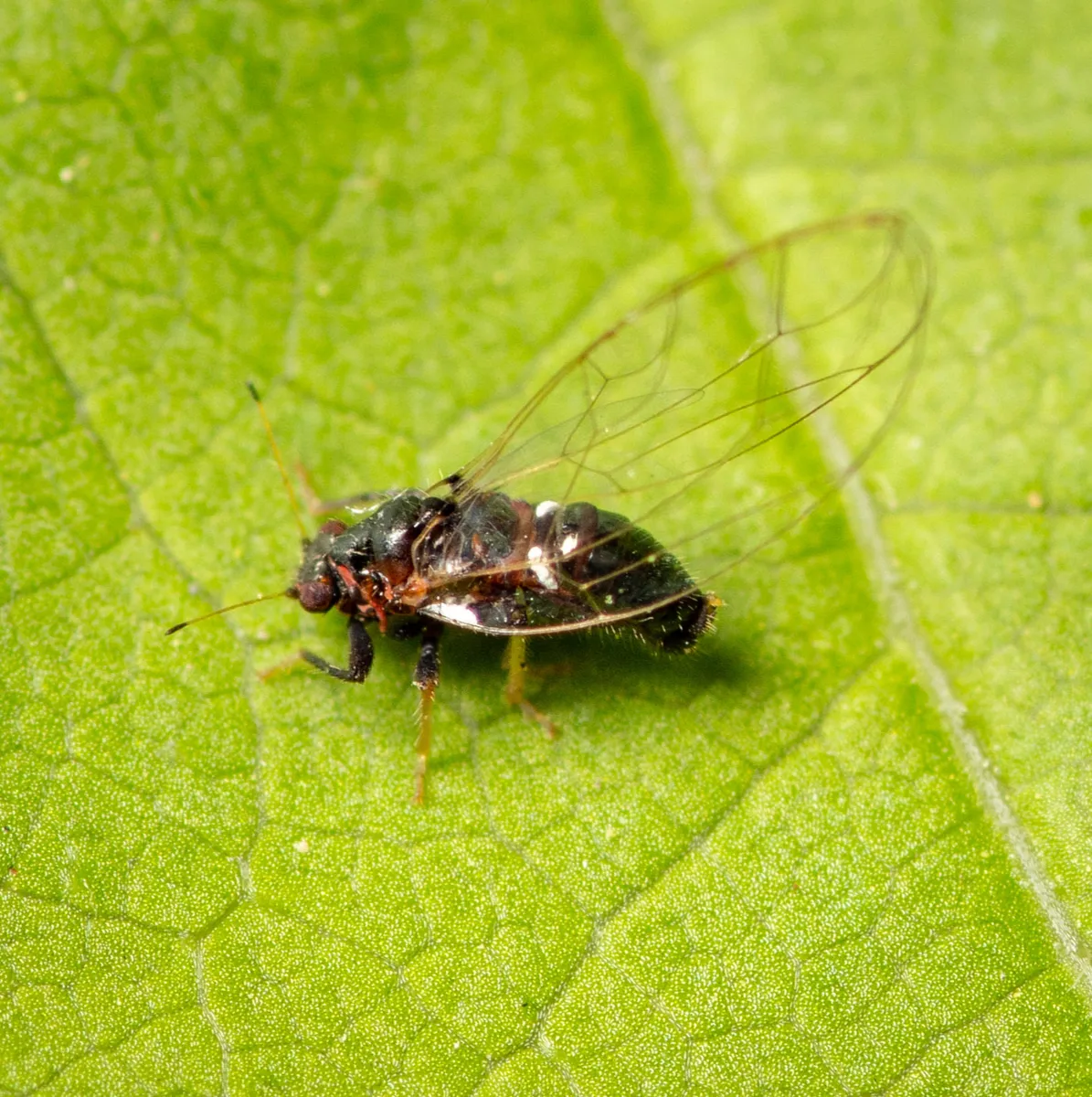
Persimmon Psyllid
Baeoalitriozus diospyri
Identification: Body shiny black, pubescent; forewings very long, angulate, with unusually large medial cell
Pexopsylla cercocarpi
Pexopsylla cercocarpi
Identification: Adults are light green with distal part of each antenna segment dark; antennae very long, about 3 times as long as width of head; genae short and rounded, produced vertically below antennae. Nymphs are conspicuously pubescent, with se
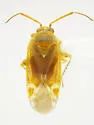
Phallospinophylus setosus
Phallospinophylus setosus
Identification: From Weirauch, omitting figure references: "Recognized by the moderate size (male total length: 3.17-3.78), rather uniform pale orange to red coloration with anterior portion of the cuneus transparent; left side of the pygophore with
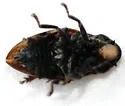
Philaronia canadensis
Philaronia canadensis
Philaronia canadensis (Philaronia canadensis) is a species in the family Aphrophoridae, commonly known as aphrophorid spittlebugs, belonging to the order Hemiptera (True Bugs, Cicadas, Hoppers, Aphids and Allies). It is classified within the subfamil
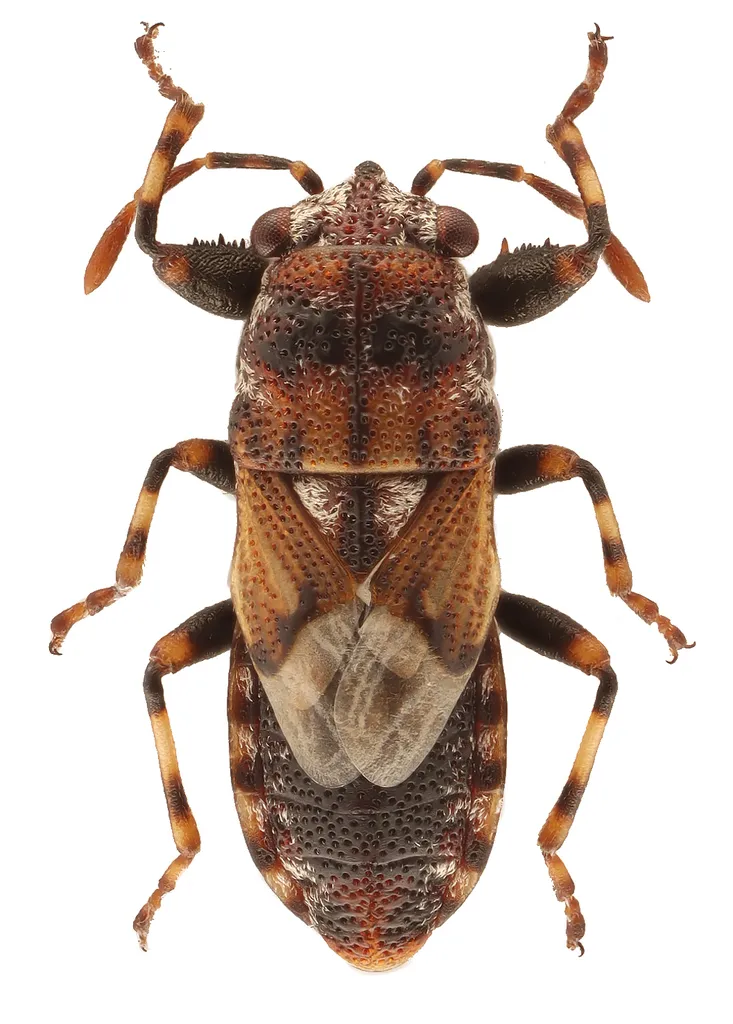
Phlegyas abbreviatus
Phlegyas abbreviatus
Identification: Yellowish to chestnut with extensive black markings (particularly on pronotal calli) as 4 streaks on posterior pronotal lobe, as a median scutellar stripe and on apical corial margin. Mostly submacropterous or brachypterous
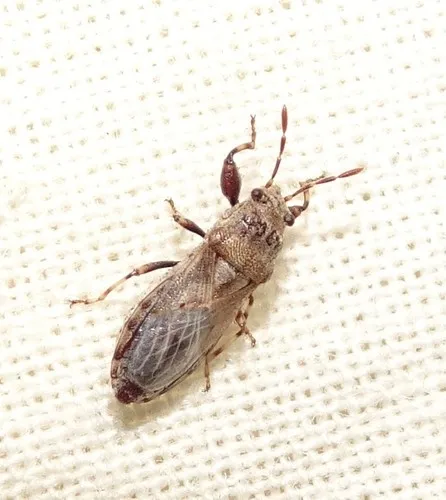
Phlegyas annulicrus
Phlegyas annulicrus
Identification: generally much paler than abbreviatus , giving a dull straw yellow impression and darker markings usually dark reddish rather than black
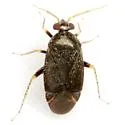
Phoenicocoris claricornis
Phoenicocoris claricornis
Identification: "positive identification would be furthered by lateral view of thorax; whether scalelike setae are present or not" (Schwartz, pers. comm. to =v=, 2012) Det. M.D. Schwartz 2012
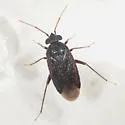
Phoenicocoris rostratus
Phoenicocoris rostratus
Identification: Recognized by the broad, apically serrate scalelike setae on the thoracic pleura and lateral margins of abdominal sternum; antennal segment 2 yellow or yellowish brown, cylindrical, length less than or subequal to width of head across
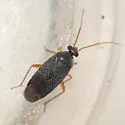
Phoenicocoris strobicola
Phoenicocoris strobicola
Identification: 1) Thoracic pleura and lateral margins of abdominal sternum with woolly or scalelike setae; 2) A2 >> head width; and 3) Antennae and legs pale yellow.
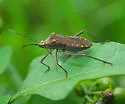
Phthiacnemia picta
Phthiacnemia picta
Identification: lacks expanded rear tibia of most other Anisoscelini, orange pronotal pattern variable, legs piceous, the front and middle tibia often with a pale ring at apical third, adult dorsal abdomen vivid-steel blue.
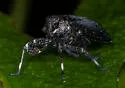
Phylloscelis pallescens
Phylloscelis pallescens
Identification: Body brown with numerous cream colored spots; carina of frons distinct and entire
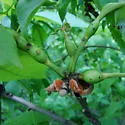
Phylloxera subelliptica
Phylloxera subelliptica
Forms galls in hickory petioles and stems that are oval and smooth, nearly an inch long, with a slight central depression .
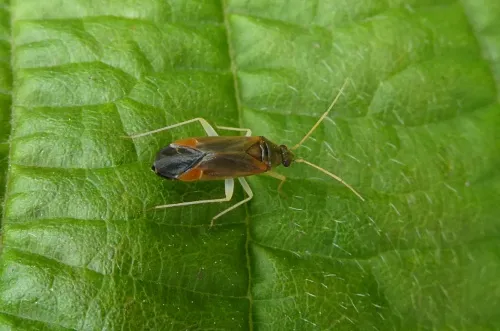
Phylus coryli
Phylus coryli
Length 4.5 to 5.5 mm. There are three species of Phylus bugs in the UK, which can be separated with some reliability by the colour of the head and forewings. Host plant is also a useful aid to identification. The forewings of this species vary from l
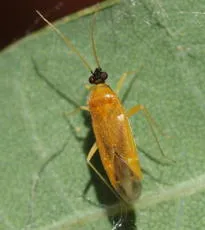
Phylus melanocephalus
Phylus melanocephalus
Length 4.5-6 mm. Phylus bugs are fairly long and slender. There are three species in the UK, which can be separated with some reliability by the colour of the head and forewings. Host plant is also a useful aid to identification. The forewings of thi
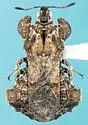
Phymata noualhieri
Phymata noualhieri
Identification: One of three Phymata species found in the US with anastomosing (reticulate) veins in the hemelytral membrane. P. luxa is easily separated from the two other species by the smaller size (5-7 mm) and by lacking the ultraconnexivum of th
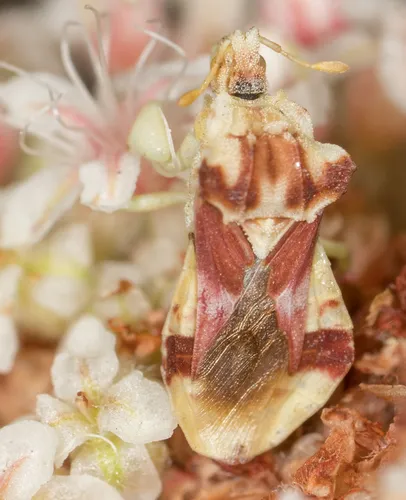
Phymata pacifica
Phymata pacifica
Identification: This is one of only three species recorded from California. Phymata salicis has the abdominal outline rounded whereas in P. pacifica the posterolateral connexival angles are more salient. Phymata arctostaphylae has the fourth connexiv
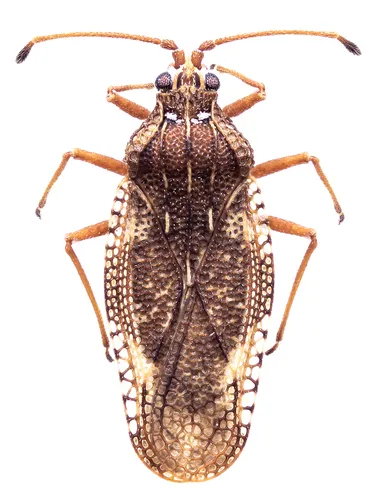
Physatocheila dumetorum
Physatocheila dumetorum
A small brown lacebug, 2.5-3mm, with down-turned sides to the pronotum. There are three keels on the pronotum, all reaching the head. It is wider across the middle of the forewings, and has a dark head and dark mark across the wdest part of the forew
Phytocoris adenostomae
Phytocoris adenostomae
Type Locality: Oak Grove, San Diego Co., California, September 10, 1975, ex Adenostoma sparsifolium Torr., J. D. Pinto (AMNH). Paratypes from Riverside Co., Calif.
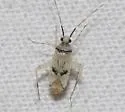
Phytocoris albellus
Phytocoris albellus
Type: Described from a single female collected at Payson, Gila Co., Arizona, 3 August 1929, E. D. Ball.
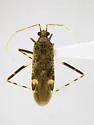
Phytocoris albicuneatus
Phytocoris albicuneatus
Rare in collections. When the species was described, only 19 specimens were known.
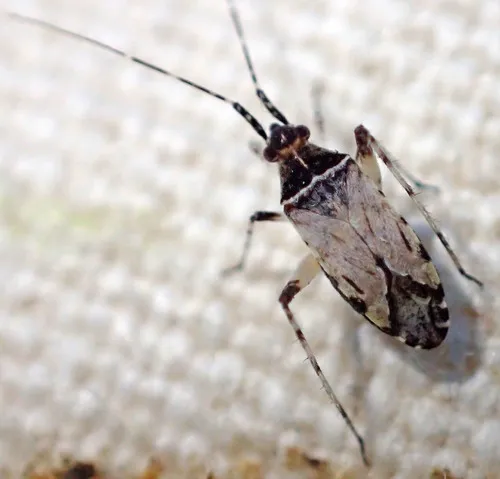
Phytocoris albidopictus
Phytocoris albidopictus
Identification: "Recognized by the extensively darkened pronotal disk, usually with only posterior margin and narrow longitudinal stripe between calli pale; mixed dorsal vestiture, including narrow scalelike, dark brown or black setae; and by the sho
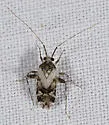
Phytocoris albifrons
Phytocoris albifrons
Identification: This is among the subset of species in the juniperanus group that have just a few scattered setae at the base of the left genital tubercle, rather than a clump of dark, bristle-like setae. Dets. Jason Botz
Phytocoris angusticollis 0
Phytocoris angusticollis
Identification: distinguished from other species of the stellatus group by the following combination of characters: ratio of length of antennal segment I to width of head across eyes from 0.85:1 to 1.10: 1; clavus and corium with brown to fuscous mar
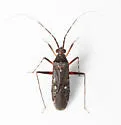
Phytocoris annulicornis
Phytocoris annulicornis
Identification: Det. Michael D. Schwartz, 2024 Type Locality: Texas ( Belfarge )
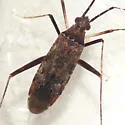
Phytocoris antennalis
Phytocoris antennalis
Identification: 1) A2 black at base, with a light-colored band more distad ; 2) A1 slender and A1 > width of pronotum at base; and 3) Four small, black, conical projections, two on either side of median line, present near posterior margin of pronotum
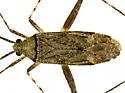
Phytocoris arizonensis
Phytocoris arizonensis
Identification: "...Distinguished from other species of the rostratus group by the large left genital tubercle, coarse serrations on the right sclerotized process of the vesica, and left process of vesica fully sclerotized, with small spines on the o
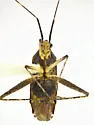
Phytocoris baboquivari
Phytocoris baboquivari
Identification: From Stonedahl, omitting references to figures: "...Distinguished from other brown or grayish brown species of the rostratus group by the following combination of characters: ratio of eye length to width of vertex from 0.90:1 to 1.10:
Phytocoris becki
Phytocoris becki
Identification: recognized by the pale yellowish green hemelytra, gray pronotum with fuscous markings, reddish yellow femora, and uniformly brownish yellow antennae (see frontispiece of Knight, 1968). The pronotum is clothed with white, sericeous set
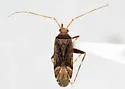
Phytocoris berbericola
Phytocoris berbericola
Identification: Among the members of the P. aurora species group, this species is distinguished by the relatively short first antennomere (0.68-0.79 times the posterior width of the pronotum); "distal two-thirds of hind femora dark reddish brown to d
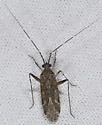
Phytocoris borregoi
Phytocoris borregoi
Identification: Similar to P. catalinae in having unusually large eyes, narrow vertex (in males), and weakly convex frons for the rostratus group. Larger on average than P. catalinae (6.80 mm vs. 5.76 mm, respectively = midpoints of published ranges
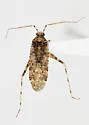
Phytocoris breviatus
Phytocoris breviatus
Identification: Similar in appearance to P. plenus but smaller, and with shorter first antennomere relative to the head size (less than 1.1x the head width across the eyes for the male and less than 1.2x for the female). Structure of the male genital
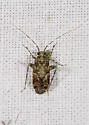
Phytocoris brevicornis
Phytocoris brevicornis
Identification: Scutellum strongly deflexed apically "Closely resembles breviusculus but differs by the brown to fuscous second antennal segment with pale median annulus, strongly convex scutellum that is abruptly deflexed apically, and by the struct
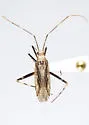
Phytocoris brevisetosus
Phytocoris brevisetosus
Identification: From Stonedahl: "...Mostly pale first antennal segment with limited brown or reddish brown markings, ratio of segment length to posterior width of pronotum 1.12:1 to 1.15:1 for males and 1.78:1 to 1.96:1 for females; pronotal disk wit
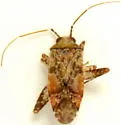
Phytocoris breviusculus
Phytocoris breviusculus
Identification: Distinguished from other brown species of the juniperanus group by the absence of dark scalelike setae on the dorsum, and the uniformly brownish yellow second antennal segment, without pale median annulus. 1) Wing membrane confusedly
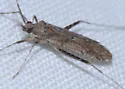
Phytocoris canescens
Phytocoris canescens
Identification: Among the P. tenuis group, "recognized by the long first antennal segment with dark markings ventrally ans well as dorsally and laterally, length of segment greater than posterior width o pronotum; hemelytra with dark spots at bases o
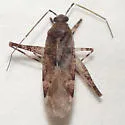
Phytocoris carnosulus
Phytocoris carnosulus
Identification: Apices of fore tibiae pale; rostrum of male reaching near middle of genital capsule; hind femora strongly tapered, basal region greatly expanded, distal half with scattered, long, bristlelike setae. Lower margin of antennal fossa well
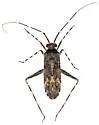
Phytocoris catalinae
Phytocoris catalinae
Identification: From Stonedahl: " Phytocoris catalinae closely resembles borregoi but differs by the smaller average size [5.76 mm vs. 6.80 mm, respectively = midpoints of published ranges for males]; propleuron without pale median line; ...genital c
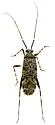
Phytocoris cercocarpi
Phytocoris cercocarpi
Identification: Overall reddish-brown color with pale mottling. To distinguish this species from others in the aurora species group: "Ratio of length of antennal segment I to posterior width of pronotum from 0.70:1 to 0.80:1 for males; apical pale an
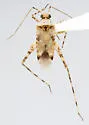
Phytocoris chemehuevi
Phytocoris chemehuevi
Identification: "Similar to carnosulus but distinguished by the smaller size; lower margin of antennal fossa at level of ventral margin of eye; hind legs with long erect setae; and by the structure of the male genitalia, especially the narrow cylindr
Phytocoris cinereus
Phytocoris cinereus
Type Locality: Red Rocks Park, nr. Morrison, 5600 ft (1710 m), Jefferson Co., Colorado, 15 July 1983, ex. Rhus trilobata , R. T. Schuh and D. A. Polhemus (AMNH).
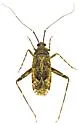
Phytocoris commissuralis
Phytocoris commissuralis
Identification: From Stonedahl: "Similar to heidemanni but distinguished by the structure of the male genitalia: shaft of left paramere with large, often spinose, tubercle basodorsally (fig. 62b); dorsal process on arm of right paramere weakly produc
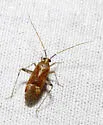
Phytocoris comulus
Phytocoris comulus
Identification: Cuneus extensively marked with red "Similar to cochise but smaller... and with darker, reddish brown or dark brown markings on the legs and first antennal segment. The banded front tibiae and large pale region between the eyes will fu
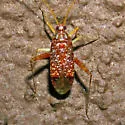
Phytocoris confluens
Phytocoris confluens
Identification: Similar to puella . Quoting from a key : Hemelytra with many small, distinct, white spots; calli darkened with fuscous --> confluens Hemelytra with only indistinct, white spots, nearly uniformly deep orange red; calli pale --> puella
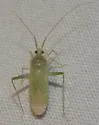
Phytocoris consors
Phytocoris consors
Identification: Overall greenish color with darker speckling. Similar to P. schwartzi but with length of first antennomere much greater than width of head across eyes (length equal or slightly greater than head width in P. schwartzi ), in addition to
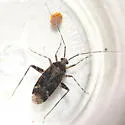
Phytocoris conspurcatus
Phytocoris conspurcatus
Identification: 1) Wing membrane confusedly sprinkled with discolored or dark spots, or with numerous, minute, pale spots; 2) A1 slender; 3) A2 with pale band at base and at middle; 4) A3 with pale band at base and at middle; 5) Dorsum bearing both b
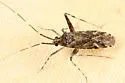
Phytocoris coronadoi
Phytocoris coronadoi
Identification: From Stonedahl, omitting references to figures: "Recognized by the dark brown general coloration; small knoblike left genital tubercle; right basal lobe of vesica with small field of spinulae laterally; and left sclerotized process ab
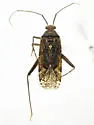
Phytocoris corticola
Phytocoris corticola
Identification: " Phytocoris corticola is distinguished from other large, gray or brown species of the fraterculus group by the structure of the male genitalia: shaft base of left paramere with prominent, ridgelike process dorsally; arm of right para
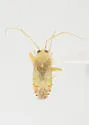
Phytocoris cuneotinctus
Phytocoris cuneotinctus
Identification: "Distinguished from other species of the juniperanus group by the pale green general coloration with small, dusky flecks on the hemelytra." There is also generally a pink area covering at least part of the cuneus. P. vanduzeei is also
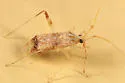
Phytocoris depictus
Phytocoris depictus
Identification: Length of first antennal segment less than width of head and vertex combined (last couplet)