
Pemphigus populinigrae agg.
This record describes Pemphigus populinigrae agg. (species). Recorded family: Aphididae. Recorded order: Hemiptera.
Identification and Appearance
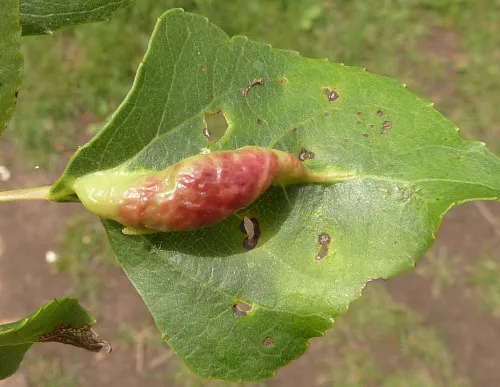
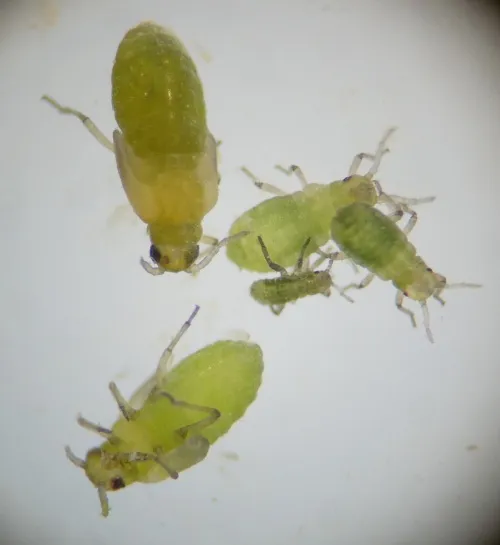
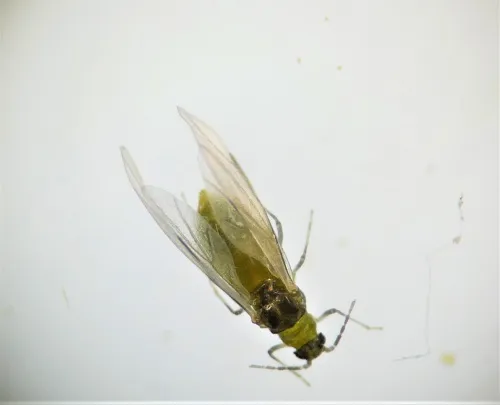
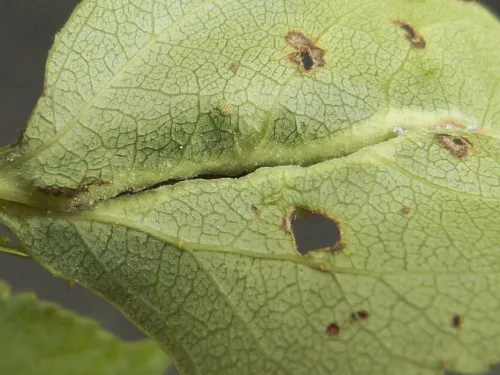
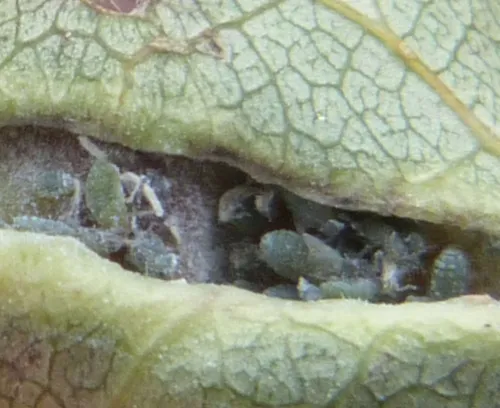
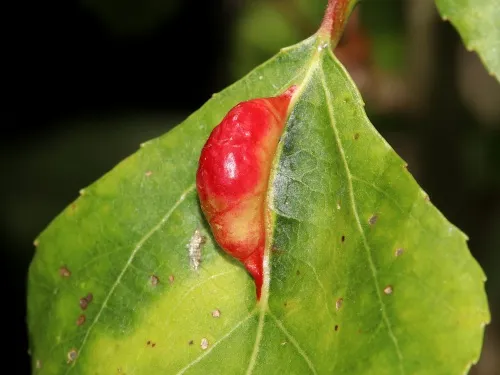
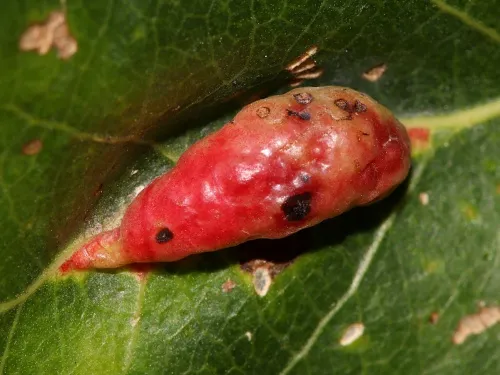
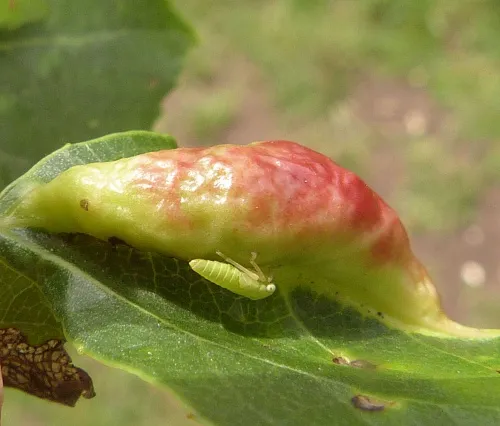
The fundatrices of the aphid Pemphigus populinigrae induce yellowish or dull reddish broad pouch-shaped galls on the midrib of the upperside of leaves of poplar (mainly Black Poplar and Lombardy Poplar). Mature galls are rounded and smooth on top and are sometimes partially subdivided The galls of Pemphigus populinigrae are usually located near the middle of the leaf and open on the underside of the leaf. The fundatrices are green or greyish green, and have no siphunculi. They have 4-segmented antennae which are about 0.17 times the length of the body. There are a number of aphids producing very similar galls on these poplar species notably P. phenax and P. gari. Identification to species level is very difficult, requiring expert examination to identify winged adults and for this reason we have decided to treat this group as a species aggregate. Gall must be situated on the midrib of the upperside of the leaf not on the petiole Identification to species level is very difficult, requiring expert examination to identify winged adults. For all other records please record as the species aggregate. Galls can be encountered on the leaves of Black Poplar and Lombardy Poplar. Galls can be seen when the host trees are in leaf. Status in Britain is difficult to determine due to lack of records. https://influentialpoints.com/Gallery/Pemphigus_populinigrae_poplar-cudweed_pouch_gall_aphid.htm
Classification
Habitat and Range
Habitat
Galls can be encountered on the leaves of Black Poplar and Lombardy Poplar.
Seasonal Activity
Galls can be seen when the host trees are in leaf.
Additional species information
Recorded status
Status in Britain is difficult to determine due to lack of records.
About True Bugs, Cicadas, Hoppers, Aphids and Allies: the wider group
Order-level background for Hemiptera, the group containing Pemphigus populinigrae agg.. Species-specific details appear above.
Group overview
Hemiptera (true bugs) includes over 80,000 described species across cicadas, aphids, leafhoppers, shield bugs, and bed bugs. Aphids alone cost global agriculture an estimated $2.5 billion annually in crop losses.
Ecological role of the group
Many Hemiptera are essential food sources for birds and predatory insects. Cicadas provide massive nutrient pulses during emergence events - a single Brood X emergence can involve trillions of individuals across 15 states.
Economic and practical significance of the group
The brown marmorated stink bug (Halyomorpha halys) caused $37 million in apple crop losses in a single year in the U.S. Mid-Atlantic region. Bed bug infestations in the U.S. increased by 500% between 2001-2010, costing the hotel industry hundreds of millions annually.
Recorded sources for this group: USDA, EPA, University research. Imported estimates may describe particular regions or reporting periods.
Photos of Pemphigus populinigrae agg. (10)
Frequently Asked Questions About Pemphigus populinigrae agg.
What is Pemphigus populinigrae agg.?
Pemphigus populinigrae agg. is a species in the family Aphididae, within the order Hemiptera.
How big is Pemphigus populinigrae agg.?
of the body.
How do you identify Pemphigus populinigrae agg.?
to species level is very difficult, requiring expert examination to identify winged adults and for this reason we have decided to treat this group as a species aggregate.
Where is Pemphigus populinigrae agg. found?
Habitat: Galls can be encountered on the leaves of Black Poplar and Lombardy Poplar.
When is Pemphigus populinigrae agg. active?
Pemphigus populinigrae agg.: seasonal activity - Galls can be seen when the host trees are in leaf..