
Family Plant Bugs (Miridae)
Miridae is a family in the order Hemiptera. Browse 969 named species recorded in this family, or open an individual profile for its available identification and natural-history information.
Species in Miridae (969)
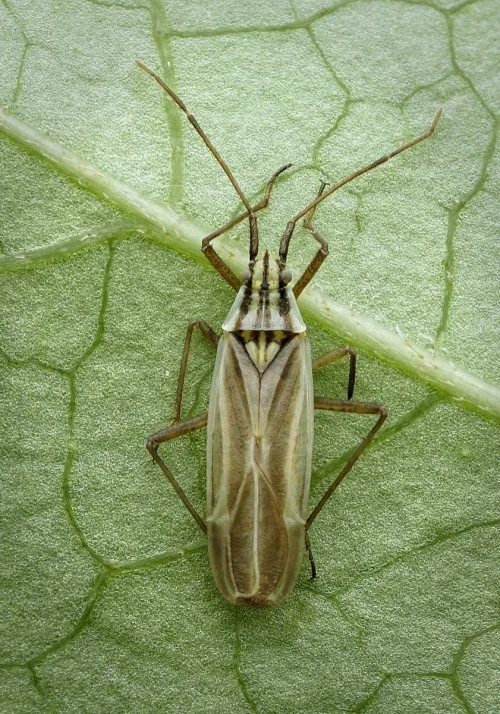
Acetropis gimmerthalii
Acetropis gimmerthalii
Length 5 to 6 mm. An elongate grass bug with a transverse furrow between the eyes, Acetropis gimmerthalii is relatively broad and oval in shape and bears a superficial resemblance to Stenodema holsata . However, the pronotum is smooth, lacking obviou
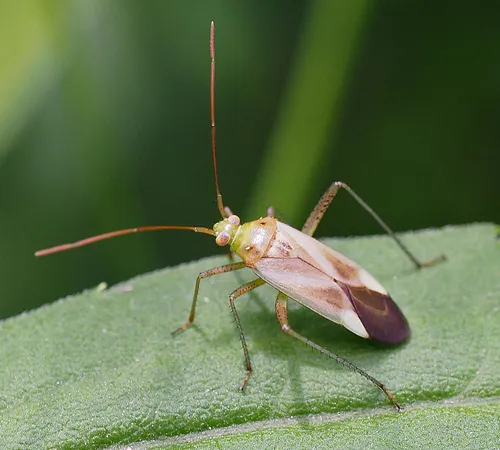
Lucerne Bug
Adelphocoris lineolatus
Length 8 to10 mm. Although one of several similar pale greenish species. Defining features include its large size and rather elongate body shape. The spines on the hind tibia are equal to or greater than the tibial width. The prominent pale cuneus an
Rapid Plant Bug
Adelphocoris rapidus
Identification: note: very long antenna, a relatively small head, and the color of the antennal segments (adapted from wongun's comments on iNat) first image is the most common form: these alternate forms ( A. superbus ) are of western distribution:
Agaveocoris barberi
Agaveocoris barberi
Identification: 1) Body length ≥ 4.6 mm; 2) A1 uniformly black; 3) Hemelytra uniformly bluish black; and 4) A2 < (vertex width) + an eye
Alepidiella heidemanni
Alepidiella heidemanni
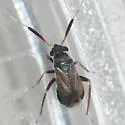
Identification: "Recognized by the generally distributed scalelike setae and the enlarged second antennal segment."
Alloeotomus gothicus
Alloeotomus gothicus
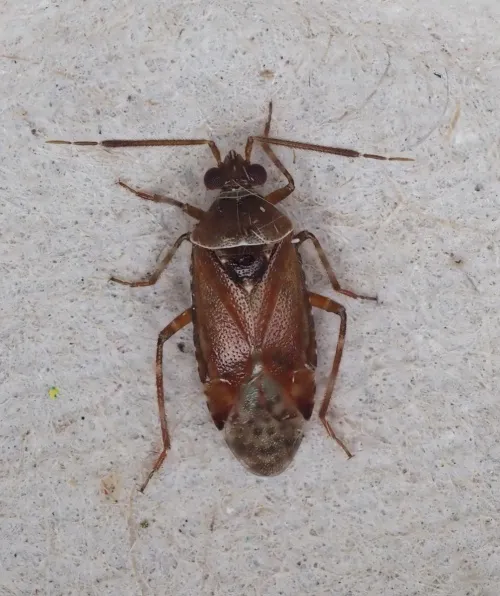
Length 5 to 6 mm. Translucent light brown with orange-brown markings, corium punctures concolorous; membrane dusky, mottled with black; costal rib of corium banded brown & white, hind tarsus T1≈T2+T3. Detailed photographs showing key features require
Amblytylus nasutus
Amblytylus nasutus
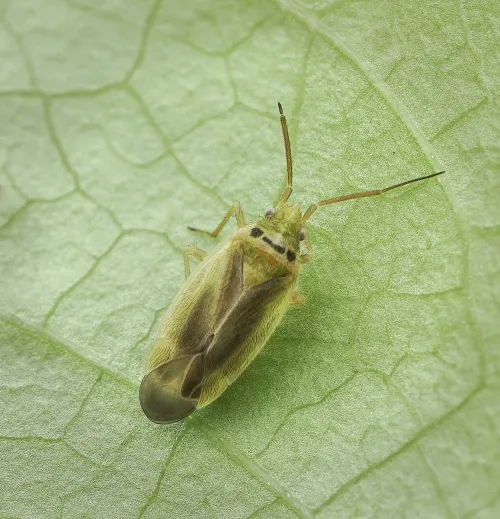
Length ~ 4.5 mm. Amblytylus species are greenish-yellow elongate oval bugs in which the head is rather long (almost as long as broad) and the eyes are small. The upper surface is densely covered in hairs. In A. nasutus these hairs are dark, as is the
Americodema knighti
Americodema knighti
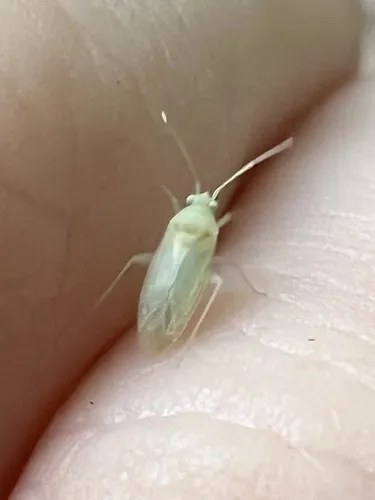
Identification: Recognized by the uniformly pale greenish-white to pale greenish-yellow coloration Apex of tylus and all appendages uniformly pale greenish white, lacking black markings Type Locality: Missouri
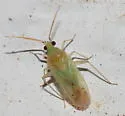
Americodema nigrolineatum
Americodema nigrolineatum
Identification: Recognized by the presence of a fuscous spot at the apex of the tylus and the relatively large fuscous spot (subequal in size to a knee spot) on the anterior apical 1/3 of the metafemur. - shows tylus spot (in front of the eye) - show
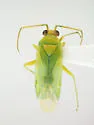
Apachemiris areolatus
Apachemiris areolatus
Identification: Largest species in the genus. Length of cuneus > 1.5x its width. Width of pronotum is 1.33x the width of the head across the eyes.
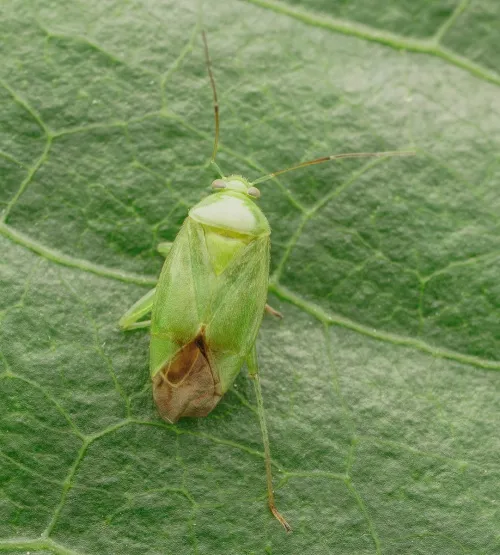
Apolygus lucorum
Apolygus lucorum
Length 5 to 6 mm. The black tibial spines do not arise from black spots and the 2nd antennal segment is usually shorter than the width of the pronotum at the base. Separated from the similar A. spinolae by the darker ground colour and by the cuneus,
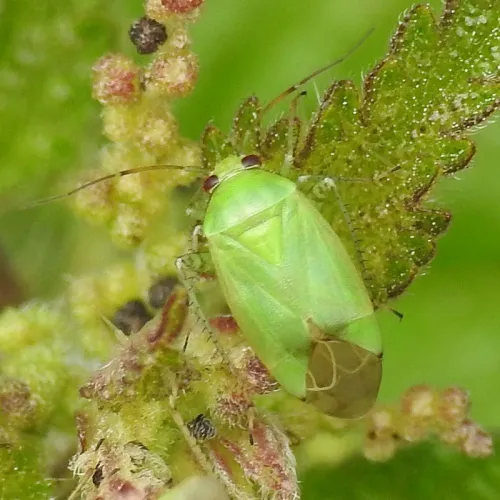
Apolygus spinolae
Apolygus spinolae
Length 5 to 6 mm. Separated from the similar A. lucorum by the paler ground colour and by the cuneus, which is black at the extreme apex. Apolygus species are green and rather broadly oval in shape. The black tibial spines do not arise from black spo
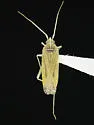
Argyrocoris scurrilis
Argyrocoris scurrilis
Identification: Species notes from Van Duzee : "Testaceous white; pronotum with five lines of appressed silvery scales the three median of which are continued over the head. Length 5 mm... Elytra nearly unicolorous. Membrane white, sparingly marmorat
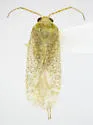
Arizonapsallus stonedahli
Arizonapsallus stonedahli
Identification: "Recognized by the relatively large size within the Phymatopsallus group,... pale coloration, spotted dorsum, and the left side of the pygophore lacking a specialized field of spicules or a tubercle."
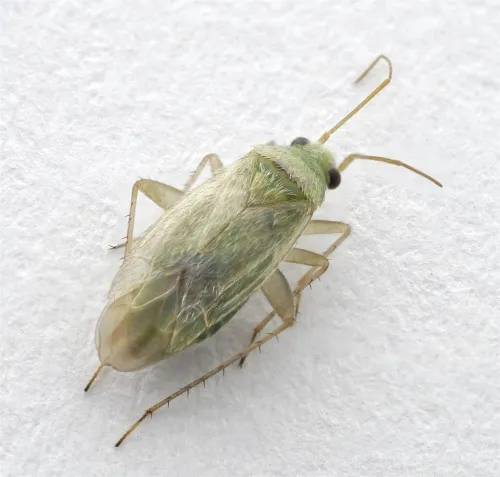
Asciodema obsoleta
Asciodema obsoleta
Length: 4 to 5 mm. A dense covering of white hairs gives this bug a very pale green appearance. Sparse dark hairs are also present on closer examination. The antennae are pale. The femora are unspotted and it has dark tibial spines, but these do not
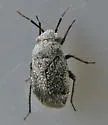
Atractotomus balli
Atractotomus balli
Identification: Recognized by its small size; short second antennal segment; generally distributed, scalelike setae on hemelytral membrane and hind femora; antennal fossae removed from anteroventral margin of eye by distance equal to or greater than
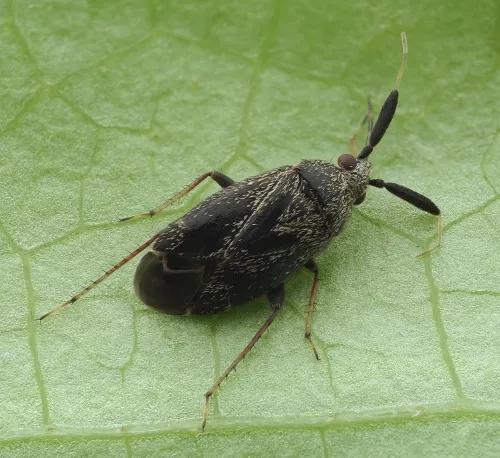
Apple Brown Bug
Atractotomus mali
Length 3.5mm The 1st antennal segment is triangular and tapers towards the base, while the 2nd segment is much thickened in both sexes, particularly so in females. The body shape is rather oval and convex. The larvae are red, with the fore-parts dark
Atractotomus nicholi
Atractotomus nicholi
Identification: Recognized by its small size; brownish yellow general coloration, sometimes suffused with fuscous dorsally but leaving scutellum pale; dorsum with light and dark scalelike setae; antennal segment II black, slightly inflated in both se
Barberiella formicoides
Barberiella formicoides
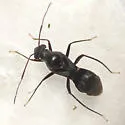
Identification: A triangular projection on the scutellum.
Bisulcopsallus fulvipunctatus
Bisulcopsallus fulvipunctatus
Identification: "Recognized by the relatively small size among Bisulcopsallus spp., average length approximately 2.7 [mm], the pale background coloration with dull orange spots primarily on the coriaceous parts of the hemelytra..." and genitalic char
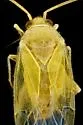
Bisulcopsallus pallidus
Bisulcopsallus pallidus
Identification: "Recognized by the relatively large size among Bisulcopsallus spp.,... the entirely pale coloration, and the structure of the male genitalia..."
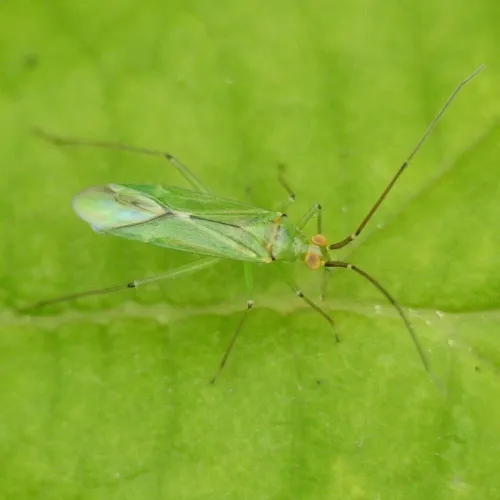
Black Kneed Capsid
Blepharidopterus angulatus
Length 5 to 6 mm. A slender and parallel-sided blue-green species with black patches at the base of the rather bristly tibia ('knees'), parts of the antennae and at the posterior angles of the pronotum The length of the first antennal segment is roug
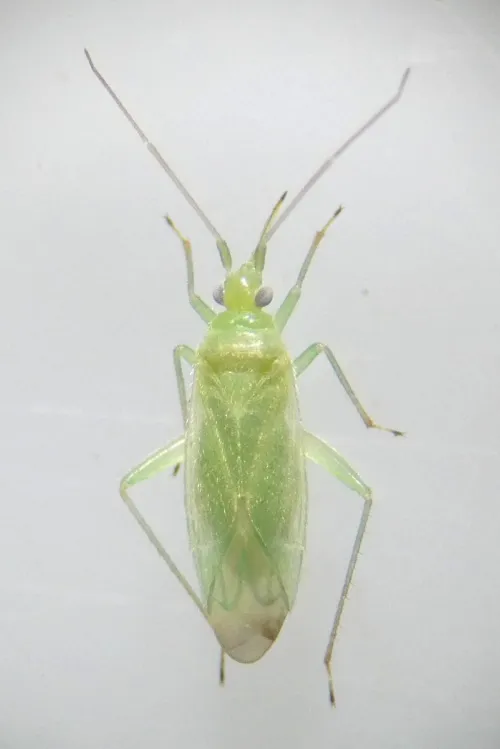
Blepharidopterus diaphanus
Blepharidopterus diaphanus
Length 4.5mm. Translucent, very pale green; upperside with fine pale erect hairs. Rostrum short, front femur with fringe of long fine pale hairs along lower edge; pronotum & antennae entirely pale.
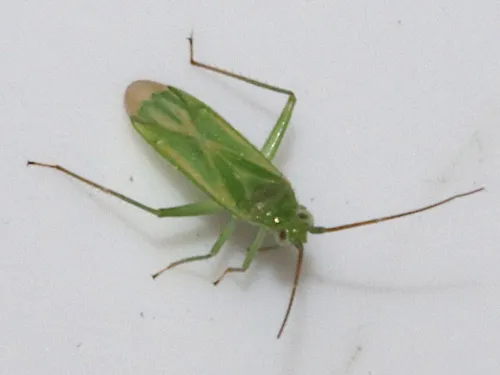
Brachynotocoris puncticornis
Brachynotocoris puncticornis
4-5mm long. Green with yellow borders adjoining the hemelytral margins (usually). The base of the hemelytra are wider than the pronotum and the scutellum is longer than the pronotum. The rostrum is short, and expanded near the apex as in Platycranus
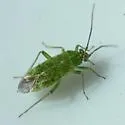
Hollyhock Plant Bug
Brooksetta althaeae
Identification: Dosum with black, scalelike pubescence; color chiefly deep apple green; veins green; membrane including larger areoles fuscous.
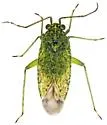
Brooksetta malvastri
Brooksetta malvastri
Identification: Inspection of male genitalia (namely, shape of right paramere and tergal process on anterodorsal edge of genital cavity) is generally needed to differentiate this from similar species. Females are identified by association with males.
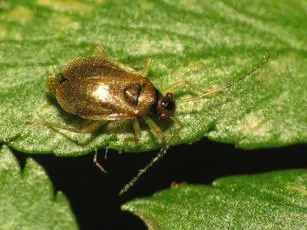
Bryocoris pteridis
Bryocoris pteridis
Length 2 to 4 mm. A small bug found on ferns. Adults can be fully winged or have short rudimentary wings and the head is at least partly dark brown or black. The 1st antennal segment is longer than the width of the head. Be sure to rule out Monalocor
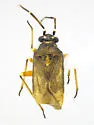
Calidroides schaffneri
Calidroides schaffneri
Identification: "Distinguished from C. negro by... dusky orange brown coloration; campanulate pronotum in dorsal view; usually more narrow head and vertex; shorter antennal segments; shorter labium; and pointed unarmed apex of vesica."
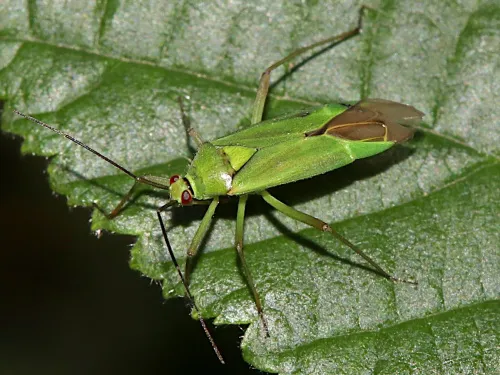
Calocoris alpestris
Calocoris alpestris
Length 9-11 mm. One of many entirely green plant bugs but distinctive due to its large size and very elongate shape. The 1st antennal segment is very long. The base of the scutellum is sometimes narrowly dark, as is a thin collar behind the head. Thi
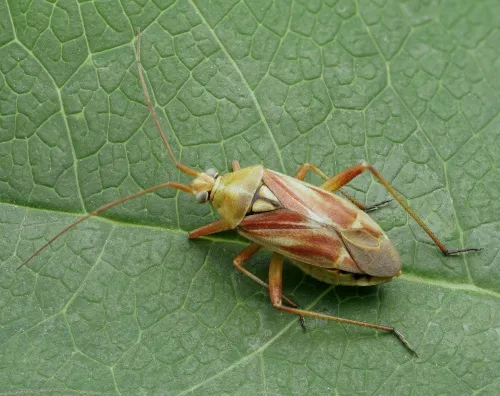
Calocoris roseomaculatus
Calocoris roseomaculatus
Length 6 to 8 mm. A beautifully marked bug. The rosy patches on the forewings are characteristic, with the pale scutellum bisected by a dark line. The head, pronotum and legs may also be rose-tinged and the 2nd antennal segment is shorter than the 3r
Calocoris texanus
Calocoris texanus
Identification: Distinguished by the orange coloration, with antennae, tibiae, and tips of femora black. Type Locality: Uvalde, Texas, 5 June 18, 1936 (S. E. Jones)
Mullein Bug
Campylomma verbasci
First found in the US in 1886 Used as biocontrol of orchard pests. Its populations, especially early in the season, have to be monitored so that they don't damage fruits in the absence of sufficient prey. In Europe it is not known to damage fruits an
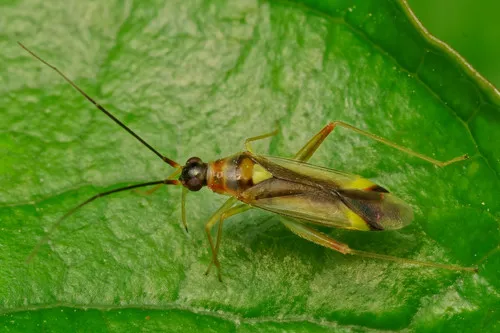
Campyloneura virgula
Campyloneura virgula
Length 4 to 5 mm. A distinctively marked species which has very long antennae and a bright yellow cuneus, tipped with dark red. Nymphs are yellow, with red-banded antennae and a red stripe on the margins of the pronotum. Males are extremely rare; rai
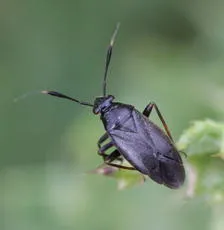
Capsus ater
Capsus ater
Length 5-6 mm. This common bug is characterised by its rather oval body shape, black forewings and 2nd antennal segment, which is swollen towards the apex. The widest part of this segment is more than twice as broad as the narrowest section. The head
Cariniocoris geminatus
Cariniocoris geminatus
Identification: dimorphic; males with hemelytra uniformly dark brown, base of corium sometimes paler, females uniformly pale greenish; primary spiculum Type Locality: Holotype and 31 paratypes, College Station, Brazos Co., TX, 7-12 Apr. 1928, H. G. J
Ceratocapsidea fusiformis
Ceratocapsidea fusiformis
Identification: distinguished by the striate frons, the brown pronotum often having the base and calli darker brown, the dark or reddish hind femur, silvery scale-like and bristle-like setae on the hemelytron, and the male genitalia
Ceratocapsidea rileyi 0
Ceratocapsidea rileyi
Identification: final key couplet: Antennal segments I and II dark brown to fuscous; left paramere (Fig. 189) with beak-like process broadly rounded; right paramere (Fig. 191) with one, relatively short, upturned lateral arm; phallotheca stout, broad
Ceratocapsidea texensis 0
Ceratocapsidea texensis
Identification: final key couplet (part): Broadly rounded, uniformly reddishbrown species (Figs 45, 46); legs uniformly yellow distinguished by the small size, oval body form, the uniformly pale yellowish brown appendages, and the male genitalia. Typ
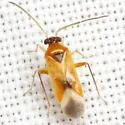
Ceratocapsus apicalis
Ceratocapsus apicalis
Identification: black pronotum and scutellum, distinctly blackish apical half of membrane, and fuscous cloud at inner apical angles of corium. Type Locality: Fabens, El Paso Co., Texas
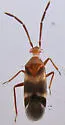
Ceratocapsus apicatus
Ceratocapsus apicatus
Identification: Closely allied to fasciatus Uhl., but with thicker antenna, a pale band across apex of corium as well as one at apex of scutellum, a unicolorous membrane and darker legs ( original description )
Ceratocapsus barbatus 0
Ceratocapsus barbatus
Identification: Fuscous, clavus and corium more brown, thickly clothed with semi-erect and erect, brown pubescence; antennal segments brown; eyes with rather long setae (Fig. 27b) ( 3 ) " Ceratocapsus barbatus resembles C. cecilsmithi and C. pubescen
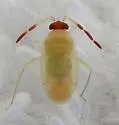
Ceratocapsus bifurcus
Ceratocapsus bifurcus
Identification: Det. Michael D. Schwartz, 2024 Henry examined numerous specimens collected at Highlands Co., Archbold Biological Station, May 5, 1977, B. Stinner, at light (PDA, TJH). He studied the Ceratocapsus Frost listed as C. lutescens and found
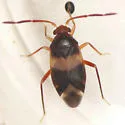
Ceratocapsus fasciatus
Ceratocapsus fasciatus
Identification: Dorsum dark brown and clothed only with simple pubescence, and a broad pale or yellowish mark extending across hemelytra just beyond tip of scutellum. uncommon (BG data)
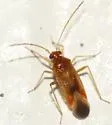
Ceratocapsus fuscosignatus 0
Ceratocapsus fuscosignatus
Identification: Suggestive of punctulatus Reuter described from Texas, but differs in the shorter pubescence, shorter antennal segments, and the setigerous punctures of the dorsum not infuscated. Type Locality: Tampa, Florida
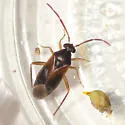
Ceratocapsus modestus
Ceratocapsus modestus
Identification: Separated from other Ceratocapsus by the lack of pilose or tomentose pubescence on the hemelytra, the overall yellowish-brown color with the more fuscous pronotum, scutellum and apical portion of the hemelytra , and the male genitalia
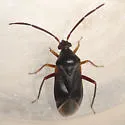
Ceratocapsus nigellus
Ceratocapsus nigellus
Identification: Recognized among species of Ceratocapsus lutescens group by: 1) Clavus and middle of corium clothed with silky or tomentose pubescence intermixed with simple, erect, semierect or pilose setae; 2) Dorsum with only shorter, more recumbe
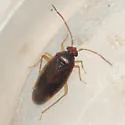
Ceratocapsus pumilus
Ceratocapsus pumilus
Identification: 1) Clothed with two types of pubescence; 2) Dorsum without transverse pale mark; 3) Pronotum punctate with calli and anterior area of disk dark fuscous to black; 4) (vertex width + dorsal width of one eye) < A3 < (head width); 5) Scut
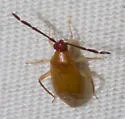
Ceratocapsus rubricornis
Ceratocapsus rubricornis
Identification: totally red antennae Det. Jason Botz, 2024 Note: I have seen a specimen of C. rubricornis with partially pale antennae, as in lutescens & bifurcus. (B Barnd, 2025) Type Locality: Mississippi
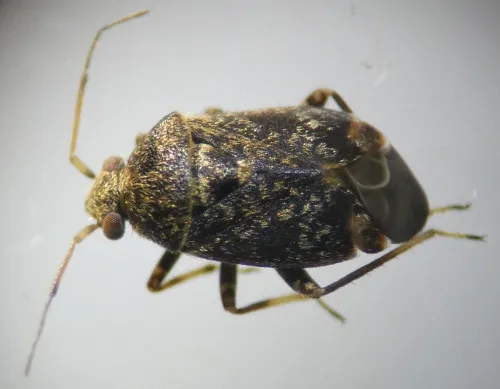
Charagochilus gyllenhalii
Charagochilus gyllenhalii
Length ~3.5 mm. Charogochilus species are small dark plant bugs which are covered in scale-like golden pubescence. The wing membrane is often strongly curved downward, and the tibial spines are very fine and pale. The similar but very rare Charagochi
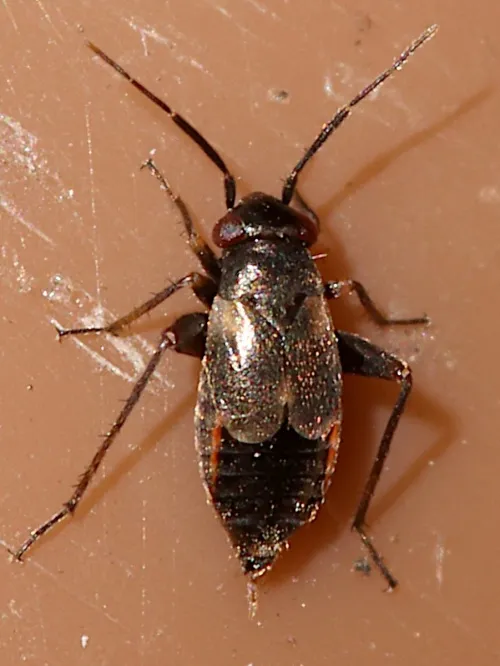
Chlamydatus saltitans
Chlamydatus saltitans
Length about 2.5 mm. This genus comprises five very small and almost entirely black bugs with rather broad hind femora. Halticus species are similar, but have longer antennae ( body length). The 2nd antennal segment in Chlamydatus is head width. C.
Chlamydatus suavis
Chlamydatus suavis
Identification: last key couplet: Tibial spines black but without black spots at base; rostrum reaching upon posterior trochanters Det. Jason Botz, 2017 Type Locality: Texas ( Belfarge )
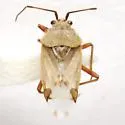
Clivinema detecta
Clivinema detecta
Identification: Distinguished from villosa Reut. by the more strongly inflated scutellum and by the fuscous marks on membrane. and by orange legs? Type Locality: Jemez Springs, New Mexico, alt. 6400 ft., August 1-15, 1916
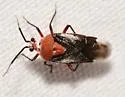
Clivinema regalis
Clivinema regalis
Identification: Distinctive in the genus for having bright red to orange-red dorsum with black hemelytra , antennae, and tibiae. [emphasis added]
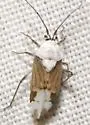
Clivinema villosa
Clivinema villosa
Identification: White-grey, white-grey-villous above the forehead two strigis, wedge, membranous vein apical areolae minor, the antennae, the feet, and the lateral spots of the belly are brownish-testaceous; on the eyes, in the middle of the breast,
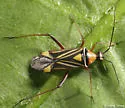
Closterocoris amoenus
Closterocoris amoenus
Identification: Adults are distinctively colored/patterned: Nymphs (immatures) appear "ant-like":
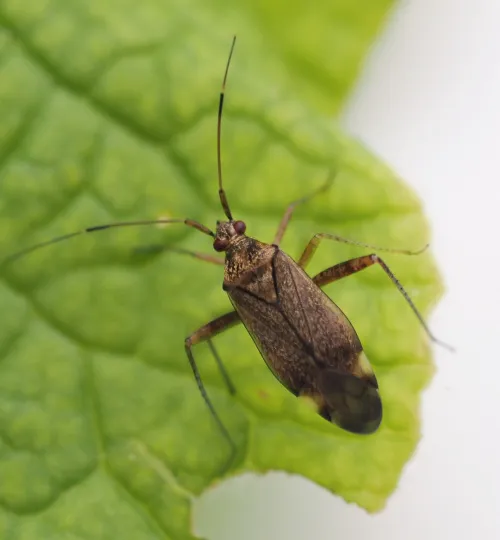
Closterotomus fulvomaculatus
Closterotomus fulvomaculatus
Length 6 to7 mm. A fairly large and mainly brownish plant bug in which the upper surface is covered in flattened golden hairs. Confusion with other species is unlikely. Feeds mainly on Hop, although Nettles and Meadowsweet are also used as foodplants
Potato Bug
Closterotomus norvegicus
Identification: Adult: mostly green above, with two small black dots on anterior half of pronotum near midline; scutellum with dark marks at base (sometimes lacking); hemelytra of some specimens has reddish-brown tint; membranous portion of forewing
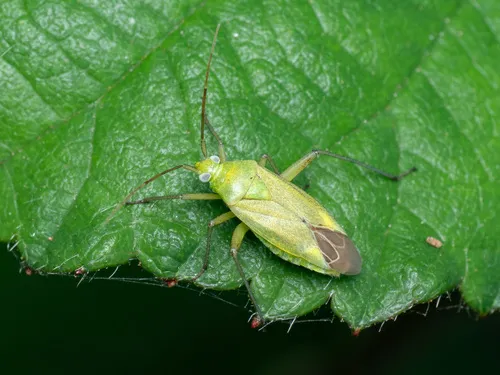
Potato Capsid
Closterotomus norwegicus
Length 6-8 mm. It is one of several similar green species, although mature males are tinged red-brown and specimens from northern Britain may have brownish-black markings. The tibial spines are shorter than the width of the tibia, and the length of t
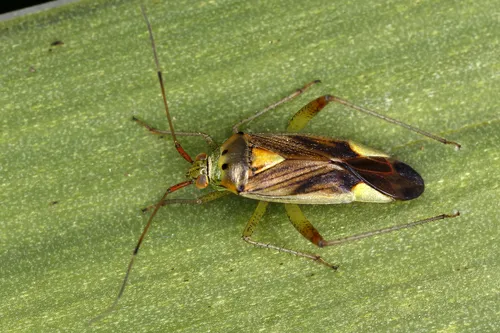
Closterotomus trivialis
Closterotomus trivialis
Females are greenish, typically with a green cuneus and two dark spots on the pronotum. Males are usually darker, with red cuneus. Both sexes have darkish wing membranes with reddish wing veins Quite similar to Closterotomus fulvomaculatus – care nee
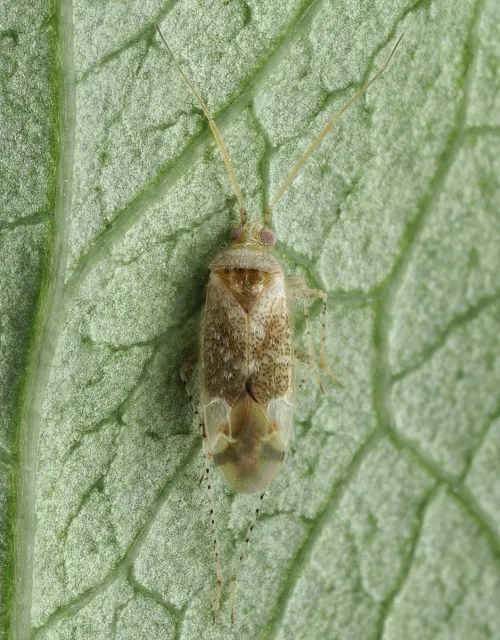
Compsidolon salicellum
Compsidolon salicellum
Length about 4mm. The pale greyish-yellow ground colour of this bug is often broken up by brown spotting across the forewings, although the cuneus is pale. The hind femora are dark, particularly towards the apex and there are dark marks on the wing m
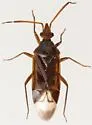
Conocephalocoris nasicus
Conocephalocoris nasicus
Identification: Monotypic genus. Similar to Eurychilopterella spp., "but head longer and more cone-shaped; antennal segment III about equal to segment IV (in Eurychilopterella segment III distinctly longer than IV)." Overall look is reminiscent of an
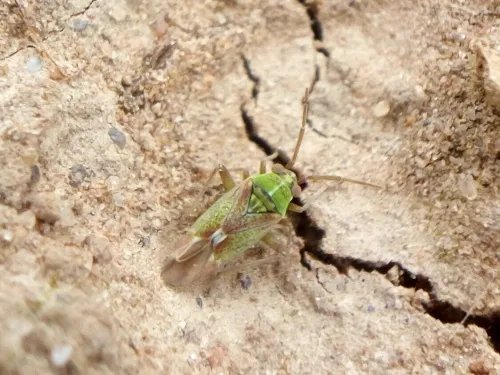
Conostethus venustus
Conostethus venustus
Length 3.0 mm. Conostethus species have a distinctively shaped pronotum, which is much wider than long and has concave lateral margins. This species is usually easily recognised by the rosy markings on the clavus, cuneus and part of the corium, altho
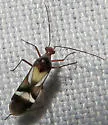
Coquillettia albiclava
Coquillettia albiclava
Identification: white clavus, pale translucent basal half of corium, embolium dark; antennomeres II & III equal in length
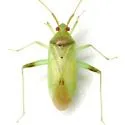
Creontiades debilis
Creontiades debilis
Identification: Uniformly green or yellowish-green dorsal coloration without red lines or a red tinge Type Locality: Georgia
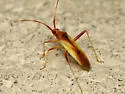
Creontiades rubrinervis
Creontiades rubrinervis
Identification: red-tinged A1 and apically red A2 & A3, yellowish-green upper surface and legs variously tinged or marked with red.
Salien Plant Bug
Criocoris saliens
Identification: Distinguished by scalelike hairs on femora and fusiform [tapering at both ends] A2 in male Type Locality: Texas ( Belfarge )
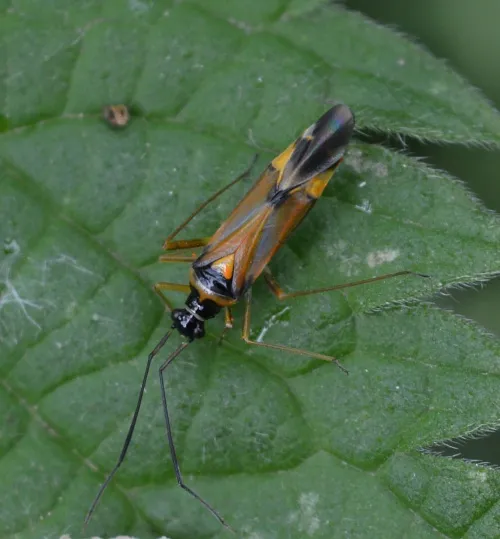
Cyllecoris histrionius
Cyllecoris histrionius
The adult is a strikingly marked and elongate bug reaching a length of 6 to 8 mm. The largely black pronotum is strongly narrowed at the front, forming a distinct collar which is marked with yellow or white. The antennae are red tipped. This species
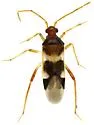
Cyrtopeltocoris rubripes
Cyrtopeltocoris rubripes
Identification: Edges of white markings on corium somewhat blurry, not distinct. "Head, pronotum, and scutellum reddish brown, contrasting with a darker brown cuneus and posterior half of corium." Type Locality: Argus Mountains, California, April 29.
Cyrtorhinus caricis 0
Cyrtorhinus caricis
Cyrtorhinus caricis 0 (Cyrtorhinus caricis) is a species in the family Miridae, commonly known as plant bugs, belonging to the order Hemiptera (True Bugs, Cicadas, Hoppers, Aphids and Allies). It is classified within the subfamily Orthotylinae, tribe
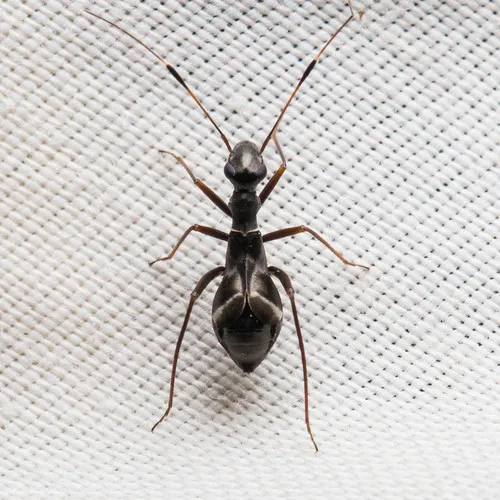
Dacerla mediospinosa
Dacerla mediospinosa
Identification: Distinctive Characters: 1) Hind-margin of pronotum abruptly upturned as a thin flange, which is elongated in its median portion and raised into a spine-like projection (but is hollow from behind). 2) Hemelytra (= fore-wings) short; ta
Dagbertus fasciatus
Dagbertus fasciatus
Identification: A2 uniformly pale, scutellum lacking red or fuscous markings, if weakly marked, inner margin of clavus infuscated or clouded with brown. Paraclypeus with a bright red, transverse band apically. Pronotum with a dark, transverse band po
Dagbertus olivaceus
Dagbertus olivaceus
Identification: apically black A2; entirely or apically red or fuscous scutellum, and the unmarked clavus. Paraclypeus unmarked. Labium straw colored, segment IV dark brown or black apically. Scutellum mostly red or at least apical third red, speckle
Deraeocoris cochise
Deraeocoris cochise
Identification: From the description: "Dorsum pale yellow, nearly glabrous; hemelytra trnaslucent; scutellum impunctate; legs uniformly pale yellow; claws deeply cleft near bases; genitalia distinctive for the species."
Deraeocoris davisi
Deraeocoris davisi
Identification: Scutellum impunctate; tibiae uniformly pale; metafemora pale with incomplete dark band; antennae pale yellow ; membrane with apical half pale; pronotum, clavus, and inner half of corium dark brown to black; and outer half of corium us
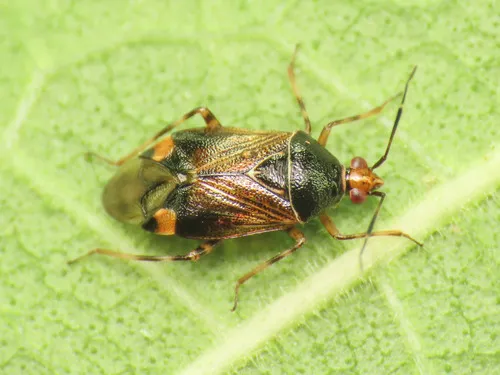
Deraeocoris flavilinea
Deraeocoris flavilinea
Length 7-8 mm. It is a large and fairly distinctive bug, but sexually dimorphic and thus rather variable. Males are much darker than the more orange females. The front and rear margins of the pronotum are narrowly pale. The cuneus is variable and the
Deraeocoris fulvus
Deraeocoris fulvus
Identification: "Small in size, less than 5 mm; general coloration fulvous to piceous; scutellum convex, pale or yellowish; membrane clear; genital structures distinctive for the species."
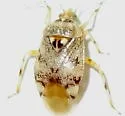
Deraeocoris gilensis
Deraeocoris gilensis
Identification: "Closely related to D. vanduzeei Knight, but setae on dorsum, antennae and legs denser and distinctly longer; punctures on dorsum sparser, except for cluster of punctures behind calli." The characters that lead to this species in Raza
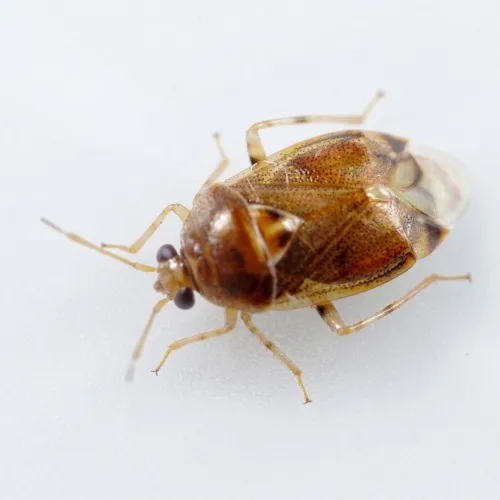
Deraeocoris lutescens
Deraeocoris lutescens
Length ~4 mm. A small bug, generally orange-brown with blackish markings and translucent forewings. Although sometimes rather variable, there are usually two dark bars on the scutellum, which is unpunctured. Found on a wide variety of plants but favo
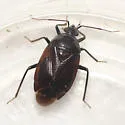
Deraeocoris nigritulus
Deraeocoris nigritulus
Identification: 1) Dorsum hairy; 2) Pronotum, hemelytra, and legs uniformly dark brown; 3) Paler subtranslucent areas of hemelytra stained with brownish; and 4) Apical half of hind tibiae usually with a pale ring.
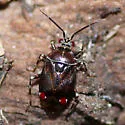
Deraeocoris poecilus
Deraeocoris poecilus
Identification: 1) Pronotum punctate; 2) Cuneus red; and 3) A2 ≥ pronotum.
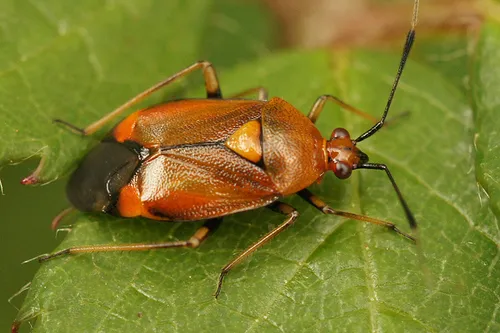
Red Bug
Deraeocoris ruber
Length 6-8 mm. The ground colour (including the scutellum) ranges from red-orange to almost fully black, although the cuneus is always red to some extent. The forewings are very shiny. The tibiae are unbanded and the 1st antennal segment and at least
Deraeocoris sayi
Deraeocoris sayi
Identification: scutello rufo-testaceo Det. M. A. Quinn, 2014 Type Locality: Texas ( Belfarge )
Derophthalma emissitia
Derophthalma emissitia
Identification: Brownish-ochraceous; two irregular central fasciae to pronotum, inner margins of clavus, a transverse spot near centre of corium and a spot at inner angle of same, body beneath, and femora fuscous; cuneus castaneous; antennae, lateral
Dichrooscytus cuneatus
Dichrooscytus cuneatus
Identification: Basal half and apex of cuneus red. "[Base color of] hemelytra pale yellowish, apical margin of corium infuscated." The hemelytra are weakly to strongly speckled with red flecks (J.T. Botz, personal observation).
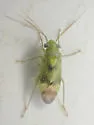
Dichrooscytus longirostris
Dichrooscytus longirostris
Identification: Overall green color, long rostrum (reaching beyond hind trochanters onto genital segment).
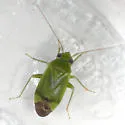
Dichrooscytus repletus
Dichrooscytus repletus
Identification: <4.00 mm, vertex width <A1, dorsum uniformly green with blackish hair
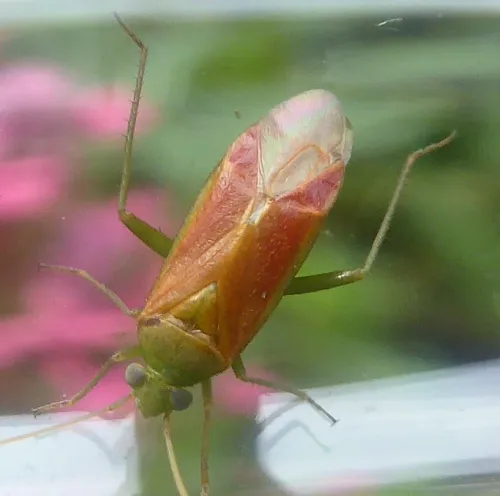
Dichrooscytus rufipennis
Dichrooscytus rufipennis
Dichrooscytus is comprised of 4 species in Europe. These are all quite similar. They are mainly green and have greenish red wings. Dichrooscytus rufipennis is the biggest of the four species, measuring some 6 mm. The second antennal segment is larger
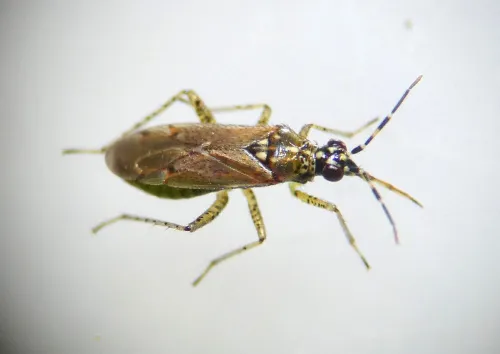
Dicyphus annulatus
Dicyphus annulatus
A small bug, found on restharrow. Head marked in black and white, and antennae black with white rings on basal and 2nd segment. Tibial spines arise from black spots. (ref.: B S Nau, unpublished key to Miridae, 2012) Several other Dicyphus species are
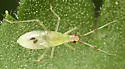
Dicyphus discrepans
Dicyphus discrepans
Identification: “Head black, area behind each eye yellow. (...) First antennal segment yellow, base and apex red, often all black; second segment longer than width of pronotum at base. Pronotum pale yellow, transverse groove behind calli often red. S
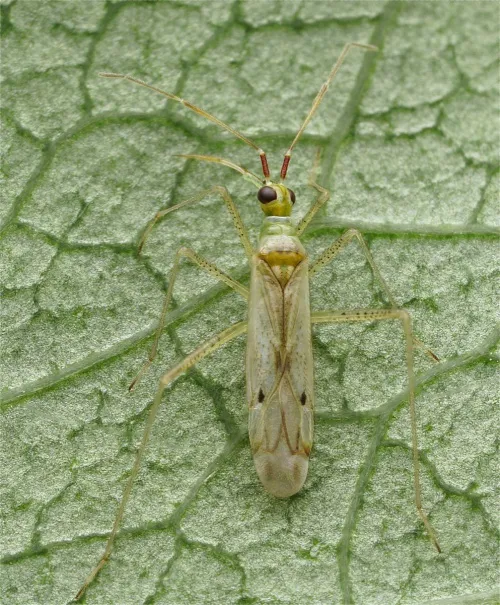
Dicyphus epilobii
Dicyphus epilobii
Length of adult macropters (long-winged forms) 4 to 5 mm. Legs and antennae long and slender; hind tibia c.3mm. and antennnae >3mm. Pale green with green collar between head and pronotum; vertex (front of head) often marked with red or brown. Often w
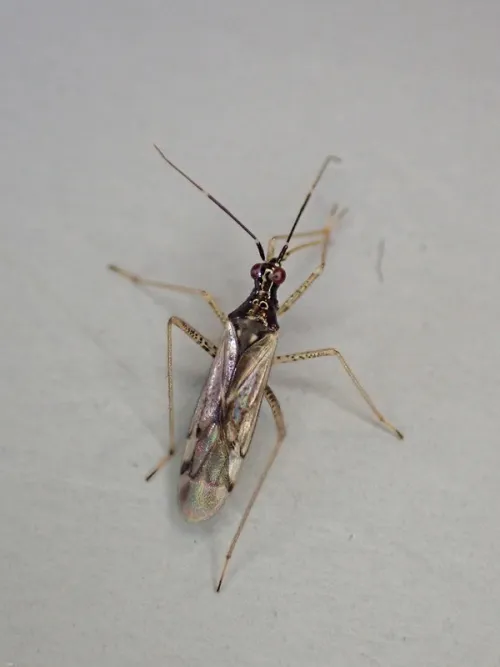
Dicyphus errans
Dicyphus errans
Length of adult macropters (long-winged forms) 4 to 5 mm. Legs and antennae long and slender; hind tibia c.3mm. and antennnae >3mm. Head, pronotum and basal and 2nd antennal segments often black. Teneral and pale forms have paler heads and antennae.
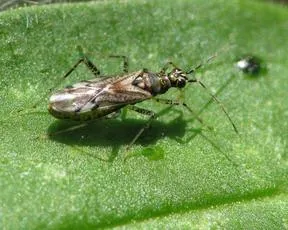
Dicyphus escalerae
Dicyphus escalerae
The rather coarse black pubescence arising from black spots on the dorsal surface helps to distinguish it from other UK Dicyphus species. Detailed examination of the specimen is needed to identify the species. You must state the host-plant. UK sighti
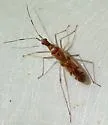
Dicyphus famelicus
Dicyphus famelicus
Identification: “Head light yellow often marked with red. First antennal segment pale green, bar near base and apex red; second segment pale green, apical one third red or black. Pronotum and scutellum light yellow. Hemelytra opaque white marked with
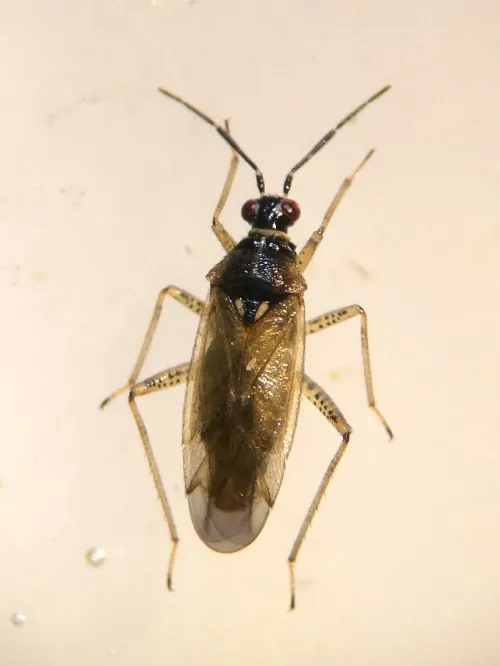
Dicyphus globulifer
Dicyphus globulifer
A small bug with short legs and antennae compared to other Dicyphus species; the 3rd antennal segment is much less than the head width across the eyes. The head and antennae are black, and there are dark marks on the pronotum. The rear of the pronotu
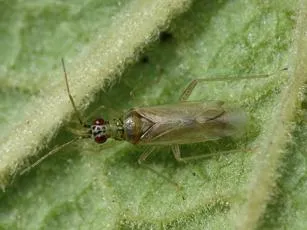
Dicyphus pallicornis
Dicyphus pallicornis
Length 3.5 to 4 mm; macropterous or brachypterous. Shorter legs and antennae than many other Dicyphus ; the 3rd antennal segment is much less than head width across the eyes. The 2nd antennal segment is usually pale, but may be darker at the base; th
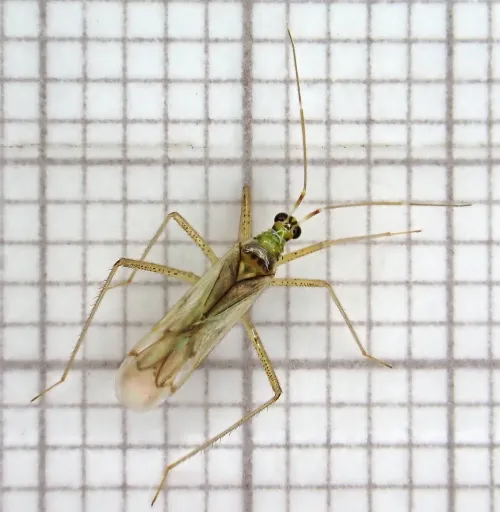
Dicyphus pallidus
Dicyphus pallidus
ant2 >2.1× longer than head width; body length 5.2–5.8mm in macropters, 4.3–5.1mm in brachypters; ant3 > head width across eyes; head, pronotum, ant1+2 largely pale ( D. errans tenerals are ‘dusky’); ant1 marked with red; pronotal callosities large –
Dicyphus stachydis
Dicyphus stachydis
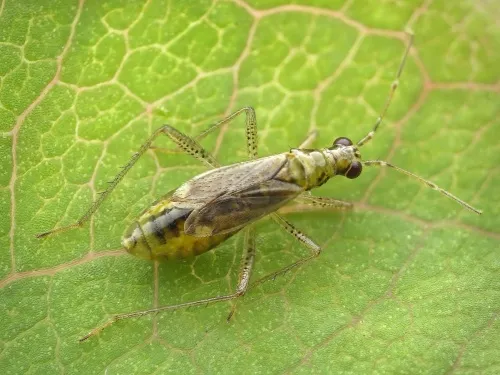
Length 4.5 mm. The adults are usually brachypterous and often show a dark spot at the apex of both the corium and the cuneus as in D. epilobii , but the 1st antennal segment is mainly pale and the head has dark markings. Detailed examination s needed
Dicyphus tamaninii
Dicyphus tamaninii
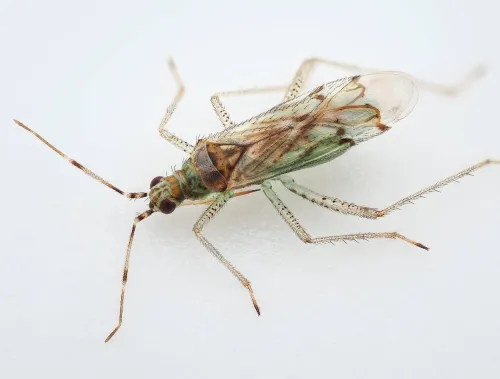
Similar to D. escalerae in appearance. Strong black upperside pubescence; ant1 with dark rings near base and apex (uniformly dark in escalerae); femora finely spotted (coarsely spotted in escalerae); tibiae pale (with a basal ring in escalerae); left
Dryophilocoris flavoquadrimaculatus
Dryophilocoris flavoquadrimaculatus
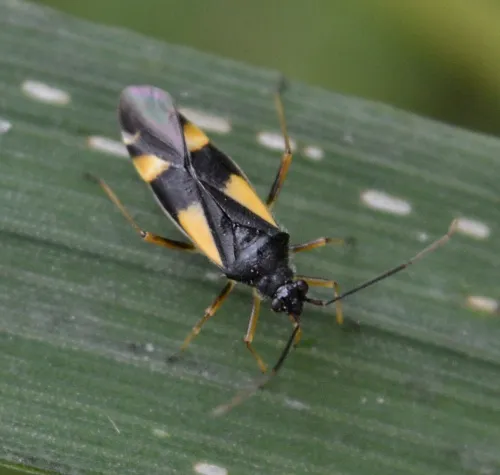
Length 6-7 mm. This is one of several mirids which are mostly black with yellow markings. Although distinctive, it is similar to the much rarer Globiceps species, which have less extensive yellow areas at the front of the corium. In addition, the pro
Tomato Bug
Engytatus modestus
Identification: The smooth pronotum avoids Dicyphus and then the large eyes located near the calli show it's a species of Engytatus or Nesidocoris . Regarding the identification of the Dicyphini Genera, I referred to "A systematic study of the subfam