
Anelosimus studiosus
This record describes Anelosimus studiosus (species). Recorded family: Theridiidae. Recorded order: Araneae.
Identification and Appearance
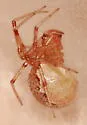
Female Only about 23 among more than 38,000 known spider species can be considered social! Unlike social insects, where the workers are sterile and only the queen lays eggs, all social spiders in a colony are able to reproduce. Deborah R. Smith of the University of Kansas at Lawrence compares social spiders to a pride of lions. It's always interesting to see an organism one usually thinks of as asocial, predatory, and cannibalistic, forming large cooperative societies, says Smith. Group living has its benefits, says Leticia Avilés of the University of Arizona in Tucson, who studies cooperative spiders in Ecuador. Working together, social spiders can capture prey as large as 10 times their size, whereas an individual spider is lucky to bag a bug twice as big as itself. In some spider species the mothers care for the young well after they have hatched but do not establish colonies. Each generation of young goes off and makes its own single-family web. These species, Smith speculates, resemble forerunners to the fully social spiders. After some point in evolution, she says, the babies just never leave home. Social spider colonies have been found to have a female-biased sex ratio, sometimes as high as 9:1! This no doubt facilitates population growth during times of plenty. A variety of other species live in association with the social spiders in their webs including 13 species of spiders and 11 species of insects.
Identification notes
Female
Classification
- Kingdom
- Animalia
- Phylum
- Arthropoda
- Class
- Arachnida
- Order
- Araneae (Spiders)
- Family
- Theridiidae (Cobweb Spiders)
- Genus
- Anelosimus (Social cobweb spiders)
Imported taxonomy record. Source availability varies; see the source references and editorial policy below.
Habitat and Range
Geographic Range
e U.S., most records along the Gulf and Atlantic coast (TX-FL-CT-OK) south to northern Argentina (Draney, 2001),(BG data)
Seasonal Activity
April to October in e TX
Diet and Behavior
Life History
Females of Anelosimus cf. studiosus care for their egg-sacs and open them to allow the emergence of the spiderlings, which they feed by regurgitation. The caterpillar of a Pyralid moth, Tallula watsoni , is known to inhabit the web of this spider in Florida (Deyrup et al. 2004).
Additional species information
Species notes from the sources
Etymology: Anelosimus studiosus (Hentz, 1850)
About Spiders: the wider group
Order-level background for Araneae, the group containing Anelosimus studiosus. Species-specific details appear above.
Group overview
As of 2023, 51,673 spider species in 136 families have been recorded, though an estimated 150,000 species exist. Spiders rank 7th in total species diversity among all organism orders. Only 0.5% of spider species pose any risk to human health.
Ecological role of the group
Spider venom contains complex peptides with diverse pharmacological activities, making them valuable for drug development research. Spiders produce up to 7 types of silk from specialized glands. Spider silk genes have been inserted into mammals and plants for biotech applications.
Economic and practical significance of the group
The global spider community kills an estimated 400-800 million tons of prey annually (2017 study). Spiders provide billions of dollars in natural pest control for agriculture. Spider silk is 5× stronger than steel of the same diameter, driving a biomaterials research industry.
Recorded sources for this group: World Spider Catalog, PNAS, Nature, ScienceDirect. Imported estimates may describe particular regions or reporting periods.
Photos of Anelosimus studiosus (5)
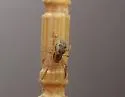
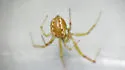
Photo credits: Contributed by Jeff Hollenbeck; Additional contributions by cotinis , Lynette Elliott , Mike Quinn , Tyler Hedlund
Frequently Asked Questions About Anelosimus studiosus
What is Anelosimus studiosus?
Anelosimus studiosus is a species in the family Theridiidae, within the order Araneae.
How big is Anelosimus studiosus?
8 mm
How do you identify Anelosimus studiosus?
Female
Where is Anelosimus studiosus found?
Range: e U.S., most records along the Gulf and Atlantic coast (TX-FL-CT-OK) south to northern Argentina (Draney, 2001),(BG data)
When is Anelosimus studiosus active?
Anelosimus studiosus: seasonal activity - April to October in e TX.
What is the life cycle of a Anelosimus studiosus?
Females of Anelosimus cf. studiosus care for their egg-sacs and open them to allow the emergence of the spiderlings, which they feed by regurgitation. The caterpillar of a Pyralid moth, Tallula watsoni , is known to inhabit the web of this spider in Florida (Deyrup et al. 2004).