
Agyneta serrata
This record describes Agyneta serrata (species). Recorded family: Linyphiidae. Recorded order: Araneae.
Identification and Appearance
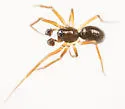
| Feature | Description |
|---|---|
| Carapace | Carapace light orange, shiny, finely reticulate; radiating lines, margin suffused with dark gray; trident mark present. |
| Abdomen | Abdomen uniformly light to dark gray, sometimes with apical white hourglass mark. |
| Legs | Legs light yellow, femurs lightly suffused with gray. Palp |
Classification
- Kingdom
- Animalia
- Phylum
- Arthropoda
- Class
- Arachnida
- Order
- Araneae (Spiders)
- Family
- Linyphiidae (Sheetweb and Dwarf Spiders)
- Subfamily
- Linyphiinae
- Genus
- Agyneta
Imported taxonomy record. Source availability varies; see the source references and editorial policy below.
Habitat and Range
Habitat
Hardwood hammock forests; sometimes in caves
Geographic Range
Eastern USA, west to Texas and Ontario. According to the American Arachnological Society --NS, ON; AR, FL, GA, IN, MA, MI, MO, NC, NY, OH, OK, PA, TX, VA, WI, WV
Additional species information
Species notes from the sources
Etymology: Agyneta serrata (Emerton, 1909)
About Spiders: the wider group
Order-level background for Araneae, the group containing Agyneta serrata. Species-specific details appear above.
Group overview
As of 2023, 51,673 spider species in 136 families have been recorded, though an estimated 150,000 species exist. Spiders rank 7th in total species diversity among all organism orders. Only 0.5% of spider species pose any risk to human health.
Ecological role of the group
Spider venom contains complex peptides with diverse pharmacological activities, making them valuable for drug development research. Spiders produce up to 7 types of silk from specialized glands. Spider silk genes have been inserted into mammals and plants for biotech applications.
Economic and practical significance of the group
The global spider community kills an estimated 400-800 million tons of prey annually (2017 study). Spiders provide billions of dollars in natural pest control for agriculture. Spider silk is 5× stronger than steel of the same diameter, driving a biomaterials research industry.
Recorded sources for this group: World Spider Catalog, PNAS, Nature, ScienceDirect. Imported estimates may describe particular regions or reporting periods.
Photos of Agyneta serrata (5)
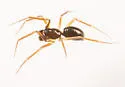
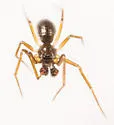
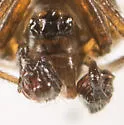
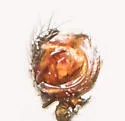
Photo credits: Contributed by John Rosenfeld; Additional contributions by cheins
Frequently Asked Questions About Agyneta serrata
What is Agyneta serrata?
Agyneta serrata is a species in the family Linyphiidae, within the order Araneae.
How big is Agyneta serrata?
| Feature | Details |
|---|---|
| Male | 1.31mm |
| Female | 1.35mm |
How do you identify Agyneta serrata?
| Feature | Description |
|---|---|
| Carapace | Carapace light orange, shiny, finely reticulate; radiating lines, margin suffused with dark gray; trident mark present. |
| Abdomen | Abdomen uniformly light to dark gray, sometimes with apical white hourglass mark. |
| Legs | Legs light yellow, femurs lightly suffused with gray. Palp |
Where is Agyneta serrata found?
| Feature | Details |
|---|---|
| Habitat | Hardwood hammock forests; sometimes in caves |
| Range | Eastern USA, west to Texas and Ontario. According to the American Arachnological Society --NS, ON; AR, FL, GA, IN, MA, MI, MO, NC, NY, OH, OK, PA, TX, VA, WI, WV |