
Family Underwing, Tiger, Tussock, and Allied Moths (Erebidae)
Erebidae is a family in the order Lepidoptera. Browse 932 named species recorded in this family, or open an individual profile for its available identification and natural-history information.
Species in Erebidae (932)
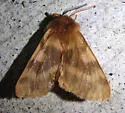
Bean's Tiger Moth - Hodges#8160
Chelis beanii
Bean's Tiger Moth - Hodges#8160 (Chelis beanii) is a species in the family Erebidae, belonging to the order Lepidoptera (Butterflies and Moths). It is classified within the subfamily Arctiinae, tribe Arctiini, superfamily Noctuoidea. This species bel
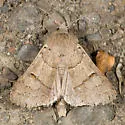
Indiscrete Cissusa Moth - Hodges#8594
Cissusa indiscreta
Identification: Miller & Hammond (2003) describe the larva as mottled silver, grey and black. ( 5 )
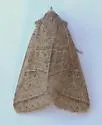
Cissusa mucronata - Hodges#8593
Cissusa mucronata
Identification: Adult - see original description in Print References.
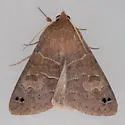
Black-dotted Brown Moth - Hodges#8592
Cissusa spadix
Identification: Adult - overall forewing color varies from light to very dark. Larva - see Coyle et. al, 2013 (fig.1c, p.83) in Print References or consult Wagner et al., 2011.
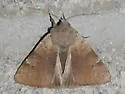
Vigorous Cissusa Moth - Hodges#8596
Cissusa valens
Identification: Larva - see Crumb in Print References. Adult - see Edwards in Print References.
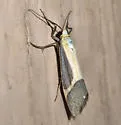
Angel Lichen Moth - Hodges#8070
Cisthene angelus
Identification: Dyar's original description of angelus and Knowlton's revision of the genus both emphasize the solid yellow/orange color of the thorax, lacking any black or gray spot. This is combined with a wide yellow/orange band on the FW inner ma
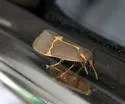
Barnes' Lichen Moth - Hodges#8074
Cisthene barnesii
Identification: Similar to several other Cisthene lichen moths, particularly Thin-banded: wings slate gray with orange on thorax, basal streak on FWs, and variable PM band. Most importantly, on Barnes' the top of head (vertex) is gray (but collar an
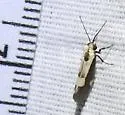
White-streaked Lichen Moth - Hodges#8073
Cisthene conjuncta
Identification: Similar in size and general pattern to a few other Cisthene species (e.g. packardii ) but pale areas of FWs whitish. Head and thorax whitish, base of collar slightly pink; FWs dark gray with a squarish white spot on costa just beyond
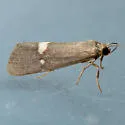
Cisthene dorsimacula - Hodges#8065
Cisthene dorsimacula
Identification: Cisthene dorsimacula is dimorphic with the hindwing color of light pink or yellow. ( 3 )
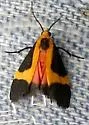
Kentucky Lichen Moth - Hodges#8061
Cisthene kentuckiensis
Identification: Adult is best identified by the black ground color, dark thoracic disk, and wide orange or yellow basal streak which is well connected to the wide PM band. The basal edge of the PM band is broadly and evenly concave (contrast with One
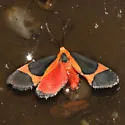
Martin's Lichen Moth - Hodges#8078
Cisthene martini
Identification: Martin's Lichen Moth is similar to Thin-banded except that all the colors are darkened and over-saturated. Most noticeably, the basal streak and PM band are usually dark red-orange. In many online images, the PM band shows a thin hint
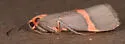
Cisthene perrosea - Hodges#8069
Cisthene perrosea
Identification: Pale color on the thorax and forewings is typically pink-orange but may be yellow-orange. The thoracic disk has a distinctive pattern with the pink-orange of the tegulae "bleeding" onto the disk, with the disk being about 50-50 gray
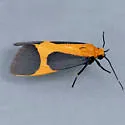
Pictured Lichen Moth - Hodges#8075
Cisthene picta
Identification: Pictured Lichen Moth is one of the two species in the genus which has a completely orange thorax, a character shared with Angel Lichen Moth. The basal streak is wide, straight edged, and broadly connected to a wide PM band. The PM b
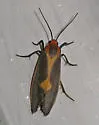
Lead-colored Lichen Moth - Hodges#8067
Cisthene plumbea
Identification: Recognized by the flat medium gray ground color, extensive yellowish or orange streak along the costal margin, single PM spot on the inner FW margin, and lack of a corresponding spot on the costal margin. The amount of yellow/orange
Striated Lichen Moth - Hodges#8068
Cisthene striata
Identification: Similar to Lead-colored Lichen Moth but with blurry whitish to pale gray dusting in three broad bands in basal 2/3 of forewings and similar color between all veins in outer par of the wing. Pink-orange PM spot on inner margin ranges f
Subject Lichen Moth - Hodges#8071
Cisthene subjecta
Identification: Recognized by a combination of characters: -- Basal red/yellow streak is separated from the inner forewing margin by gray. -- Basal streak connects to the red PM spot on the inner margin at it's "top", i.e. at the point closest to the
Tamaulipan Lichen Moth - Hodges#8059
Cisthene subrufa
Identification: Identified by range and a combination of characters ( 4 ) : -- Pale creamy yellow rather than orange color areas. -- Basal streaks stop well short of the PM band; margins of the basal streaks are convex, resulting in an elliptical pal
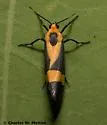
Thin-banded Lichen Moth - Hodges#8066
Cisthene tenuifascia
Identification: Identified by the combination of yellow/orange vertex, dark gray thoracic disk, narrow basal orange streaks which connect thinly or not at all to PM band, and a thin PM band which is sometimes irregular and sometimes broken into spots
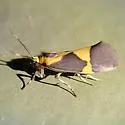
One-banded Lichen Moth - Hodges#8060
Cisthene unifascia
Identification: Adults can be recognized by the shape of the PM band which is in the form of two broad-based triangles which meet thinly--or not at all--in the middle; the forward margin of the PM band is thus deeply indented, irregular, and rather r
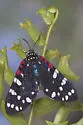
Faithful Beauty - Hodges#8038
Composia fidelissima
Identification: Distinctive day-flying moth found in South Florida. Lovely.
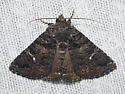
Black-waved Owlet - Hodges#8662
Coxina cinctipalpis
Identification: Smith original description as Campometra cinctipalpis is available in PDF. Determined by Bob Patterson.
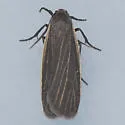
Dark Gray Lichen Moth - Hodges#8045
Crambidia lithosioides
Identification: Female has dark brownish-gray forewing with paler veins, pale yellow strip along costa and serrate antennae. Male has pale grayish-brown forewing with paler veins, lacks pale costal strip and has pectinate antennae. ♀
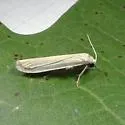
Crambidia myrlosea - Hodges#8048
Crambidia myrlosea
Identification: Dyar (1917) description. "Head white, thorax gray. Fore wing with the costa broadly white, succeeded by dark gray, the veins faintly paler, especially towards costa. Hind wing dark gray."
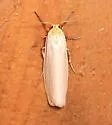
Crambidia xanthocorpa - Hodges#8053.1
Crambidia xanthocorpa
Identification: " Crambidia xanthocorpa is superficially most similar to Crambidia cephalica ; it usually can usually be distinguished by the white patagia, tegulae, and prothorax of eastern specimens of the latter, which are pale to butter yellow in
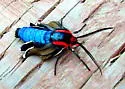
Brown Ctenucha - Hodges#8265
Ctenucha brunnea
Identification: Stretch original description and the Hampson description are both available online in the print references. Forewings pale brown with black veins and blue spot at wing base, costa and fringe of outer margin is white. The population is
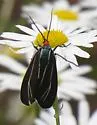
Ctenucha cressonana - Hodges#8261
Ctenucha cressonana
Identification: This species is found in Colorado, C. venosa is not. Both species are found southward. See p.274 in Moths of Western North America . … Bob Patterson, 27 July, 2009 Not easy to determine venosa from cressonana from a photo. Location an
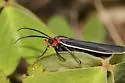
Ctenucha multifaria - Hodges#8263
Ctenucha multifaria
Identification: Distal tip and entire costal edge of forewing narrowly white-marginned. Patagia ** entirely black. ** patagia = pair of small articulated plates, one on each side of the dorsum of the prothorax. The patagia are visible in front of t
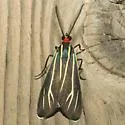
Veined Ctenucha - Hodges#8260
Ctenucha venosa
Sometimes abundant at lights but often found during the day.
Cutina aluticolor - Hodges#8729.1
Cutina aluticolor
Identification: The original description of Cutina aluticolor Pogue & Ferguson, is available in PDF and online in the print references below.
Cutina arcuata - Hodges#8729.2
Cutina arcuata
Identification: The original description of Cutina arcuata Pogue & Ferguson, is available in PDF.
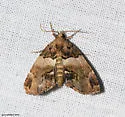
Distinguished Cypress Owlet - Hodges#8729
Cutina distincta
Identification: Pogue & Ferguson revised description is available online in PDF. The original description as Eustrotia distincta Grote, is available online in the print references below. Adult: forewing gray with blackish shading inside AM line, and
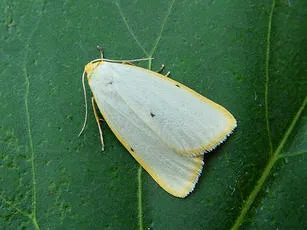
Four-dotted Footman
Cybosia mesomella
Wingspan 25 to 33 mm. When at rest, this moth appears to show only three dots, one being hidden by the overlapping wings. Occasional specimens have a more yellowish ground colour to the forewings. Adults fly from dusk onwards during the period from J
Cycnia collaris - Hodges#8229
Cycnia collaris
Identification: Moth varies phenotypically with wings from white to gray and patigia from yellow to gray. All images previously placed in C. inopinatus have been moved to C. collaris as a result of synonomy per Lafontaine & Schmidt, 2015 .
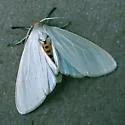
Oregon Cycnia - Hodges#8231
Cycnia oregonensis
Identification: forewing pale whitish-gray with white wing veins and no yellow along costa; top of head yellow; dorsal surface of abdomen orangish-yellow with large black spot on each segment.
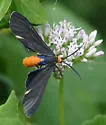
Black-winged Dahana - Hodges#8266
Dahana atripennis
Identification: Orange abdomen, blue at base. Brown-black forewings with yellow anal dash. Black hindwings with blue tint
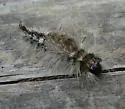
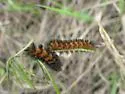
Sharp-lined Tussock - Hodges#8293
Dasychira dorsipennata
Identification: Barnes & McDunnough original description as Olene dorsipennata is available online. Adult: Paler than obliquata , with less of the brown shading in the basal and postmedial areas of the forewing, and a less dentate AM line. It is also
Streaked Tussock Moth - Hodges#8302
Dasychira obliquata
Identification: Tough--variable. Distinctive when shows long thin streaks on forewings. Detailed description available in MONA Fascicle 22-2 at link in citations below.
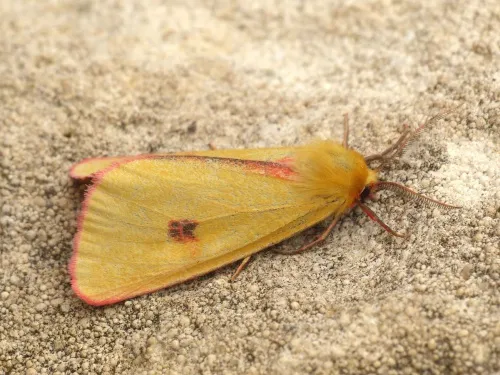
Clouded Buff
Diacrisia sannio
Wingspan 35 to 50 mm. The males are larger and more brightly coloured than the females. Although this species is fairly distinctive it is quite rare at present in our area. We therefore ask you to submit photographs to support any record and, if poss
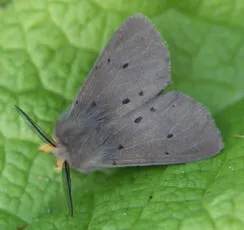
Muslin Moth
Diaphora mendica
Wingspan 28 to 38 mm. Showing distinct sexual dimorphism, the males of this moth are soft grey or grey brown, the females are white, both sparsely speckled with black. It occurs in woodland, downland and suburban habitats. The larvae feed on a variet
Doryodes desoto - Hodges#8765.1
Doryodes desoto
Identification: Description by Lafontaine & Sullivan can be found at the link in citations below. Although superficially indistinguishable from D. spadaria , D. fuselli and D. broui , the range for D. desoto is north and west of the range for spadari
Doryodes fulva - Hodges#8765.11
Doryodes fulva
Identification: Description by Troubridge can be found at the link in citations below.
Doryodes okaloosa - Hodges#8765.2
Doryodes okaloosa
Identification: Description by Lafontaine & Sullivan can be found at the link in citations below.
Doryodes unica - Hodges#8767.5
Doryodes unica
Identification: Description by Troubridge can be found at the link in citations below.
Shadowy Arches - Hodges#8636
Drasteria adumbrata
Identification: Adult: forewing mottled light and dark brown; basal area, median band, reniform spot, and subterminal area paler; AM line curves toward base near inner margin; hindwing creamy yellow to orange with black marginal and PM bands, the lat
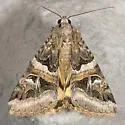
Drasteria divergens - Hodges#8630
Drasteria divergens
Identification: Adult: forewing dark brown to blackish in basal and median areas, light brownish-gray in AM and terminal areas; reniform spot with pointed projections and white highlights; AM line has peculiar but distinctive lobed shaped; hindwing y
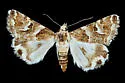
Drasteria eubapta - Hodges#8617
Drasteria eubapta
Identification: Specimen determined by DNA analysis (BOLD).
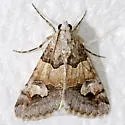
Smoky Arches - Hodges#8629
Drasteria fumosa
Identification: Adult: forewing basal and PM areas dark gray to blackish; PM line highly convoluted, merging with outer edge of large reniform spot, as in other Drasteria species; subterminal area lighter gray; median area variably light grayish-brow
Graphic Moth - Hodges#8618
Drasteria graphica
Identification: forewing may be uniformly gray or light and dark gray with black AM and PM lines; AM line deeply bow-shaped; diffuse brown medial line may be present; PM line highly convoluted, merges with outer edge of reniform spot; ST line almost
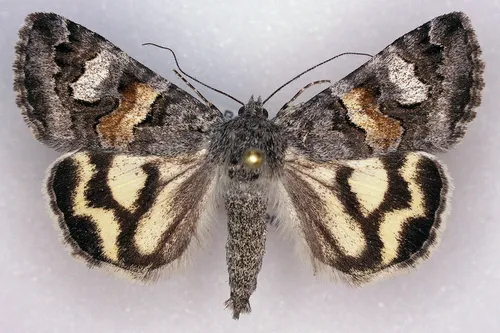
Northern Arches - Hodges#8632
Drasteria hudsonica
Identification: Adult: forewing mottled shades of gray with pale whitish-gray median and subterminal areas; median area often chestnut brown; AM and PM lines variably black to light gray; AM line runs slightly outwardly oblique to the inner margin (r
Inept Drasteria - Hodges#8622
Drasteria inepta
Identification: Adult: dull, drab, and unremarkable compared to bright colors and bold patterns of other Drasteria species; forewing variably yellowish-gray to orangish-brown with dark C-shaped reniform spot surrounded by pale spots; AM, PM, and term
Drasteria ingeniculata - Hodges#8620
Drasteria ingeniculata
Identification: Adult: basal area and distal half of forewing dark blackish-gray; median area and PM patch pale gray with dark speckling; AM line a smooth convex arc; hindwing orangish-yellow with black terminal and PM bands; large black discal spot
Drasteria mirifica - Hodges#8616
Drasteria mirifica
Identification: Crumb described the larvae as generally white, including the head.
Occult Drasteria Moth - Hodges#8619
Drasteria occulta
Identification: Adult - the only similar Drasteria in D. occulta's range is D. graphica atlantica, which can be differentiated by the well-defined ST line on the forewings. D. occulta's ST line isn't so much a "line" as it is a boundary between the d
Drasteria ochracea - Hodges#8626
Drasteria ochracea
Identification: Powell & Opler describe the larvae as having longitudinal bands of yellow and tan bordered by darker shades. Head with six distinct bands.
Perplexed Arches - Hodges#8635
Drasteria perplexa
Identification: Adult: basal half of forewing uniformly grayish-brown with indistinct AM line; terminal area light brownish-gray; PM patch pale, surrounded by black shading; hindwing orange or orangish-yellow with black margin and PM band; black disc
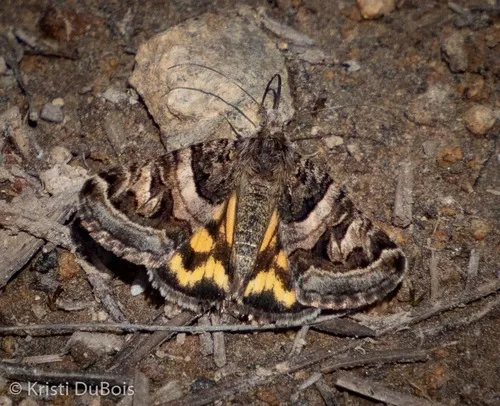
Little Arches - Hodges#8631
Drasteria petricola
Identification: The smallest of the Arches (Drasteria) moths. In Alberta, it is the only species in the genus with black lines along the veins of the ventral forewing margin. The mountain populations (ssp. athabasca) tend to be slightly larger and ha
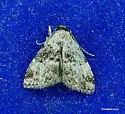
Visitation Moth - Hodges#8426
Dyspyralis illocata
Identification: forewing mottled grayish-brown with broad dark grayish band crossing wing in median area (edges of band irregular); dark oblique patch along costa near apex; terminal line composed of several dark semi-ellipses; fringe checkered pale
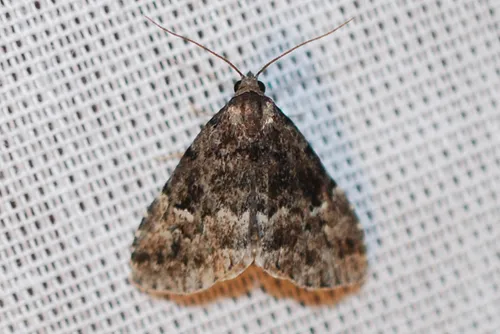
Dyspyralis nigellus - Hodges#8428
Dyspyralis nigellus
Identification: Head: Head and thorax dark purplish brown. Antenna: Simple, reaches to about mid-wing. Thorax: Head and thorax dark purplish brown. Wings: Forewings: Dark brown, purplish sheen. Jagged black line near base (a.m. line). No orbicular sp
Dyspyralis noloides - Hodges#8429
Dyspyralis noloides
Identification: Barnes & McDunnough (1916) original description is online in print references. "Palpi blackish outwardly, the joints tipped with yellow; front and thorax pale ochreous mixed with a few black scales, the latter crossed by a dark band o
Clio Tiger Moth - Hodges#8249
Ectypia clio
Identification: Adult - all white except for black lines along veins of forewing and three longitudinal black lines on top of thorax.
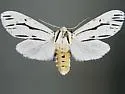
Ectypia mexicana - Hodges#8248
Ectypia mexicana
Identification: Appears to be distinguished from Ectypia clio by having thinner black streaks on the FWs and only two black stripes on the thorax. Both species are distinguished from Ectypia bivittata by have black streaks on the FWs rather than a se
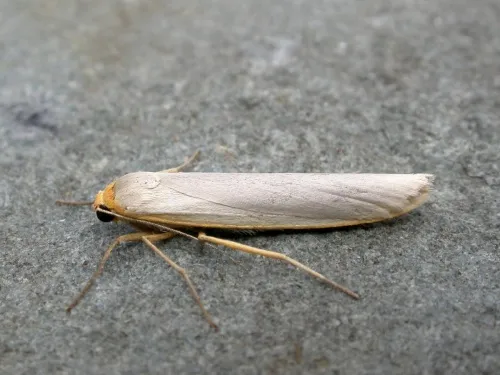
Hoary Footman
Eilema caniola
Wingspan 28 to 35 mm. Paler and greyer than similarly patterned 'footmen'. Very similar to Scarce Footman (E. complana), but hindwing very pale yellowish grey (ochreous yellow in Scarce Footman), a feature which is difficult to see on live specimens.
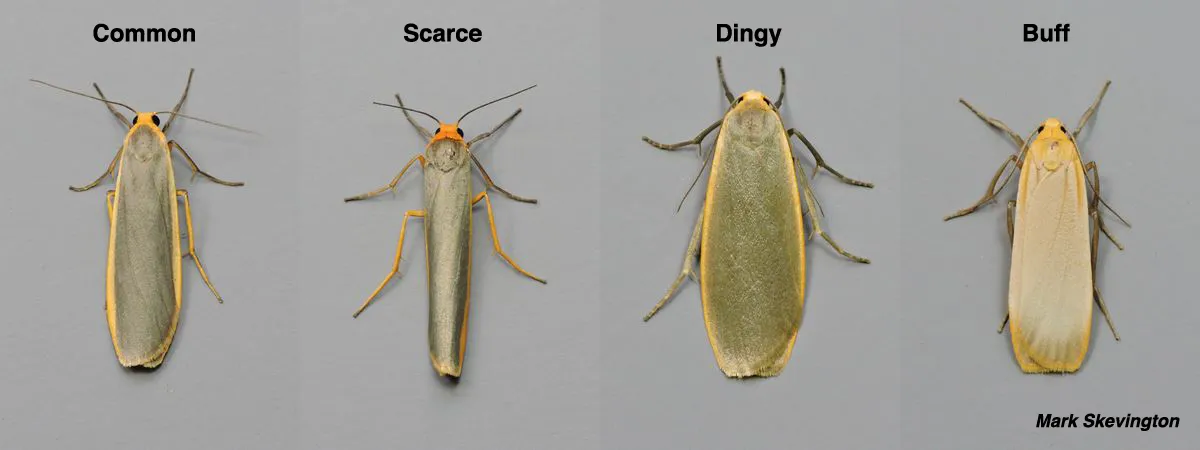
Scarce Footman
Eilema complana
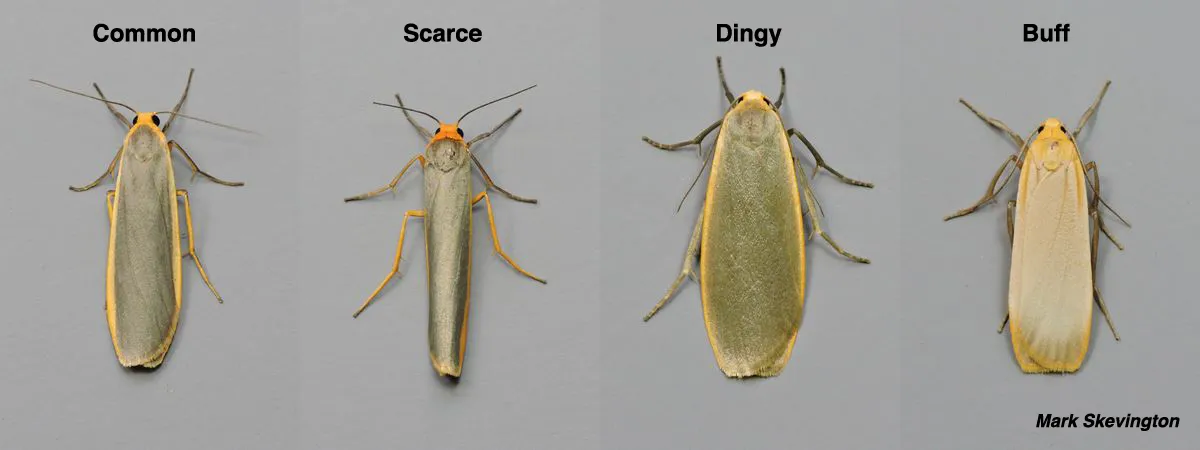
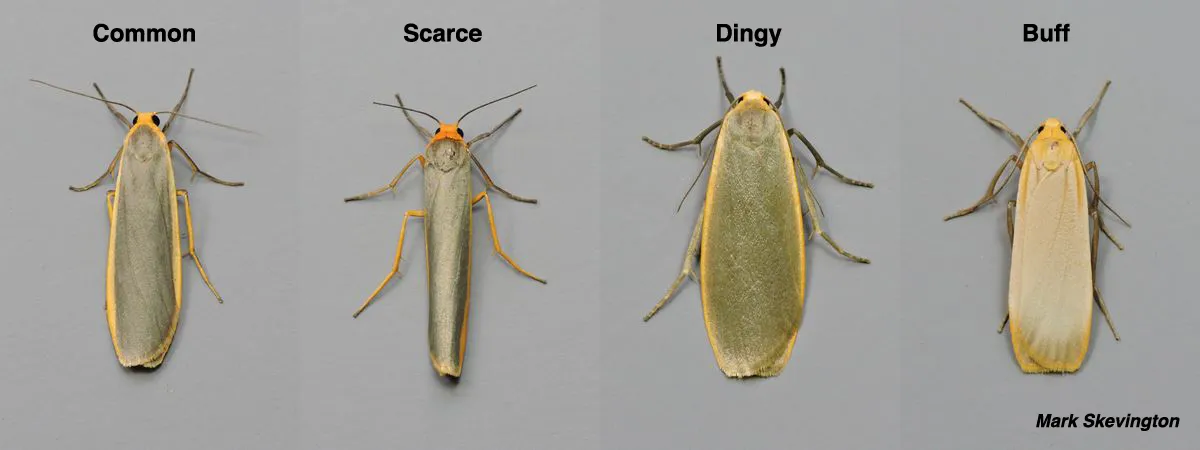
Wingspan 28-35 mm. Similar to the Common Footman ( E. Lurideola ) in appearance but holds its wings furled tightly around the body and presents a much slimmer outline than the flatter appearance of E. lurideola . Common Footman, Dingy Footman, Scarce
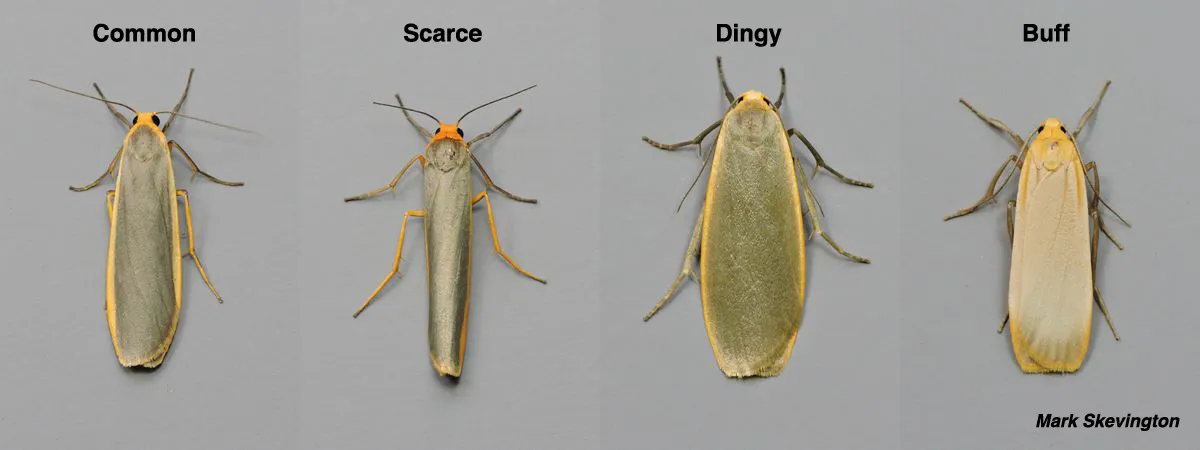
Buff Footman
Eilema depressa
Wingspan 28 to 36 mm. The male forewing is greyish white with a faint yellow stripe along the basal third of the leading edge. There is an orange yellow fringe on both wings. In the slightly larger female the forewing is usually brownish grey with a
Dingy Footman
Eilema griseola
Wingspan 32-40 mm. Several of the Eilema species can be difficult to tell apart, but this moth has broader, more rounded forewings than many of the others. It can be quite greyish, but a yellowish form, straminola , does occur in places. Common Footm
Common Footman
Eilema lurideola
Wingspan 28-35 mm. The forewings are greenish-grey, with a leading yellow stripe, tapering to a point at the tip. The wings are folded flat over the back when at rest. In flight, the yellow hindwings are noticeable, and it looks a much larger moth. C
Orange Footman
Eilema sororcula
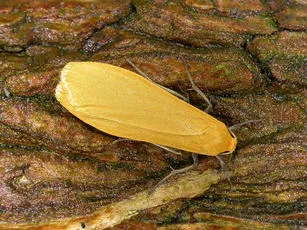
Wingspan 27 to 30 mm. Noticeably orange in colour. The single brood flies in May and June, when it can be attracted to light. The larvae live on lichens growing on the trunks of Oak and Beech trees. This moth is distributed in the southern half of Br
Epidromia lienaris - Hodges#8585
Epidromia lienaris
Identification: Lafontaine & Dickel describe the three know North American species in the genus Epidromia
Epidromia pannosa - Hodges#8585.2
Epidromia pannosa
Identification: Solis distinguishes Epidromia pannosa from E. fergusoni . Lafontaine & Dickel describe the three know North American species in the genus Epidromia
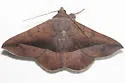
Epidromia rotundata - Hodges#8585.3
Epidromia rotundata
Identification: Adult: forewing brown with purplish tint (which may disappear with age); median area with large dark triangular patch in male (patch reduced or absent in female); patch begins near base of AM line, and extends to PM line near costa; r
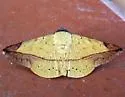
Epitausa coppryi - Hodges#8581.1
Epitausa coppryi
Identification: Specimen identified by DNA analysis (BOLD).
Epitausa prona - Hodges#8581
Epitausa prona
Brou stated "Apparently, the first record of this species in the United States was made by Andre Blanchard who captured one male in Welder Wildlife Refuge, San Patricio County, near Sinton, Texas on November 14, 1968."
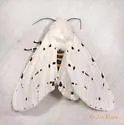
Estigmene albida - Hodges#8132
Estigmene albida
Identification: The original description as Leucarctia albida Stretch, is available online using the link in the print preferences below.
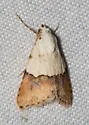
Euaontia semirufa - Hodges#8567
Euaontia semirufa
Identification: Barnes & McDunnough (1910) original description is online in the print references.
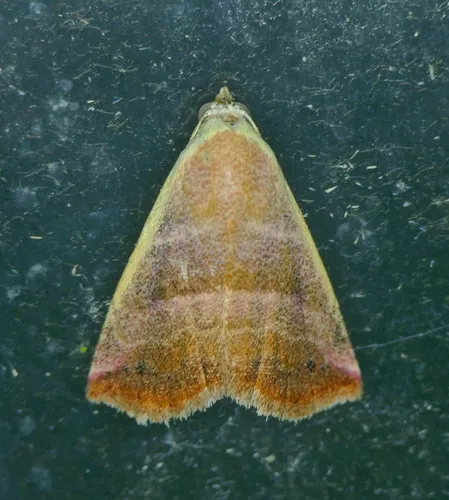
Eublemma cinnamomea - Hodges#9077
Eublemma cinnamomea
Identification: The revised description by Hampson (1910) is available online in the print references below.
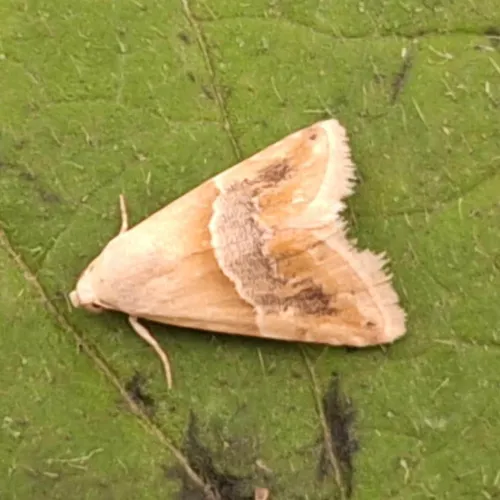
Small Marbled
Eublemma parva
Another migrant species which occasionally arrives along with the Purple Marbled in June and July, mostly in the south of England. Larvae are sometimes found in immigration years, these feeding on Common Fleabane and Ploughman's-spikenard. Occasional
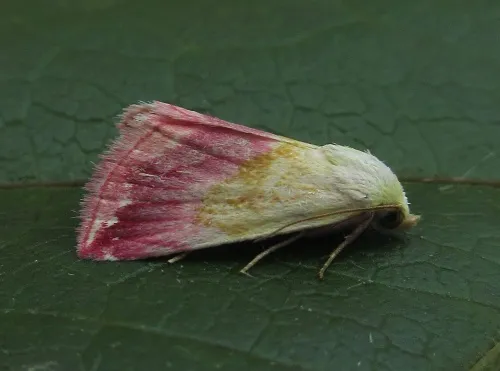
Beautiful Marbled
Eublemma purpurina
Wingspan 25 to 30 mm. A very beautiful and distinctive moth. Although distinctive in appearance, photographic evidence is requested to support records for this species due to its rarity in Britain at present. Dry grassland. It occurs in Britain as a
Eublemma recta - Hodges#9078
Eublemma recta
Identification: Adult: forewing light brown with dark brown straight PM line running diagonally from mid-way along inner margin to near apex, bordered distally by white; 3-6 black dots or flecks in subterminal area; subterminal line either reddish an
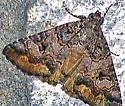
Eubolina Moth - Hodges#8720
Eubolina impartialis
Identification: Adult: forewing light gray with greenish tint; subterminal line black, wavy, diffuse, varying in width from thick to thin, bordered distally by brownish scales; PM line black, irregular, with large lobe-like jog in upper half; renifor
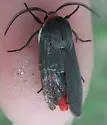
Euchaetes bolteri - Hodges#8241
Euchaetes bolteri
Identification: male......................female species page created based on this photograph identified by Ed Knudson, Texas Lepidoptera Survey
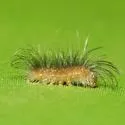
Elegant Tussock Moth - Hodges#8237
Euchaetes elegans
Identification: Adult - sexually dimorphic. In males the dorsal abdomen is entirely crimson while in females the last segment is white.
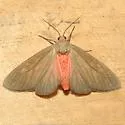
Euchaetes perlevis - Hodges#8233
Euchaetes perlevis
Identification: Adult - see original description in Print References. Euchaetes have been extensively studied by chemical ecologists and behaviorists for their use of courtship ultrasound.
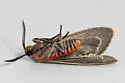
Euchaetes polingi - Hodges#8240
Euchaetes polingi
Identification: Adult description adapted from Cassino (1928). Forewing is dark gray with no markings; costa has a white edge. Hindwings are also dark gray but often slightly lighter. Underside of both wings a dark gray. Head is black, with a few
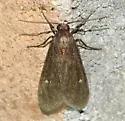
Euchaetes zella - Hodges#8232
Euchaetes zella
Identification: Larva - not unlike its cogeners. See Comstock & Dammers. Type locality: "Hot Springs", Arizona.
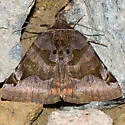
Euclidia ardita - Hodges#8732
Euclidia ardita
In flight Euclidia greatly resemble skippers of the genus Erynnis ; they flush from the ground and fly rapidly for 20 meters or so before dropping back to the ground (E.H. Strickland Entomological Museum)
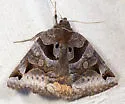
Toothed Somberwing - Hodges#8731
Euclidia cuspidea
Identification: Adult - forewing purplish-gray and brown with distinctive black PM triangle, basal and apical spots, and AM band; hindwing yellowish-brown with two blackish lines and basal shading. [description by Charles Covell] Larvae - slender and
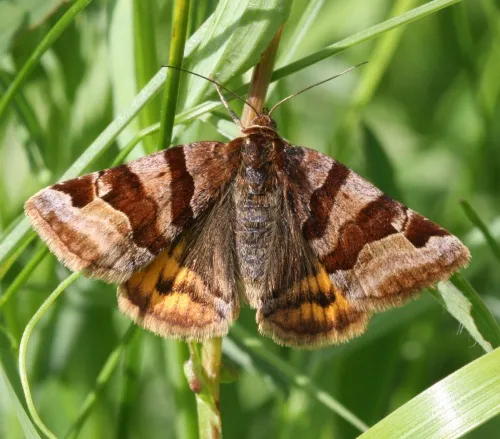
Burnet Companion
Euclidia glyphica
Wingspan 25-30 mm. Gets its English name from the fact that it is often found in company with Burnet Moths ( Zygaena spp). It inhabits open woodland, pastures, roadside verges and flower meadows. It is relatively common in the southern half of Britai
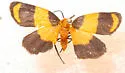
Arid Eudesmia - Hodges#8096
Eudesmia arida
Identification: Adult: forewing dark gray to blackish with broad transverse yellow band in median area, and narrow yellow band in subterminal area; subterminal band does not extend to costa or inner margin; hindwing blackish distally, yellow basally;
Eudesmia menea - Hodges#8097
Eudesmia menea
The basis for inclusion of Eudesmia menea in the North American fauna is tenuous. For a time in the first half of the 20th Century Eudesmia arida was synonymized (wrongly) under E. menea , thus the many records in AZ and TX were for a time listed un
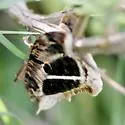
Eudocima apta - Hodges#8543
Eudocima apta
Identification: See MPG , (Brou 2006). Members of this genus are sexually dimorphic. Type Locality: Brazil
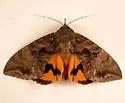
Eudocima serpentifera - Hodges#8543.1
Eudocima serpentifera
Brou (2006) reported the first United States record at UV light trap on October 25, 2006 at 4.2 mi NE of Abita Springs, Louisiana Pague & Brou (2013) reported the second United States record on September 13, 2013 at Medano Zapata Ranch/Inn, Alamosa C
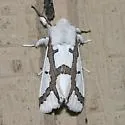
Red-tailed Specter - Hodges#8141
Euerythra phasma
Identification: Harvey original description is available online. Uncommon , rare in Florida .
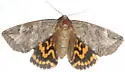
Locust Underwing - Hodges#8719
Euparthenos nubilis
Identification: The hindwing is deep yellow/orange with 4 wavy black bands. Adults are often attracted to light.
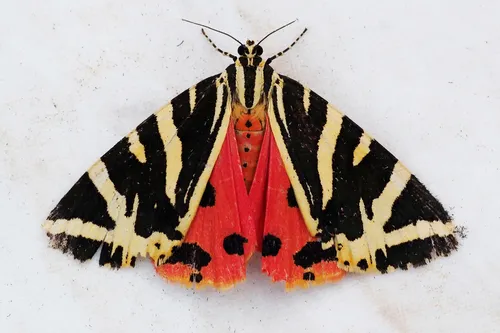
Jersey Tiger
Euplagia quadripunctaria
Euplagia quadripunctaria, the Jersey tiger, is a day-flying moth of the family Erebidae. The adult wingspan is 52–65 millimetres (2.0–2.6 in), and they fly from July to September, depending on the location. They tend to fly close to Eupatorium cannab
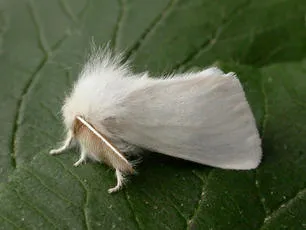
Brown-tail
Euproctis chrysorrhoea
Wingspan 36 to 42 mm. A plain white species when at rest, although the abdomen, as the name suggests, has a brown tuft of hairs which the female uses to cover the eggs with when they are laid. The brown colouration extends along most of the back of t
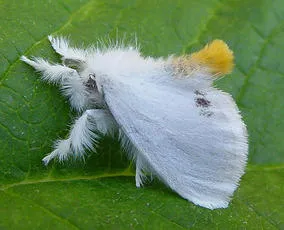
Yellow-tail
Euproctis similis
Wingspan 28-35 mm. The female is larger than the male and has a large tuft of yellow hairs at the tip of her abdomen, which is used to cover the newly-laid eggs. Occupies a number of habitats such as woodland, scrub and gardens. The caterpillars, in
Focillidia texana - Hodges#8730
Focillidia texana
Identification: The original description is available online in the print references listed below.
Forsebia Moth - Hodges#8613
Forsebia cinis
Identification: ♂ . . . . . . . . . . . . . . . .♀ - Notes distinguishing female Forsebia cinis from Allerastria albiciliatus by Jan Metlevski .
Gabara obscura - Hodges#8518
Gabara obscura
Identification: The original description as Scolecocampa obscura Grote is available at the link in the print references below. - Specimen identified by DNA analysis (BOLD). ( 5 )
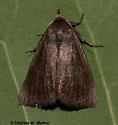
Gabara stygialis - Hodges#8520
Gabara stygialis
Identification: Specimen identified by DNA analysis (BOLD). ( 4 )