
Tamaulipan Lichen Moth - Hodges#8059
Cisthene subrufa
This record describes Cisthene subrufa (species). Recorded family: Erebidae. Recorded order: Lepidoptera.
Identification and Appearance
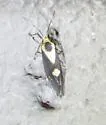
Identified by range and a combination of characters ( 4 ) : -- Pale creamy yellow rather than orange color areas. -- Basal streaks stop well short of the PM band; margins of the basal streaks are convex, resulting in an elliptical pale area surrounding the thoracic disk, like an avocado cut in half. -- Ground color is brownish gray. -- PM band flares out much wider on inner (dorsal) margin compared to costal margin. PM band usually complete but may be split into triangles on each margin; the one on the inner margin always larger than the costal one. -- Leg color is useful: Hind legs are usually all yellow; middle legs are banded yellow and gray, particularly the middle tibia on which the middle 1/3 is yellow, flanked by gray on each end. -- Small size (FW 5.5 to 7 mm). Previously confused with Schwarz's Lichen Moth of AZ, but the ranges of the two are well separated. Previous reports of the species in AZ (e.g. MPG, Wikipedia) were based on that species.
Classification
- Kingdom
- Animalia
- Phylum
- Arthropoda
- Class
- Insecta
- Order
- Lepidoptera (Butterflies and Moths)
- Superfamily
- Noctuoidea
- Family
- Erebidae
- Subfamily
- Arctiinae
- Tribe
- Lithosiini
- Genus
- Cisthene
Imported taxonomy record. Source availability varies; see the source references and editorial policy below.
Habitat and Range
Habitat
Subtropical Thorn Woodland in south Texas.
Geographic Range
Originally described from Cameron Co., TX. Now documented uncommonly north to Bastrop, Travis, and Edwards counties in Texas. Occurs south into Mexico at least as far as e. San Luis Potosi (iNaturalist) .
Diet and Behavior
Diet: Wagner et al. (2008) collected larvae from Psychia lichens on Texas Ebony ( Ebenopsis ebano ).
About Butterflies and Moths: the wider group
Order-level background for Lepidoptera, the group containing Cisthene subrufa. Species-specific details appear above.
Group overview
Lepidoptera includes approximately 180,000 described species of butterflies and moths. Moths outnumber butterflies roughly 10:1. The monarch butterfly's eastern population has declined by more than 80% since the mid-1990s, and the western population by over 95% since the 1980s. The IUCN lists the migratory monarch as Vulnerable.
Ecological role of the group
Butterflies and moths are essential indicators of ecosystem health. As caterpillars, they are a primary food source for birds - a single nest of blue tit chicks requires ~10,000 caterpillars. Adult moths pollinate many night-blooming plants.
Economic and practical significance of the group
Lepidoptera are critical pollinators. In Europe, grassland butterfly species have declined by almost 50% since the early 1990s. In the UK, three-quarters of butterflies are in decline. In the U.S., five butterfly species have gone extinct since 1950, with 29 listed as endangered.
Recorded sources for this group: IUCN Red List, Xerces Society, USFWS, PNAS, WWF. Imported estimates may describe particular regions or reporting periods.
Photos of Tamaulipan Lichen Moth - Hodges#8059 (5)
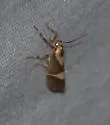
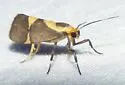
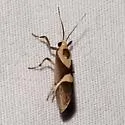
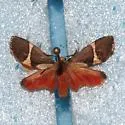
Photo credits: Contributed by Maury J. Heiman; Additional contributions by Chuck Sexton , Randy Hardy
Frequently Asked Questions About Tamaulipan Lichen Moth - Hodges#8059
What is Tamaulipan Lichen Moth - Hodges#8059?
Tamaulipan Lichen Moth - Hodges#8059 (Cisthene subrufa) is a species in the family Erebidae, within the order Lepidoptera.
How big is Tamaulipan Lichen Moth - Hodges#8059?
Wingspan about 13-16 mm ( 3 ) ; FW length 5.5 to 7 mm ( 4 ) .
How do you identify Tamaulipan Lichen Moth - Hodges#8059?
Identified by range and a combination of characters ( 4 ) : -- Pale creamy yellow rather than orange color areas. -- Basal streaks stop well short of the PM band; margins of the basal streaks are convex, resulting in an elliptical pale area surrounding the thoracic disk, like an avocado cut in half. -- Ground color is brownish gray. -- PM band flares out much wider on inner (dorsal) margin compared to costal margin. PM band usually complete but may be split into triangles on each margin; the one on the inner margin always larger than the costal one. -- Leg color is useful: Hind legs are usually all yellow; middle legs are banded yellow and gray, particularly the middle tibia on which the middle 1/3 is yellow, flanked by gray on each end. -- Small size (FW 5.5 to 7 mm).
Where is Tamaulipan Lichen Moth - Hodges#8059 found?
| Feature | Details |
|---|---|
| Habitat | Subtropical Thorn Woodland in south Texas. |
| Range | Originally described from Cameron Co., TX. Now documented uncommonly north to Bastrop, Travis, and Edwards counties in Texas. Occurs south into Mexico at least as far as e. San Luis Potosi (iNaturalist) . |
What does Tamaulipan Lichen Moth - Hodges#8059 eat?
The diet of the Tamaulipan Lichen Moth - Hodges#8059 includes Wagner et al. (2008) collected larvae from Psychia lichens on Texas Ebony ( Ebenopsis ebano )..