
Family Crambid Snout Moths (Crambidae)
Crambidae is a family in the order Lepidoptera. Browse 788 named species recorded in this family, or open an individual profile for its available identification and natural-history information.
Species in Crambidae (788)
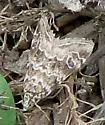
Hellula rogatalis - Hodges#4846
Hellula rogatalis
Identification: Adult - FW brownish-yellow or grayish-yellow with wavy white AM, median, and PM lines; reniform spot smoothly-rounded, oval or kidney-shaped; ST composed of several equally-spaced black dots some distance from outer margin; HW light g
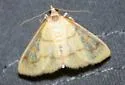
Helvibotys helvialis - Hodges#4980
Helvibotys helvialis
Identification: Adult: forewing variably yellowish, orangish, or tan with brown AM and PM lines; AM line a smooth shallow arc, almost straight; PM line a smooth shallow S-shaped curve; two discal spots in median area near costa are same color as AM a
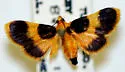
Helvibotys pucilla - Hodges#4984
Helvibotys pucilla
Identification: Adult: forewing black in basal quarter/third and distal half, leaving broad yellow band in median area; hindwing yellow except for broad black terminal band; fringe yellow on all wings; antennae white from tip to beyond middle, then b
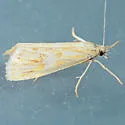
Hemiplatytes epia - Hodges#5507
Hemiplatytes epia
Identification: Sexually dimorphic. Forewing of female is whitish with a trace of brown markings. Hindwing white. Forewing of male is dark brown with black hindwing.
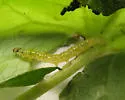
Serpentine Webworm - Hodges#5280
Herpetogramma aeglealis
Identification: Adults are sexually dimorphic. The HW of the males are dirty white with dark-grey shading on the discal spot, wing veins, subterminal area and an irregular but contrasting PM. Females have a golden hue. There are two forms, the typica
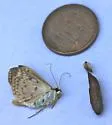
Herpetogramma aquilonalis - Hodges#5277.1
Herpetogramma aquilonalis
Identification: From the key to Canadian species of Herpetogramma - Terminal line of hindwing barely marked, usually represented by dark dots on wing veins.
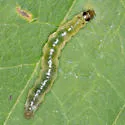
Greater Sweet Potato Webworm Moth - Hodges#5244
Herpetogramma fluctuosalis
Identification: Similar to H. bipunctalis , but lacks the 2 dark brown spots on the second sternite of the abdomen. ( 3 ) Specimen identified by DNA analysis (BOLD). ( 4 )
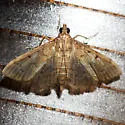
Dusky Herpetogramma - Hodges#5274
Herpetogramma phaeopteralis
Identification: Adult: forewing medium to dark grayish-brown with blackish AM and PM lines; PM line toothed, sinuous; two dark spots in median area, the outer one larger; hindwing with similar pattern but slightly paler; fringe dark on all wings Larv
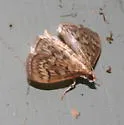
Zigzag Herpetogramma - Hodges#5277
Herpetogramma thestealis
Identification: "Forewing with high contrast between dark brown or beige marginal shade and basal areas" (Solis, 2010) , but see update in Handfield & Handfield .
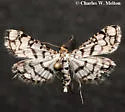
Hileithia aplicalis - Hodges#5188
Hileithia aplicalis
Blepharomastix magualis, aplicalis, rehamalis , and differentialis were transferred to Hileithia in Munroe (1995a).
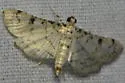
Hileithia differentialis - Hodges#5190
Hileithia differentialis
Identification: Determined by Jim Vargo. Blepharomastix magualis, aplicalis, rehamalis , and differentialis were transferred to Hileithia in Munroe (1995a).
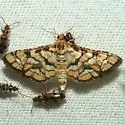
Hileithia magualis - Hodges#5187
Hileithia magualis
Blepharomastix magualis, aplicalis, rehamalis , and differentialis were transferred to Hileithia in Munroe (1995a).
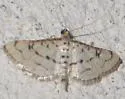
Hileithia rehamalis - Hodges#5189
Hileithia rehamalis
Identification: Adult: wings white with irregular black lines; top of head yellow; top of thorax and abdomen white with black spots Blepharomastix magualis, aplicalis, rehamalis , and differentialis were transferred to Hileithia in Munroe (1995a).
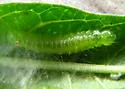
Hodebertia testalis - Hodges#5199.6
Hodebertia testalis
Hodebertia testalis (Fabricius, 1794) is now recognized from Florida and Texas in Hayden & Minno (2016), News Lepid. Soc., 58(4): 166-170.
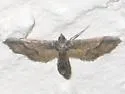
Ornate Hydriris Moth - Hodges#5127
Hydriris ornatalis
Identification: Adult: forewing brownish-gray in basal area and beyond PM line; median area yellowish with shiny metallic orbicular and reniform spots; PM line black, thick, slightly wavy; diffuse blackish subapical streak extends from PM line to out
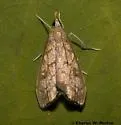
Hydropionea fenestralis - Hodges#5125
Hydropionea fenestralis
Identification: Hindwing is glossy white with a rust colored line along the base of the fringe. Specimen identified by DNA analysis (BOLD).
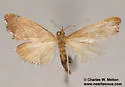
Hydropionea oblectalis - Hodges#5124
Hydropionea oblectalis
Identification: Det. James Hayden of the McGuire Center for Lepidoptera in Florida
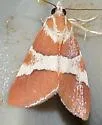
Jativa castanealis - Hodges#4827
Jativa castanealis
Identification: Adult - forewing orangish-brown with broad white median band, splitting into a Y shape at the costa; oblique white band near base; hindwing slightly paler with wavy grayish median line; top of head white.
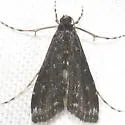
Black Langessa Moth - Hodges#4758
Langessa nomophilalis
Identification: The original description as Nymphula nomophilalis Dyar, is available online at the link in the print references below. - Determined by Bob Patterson.
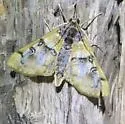
Laniifera cyclades - Hodges#5236
Laniifera cyclades
Considered a pest of the commercial production of Opuntia prickly pear cactus or nopal.
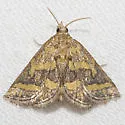
Leptosteges flavifascialis - Hodges#5302
Leptosteges flavifascialis
Identification: Adult: forewing white with golden-brown discal patch between two similarly-colored bands crossing wing; strip of same color along basal half of costa, and another strip from subterminal band to center of outer margin; terminal line br
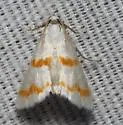
Leptosteges xantholeucalis - Hodges#5300
Leptosteges xantholeucalis
Identification: Rough Google translation: "14mm. Forewings, triangular, acute apex, right side: the hind wings narrow, undeveloped and acute, triangular; the four of pure white, silky, with a vague border, ochraceous. Forewings having two strips of a
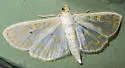
Leucochroma corope - Hodges#5210
Leucochroma corope
In 1959 the United States Department of Agriculture reported Leucochroma corope was intercepted in Florida. Transported by airplane from from Panama.
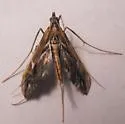
Lineodes elcodes - Hodges#5109.1
Lineodes elcodes
Identification: The original description as Ciraphorus elcodes Dyar, is available in PDF or online in the print references below. Determined by Jerry Powell Introduced species that is considered a pest.
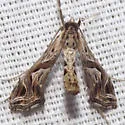
Eggplant Leafroller - Hodges#5107
Lineodes integra
Identification: Adult - forewing light brown, long and slender with pointed apex; dark brown arc begins at inner margin about one-third distance from base, and ends in subterminal area; white-outlined dark brown semicircular patch along costa near ap
Lineodes triangulalis - Hodges#5109
Lineodes triangulalis
Lineodes triangulalis - Hodges#5109 (Lineodes triangulalis) is a species in the family Crambidae, commonly known as crambid snout moths, belonging to the order Lepidoptera (Butterflies and Moths). It is classified within the subfamily Spilomelinae, t
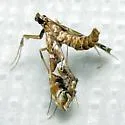
Lineodes vulnifica - Hodges#5109.3
Lineodes vulnifica
Identification: See Hayden et al., species page at idtools.org This species has beed confused with Lineodes triangulalis in collections including the USNM collection where the lectotypes are kept, possibly the source of the confusion - paraphrased fr
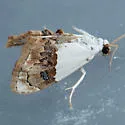
Lipocosma albinibasalis - Hodges#4886
Lipocosma albinibasalis
Identification: Adult - white proximal half of forewing sharply divided from mostly dark brownish-gray distal half.
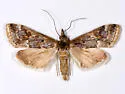
Loxostege allectalis - Hodges#5000
Loxostege allectalis
Identification: Adult: forewing a mixture of speckled gray and brown patches and dark brownish irregular spots in median area; PM line irregular, meandering; terminal line a series of dark dashes; hindwing brownish-gray with pale fringe.
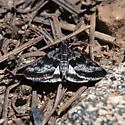
Loxostege anartalis - Hodges#5010
Loxostege anartalis
Subspecies: Loxostege anartalis anartalis (California) Loxostege anartalis albertalis Barnes & McDunnough, 1918 (Manitoba west to the southern interior of British Columbia, north to the Northwest Territories and Alaska) Loxostege anartalis lulualis (
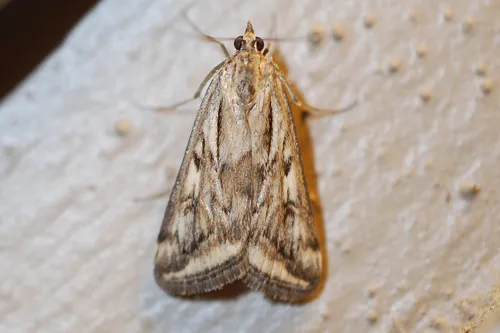
Alfalfa Webworm - Hodges#5017
Loxostege cereralis
Identification: Adult: forewing whitish or pale gray with several longitudinal black and brown streaks; whitish or pale yellow patch in median area near costa; subterminal area yellow, shaped liked an almost-flat triangle; fringe dark brownish-gray;
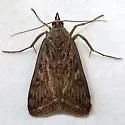
Loxostege commixtalis - Hodges#5016
Loxostege commixtalis
Loxostege commixtalis - Hodges#5016 (Loxostege commixtalis) is a species in the family Crambidae, commonly known as crambid snout moths, belonging to the order Lepidoptera (Butterflies and Moths). It is classified within the subfamily Pyraustinae, tr
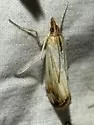
Loxostege egregialis - Hodges#5003
Loxostege egregialis
Identification: Description can be found in MONA Fascicle 13-2A at link in citations below.
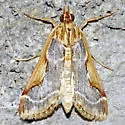
Christmas-berry webworm moth - Hodges#4994
Loxostege floridalis
The four specimens from FL and three from TX and NM in the BOLD BIN for this species ( BOLD:AAH5264 ) form two narrowly divergent clades (~0.5%). The one specimen from NM was identified by Munroe.
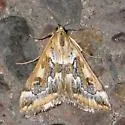
Loxostege lepidalis - Hodges#4995
Loxostege lepidalis
Identification: Adult - forewing a patchy mixture of white, black, and light yellowish-brown forming a distinctive pattern; terminal line a series of dark dashes; hindwing gray with partial whitish median band and yellowish-brown terminal band; fring
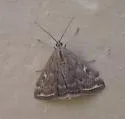
Beet Webworm Moth - Hodges#5004
Loxostege munroealis
Identification: Adult: forewing fringe scales black, contrasting with thin yellowish band along outer margin; ground color yellowish-brown with patchwork pattern of light and dark blotches; PM line very wavy, with a pale area distal to the line where
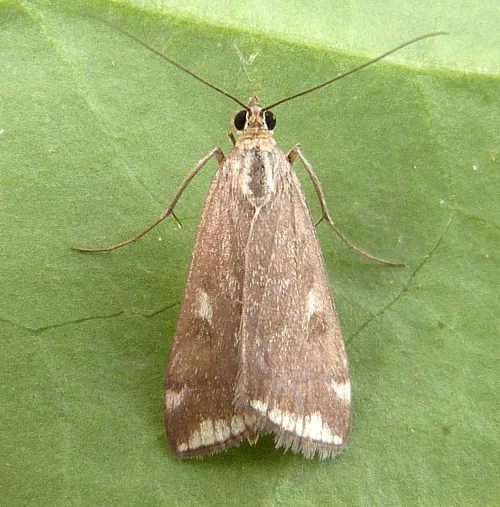
Loxostege sticticalis
Loxostege sticticalis
Photograph required please to support records. Typically arriving in late summer or early autumn. The larval foodplants are Mugwort ( Artemisia vulgaris ) and Field Wormwood ( A. campestris ). Although suspected as a resident in the Breckland distric
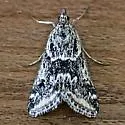
Loxostege terpnalis - Hodges#4998
Loxostege terpnalis
Identification: plain gray forewing without basal brownish area, small orbicular and reniform spots, hindwing brownish
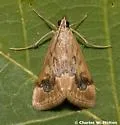
Loxostege typhonalis - Hodges#5001
Loxostege typhonalis
Identification: The original description is available online in the print references below.
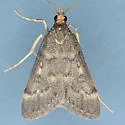
Loxostegopsis xanthocrypta - Hodges#5116
Loxostegopsis xanthocrypta
Identification: The original description as Pyrausta xanthocrypta Dyar, is available in PDF or view online in the print references below. Genitalia: Throughout the range Loxostegopsis xanthocrypta may possibly refer to two species.
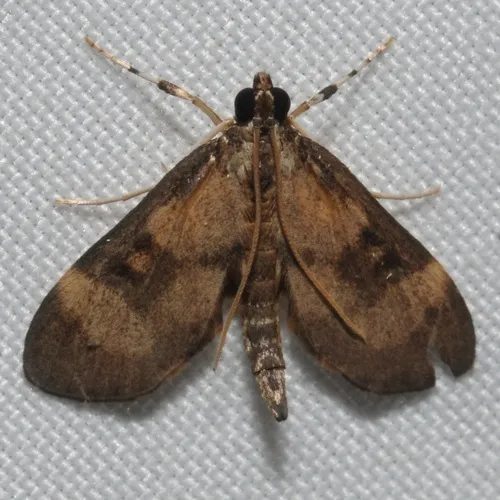
Lygropia fusalis - Hodges#5192
Lygropia fusalis
This species was mistakely placed in Lypotigris on BugGuide and MPG previously. This species is listed as Lygropia fusalis in Scholtens and Solis. They list the only Lypotigris species in our area to be Lypotigris reginalis . Dr. Scholtens says that
Bog Lygropia - Hodges#5250
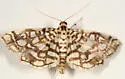
Lygropia rivulalis
Identification: forewing ground color pale yellowish or cream; several irregular white patches are surrounded and connected by thick brown lines; the white patch nearest the anal angle is oval or circular; a broad white subterminal line becomes wider
Sweetpotato leafroller - Hodges#5248
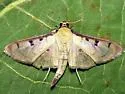
Lygropia tripunctata
Identification: Description summary: Wings light yellowish and iridescent. Dark grayish-brown band along the costa that continues along the outer margin of both forewing and hindwing, being widest at the apex. Two black spots along the costa with the
Marasmia cochrusalis - Hodges#5289
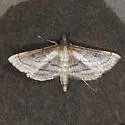
Marasmia cochrusalis
Identification: FW middle portion of st. line or shade is narrowly separated from the pm. line. The HW pm. and st. lines tend to be more narrowly separated than in trapezalis with pm. line bending more toward the apex. The HW pm. line tends to align
Trapeze Moth - Hodges#5288
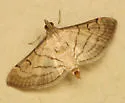
Marasmia trapezalis
Identification: FW middle portion of st. line or shade is more widely separated from the pm. line than in cochrusalis . The HW pm. and st. lines of cochrusalis tend to be more narrowly separated with pm. line bending more toward the apex. The HW pm.
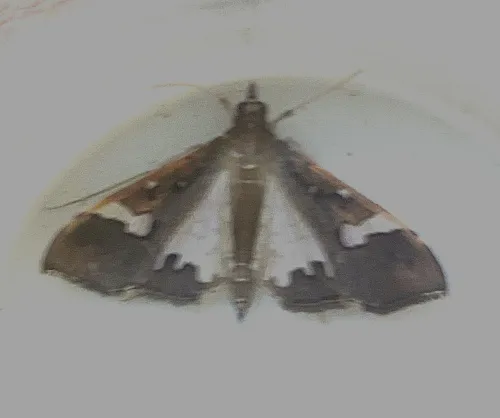
Mung Moth
Maruca vitrata
Wingspan 28 to 34 mm. A distinctive species. A rare species in VC55. Please provide a photograph and retain moth until identification is confirmed. A very rare vagrant or adventive species, possibly imported from the Tropics in leguminous vegetables.
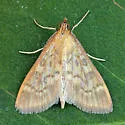
Orange-toned Mecyna - Hodges#5135
Mecyna submedialis
Identification: Adult: forewing light orangish-yellow with jagged brown AM and PM lines; reniform spot a short horizontal brown bar; orbicular spot small and solid brown; area between reniform spot and AM line clear yellow, surrounded by orangish-bro
Mesolia huachucaella - Hodges#5330
Mesolia huachucaella
Identification: "This species is unlike any of our Mesolia-Prionapteryx group in the decided grayer hue of the fore wings; all the other species have a superficially ochreous or ochreous-brown tinge, and it can be easily separated by this character..
Microcrambus copelandi - Hodges#5418
Microcrambus copelandi
Microcrambus copelandi - Hodges#5418 (Microcrambus copelandi) is a species in the family Crambidae, commonly known as crambid snout moths, belonging to the order Lepidoptera (Butterflies and Moths). It is classified within the subfamily Crambinae, tr
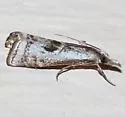
Microcrambus croesus - Hodges#5426
Microcrambus croesus
Identification: The FWs are mostly silvery white with a dark brown curved patch on the dorsum, dark brown along the costal margin, and an oblique dark streak off the costa in the postmedian area. The subterminal line consists of a pair of (usually)
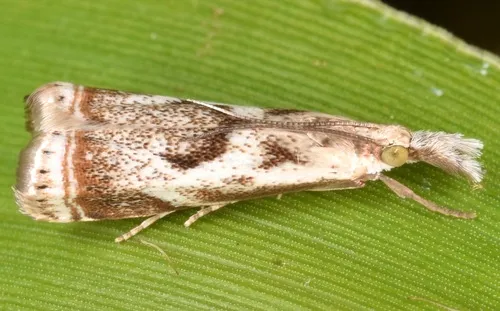
Elegant Grass-veneer
Microcrambus elegans
Microcrambus elegans, the elegant grass-veneer moth, is a moth of the Crambidae family. It is found from Ontario, Quebec and Maine to Florida, west to Texas, north to Kansas and Illinois.
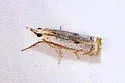
Microcrambus polingi - Hodges#5421
Microcrambus polingi
Identification: Adult : Ground color dull whitish, almost always heavily dusted with dark scales. PM and ST lines dark and infuscated, often obscured by dark dusting and clouding. Terminal line, thin, dark and distinct. Kearfott's Mexican specimens w
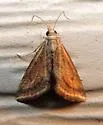
Yellow-veined Moth - Hodges#4796
Microtheoris ophionalis
Identification: Powell & Opler (2009) states "The wing colors vary from dark ochreous brown or rust brown with well-defined subterminal line, to pale tan with brown subterminal lines, and spring moths are darker than summer individual." ( 3 ) Adults
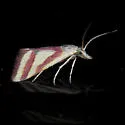
Whip-marked Snout Moth - Hodges#4795
Microtheoris vibicalis
Identification: Adult: forewing white or cream-colored with broad maroon AM and PM lines; AM line oblique, almost parallel to costa; PM line parallel to outer margin; fringe and strip along inner margin maroon; hindwing gray with long fringe of hairl
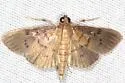
Microthyris lelex - Hodges#5264.1
Microthyris lelex
Identification: Description by Hayden & Dickel can be found at link in citations below.
Microthyris prolongalis - Hodges#5264
Microthyris prolongalis
Identification: The hyaline spot is much larger in the females. Specimen identified by DNA analysis (BOLD). ( 3 ) Holotype ♂ collected in Brazil.
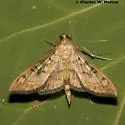
Mimorista subcostalis - Hodges#5139
Mimorista subcostalis
Identification: "Distinctive" forewing pattern with the California specimens being smaller and less colorful. ( 3 ) Mimorista trimaculalis from Texas is similar; in need of distinguishing information. In his 1913 description of subcostalis , Hampson
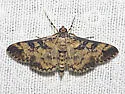
Mimorista tristigmalis - Hodges#5141
Mimorista tristigmalis
Identification: The original description as Pilocrocis tristigmalis Hampson is available online in the print references below. Type locality: USA, Florida
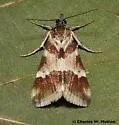
Rufous-banded Crambid - Hodges#4826
Mimoschinia rufofascialis
Identification: Larva - strikingly beautiful. General body color is white, front half wine-red with partial bands of that color posteriorly. Rather like a barberpole, as its commom name suggests. Head is light yellow (adapted from Heinrich, 1921). La
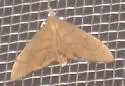
Munroeodes thalesalis - Hodges#4934
Munroeodes thalesalis
Identification: This species was identified by James McDermott.
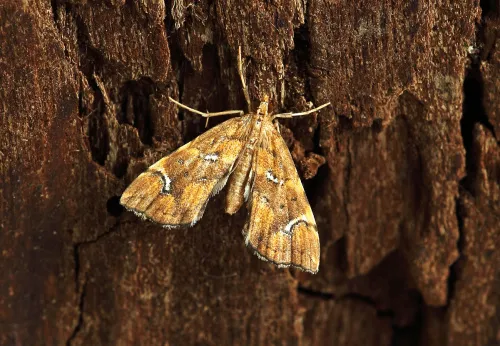
Musotima nitidalis
Musotima nitidalis
This species has a multi shaded brown forewing with white marks and is quite distinctive. Because this species is still rare in our area a photograph is required to support your record. Most records in Britain are from the period May to November. Thi
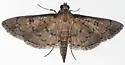
Nacoleia charesalis - Hodges#5178.5
Nacoleia charesalis
Identification: Adult : Color is brown with dark, grayish brown lines, distinctive only by dint of its extreme dullness. Labial palpi are upturned and uniformly colored. FW lines are sharply defined and fairly smooth. The PM is “B”-shaped (the curve
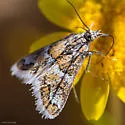
Nannobotys commortalis - Hodges#4822
Nannobotys commortalis
Identification: Specimen identified by DNA analysis (BOLD). ( 6 ) Powell & Opler (2009) reported the adults are diurnal , and common at flowers in March and April. ( 5 )
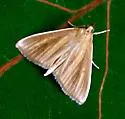
Streaked Orange - Hodges#4937
Nascia acutellus
Identification: Adult: forewing light yellow to orange or brownish with dark brown longitudinal streaks along veins hindwing pale yellowish with whitish or pale gray shading
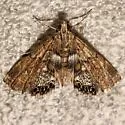
Dimorphic Leafcutter Moth - Hodges#4769
Neargyractis slossonalis
Identification: The single species is distinguished from other members of the Acentropinae tribe by the dark brown forewing which has a distinctly paler AM band.
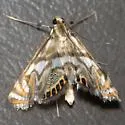
Scrollwork Pyralid Moth - Hodges#4743
Neocataclysta magnificalis
Identification: Hindwing has a yellow band along the outer margin with six black spots. Five of the spots have a blue center dot. ( 3 )
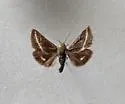
Neocymbopteryx heitzmani - Hodges#4806
Neocymbopteryx heitzmani
Known only from the type specimen, a male. From the species description: "Although the only known specimen was taken at "black light," the reduced eyes suggest that the species is adapted to daylight activity."
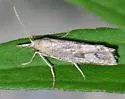
Black Grass-veneer - Hodges#5381
Neodactria caliginosellus
Identification: Adult: forewing dark brown to blackish with inconspicuous black PM and subterminal lines; ST line is irregularly jagged with small teeth - a distinctive feature; hindwing dark grayish-brown with pale yellowish fringe Larva: body pale
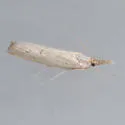
Neodactria murellus - Hodges#5382
Neodactria murellus
Identification: Specimen identified by DNA analysis (BOLD).
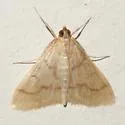
Neohelvibotys polingi - Hodges#4979
Neohelvibotys polingi
Identification: Capps described the adult, including the genitalia.
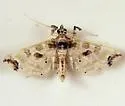
Neoleucinodes prophetica - Hodges#5102
Neoleucinodes prophetica
Neoleucinodes prophetica - Hodges#5102 (Neoleucinodes prophetica) is a species in the family Crambidae, commonly known as crambid snout moths, belonging to the order Lepidoptera (Butterflies and Moths). It is classified within the subfamily Spilomeli
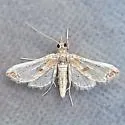
Neoleucinodes torvis - Hodges#5102.1
Neoleucinodes torvis
Identification: Description by Hayden & Dickel can be found at link in citations below.
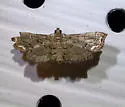
Lygodium Defoliator Moth - Hodges#4896.5
Neomusotima conspurcatalis
Introduced to FL in 2008 as biological control agent for the Old World, or Asian, Climbing Fern, Lygodium microphyllum .
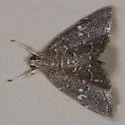
Kidney Moth - Hodges#4857
Nephrogramma reniculalis
Identification: Adult: forewing dark brownish-gray with white reniform spot, noticeably curved or bent in middle; AM line pale, scalloped, indistinct; PM line pale, indistinct, curving around reniform spot and terminating in small wedge at costa; hin
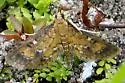
Water Hyacinth Moth - Hodges#5149
Niphograpta albiguttalis
Identification: Adult: forewing golden yellow speckled with gray, and with gray and blackish shading beyond PM line and in strip along costa; PM line sharply and deeply indented near inner margin, and with conspicuous white spots along its length; di
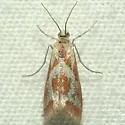
Noctueliopsis aridalis - Hodges#4834
Noctueliopsis aridalis
Type locality: USA, California, Imperial Co., Dixieland
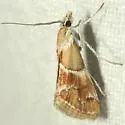
Noctueliopsis bububattalis - Hodges#4837
Noctueliopsis bububattalis
Noctueliopsis bububattalis - Hodges#4837 (Noctueliopsis bububattalis) is a species in the family Crambidae, commonly known as crambid snout moths, belonging to the order Lepidoptera (Butterflies and Moths). It is classified within the subfamily Odont
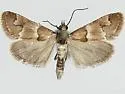
Noctueliopsis palmalis - Hodges#4832
Noctueliopsis palmalis
Identification: The brown forewings have a reddish tinge. Type locality: USA, California, Riverside Co., Palm Springs
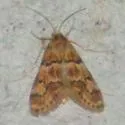
Noctueliopsis puertalis - Hodges#4831
Noctueliopsis puertalis
Identification: Described by Munroe in MONA Fascicle 13-1B as resembling Noctueliposis brunnealis but smaller (FW length 6-8 mm); maculation of FW less contrasting; AM/PM lines and discocellular lunule much weaker or even obsolete; PM line less stron
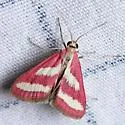
Noctueliopsis rhodoxanthinalis - Hodges#4836
Noctueliopsis rhodoxanthinalis
Identification: Forewing above bright pink. A contrasting, inwardly oblique, straight, yellow antemedial band, extending from R to basal part of posterior margin. A similar, somewhat less strongly inwardly oblique, postmedial band from R, to posterio
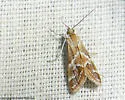
Noctueliopsis virula - Hodges#4838
Noctueliopsis virula
Identification: The original description as Noctuelia virula Barnes & McDunnough is available online in the print references below.
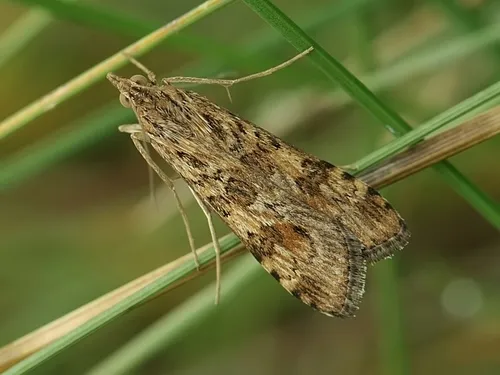
Rush Veneer
Nomophila noctuella
Wingspan 26-32 mm. When at rest, this moth has a very elongated and narrow shape, which makes it easily recognisable. A well-known migrant, it can often be found in large numbers at coastal watch-points but can also be found inland. Tends to occur in
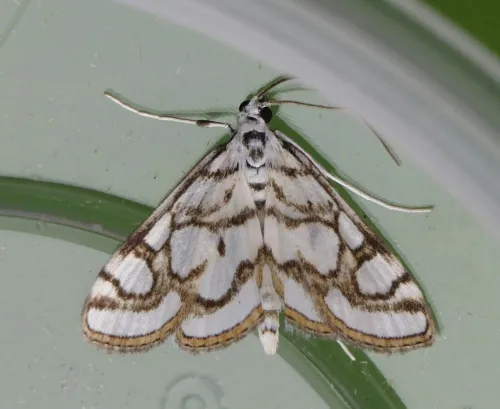
Beautiful China-mark
Nymphula nitidulata
Wingspan 18-22 mm. One of the more distinctive and beautiful members of the Pyralidae. On the wing during July and August. It flies in the evening and at night, and comes readily to light. Larvae are aquatic, feeding on Bur-reed and other water plant
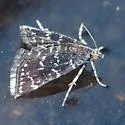
China Mark Moth - Hodges#4753
Nymphuliella daeckealis
Identification: The original description as Nymphula broweri Heinrich, is available in the print references below.
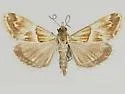
Odontivalvia radialis - Hodges#4829
Odontivalvia radialis
Type locality: USA, Texas, Big Bend NP, Chihuahuan Desert near Nugent Mt
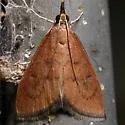
Oenobotys texanalis - Hodges#4941
Oenobotys texanalis
Identification: From Munroe & Blanchard's original description : Similar in general appearance to O. vinotinctalis , but larger (FW 9 mm); FW wider, with apex sharper and termen less strongly convex; transverse lines of FW finer and less blurred; bot
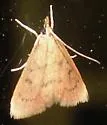
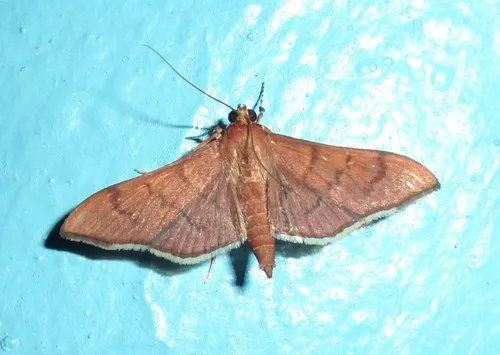
Wine-tinted Oenobotys - Hodges#4940
Oenobotys vinotinctalis
Identification: Adult: forewing color varies from brownish-red to yellowish-red to pinkish-red with black AM and PM lines and two black discal spots, the inner one smaller and fainter than the outer one; median area may or may not be slightly darker
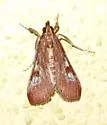
Omiodes martyralis - Hodges#5214.1
Omiodes martyralis
Identification: "100. Coenostola martyralis. 28 mm. Dusty reddish brown, the fringes on the forewings from the middle to the inner angle, whitish on the back. Both blemishes small, dull gray-brown; across the round a dusty brown, slightly curved tran
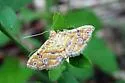
Omiodes stigmosalis - Hodges#5214
Omiodes stigmosalis
Identification: Warren (1892) original description as Tholeria stigmosalis is available online in the print references.
Orange Silver-Spot - Hodges#5294
Ommatospila narcaeusalis
Identification: This distinctive species is unlikely to be confused with others. Det. M. J. Heiman, 2008
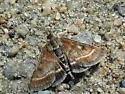
Ostrinia marginalis - Hodges#4948
Ostrinia marginalis
Identification: Ferruginous. Body beneath and legs silvery white. Palpi porrect, smooth, broad, white beneath, nearly as long as the breadth of the head; third joint acute, minute. Abdomen cinereous. Legs smooth, slender. Wings rather broad, with a c
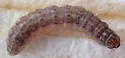
Smartweed Borer - Hodges#4947
Ostrinia obumbratalis
Identification: Specimen identified by DNA analysis: Genitalia:
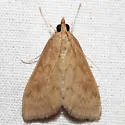
American Lotus Borer - Hodges#4946
Ostrinia penitalis
Identification: Adult: forewing orangish to light brown with zigzag AM line and jagged PM line that includes a large projecting "tooth" near the inner margin; ST line jagged and more diffuse than PM line; outer part of median area with dark diffuse b
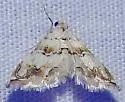
Oxyelophila callista - Hodges#4788
Oxyelophila callista
Identification: Original description is online as Argyractis callista in Forbes 1922, p. 102 . Forewing strongly falcate ; much of forewing white; PM line makes a deep graceful outward loop off of costa, then recurves to inner margin. Abdomen has bl
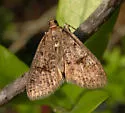
Palpita arsaltealis - Hodges#5222
Palpita arsaltealis
Identification: Adult: forewing light grayish-brown with heavy dark speckling; irregular dark patches in median and basal areas; hindwing similar but lacks large dark patches page creation based on Brian Scholtens' identification of images here and h
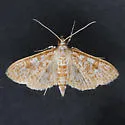
Freeman's Palpita Moth - Hodges#5225
Palpita freemanalis
Identification: This species has two rather sharply distinct forms. In one the ground color is gray and the dark markings fuscous; in the other the ground color is white and the dark markings bright orange. Intermediate forms sometimes occur. The gra
Kimball's Palpita Moth - Hodges#5219
Palpita kimballi
Identification: Adult : Semi-translucent satin white FW, with narrow orange streak along costa Type locality: USA, Florida, Englewood
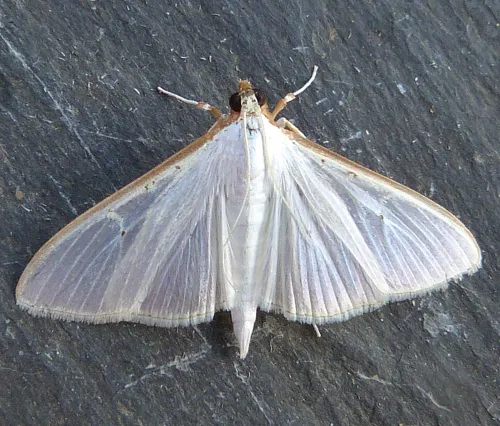
Palpita vitrealis
Palpita vitrealis
Wingspan 27 to 31 mm. The wings are translucent with a slight sheen and an orange or brown leading edge. As an immigrant to Britain it is often found near to the coast. Autumn is the most likely period to encounter this species. Abroad, the species f
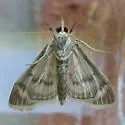
Paracorsia repandalis - Hodges#4992.5
Paracorsia repandalis
Paracorsia repandalis is here reported for the first time in the United States from Indiana by Jim Vargo. Specimens at the FMNH (Florida Museum of Natural History): Mishawaka, 41°37’46.2”N -86°08’13.9”, St. Joseph Co. on 11 Aug 2010 and again on 14 A
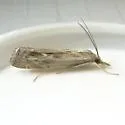
Parapediasia hulstellus - Hodges#5386
Parapediasia hulstellus
Identification: See Fernald, 1885 in Print References below Identified by Jim Vargo: