
Water Hyacinth Moth - Hodges#5149
Niphograpta albiguttalis
This record describes Niphograpta albiguttalis (species). Recorded family: Crambidae. Recorded order: Lepidoptera.
Identification and Appearance
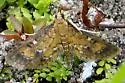
Adult: forewing golden yellow speckled with gray, and with gray and blackish shading beyond PM line and in strip along costa; PM line sharply and deeply indented near inner margin, and with conspicuous white spots along its length; discal spot white, squarish, bordered above and below by black-rimmed spot filled with ground color; hindwing bright yellow with prominent black discal spot and thick white jagged PM line, edged with black on both sides; abdomen reddish-brown with white band at base of each segment Larva: first instar larvae have a brown body with dark brown to black head; later instars are cream-colored with scattered dark brown spots and dark orange head; larvae are rarely seen because they are normally hidden inside the host plant Niphograpta albiguttalis was released at 20 sites in Florida in 1976 in an attempt to control the spread of water hyacinth, which clogs tropical waterways. The moth became established at or near 16 sites and continues to spread beyond those sites. The species has also been introduced to Africa and Australia. Introductions have had mixed results, and there are other insects (such as the weevils Neochetina eichhorniae and N. bruchi ) that have been found to be more effective in controlling the spread of water hyacinth.
Classification
- Kingdom
- Animalia
- Phylum
- Arthropoda
- Class
- Insecta
- Order
- Lepidoptera (Butterflies and Moths)
- Superfamily
- Pyraloidea
- Family
- Crambidae (Crambid Snout Moths)
- Subfamily
- Spilomelinae
- Tribe
- Nomophilini
- Genus
- Niphograpta
Imported taxonomy record. Source availability varies; see the source references and editorial policy below.
Habitat and Range
Habitat
wet areas where water hyacinth grows
Geographic Range
Florida and along gulf coast to Louisiana and Texas native to the Amazon basin; introduced as a biological control agent of water hyacinth
Diet and Behavior
Diet: larvae bore in stems (petioles) and leaf buds of Common Water Hyacinth ( Eichhornia crassipes )
About Butterflies and Moths: the wider group
Order-level background for Lepidoptera, the group containing Niphograpta albiguttalis. Species-specific details appear above.
Group overview
Lepidoptera includes approximately 180,000 described species of butterflies and moths. Moths outnumber butterflies roughly 10:1. The monarch butterfly's eastern population has declined by more than 80% since the mid-1990s, and the western population by over 95% since the 1980s. The IUCN lists the migratory monarch as Vulnerable.
Ecological role of the group
Butterflies and moths are essential indicators of ecosystem health. As caterpillars, they are a primary food source for birds - a single nest of blue tit chicks requires ~10,000 caterpillars. Adult moths pollinate many night-blooming plants.
Economic and practical significance of the group
Lepidoptera are critical pollinators. In Europe, grassland butterfly species have declined by almost 50% since the early 1990s. In the UK, three-quarters of butterflies are in decline. In the U.S., five butterfly species have gone extinct since 1950, with 29 listed as endangered.
Recorded sources for this group: IUCN Red List, Xerces Society, USFWS, PNAS, WWF. Imported estimates may describe particular regions or reporting periods.
Photos of Water Hyacinth Moth - Hodges#5149 (5)
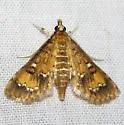
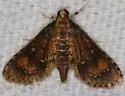
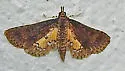
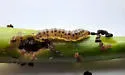
Photo credits: Contributed by Robin McLeod; Additional contributions by Beatriz Moisset , Maury Heiman , Kyhl Austin
Frequently Asked Questions About Water Hyacinth Moth - Hodges#5149
What is Water Hyacinth Moth - Hodges#5149?
Water Hyacinth Moth - Hodges#5149 (Niphograpta albiguttalis) is a species in the family Crambidae, within the order Lepidoptera.
How do you identify Water Hyacinth Moth - Hodges#5149?
Adult: forewing golden yellow speckled with gray, and with gray and blackish shading beyond PM line and in strip along costa; PM line sharply and deeply indented near inner margin, and with conspicuous white spots along its length; discal spot white, squarish, bordered above and below by black-rimmed spot filled with ground color; hindwing bright yellow with prominent black discal spot and thick white jagged PM line, edged with black on both sides; abdomen reddish-brown with white band at base of each segment Larva: first instar larvae have a brown body with dark brown to black head; later instars are cream-colored with scattered dark brown spots and dark orange head; larvae are rarely seen because they are normally hidden inside the host plant
Where is Water Hyacinth Moth - Hodges#5149 found?
| Feature | Details |
|---|---|
| Habitat | wet areas where water hyacinth grows |
| Range | Florida and along gulf coast to Louisiana and Texas native to the Amazon basin; introduced as a biological control agent of water hyacinth |
What does Water Hyacinth Moth - Hodges#5149 eat?
The diet of the Water Hyacinth Moth - Hodges#5149 includes larvae bore in stems (petioles) and leaf buds of Common Water Hyacinth ( Eichhornia crassipes ).