
American Lotus Borer - Hodges#4946
Ostrinia penitalis
This record describes Ostrinia penitalis (species). Recorded family: Crambidae. Recorded order: Lepidoptera.
Identification and Appearance
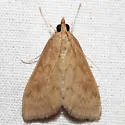
Adult: forewing orangish to light brown with zigzag AM line and jagged PM line that includes a large projecting tooth near the inner margin; ST line jagged and more diffuse than PM line; outer part of median area with dark diffuse blotch, and inner part with smaller dark spot; hindwing light gray with yellowish shading in outer half, dark discal spot, and dark PM and ST lines; adults rest with their forewings touching, hiding the hindwings. Specimens identified by DNA analysis: Larva: body pale greenish-yellow with dark dorsal line and subdorsal spot on each abdominal segment; head brownish.
Classification
- Kingdom
- Animalia
- Phylum
- Arthropoda
- Class
- Insecta
- Order
- Lepidoptera (Butterflies and Moths)
- Superfamily
- Pyraloidea
- Family
- Crambidae (Crambid Snout Moths)
- Subfamily
- Pyraustinae
- Tribe
- Pyraustini
- Genus
- Ostrinia
Imported taxonomy record. Source availability varies; see the source references and editorial policy below.
Habitat and Range
Habitat
marshes and pondsides where foodplants grow
Geographic Range
Quebec to British Columbia and all of United States, south to Amazon basin
Seasonal Activity
adults fly from May to September in the north; earlier in the south
Diet and Behavior
Diet: American lotus, Nelumbo lutea Smartweed, Polygonum [ Persicaria ?] L., sp. indet. Smartweed, Polygonum densiflorum [ Persicaria glabra ] Smartweed, Polygonum hydropiper L. [ Persicaria hydropiper ] Smartweed, Polygonum punctatum [ Persicaria punctatum ]
Life History
a mass of up to 60 eggs is laid on upper surface of leaf of hostplant, and covered with an amber-colored material; young larvae attach themselves to the leaf by thin silken strands, which prevents them from becoming dislodged by wind or wave action; mature larvae are often covered entirely by a loose silk net, and entire portions of a leaf may be rolled over the larva; mature larvae tunnel into the leaf petiole and form a burrow where pupation occurs; adults emerge from previously-formed exit holes in the petiole. - This information is from a defunct US Army webpage which as of 2019 is still accessible at Archive.org here . The same information found in Center et al. .
About Butterflies and Moths: the wider group
Order-level background for Lepidoptera, the group containing Ostrinia penitalis. Species-specific details appear above.
Group overview
Lepidoptera includes approximately 180,000 described species of butterflies and moths. Moths outnumber butterflies roughly 10:1. The monarch butterfly's eastern population has declined by more than 80% since the mid-1990s, and the western population by over 95% since the 1980s. The IUCN lists the migratory monarch as Vulnerable.
Ecological role of the group
Butterflies and moths are essential indicators of ecosystem health. As caterpillars, they are a primary food source for birds - a single nest of blue tit chicks requires ~10,000 caterpillars. Adult moths pollinate many night-blooming plants.
Economic and practical significance of the group
Lepidoptera are critical pollinators. In Europe, grassland butterfly species have declined by almost 50% since the early 1990s. In the UK, three-quarters of butterflies are in decline. In the U.S., five butterfly species have gone extinct since 1950, with 29 listed as endangered.
Recorded sources for this group: IUCN Red List, Xerces Society, USFWS, PNAS, WWF. Imported estimates may describe particular regions or reporting periods.
Photos of American Lotus Borer - Hodges#4946 (5)
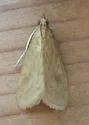
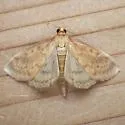
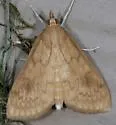
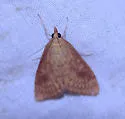
Photo credits: Contributed by Robin McLeod; Additional contributions by Steve Nanz , Robert H. Biagi
Frequently Asked Questions About American Lotus Borer - Hodges#4946
What is American Lotus Borer - Hodges#4946?
American Lotus Borer - Hodges#4946 (Ostrinia penitalis) is a species in the family Crambidae, within the order Lepidoptera.
How big is American Lotus Borer - Hodges#4946?
wingspan about 21 mm, based on specimen by Jim Vargo at MPG
How do you identify American Lotus Borer - Hodges#4946?
Adult: forewing orangish to light brown with zigzag AM line and jagged PM line that includes a large projecting tooth near the inner margin; ST line jagged and more diffuse than PM line; outer part of median area with dark diffuse blotch, and inner part with smaller dark spot; hindwing light gray with yellowish shading in outer half, dark discal spot, and dark PM and ST lines; adults rest with their forewings touching, hiding the hindwings. Specimens identified by DNA analysis: Larva: body pale greenish-yellow with dark dorsal line and subdorsal spot on each abdominal segment; head brownish.
Where is American Lotus Borer - Hodges#4946 found?
| Feature | Details |
|---|---|
| Habitat | marshes and pondsides where foodplants grow |
| Range | Quebec to British Columbia and all of United States, south to Amazon basin |
What does American Lotus Borer - Hodges#4946 eat?
The diet of the American Lotus Borer - Hodges#4946 includes American lotus, Nelumbo lutea Smartweed, Polygonum [ Persicaria ?] L., sp. indet. Smartweed, Polygonum densiflorum [ Persicaria glabra ] Smartweed, Polygonum hydropiper L. [ Persicaria hydropiper ] Smartweed, Polygonum punctatum [ Persicaria punctatum ].
When is American Lotus Borer - Hodges#4946 active?
American Lotus Borer - Hodges#4946: seasonal activity - adults fly from May to September in the north; earlier in the south.
What is the life cycle of a American Lotus Borer - Hodges#4946?
a mass of up to 60 eggs is laid on upper surface of leaf of hostplant, and covered with an amber-colored material; young larvae attach themselves to the leaf by thin silken strands, which prevents them from becoming dislodged by wind or wave action; mature larvae are often covered entirely by a loose silk net, and entire portions of a leaf may be rolled over the larva; mature larvae tunnel into the leaf petiole and form a burrow where pupation occurs; adults emerge from previously-formed exit holes in the petiole. - This information is from a defunct US Army webpage which as of 2019 is still accessible at Archive.org here . The same information found in Center et al. .