
Daecke's Grass-veneer - Hodges#5350
Crambus daeckellus
This record describes Crambus daeckellus (species). Recorded family: Crambidae. Recorded order: Lepidoptera.
Identification and Appearance
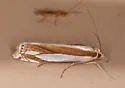
The combination of its large size and pattern of silvery streaks should be diagnostic . Heavily dependent on frequent fire, which cuts back on tall shrubs, invasive species, and allows Eastern Turkeybeard ( Xerophyllum asphodeloides ), its suspected hostplant, to grow .
Classification
- Kingdom
- Animalia
- Phylum
- Arthropoda
- Class
- Insecta
- Order
- Lepidoptera (Butterflies and Moths)
- Superfamily
- Pyraloidea
- Family
- Crambidae (Crambid Snout Moths)
- Subfamily
- Crambinae
- Tribe
- Crambini
- Genus
- Crambus
Imported taxonomy record. Source availability varies; see the source references and editorial policy below.
Habitat and Range
Habitat
Found in pitch pine ( Pinus rigida ) lowlands and reedgrass ( Calamovilfa brevipilis ) savannas. All documented recent sites had burned within the previous 1-5 years, and some occupied patches burn almost every year" .
Geographic Range
Endemic to the Pine Barrens of New Jersey (known from Fort Dix, Lakehurst Naval Station, and near Warren Grove), but its suspected foodplant also occurs in the southern Appalachians .
Seasonal Activity
May to June, September .
Diet and Behavior
Diet: Suspected to be Eastern Turkeybeard ( Xerophyllum asphodeloides ), but this has not been confirmed .
Life History
Very little is known about the biology of this species. "Adults are often found a few months after fires, suggesting that the caterpillars and pupae live underground" .
Additional species information
Species notes from the sources
Etymology: Specific epithet in honor of German-born entomologist Von Adolf Erich Daecke who collected the first specimens.
About Butterflies and Moths: the wider group
Order-level background for Lepidoptera, the group containing Crambus daeckellus. Species-specific details appear above.
Group overview
Lepidoptera includes approximately 180,000 described species of butterflies and moths. Moths outnumber butterflies roughly 10:1. The monarch butterfly's eastern population has declined by more than 80% since the mid-1990s, and the western population by over 95% since the 1980s. The IUCN lists the migratory monarch as Vulnerable.
Ecological role of the group
Butterflies and moths are essential indicators of ecosystem health. As caterpillars, they are a primary food source for birds - a single nest of blue tit chicks requires ~10,000 caterpillars. Adult moths pollinate many night-blooming plants.
Economic and practical significance of the group
Lepidoptera are critical pollinators. In Europe, grassland butterfly species have declined by almost 50% since the early 1990s. In the UK, three-quarters of butterflies are in decline. In the U.S., five butterfly species have gone extinct since 1950, with 29 listed as endangered.
Recorded sources for this group: IUCN Red List, Xerces Society, USFWS, PNAS, WWF. Imported estimates may describe particular regions or reporting periods.
Photos of Daecke's Grass-veneer - Hodges#5350 (3)
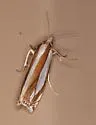
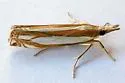
Photo credits: Contributed by Kyhl Austin; Additional contributions by Robert Lord Zimlich , Randy Hardy
Frequently Asked Questions About Daecke's Grass-veneer - Hodges#5350
What is Daecke's Grass-veneer - Hodges#5350?
Daecke's Grass-veneer - Hodges#5350 (Crambus daeckellus) is a species in the family Crambidae, within the order Lepidoptera.
How big is Daecke's Grass-veneer - Hodges#5350?
Wingspan: 27-31 mm, making it the largest Crambus species normally found in the eastern US .
How do you identify Daecke's Grass-veneer - Hodges#5350?
The combination of its large size and pattern of silvery streaks should be diagnostic .
Where is Daecke's Grass-veneer - Hodges#5350 found?
| Feature | Details |
|---|---|
| Habitat | Found in pitch pine ( Pinus rigida ) lowlands and reedgrass ( Calamovilfa brevipilis ) savannas. All documented recent sites had burned within the previous 1-5 years, and some occupied patches burn almost every year . |
| Range | Endemic to the Pine Barrens of New Jersey (known from Fort Dix, Lakehurst Naval Station, and near Warren Grove), but its suspected foodplant also occurs in the southern Appalachians . |
What does Daecke's Grass-veneer - Hodges#5350 eat?
The diet of the Daecke's Grass-veneer - Hodges#5350 includes Suspected to be Eastern Turkeybeard ( Xerophyllum asphodeloides ), but this has not been confirmed ..
When is Daecke's Grass-veneer - Hodges#5350 active?
Daecke's Grass-veneer - Hodges#5350: seasonal activity - May to June, September ..
What is the life cycle of a Daecke's Grass-veneer - Hodges#5350?
Very little is known about the biology of this species. Adults are often found a few months after fires, suggesting that the caterpillars and pupae live underground .