
Watson's Grass-veneer - Hodges#5366
Crambus watsonellus
This record describes Crambus watsonellus (species). Recorded family: Crambidae. Recorded order: Lepidoptera.
Identification and Appearance
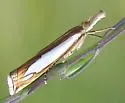
Adult: forewing ground color light golden brown, with a satiny luster, paler dorsally. Silvery white discal stripe very broad, separated from costa along its basal half by only a narrow, dark brown line, then diverging. A dorsal tooth, sometimes small, from the stripe beyond its middle. About one-fifth of its length from its tip, the silvery white stripe narrows abruptly, being somewhat concave toward the costa, and terminates in a very slender, acute point. Costad of the tip of the stripe a strong, spindle-shaped, silvery white dash. Both this dash and the large stripe narrowly outlined with darker brown scales. Dorsad of the tip of the stripe a number of intervenular dark brown lines which may extend nearly to the submarginal line. Submarginal line beginning on the costa at a very acute angle, running toward the outer margin below the apex, then curving dorsad, forming a rounded angle of slightly less than 90 degrees and running to the inner margin diverging from the outer margin. Submarginal line of shining, semi-metallic scales, very narrowly margined internally with dark brown. Apical area yellowish white and containing a slender, triangular, dark brown spot. Below this the space between the submarginal line and the outer margin is light yellowish brown, lighter than the ground color of the wing, and somewhat powdery, and contains five short, black, intervenular dashes. Outer margin narrowly dark brown, darkest below the apex. Fringe with a satiny luster, yellowish white with dark brown termination. Hindwing ground color very pale brownish tinged white, somewhat darker subapically. Fringe much lighter than the ground color, almost white, semi-lustrous. [copied from original description of species by Alexander Klots] The large spindle-shaped white dash at the distal end of the white stripe is also present in Crambus satrapellus but that species differs in several ways, as described in the See Also section below. page creation based on matching Klots' original description of this species with the characteristics visible in this photo
Classification
- Kingdom
- Animalia
- Phylum
- Arthropoda
- Class
- Insecta
- Order
- Lepidoptera (Butterflies and Moths)
- Superfamily
- Pyraloidea
- Family
- Crambidae (Crambid Snout Moths)
- Subfamily
- Crambinae
- Tribe
- Crambini
- Genus
- Crambus
Imported taxonomy record. Source availability varies; see the source references and editorial policy below.
Habitat and Range
Habitat
Marshy areas; near creeks; calcareous (limestone) prairies.
Geographic Range
Maine to Florida, west to at least Illinois and Ontario.
Seasonal Activity
The adults fly from August to October. ( 3 )
Additional species information
Species notes from the sources
Etymology: Named in honor of Frank E. Watson, entomologist at American Museum of Natural History in the early 1900's.
About Butterflies and Moths: the wider group
Order-level background for Lepidoptera, the group containing Crambus watsonellus. Species-specific details appear above.
Group overview
Lepidoptera includes approximately 180,000 described species of butterflies and moths. Moths outnumber butterflies roughly 10:1. The monarch butterfly's eastern population has declined by more than 80% since the mid-1990s, and the western population by over 95% since the 1980s. The IUCN lists the migratory monarch as Vulnerable.
Ecological role of the group
Butterflies and moths are essential indicators of ecosystem health. As caterpillars, they are a primary food source for birds - a single nest of blue tit chicks requires ~10,000 caterpillars. Adult moths pollinate many night-blooming plants.
Economic and practical significance of the group
Lepidoptera are critical pollinators. In Europe, grassland butterfly species have declined by almost 50% since the early 1990s. In the UK, three-quarters of butterflies are in decline. In the U.S., five butterfly species have gone extinct since 1950, with 29 listed as endangered.
Recorded sources for this group: IUCN Red List, Xerces Society, USFWS, PNAS, WWF. Imported estimates may describe particular regions or reporting periods.
Photos of Watson's Grass-veneer - Hodges#5366 (5)
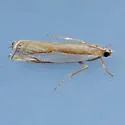
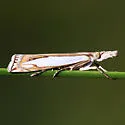
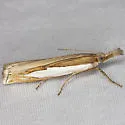
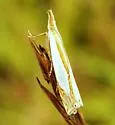
Photo credits: Contributed by Robin McLeod; Additional contributions by Steve Nanz , Maury Heiman
Frequently Asked Questions About Watson's Grass-veneer - Hodges#5366
What is Watson's Grass-veneer - Hodges#5366?
Watson's Grass-veneer - Hodges#5366 (Crambus watsonellus) is a species in the family Crambidae, within the order Lepidoptera.
How big is Watson's Grass-veneer - Hodges#5366?
Klots (1942) listed the forewing length 9.8-13.5 mm.
How do you identify Watson's Grass-veneer - Hodges#5366?
Adult: forewing ground color light golden brown, with a satiny luster, paler dorsally. Silvery white discal stripe very broad, separated from costa along its basal half by only a narrow, dark brown line, then diverging. A dorsal tooth, sometimes small, from the stripe beyond its middle. About one-fifth of its length from its tip, the silvery white stripe narrows abruptly, being somewhat concave toward the costa, and terminates in a very slender, acute point. Costad of the tip of the stripe a strong, spindle-shaped, silvery white dash. Both this dash and the large stripe narrowly outlined with darker brown scales. Dorsad of the tip of the stripe a number of intervenular dark brown lines which may extend nearly to the submarginal line. Submarginal line beginning on the costa at a very acute angle, running toward the outer margin below the apex, then curving dorsad, forming a rounded angle of slightly less than 90 degrees and running to the inner margin diverging from the outer margin. Submarginal line of shining, semi-metallic scales, very narrowly margined internally with dark brown. Apical area yellowish white and containing a slender, triangular, dark brown spot. Below this the space between the submarginal line and the outer margin is light yellowish brown, lighter than the ground color of the wing, and somewhat powdery, and contains five short, black, intervenular dashes. Outer margin narrowly dark brown, darkest below the apex. Fringe with a satiny luster, yellowish white with dark brown termination. Hindwing ground color very pale brownish tinged white, somewhat darker subapically. Fringe much lighter than the ground color, almost white, semi-lustrous. [copied from original description of species by Alexander Klots] The large spindle-shaped white dash at the distal end of the white stripe is also present in Crambus satrapellus but that species differs in several ways, as described in the See Also section below.
Where is Watson's Grass-veneer - Hodges#5366 found?
| Feature | Details |
|---|---|
| Habitat | Marshy areas; near creeks; calcareous (limestone) prairies. |
| Range | Maine to Florida, west to at least Illinois and Ontario. |
When is Watson's Grass-veneer - Hodges#5366 active?
Watson's Grass-veneer - Hodges#5366: seasonal activity - The adults fly from August to October. ( 3 ).