
Dacerla mediospinosa
This record describes Dacerla mediospinosa (species). Recorded family: Miridae. Recorded order: Hemiptera.
Identification and Appearance
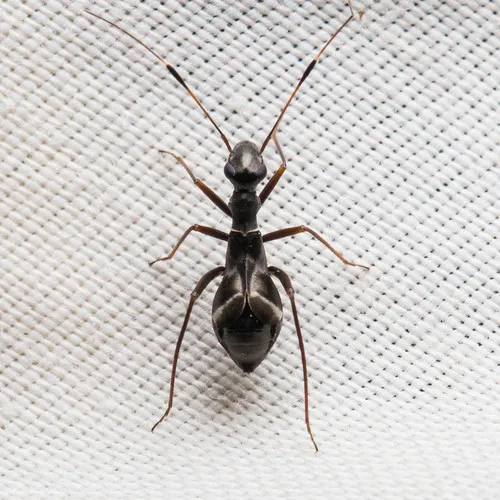
| Feature | Description |
|---|---|
| Additional details | Distinctive Characters: 1) Hind-margin of pronotum abruptly upturned as a thin flange, which is elongated in its median portion and raised into a spine-like projection (but is hollow from behind). 2) Hemelytra (= fore-wings) short; tapered basally & rounded apically; lacking the grooves separating cuneus and membrane found in typical hemipteran wings; and not covering last 3 abdominal segments. No rear wings present. Description: Ant-like. |
| Head | Head somewhat inflated, rounded anteriorly, blocky posteriorly. |
| Eyes | Eyes large, placed laterally at rear half of head. |
| Antennae | Antennae mostly black, long & narrow, attached at middle of head, 2nd antennal segment much longer than others and reddish at middle (black at very base and along somewhat swollen terminal 1/3). Tip of beak (sucking mouthparts) reaching to about base of middle legs when held straight back under body. |
| Pronotum | Pronotum with hind margin abruptly upcurved at middle, forming an acute spine (cf. Fig. 1 on pg. 3 of Carvalho & Usinger(1957)). |
| Abdomen | Abdomen swollen at middle, narrow at base...twice as wide at middle as greatest width of pronotum. |
| Forewings | Forewings (hemelytra) short, tapered-basally and rounded-apically, exposing last three abdominal segments. |
| Hindwings | Hindwings absent. |
| Head | Head, thorax, abdomen mostly black with some areas tinged rufous or brown. Narrow hind-edge of pronotum whitish; hemelytra dark overall but with a narrow, whitish, obliquely-transverse stripe positioned about 4/5's of the way to the wing apex (the stripe tapering towards the medial edge of the wing). |
| Legs | Legs reddish (chestnut), femora darker. Note: Lower elevation and more westerly (coastal) populations tend to have thorax reddish. |
| Coloration | Coloration seems to mimic either black ants or red ants. |
Classification
- Kingdom
- Animalia
- Phylum
- Arthropoda
- Class
- Insecta
- Order
- Hemiptera (True Bugs, Cicadas, Hoppers, Aphids and Allies)
- Suborder
- Heteroptera
- Superfamily
- Miroidea
- Family
- Miridae (Plant Bugs)
- Subfamily
- Mirinae
- Tribe
- Herdoniini
- Genus
- Dacerla
Imported taxonomy record. Source availability varies; see the source references and editorial policy below.
Habitat and Range
Geographic Range
California (Santa Cruz to Tulare Counties and north)
Additional species information
Species notes from the sources
Etymology: mediospinosa : Latin, medio + spinosa = "spine in middle"; referring to the distinctive medial spine along the posterior edge of the pronotum Myrmecopsis : Greek, myrmeco + opsis = "resembling an ant" inflata, -us : Latin, inflata, -us = "inflated"; Uhler (who coined the epithet) referred to the abdomen as inflated in his description; Carvalho & Usinger described head as strongly inflated. rufuscula : Latin, rufus + cula = "a little reddish"
About True Bugs, Cicadas, Hoppers, Aphids and Allies: the wider group
Order-level background for Hemiptera, the group containing Dacerla mediospinosa. Species-specific details appear above.
Group overview
Hemiptera (true bugs) includes over 80,000 described species across cicadas, aphids, leafhoppers, shield bugs, and bed bugs. Aphids alone cost global agriculture an estimated $2.5 billion annually in crop losses.
Ecological role of the group
Many Hemiptera are essential food sources for birds and predatory insects. Cicadas provide massive nutrient pulses during emergence events - a single Brood X emergence can involve trillions of individuals across 15 states.
Economic and practical significance of the group
The brown marmorated stink bug (Halyomorpha halys) caused $37 million in apple crop losses in a single year in the U.S. Mid-Atlantic region. Bed bug infestations in the U.S. increased by 500% between 2001-2010, costing the hotel industry hundreds of millions annually.
Recorded sources for this group: USDA, EPA, University research. Imported estimates may describe particular regions or reporting periods.
Photos of Dacerla mediospinosa (2)
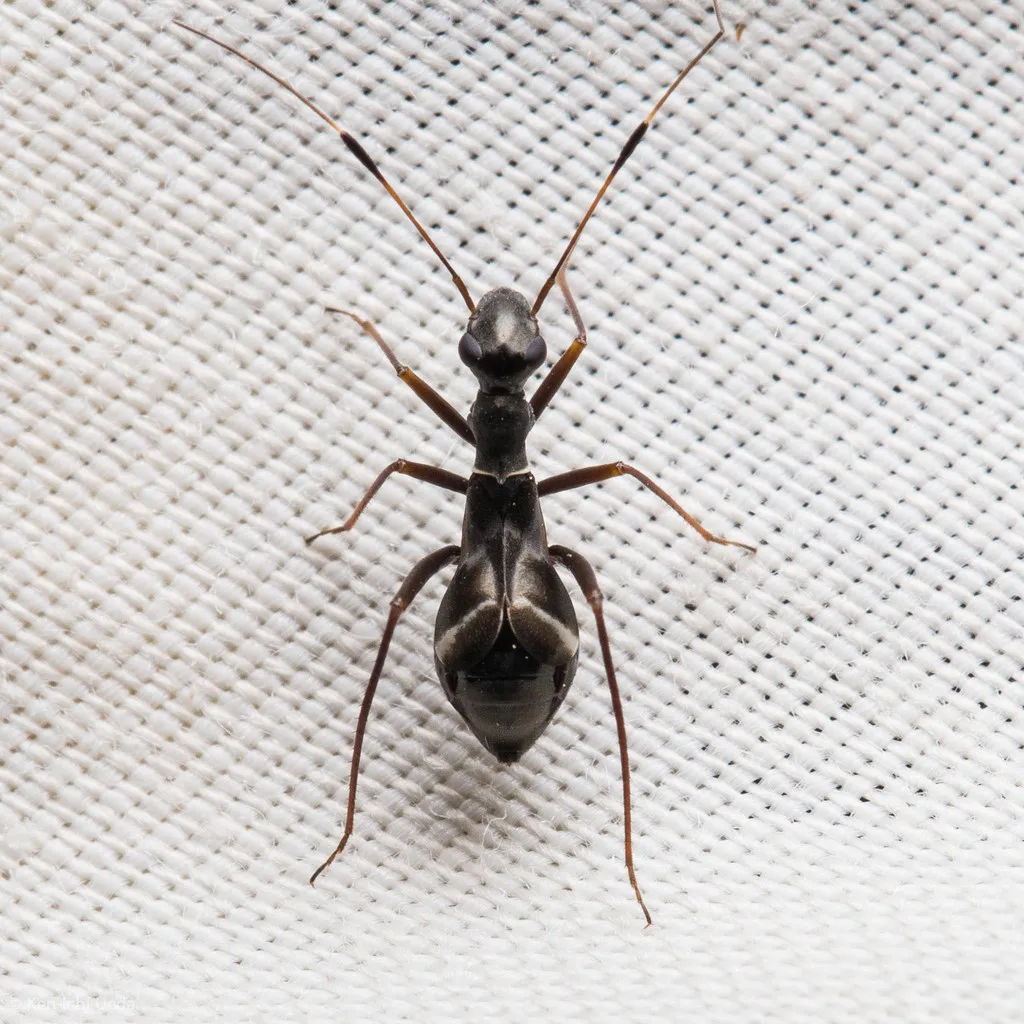
Photo credits: Contributed by Aaron Schusteff
Frequently Asked Questions About Dacerla mediospinosa
What is Dacerla mediospinosa?
Dacerla mediospinosa is a species in the family Miridae, within the order Hemiptera.
How do you identify Dacerla mediospinosa?
| Feature | Description |
|---|---|
| Additional details | Distinctive Characters: 1) Hind-margin of pronotum abruptly upturned as a thin flange, which is elongated in its median portion and raised into a spine-like projection (but is hollow from behind). 2) Hemelytra (= fore-wings) short; tapered basally & rounded apically; lacking the grooves separating cuneus and membrane found in typical hemipteran wings; and not covering last 3 abdominal segments. No rear wings present. Description: Ant-like. |
| Head | Head somewhat inflated, rounded anteriorly, blocky posteriorly. |
| Eyes | Eyes large, placed laterally at rear half of head. |
| Antennae | Antennae mostly black, long & narrow, attached at middle of head, 2nd antennal segment much longer than others and reddish at middle (black at very base and along somewhat swollen terminal 1/3). Tip of beak (sucking mouthparts) reaching to about base of middle legs when held straight back under body. |
| Pronotum | Pronotum with hind margin abruptly upcurved at middle, forming an acute spine (cf. Fig. 1 on pg. 3 of Carvalho & Usinger(1957)). |
| Abdomen | Abdomen swollen at middle, narrow at base...twice as wide at middle as greatest width of pronotum. |
| Forewings | Forewings (hemelytra) short, tapered-basally and rounded-apically, exposing last three abdominal segments. |
| Hindwings | Hindwings absent. |
| Head | Head, thorax, abdomen mostly black with some areas tinged rufous or brown. Narrow hind-edge of pronotum whitish; hemelytra dark overall but with a narrow, whitish, obliquely-transverse stripe positioned about 4/5's of the way to the wing apex (the stripe tapering towards the medial edge of the wing). |
| Legs | Legs reddish (chestnut), femora darker. Note: Lower elevation and more westerly (coastal) populations tend to have thorax reddish. |
| Coloration | Coloration seems to mimic either black ants or red ants. |
Where is Dacerla mediospinosa found?
Range: California (Santa Cruz to Tulare Counties and north)