
Family Leaf Beetles (Chrysomelidae)
Chrysomelidae is a family in the order Coleoptera. Browse 1,349 named species recorded in this family, or open an individual profile for its available identification and natural-history information.
Species in Chrysomelidae (1,349)
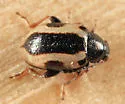
Garden Flea Beetle
Phyllotreta robusta
Identification: adult habitus Elytral yellow band expanded in the apical half to reach sutural, and lateral margins. This pattern shared with P. liebecki only; in males, the shape and length of antennal segment 5 is different: distinctly shorter than
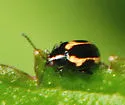
Striped Flea Beetle
Phyllotreta striolata
Identification: Elongate oval. Shining black, elytra marked with yellow. Antennae black, basal 3 segments yellow-brown, 5th segment usually 1/3 longer than 4th, its width 1/4 its length. Head, pronotum and elytra closely punctate, elytral punctures s
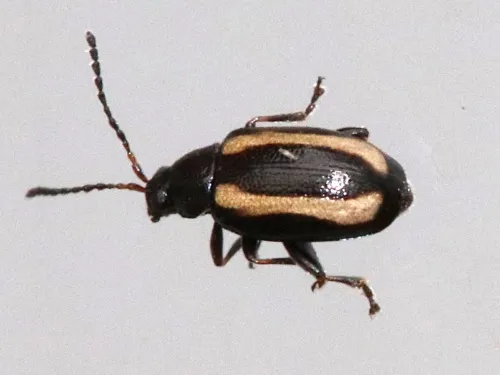
Small Striped Flea Beetle
Phyllotreta undulata
A tiny beetle, which measures little more than about 1.5 mm. Its black elytra are marked with broad straw yellow longitudinal stripes. It is similar to Phyllotreta nemorum and detailed examination is necessary to be certain of the species. Their pref
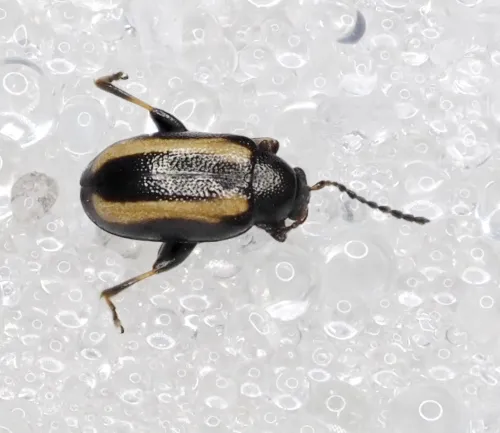
Phyllotreta vittula
Phyllotreta vittula
Approximately 2mm. The elytra are black with longitudinal straw coloured or orangey-yellow stripes. Detailed examination of the specimen is needed to identify the species (a photograph alone is not normally sufficient because key features are too sma
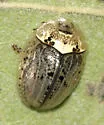
Wild Olive Tortoise Beetle
Physonota alutacea
Identification: undisturbed adults are silvery: disturbed adults: Larvae, like others of this genus, are bizarre:
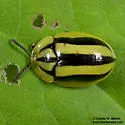
Physonota disjuncta
Physonota disjuncta
Identification: Habitus photos not recorded for the US in Riley
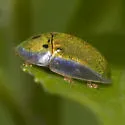
Sunflower Tortoise Beetle
Physonota helianthi
Identification: Oval. Shining pale yellow. Pronotum with margin explanate, covering head from above; having 3 black spots, median more elongate. Elytra with explanate margins; finely to moderately coarsely, mostly irregularly punctate.
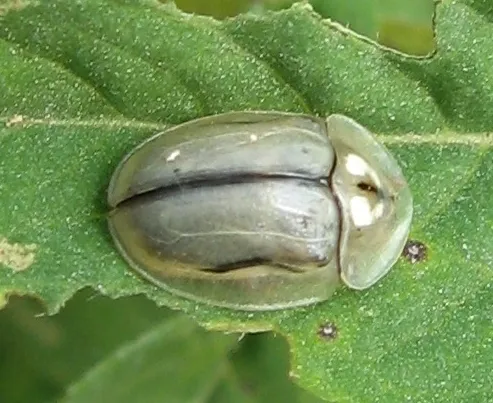
Horsemint Tortoise Beetle
Physonota unipunctata
Identification: Pale greenish yellow, three black dots on the thorax, white spots on elytra (colors fade in preserved specimens)
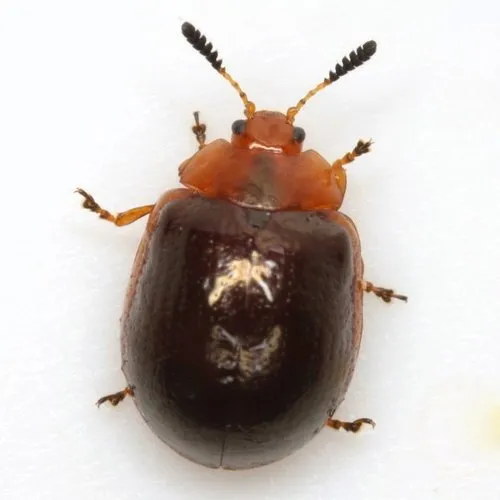
Plagiodera thymaloides
Plagiodera thymaloides
Identification: Det. E. G. Riley, 2009 Texas considers this a SGCN ( 5 )
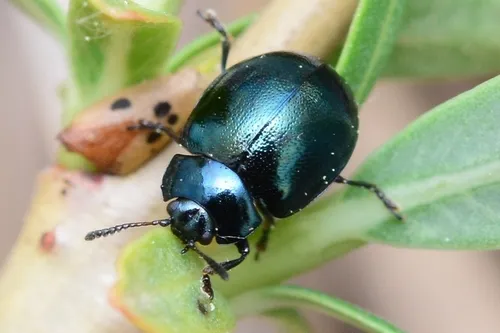
Plagiodera versicolora
Plagiodera versicolora
2.5-4.5mm. A very rounded leaf-beetle. Upperside is metallic green or blue, though occasionally purple. The underside, femora and tibiae are black, as are the tips of the antennae. The elytral punctures are generally in a confused pattern but with so
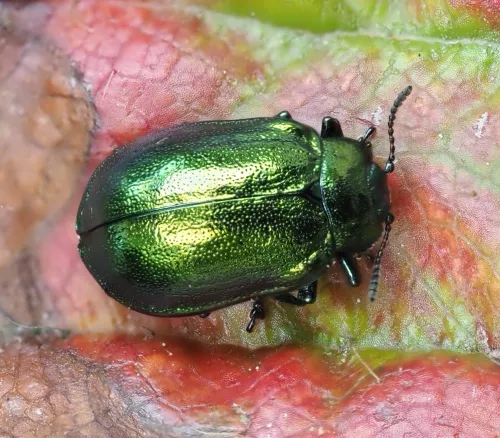
Plagiosterna aenea
Plagiosterna aenea
6.5 to 8 mm. Usually metallic or iridescent green, occasionally blue or brassy. Very similar to some other Chrysomelidae species, particularly Chrysolina herbacea . Good quality close up photographs required. Detailed examination of the specimen may
Plateumaris aurifera
Plateumaris aurifera
Identification: syntype The bright goldish green color, pale appendages, and finely but distinctly pubescent pronotum are distinctive in the genus
Plateumaris flavipes
Plateumaris flavipes
Identification: Generally easily recognized by the combination of completely testaceous appendages, moderate to absent metafemoral tooth of most specimens, pronotum with dense punctation, often rugulose to broadly indistinctly alutaceous to shagreene
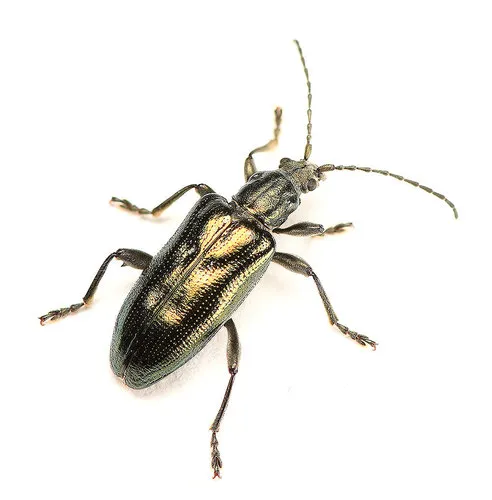
Plateumaris fulvipes
Plateumaris fulvipes
Identification: Recognized by the broad metafemoral tooth, emarginate male pygidium, notched female pygidium (larger than flavipes), most specimens with more or less quadrate pronotum and densely punctate and punctulate disc, elytra densely punctulat
Germar's reed beetle
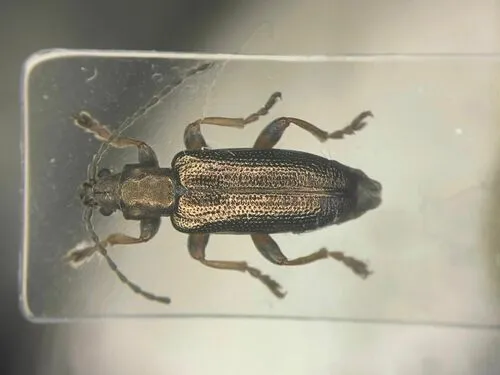
Plateumaris germari
Plateumaris germari is a species of aquatic leaf beetle in the family Chrysomelidae. It is found in western North America.
Plateumaris metallica
Plateumaris metallica
Identification: Pronotum either side of midline swollen and more or less shiny, less punctate, and with anterolateral calli shiny but more or less obsolete and poorly defined. Legs, except apex of femora, reddish, antennomeres of most specimens rufou
Plateumaris neomexicana
Plateumaris neomexicana
Identification: metafemoral spine reduced ‒Tim Loh 2013
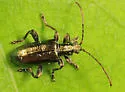
Plateumaris nitida
Plateumaris nitida
Identification: metafemoral tooth is relatively small and acute and not set off the posteroventral edge of the femur. - comment: Tim Loh 2011 Correction : this species is most reliably ID'd by the shiny convex area of the pronotum that is either side
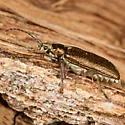
Plateumaris pusilla
Plateumaris pusilla
Identification: metafemur with prominent spine and apical dark metallic band ‒Tim Loh 2013
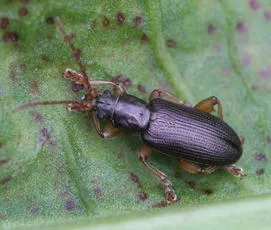
Plateumaris rustica
Plateumaris rustica
This plain looking brown 'Reed Beetle' is around 9mm. As with other species in the genus it has swollen femora with the hind one displaying a projecting spine. Found in damp habitats and at water margins Associated with plants of the Sedge family (Ca
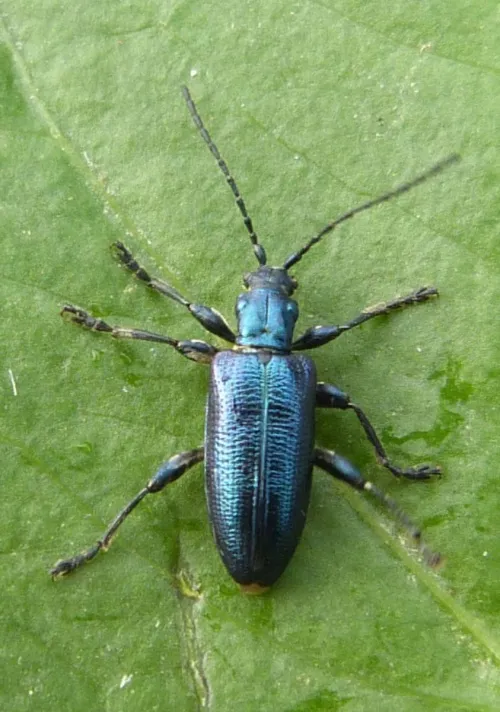
Plateumaris sericea
Plateumaris sericea
Length 9 to 12 mm. Plateumaris sericea shows amazing colour variation, ranging from blackish-blue to red with heavily pitted elytra. Plateumaris discolor is similar, but mainly found around acid waters. Around ponds where the larval foodplants are pr
Shoemaker's reed beetle
Plateumaris shoemakeri
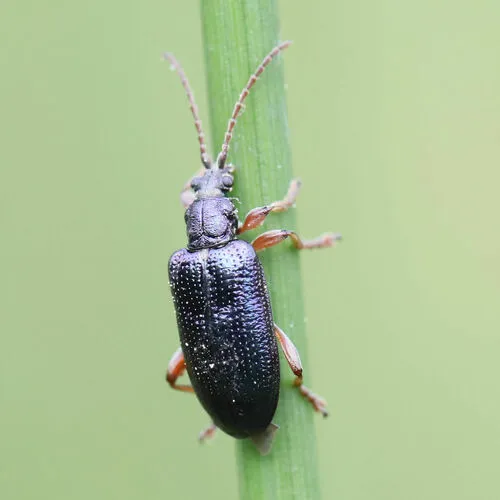
Identification: Typically, specimens of P. shoemakeri are recognized by presence of deep, regular median line and basal and callosal sulci of pronotum, largely reddish appendages, robustly clavate metafemur with large acute subapical tooth, and shiny
Brooklime Leaf Beetle
Prasocuris junci
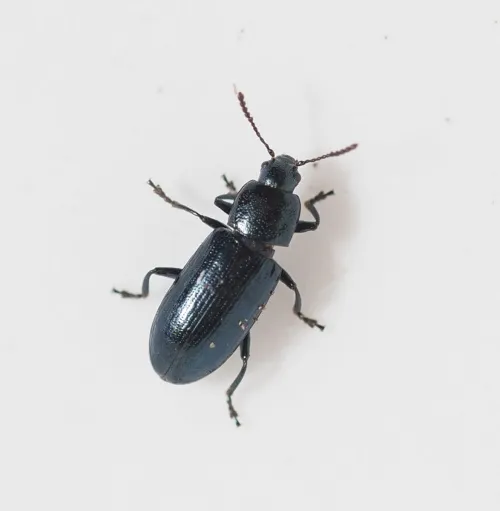
Size: 4 to 5 mm. Prasocuris junci is a very dark metallic blue or occasionally dark green beetle. Water margins where Brooklime ( Veronica beccabunga ) and Water-speedwells are present. Prasocuris junci grazes on leaves of Brooklime and Water-speedwe
Banded Leaf Beetle
Prasocuris vittata
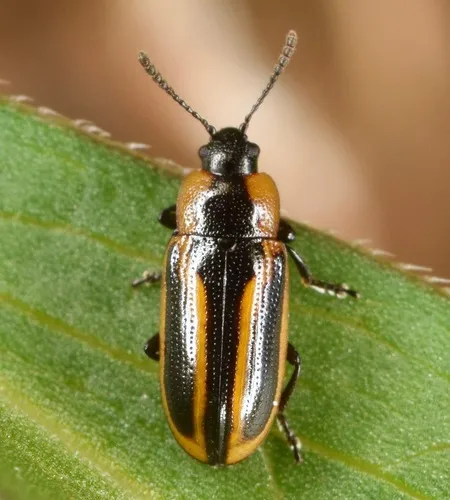
Prasocuris vittata is a species of leaf beetles in the family Chrysomelidae. It is found in North America.
Pseudodibolia opima
Pseudodibolia opima
Identification: Destinctive serate outer margin on hind tibia: Type Locality: North Carolona
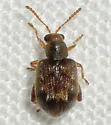
Waterfern Flea Beetle
Pseudolampsis guttata
Identification: Fuscous, densely clothed with fine short pubescence, legs and elytra paler, the latter are twice as wide as the prothorax, impressed behind the base; strife well impressed finely punctured, each with three dark spots, the first and th
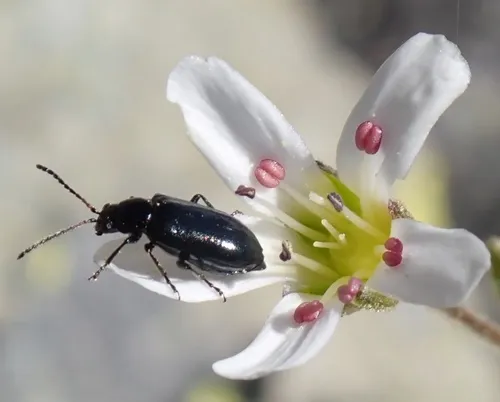
Pseudoluperus longulus
Pseudoluperus longulus
Pseudoluperus is a genus of leaf beetles in the family Chrysomelidae. It is monotypic, being represented by the single species, Pseudoluperus longulus, which is found in North America.
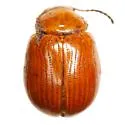
Pseudorthygia nigritarsis
Pseudorthygia nigritarsis
Identification: of the original six spmns collected, "one of which is of a blood-red colour." Type Locality: Amula, Guerrero, 6000 ft, Mexico
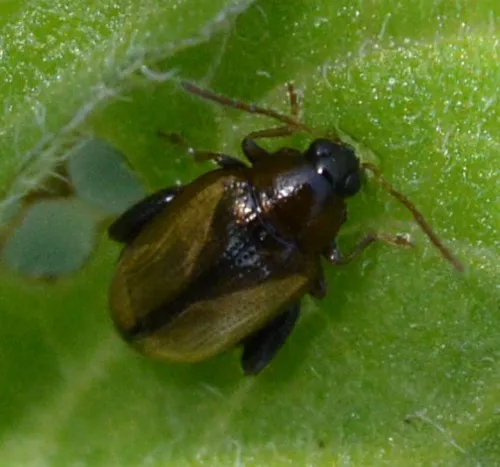
Potato Flea Beetle
Psylliodes affinis
Length 2 to 3 mm with straw yellow elytra marked with brown. It feeds on the leaves of various plants of the family Solanaceae cultivated or wild. Common and widespread in England and Wales.
Psylliodes chalcomera 0
Psylliodes chalcomera
Psylliodes chalcomera 0 (Psylliodes chalcomera) is a species in the family Chrysomelidae, commonly known as leaf beetles, belonging to the order Coleoptera (Beetles). It is classified within the subfamily Galerucinae, tribe Alticini, suborder Polypha
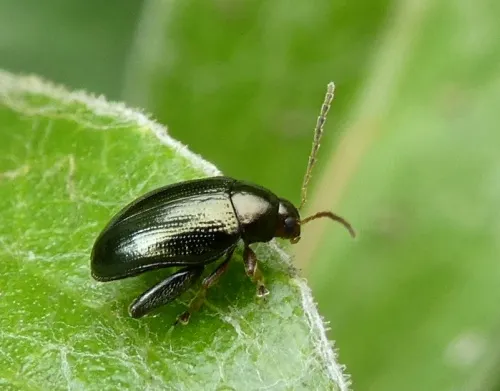
Cabbage-stem Flea Beetle
Psylliodes chrysocephala
Length 3 to 4.7 mm. A rather variable flea beetle. The elytra may vary in colour from dark blue or green through to black, though the typical form is dark metallic blue. Variety anglica is yellow to pale brown. It has the thickened thighs that are ty
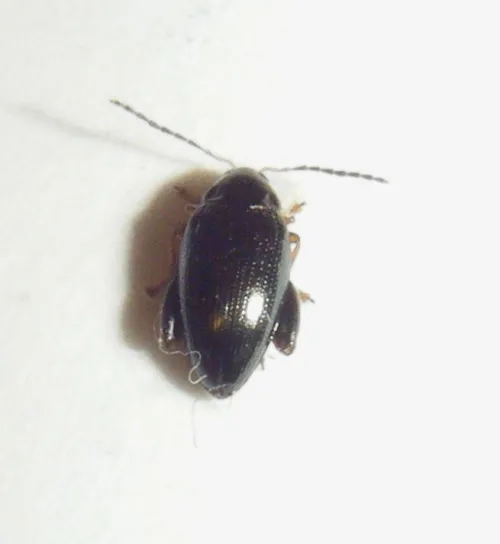
Psylliodes napi
Psylliodes napi
A small beetle (2.5 to 3.3 mm) it is dark blue, sometimes greenish, and very occasionally bronze. Associated with plants of the Brassicaceae family, the adults are found on the leaves, but the larvae are leaf- and stem-miners. Overwinters as an adult
Pteleon brevicornis
Pteleon brevicornis
Identification: generally orange, but can vary to all black with stout body and short stout ant.; often on flwrs of globemallow Dets. E. G. Riley, 2016
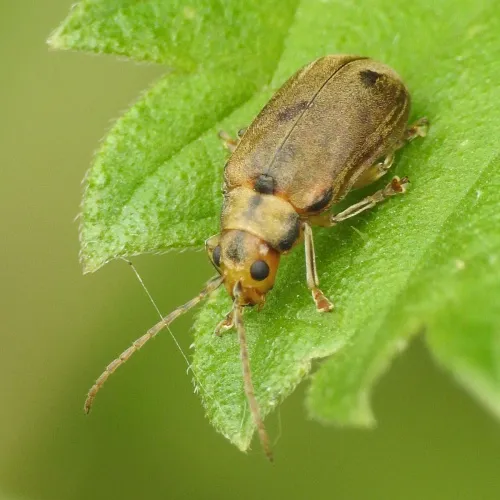
Viburnum Beetle
Pyrrhalta viburni
A small golden brown beetle (about 5 mm long), nearly always associated with plants of the Viburnum family. On Viburnum plants, such as Guelder Rose, but also feeds on the Wayfaring Tree and garden varieties. Adult beetles emerge in July and August.
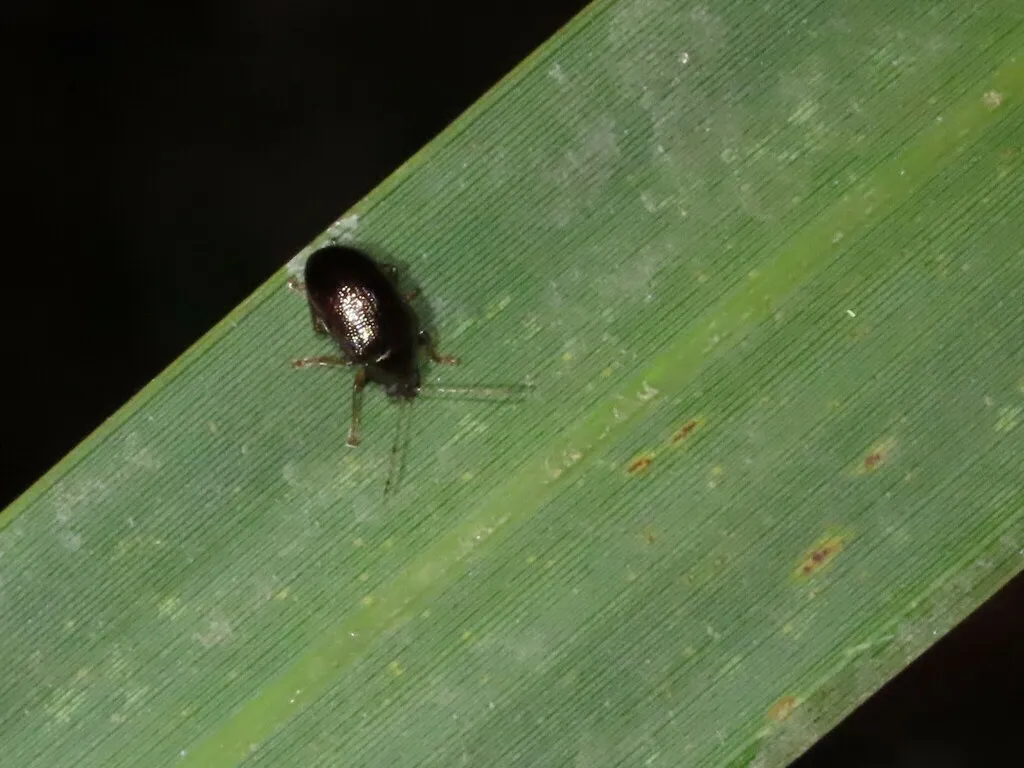
Rhabdopterus picipes
Rhabdopterus picipes
Rhabdopterus picipes, the cranberry rootworm, is a species of leaf beetle. It is found in North America.
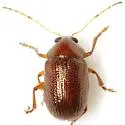
Rhabdopterus weisei
Rhabdopterus weisei
Identification: Det. E. G. Riley, 2009 Type Locality: Brownsville, Cameron Co., TX (Schaeffer 1919)
Saxinis hornii 0
Saxinis hornii
Identification: A specimen in [Fall's] collection from San Diego Co., Cal., differs only in the colour being almost black, and there can scarcely be a doubt that it is identical with the Lower California form. Syntype Type Locality: San Jose del Cabo
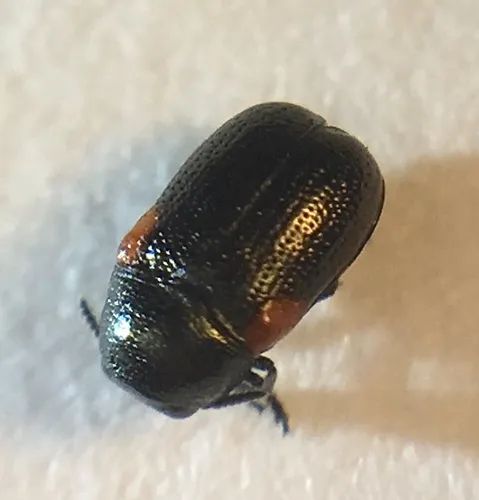
Saxinis omogera
Saxinis omogera
Saxinis omogera is a species in the family Chrysomelidae ("leaf beetles"), in the order Coleoptera ("beetles"). The distribution range of Saxinis omogera includes Central America and North America.
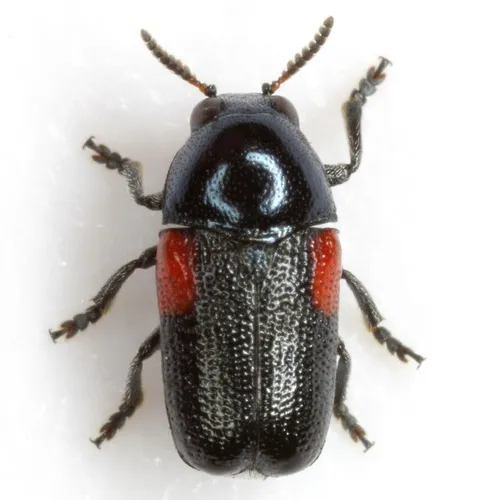
Saxinis sinuata
Saxinis sinuata
Per Schaeffer (1906), "This name is proposed for a few specimens collected in Texas (Brownsville) and Arizona (Huachuca Mts.), which have the sides of thorax strongly sinuately narrowing to base from about basal third, which causes the hind angles to
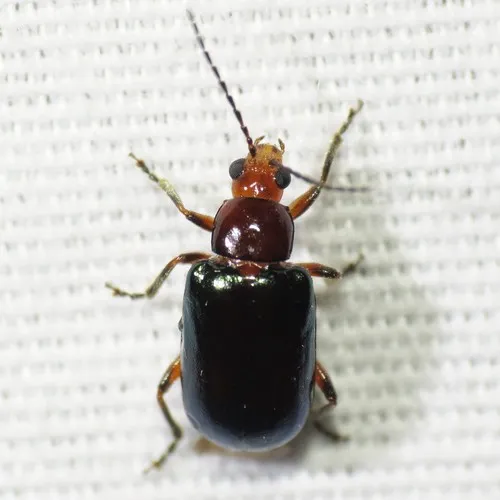
Scelida nigricornis
Scelida nigricornis
Scelida nigricornis is a species of leaf beetle in the family Chrysomelidae. It is found in Central America and North America.
Scelolyperus schwarzii
Scelolyperus schwarzii
Identification: Hind tibiae of male strongly curved (an arc of about 40°) AND pronotum as metallic as elytra; in females, an indication of that curvature also perceptible. Frontlegs partly pale.
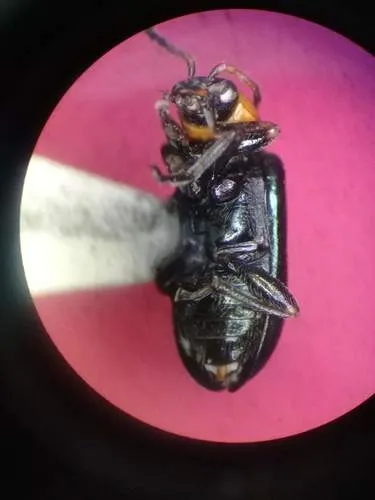
Scelolyperus torquatus
Scelolyperus torquatus
Scelolyperus torquatus is a species of skeletonizing leaf beetle in the family Chrysomelidae.
Sennius cruentatus
Sennius cruentatus
Identification: The shape of the elytral maculation will usually separate S. cruentatus from all the U.S. species except S. simulans , which is only known from AZ. Has an all-black form
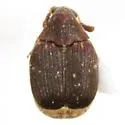
Sennius guttifer
Sennius guttifer
Identification: Det. E. G. Riley, 2010 – first USA record not reported in Kingsolver
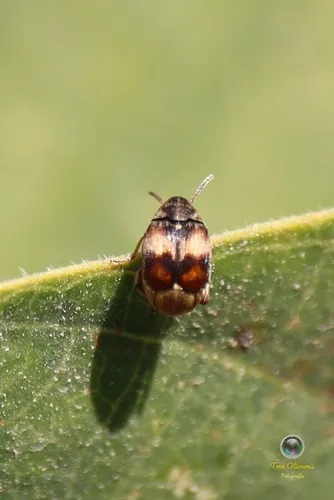
Sennius lebasi
Sennius lebasi
Identification: Body reddish yellow to black, most often dark red; head black, pronotum red to black, often with paler red median line; elytra reddish yellow to dark brown, each elytron with broad, oblique, paler band usually extending from side to s
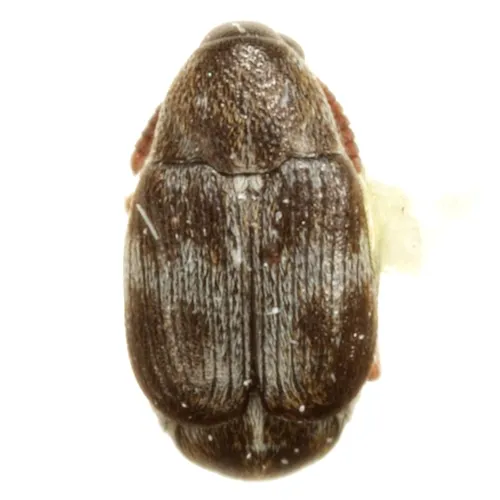
Sennius leucostauros
Sennius leucostauros
Identification: Integument black; antenna reddish brown, fore legs and mid legs reddish brown, metafemoral base black, apical one-third to one-half red. Vestiture white and dark brown; pronotum with median stripe and lateral patches white; scutellum
Sennius medialis
Sennius medialis
Identification: most closely resembles S. abbreviatus , which has the hind legs black, not red
Sennius simulans 0
Sennius simulans
Type locality: Huachuca Mountain, Cochise Co., Arizona
Smaragdina militaris
Smaragdina militaris
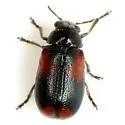
Type Locality: One specimen, New Braunfels, Texas, Mr. Lindheimer.
Sphaeroderma testaceum
Sphaeroderma testaceum
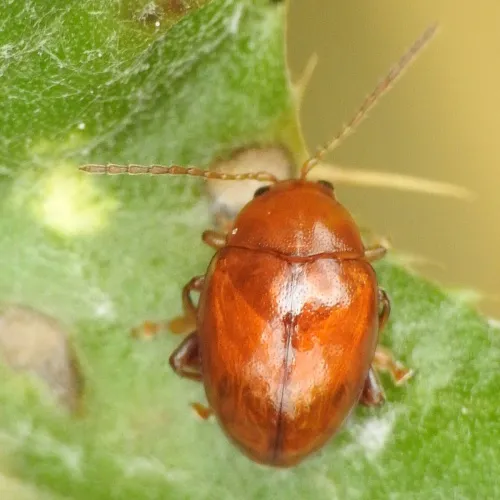
There are two very similar species of Sphaeroderma in Britain and both feed on Thistles. Both are red coloured and generally round-bodied. S. testaceum is slightly larger but there is much overlap. S. testaceum : Body less strongly rounded, slightly
Spintherophyta globosa
Spintherophyta globosa
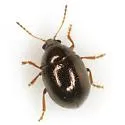
Identification: Det. M. A. Quinn, 2015 apparently does not come to lights nor to flowers, hence few records on iNaturalist ( 6 )
Spintherophyta violaceipennis
Spintherophyta violaceipennis
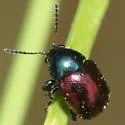
Identification: "the elytra with a violaceous tinge inclining to cupreous" (Horn 1892) Type Locality: "Collected in Arizona, precise locality unknown, but from the southern part."
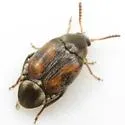
Stator beali
Stator beali
Identification: Body black except each elytron mostly red with black basal and sutural borders Closely resembles S. limbatus but differs in the yellow dorsal vestiture, prosternum separating the procoxae, the lateral elytral macula reaching 5th or 6t
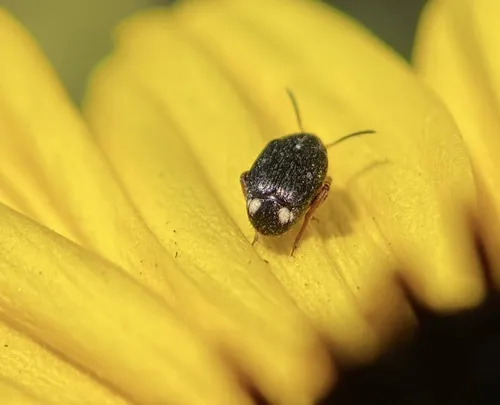
Stator chihuahua
Stator chihuahua
Stator chihuahua is a species of leaf beetle in the family Chrysomelidae. It is found in Central America and North America.
Pruinose Bean Weevil
Stator pruininus
Identification: easily recognized within the genus by uniformly gray appearance and reddish-yellow fore and mid legs
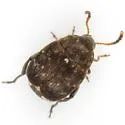
Stator subaeneus
Stator subaeneus
Identification: easily separated from other U.S. Stator by the eyes being contiguous with the vertex and sides of the head. Type Locality: Brownsville, Cameron Co., Texas
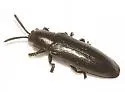
Stenispa metallica
Stenispa metallica
Identification: the only unicolorous Stenispa in our area
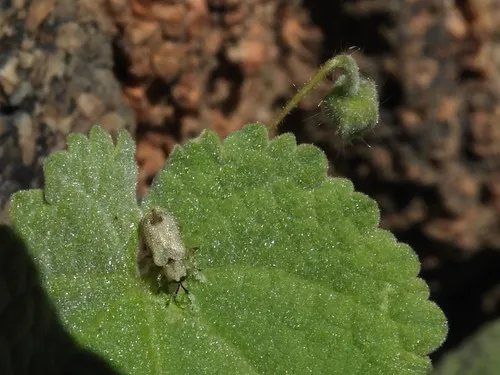
Stenopodius insularis 0
Stenopodius insularis
Stenopodius insularis is a species of beetle of the family Chrysomelidae. It is found in the United States (Arizona, California, Nevada, Utah) and Mexico (Baja California).
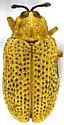
Stenopodius martini
Stenopodius martini
Identification: sides of the pronotum straight, top of head yellow
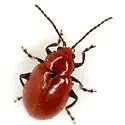
Strabala acuminata
Strabala acuminata
Type Locality: Esperanza Ranch, Brownsville, Cameron Co., Texas
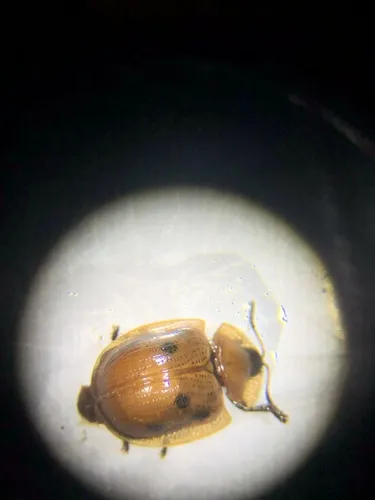
Strongylocassis atripes
Strongylocassis atripes
Identification: note the wide, shelf-like extension of the explanate elytral margin at the suture (not present in Charidotella ) --E.G. Riley's comment Type Locality: Colorado
Stylantheus macrocerus
Stylantheus macrocerus
Identification: distinctive, may be known from any in our fauna by the extremely long antennae lectotype parasitized by Urosigalphus bruchivorus Crawford (Braconidae)
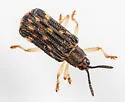
Sumitrosis inaequalis
Sumitrosis inaequalis
Identification: In central Texas, south to the Rio Grande Valley, specimens are on average of a pale coloration (as shown) and often the dark maculae are with slight metallic highlights, unlike the darker forms that occur to the east." - EGR, 2009
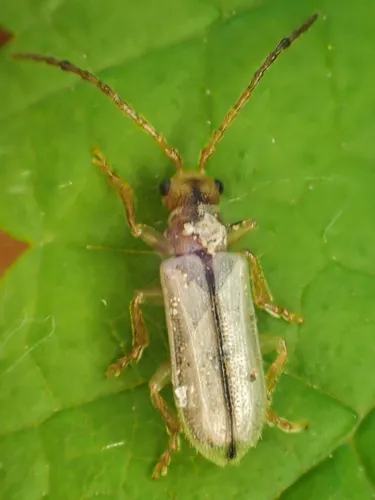
Western Fruit Beetle
Syneta albida
Syneta albida is a species of beetles from the family of leaf beetles, subfamily Synetinae.
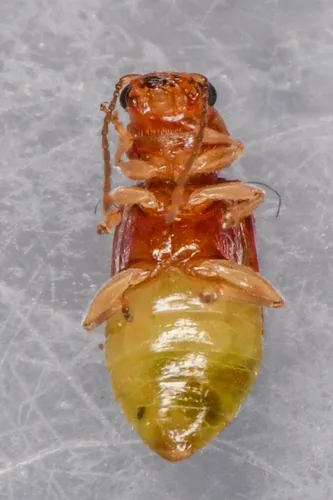
Synetocephalus autumnalis
Synetocephalus autumnalis
Synetocephalus autumnalis is a species of skeletonizing leaf beetle in the family Chrysomelidae. It is found in North America.
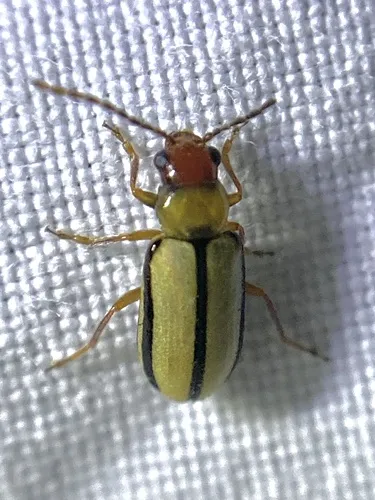
Synetocephalus diegensis
Synetocephalus diegensis
Identification: Elytral vittae narrow, antennae usually with terminal segments paler; head frequently more reddish than pronotum. Type Locality: San Diego, California
Syphrea nana
Syphrea nana
Identification: dark, shiny, pronotum with sub-basal crease, irregular (confused) shallow elytral punctations, pale tibia & tarsi, basal antennomeres also pale.
Systena collaris
Systena collaris
Identification: quadrate thorax; bluish-black, thorax yellowish-red, base of antennae piceous; head smooth; thorax sparsely, elytra more closely punctate; under side smooth. Det. E. G. Riley Type Locality: Texas (Belfrage, 878).
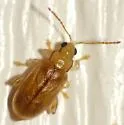
Dogwood Systena
Systena corni
Identification: differs from the similar S. marginalis by weaker markings and association with Cornus florida
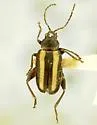
Systena dimorpha
Systena dimorpha
Identification: HOLOTYPE Type Locality: Ordway, Crowley County, Colorado
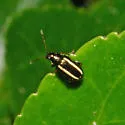
Systena elongata
Systena elongata
Identification: straight yellow stripe along each elytron; curves in slightly at apex; pronotum typically black (dull orange in S. blanda )
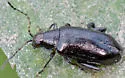
Red-headed Systena
Systena frontalis
Identification: in S. hudsonias antennomeres 3‒6 are pale brown Det. M. A. Quinn, 2021
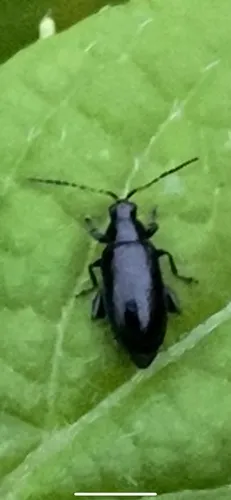
Black-headed Systena
Systena hudsonias
Systena hudsonias, the black-headed flea beetle, is a species of flea beetle in the family Chrysomelidae. It is found in North America.
Systena laevis
Systena laevis
Identification: one of the palest and smoothest of North American species of Systena , sometimes a reddish-brown, narrow sutural vitta not reaching apex, rarely a trace of a lateral vitta; elytra especially in male not much wider than prothorax. HOLO
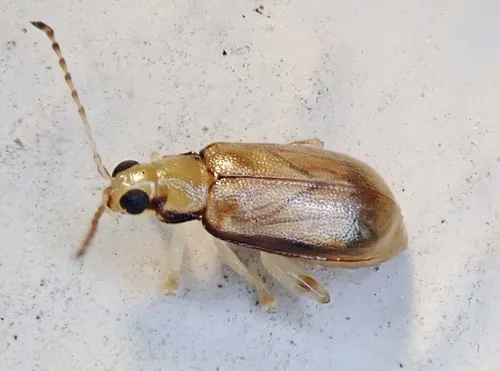
Margined Systena
Systena marginalis
Identification: Systena plicata Blatchley is similar in size and color, but has a distinct lateral fold (ridge) along the margin of each elytron (lacking in S. marginalis ). Systena corni is also similar in general appearance but differs in being les
Systena mitis 0
Systena mitis
Identification: Very like S. frontalis , but head sparingly punctate; thorax almost smooth; legs pale, head and thorax ochreous, this with the sides black; elytra as in S. elongata , but with deeper punctures by the scutellum and along the suture. Ve
Systena pallicornis
Systena pallicornis
Type Locality: Brownsville, Texas (Esperanza Ranch). (Schaeffer 1906)
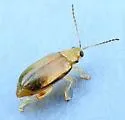
Systena plicata 0
Systena plicata
Type Locality: near Half-Moon Pond, Posey County, Indiana. September 22, 1918.
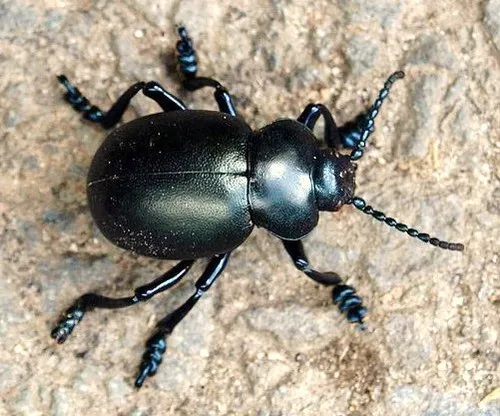
Bloody-nosed Beetle
Timarcha tenebricosa
This is a large flightless species of beetle. The rounded body is blackish in colour, often with a shiny iridescence. Adults are seen between April and June. Active mainly at night, hiding in moss or under stones during the day. It earns its common n
Australian Tortoise Beetle
Trachymela sloanei
Introduced from Australia. First recorded in 1998 in California.
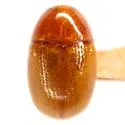
Triachus postremus
Triachus postremus
Identification: Prothorax with a row of punctures at base, which is finely but distinctly margined; oval, convex, testaceous, elytra clouded with brown; Texas. (LeConte 1880)
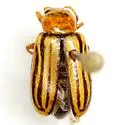
Triariodes vittipennis
Triariodes vittipennis
Type Locality: “Occurs in southwestern Texas, precise region unknown.” (Horn 1893)
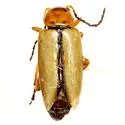
Triarius lividus
Triarius lividus
Identification: quite variable in appearance. Future study may well prove that multiple true species are involved. ( 3 ) Type Locality: Arizona
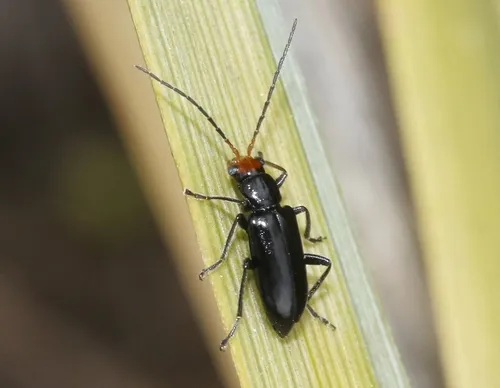
Triarius nigroflavus
Triarius nigroflavus
Identification: sexually dimorphic (BG images show males); females are larger, with orange head and pronotum and a yellow elytra border with black and a longitudinal black stripe in the middle of each elytron. I have only seen records from Orange Cou
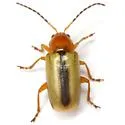
Triarius texanus 0
Triarius texanus
Identification: tarsal claws appendiculate; head and metasternum yellow. The elytra are yellow, except for a narrow, dark brown sutural stripe [likely misidentified as T. lividus in some collections] (emphasis added) Holotype male: TEXAS: Brewster Co
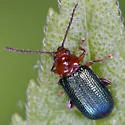
Trichaltica scabricula
Trichaltica scabricula
at high risk of endangerment due to the EAB ( 8 ) Type Locality: Texas (Belfrage)
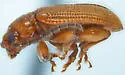
Trichaltica tibialis
Trichaltica tibialis
Trichaltica tibialis is a species of flea beetle in the family Chrysomelidae.
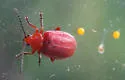
Cherry Leaf Beetle
Tricholochmaea cavicollis
Identification: Larvae are dark brown with black and yellow spots; they are about 6mm long. Overwinter as adults. In spring eggs are deposited in the soil at the base of the tree. The larvae climb the tree and feed on the foliage before returning to
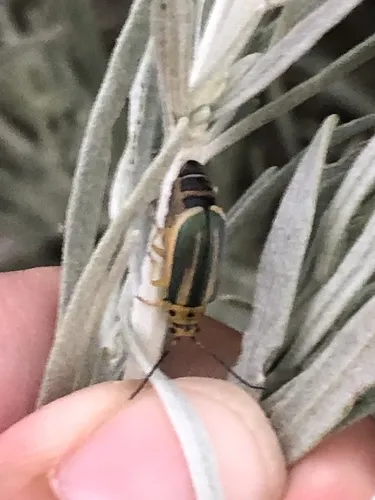
Trirhabda attenuata
Trirhabda attenuata
Trirhabda attenuata is a species of skeletonizing leaf beetle in the family Chrysomelidae. It is found in North America.
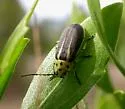
Groundselbush Beetle
Trirhabda bacharidis
Identification: Note tapering elytral stripes Introduced into Australia and Asia to control Baccharis spp. ( 3 )
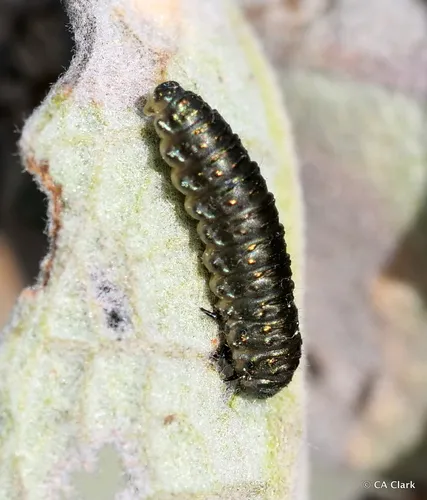
Trirhabda diducta
Trirhabda diducta
Identification: Compared to T. eriodictyonis (the only other congener feeding on Eriodictyon ), T. diducta typically have wider, well-defined sutural vittae. The pronotal spots and the occipital spot tend to be noticeably larger in T. diducta
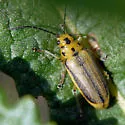
Trirhabda eriodictyonis
Trirhabda eriodictyonis
Other than T. eriodictyonis and T. diducta , only T. flavolimbata from coastal CA has been reported on Eriodictyon , considered an accidental occurrence
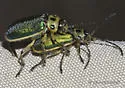
Trirhabda flavolimbata
Trirhabda flavolimbata
Identification: T. labrata is a lookalike which also feeds on Baccharis pilularis • other congeners in CA that may be mistaken for T. flavolimbata are T. luteocincta & T. sericotrachlya (both on Artemisia californica ); and T. confusa & T. manisi (b
Trirhabda labrata
Trirhabda labrata
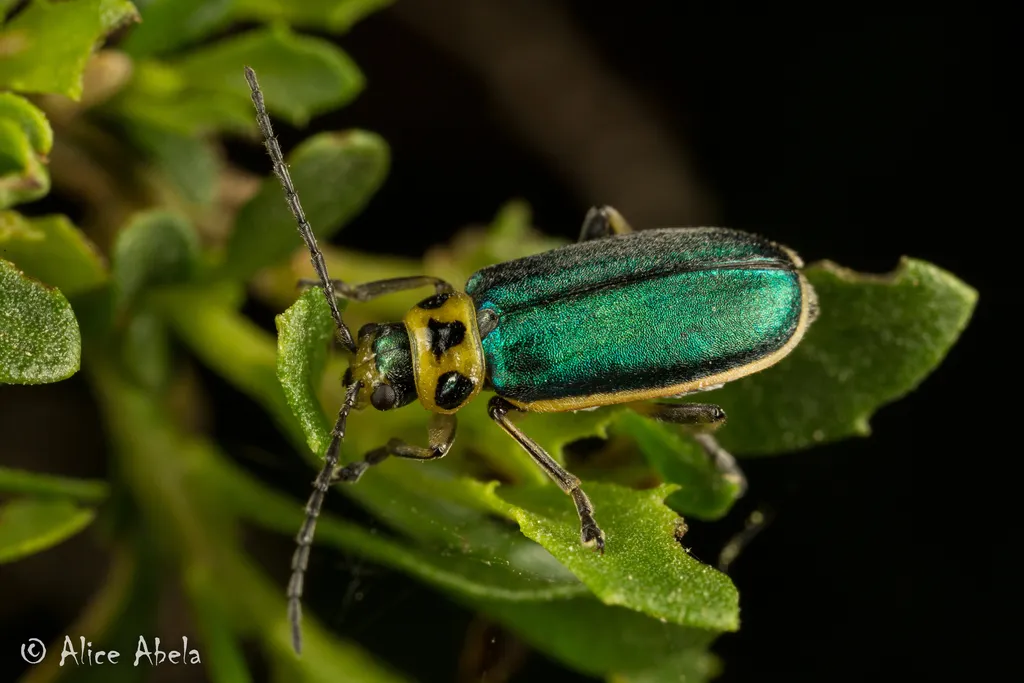
Identification: syntype • pronotal spots large; elytra entirely bright-green to blue-green except for thin pale margin, with sparse, inconspicuous pubescence T. labrata and T. flavolimbata are the only Trirhabda species reported to use the common coa
Trirhabda lewisii
Trirhabda lewisii
Identification: (Characters above culled from Blake, Wilcox, and Swigoňová & Kjer)
Trirhabda luteocincta
Trirhabda luteocincta
Identification: Elytra frequently metallic green, blue, purple or purple-black, infrequently vittate. Underside of abdomen dark (green) with metallic luster, densely hairy. Pronotal spots large, with metallic luster, median spot wedge-shaped. Occipit
Trirhabda manisi
Trirhabda manisi
Identification: The following description for T. manisi is quoted from the 1970 Ph.D dissertation of S. M. Hogue : Medium-sized; elytra metallic blue-green or green, non-vittate. Head with moderately dense, appressed hairs; epicranium alutaceous; pla
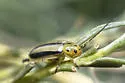
Trirhabda nitidicollis
Trirhabda nitidicollis
Identification: (Characters above culled from Blake, Wilcox, and Swigoňová & Kjer)
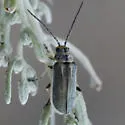
Trirhabda pilosa
Trirhabda pilosa
Identification: [Above culled from key and description in Blake (1931)]
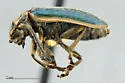
Trirhabda pubicollis
Trirhabda pubicollis
Blake's detailed original description from 1951 can be read at: http://biodiversitylibrary.org/page/39697232 .