
Trirhabda manisi
This record describes Trirhabda manisi (species). Recorded family: Chrysomelidae. Recorded order: Coleoptera.
Identification and Appearance
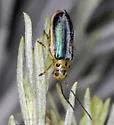
| Feature | Description |
|---|---|
| Additional details | The following description for T. manisi is quoted from the 1970 Ph.D dissertation of S. M. Hogue : Medium-sized; elytra metallic blue-green or green, non-vittate. |
| Head | Head with moderately dense, appressed hairs; epicranium alutaceous; plaga piceous or infrequently with a faint greenish luster, separated from eyes by a narrow testaceous strip and extending broadly down vertex to frontal tubercles, anterior margin transverse; labrum tawny; antennae with basal segments testaceous, terminal segments piceous, ratio of segments 3 to 5, 0.7 : 1.5 : 0.8. |
| Pronotum | Pronotum twice as broad as long, inconspicuously pubescent, lateral margin with small median angle, surface smooth, shining; spots small, lateral rounded, median spot ovoid, smaller than lateral spots and nearer posterior than anterior margin of pronotum. Scutellum piceous. |
| Elytra | Elytra densely clothed with appressed hairs; densely and finely punctate. Ventral surface tawny or with metasternum piceous; with long, dense, appressed hairs. |
| Legs | Legs with distal tarsal segments rufous. |
Classification
- Kingdom
- Animalia
- Phylum
- Arthropoda
- Class
- Insecta
- Order
- Coleoptera (Beetles)
- Suborder
- Polyphaga
- Superfamily
- Chrysomeloidea
- Family
- Chrysomelidae (Leaf Beetles)
- Subfamily
- Galerucinae
- Tribe
- Galerucini
- Genus
- Trirhabda
Imported taxonomy record. Source availability varies; see the source references and editorial policy below.
Habitat and Range
Geographic Range
Hogue lists the range as: "South-central Oregon through north-central California." However, he gives collection record citations for only 3 locales: Siskiyou Summit, Jackson Co. OR (286 specimens altogether over many years); Yreka, Siskiyou Co., CA (9 specimens from 6/28/52); and 10 miles north of Bishop, Inyo Co., CA (3 specimens on 6/30/61).
Seasonal Activity
June to August .
Diet and Behavior
Diet: Host plant is rubber rabbitbrush, Ericameria nauseosa (=Chrysothamnus nauseosus) .
About Primitive Winged Insects: the wider group
Order-level background for Coleoptera, the group containing Trirhabda manisi. Species-specific details appear above.
Group overview
Coleoptera is the largest order of insects with over 400,000 described species, representing ~25% of all known animal species and ~40% of all insects. In the U.S. alone, nearly 30,000 beetle species have been identified.
Ecological role of the group
Beetles are prominent decomposers, especially in forests, breaking down dead wood and recycling nutrients. As predators, they reduce populations of pest insects. Many species are also important pollinators of flowering plants.
Economic and practical significance of the group
Beetles have major economic significance: leaf beetles (Chrysomelidae) and weevils (Curculionoidea) are among the most destructive agricultural pests globally, costing billions annually, while predatory species like ladybugs provide natural pest control.
Recorded sources for this group: Britannica, Smithsonian, NCSU Entomology. Imported estimates may describe particular regions or reporting periods.
Photos of Trirhabda manisi (5)
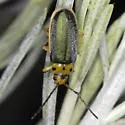
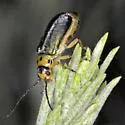
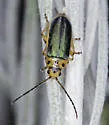
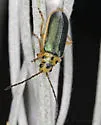
Photo credits: Contributed by Aaron Schusteff
Frequently Asked Questions About Trirhabda manisi
What is Trirhabda manisi?
Trirhabda manisi is a species in the family Chrysomelidae, within the order Coleoptera.
How big is Trirhabda manisi?
5.0-8.0 mm
How do you identify Trirhabda manisi?
| Feature | Description |
|---|---|
| Additional details | The following description for T. manisi is quoted from the 1970 Ph.D dissertation of S. M. Hogue : Medium-sized; elytra metallic blue-green or green, non-vittate. |
| Head | Head with moderately dense, appressed hairs; epicranium alutaceous; plaga piceous or infrequently with a faint greenish luster, separated from eyes by a narrow testaceous strip and extending broadly down vertex to frontal tubercles, anterior margin transverse; labrum tawny; antennae with basal segments testaceous, terminal segments piceous, ratio of segments 3 to 5, 0.7 : 1.5 : 0.8. |
| Pronotum | Pronotum twice as broad as long, inconspicuously pubescent, lateral margin with small median angle, surface smooth, shining; spots small, lateral rounded, median spot ovoid, smaller than lateral spots and nearer posterior than anterior margin of pronotum. Scutellum piceous. |
| Elytra | Elytra densely clothed with appressed hairs; densely and finely punctate. Ventral surface tawny or with metasternum piceous; with long, dense, appressed hairs. |
| Legs | Legs with distal tarsal segments rufous. |
Where is Trirhabda manisi found?
Range: Hogue lists the range as: South-central Oregon through north-central California. However, he gives collection record citations for only 3 locales: Siskiyou Summit, Jackson Co. OR (286 specimens altogether over many years); Yreka, Siskiyou Co., CA (9 specimens from 6/28/52); and 10 miles north of Bishop, Inyo Co., CA (3 specimens on 6/30/61).
What does Trirhabda manisi eat?
The diet of the Trirhabda manisi includes Host plant is rubber rabbitbrush, Ericameria nauseosa (=Chrysothamnus nauseosus) ..
When is Trirhabda manisi active?
Trirhabda manisi: seasonal activity - June to August ..