
Physocephala sagittaria
This record describes Physocephala sagittaria (species). Recorded family: Conopidae. Recorded order: Diptera.
Identification and Appearance
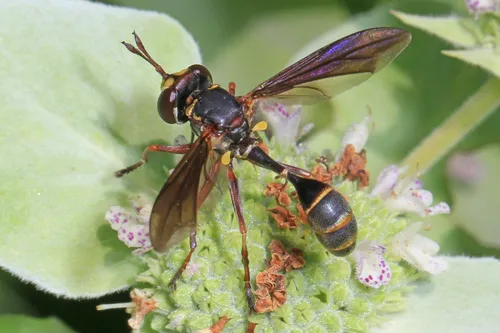
P. sagittaria is a variable species (see Remarks section below) with overall body color grading from dark brownish-black, to deep reddish with black dorsal markings. In each case, the first four or more abdominal segments have thin yellowish apical bands. The most constant characters of the species are: discal cell dark; facial grooves dark; cheeks brown fore and aft, quadrate yellow spot filling middle; yellowish humeral markings present (dash-like and waxy-dusted = pollinose), rarely the dust-like pollinosity faint, revealing underlying red. More variable characters are: vertex usually yellowish-brown to red, sometimes black; scutellum usually red, sometimes black; costal cell usually concolorous with adjacent cells, sometimes lighter brown or even partly hyaline. This appears to be one of the most variable Physocephala species (along with P. marginata and P. texana ). There are (at least) two major color forms of P. sagittaria : Other forms exist corresponding to various modalities associated with the six named entities (and their intermediates) which are synonymized under P. sagittaria .
Wikipedia reference for Physocephala sagittaria: http://en.wikipedia.org/wiki/Physocephala_sagittaria.
Classification
Habitat and Range
Geographic Range
North Dakota e. to Massachusetts, and s. to New Mexico and Florida
About Flies: the wider group
Order-level background for Diptera, the group containing Physocephala sagittaria. Species-specific details appear above.
Group overview
Diptera includes over 150,000 described species of flies, mosquitoes, and midges. Mosquitoes are the deadliest animal on Earth (CDC). Malaria alone causes ~249 million cases and over 608,000 deaths annually, mostly children under 5 (WHO). Vector-borne diseases account for over 17% of all infectious diseases, causing 700,000+ deaths per year.
Ecological role of the group
Despite their disease impact, flies are critical decomposers and pollinators. Hoverflies alone pollinate hundreds of crop and wildflower species. Flies are also the primary food source for many birds, bats, and fish. Forensic entomology relies heavily on fly species for crime scene analysis.
Economic and practical significance of the group
In the U.S., vector-borne disease cases tripled between 2004-2016, with over 640,000 cases reported in that period (CDC). Tickborne diseases doubled from 22,000 to 48,000 annual reports. Globally, mosquito-borne diseases cost billions in healthcare and lost productivity.
Recorded sources for this group: WHO, CDC, PNAS. Imported estimates may describe particular regions or reporting periods.
Photos of Physocephala sagittaria (2)
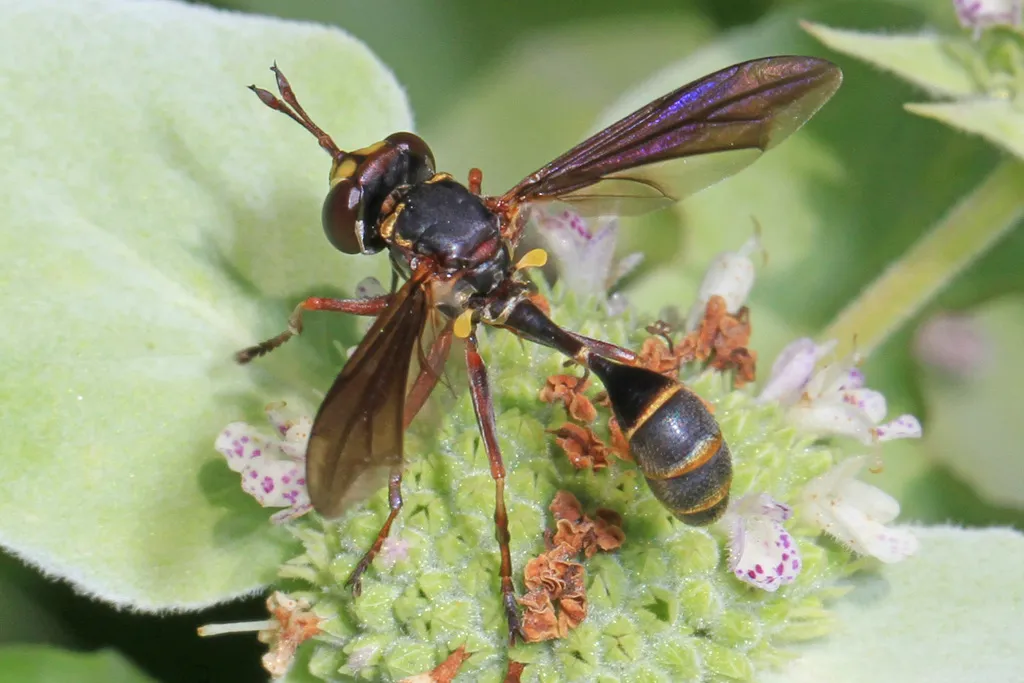
Photo credits: Contributed by Aaron Schusteff
Frequently Asked Questions About Physocephala sagittaria
What is Physocephala sagittaria?
Physocephala sagittaria is a species in the family Conopidae, within the order Diptera.
How do you identify Physocephala sagittaria?
P. sagittaria is a variable species (see Remarks section below) with overall body color grading from dark brownish-black, to deep reddish with black dorsal markings. In each case, the first four or more abdominal segments have thin yellowish apical bands. The most constant characters of the species are: discal cell dark; facial grooves dark; cheeks brown fore and aft, quadrate yellow spot filling middle; yellowish humeral markings present (dash-like and waxy-dusted = pollinose), rarely the dust-like pollinosity faint, revealing underlying red. More variable characters are: vertex usually yellowish-brown to red, sometimes black; scutellum usually red, sometimes black; costal cell usually concolorous with adjacent cells, sometimes lighter brown or even partly hyaline.
Where is Physocephala sagittaria found?
Range: North Dakota e. to Massachusetts, and s. to New Mexico and Florida