
Physocephala floridana
This record describes Physocephala floridana (species). Recorded family: Conopidae. Recorded order: Diptera.
Identification and Appearance
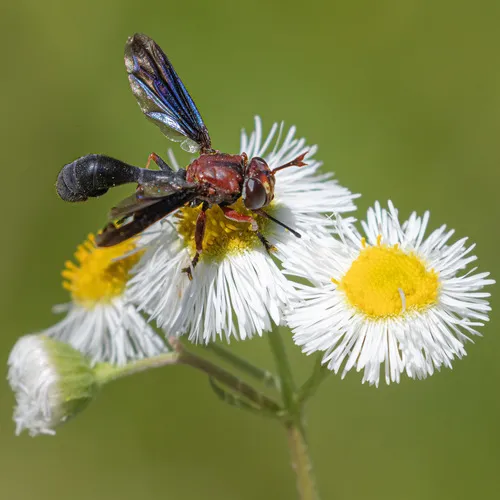
The detailed original species description of P. floridana appears on pg. 214 of Camras (1957), and keys including this species appear at the end of the references by Camras (1957,1996). It is closest in form to P. tibialis but has a distinctive gestalt within the genus arising from its: 1) robust chunkiness; 2) unusually deep-black, often bluish-glossy, wing infuscation; and 3) unusual coloration...its dark black contrasting with deep red on significant portions of the thorax, head, and legs (mainly tibiae in the latter). Note, in particular, that the color pattern on the frons can vary significantly...from having a moderately-wide T-shaped marking (black medially surrounded by white... which is the common pattern in many other Physocephala species) to, more often, having the medial stripe much wider (sometimes filling the entire frons) and being reddish (or mottled black & red). This is unique in our area (i.e north of Mesoamerica)...the posts below illustrate some of the variation: Various BugGuide posts from east Texas (mostly humid, roughly gulf-adjacent areas thereof)...as well as localities far north of Florida between Philadelphia and Rhode Island...suggest the range of this species was poorly known earlier and/or is expanding. The disjunct northern stations are particularly puzzling: it's unclear whether they represent recently-established and possibly growing populations of P. floridana (perhaps introduced by human activity); or whether they were present historically (but previously overlooked); or if they may be arising as sporadic mutants from P. tibialis (and thus perhaps be something other than P. floridana )? For more on this, see the this forum article .
Wikipedia reference for Physocephala floridana: http://en.wikipedia.org/wiki/Physocephala_floridana.
Classification
Habitat and Range
Geographic Range
s.e. US (FL, GA, LA) (Note: There are a number of BugGuide posts from eastern Texas, as well as some far to the north of Floida between Philadelphia and Rhode Island.)
About Flies: the wider group
Order-level background for Diptera, the group containing Physocephala floridana. Species-specific details appear above.
Group overview
Diptera includes over 150,000 described species of flies, mosquitoes, and midges. Mosquitoes are the deadliest animal on Earth (CDC). Malaria alone causes ~249 million cases and over 608,000 deaths annually, mostly children under 5 (WHO). Vector-borne diseases account for over 17% of all infectious diseases, causing 700,000+ deaths per year.
Ecological role of the group
Despite their disease impact, flies are critical decomposers and pollinators. Hoverflies alone pollinate hundreds of crop and wildflower species. Flies are also the primary food source for many birds, bats, and fish. Forensic entomology relies heavily on fly species for crime scene analysis.
Economic and practical significance of the group
In the U.S., vector-borne disease cases tripled between 2004-2016, with over 640,000 cases reported in that period (CDC). Tickborne diseases doubled from 22,000 to 48,000 annual reports. Globally, mosquito-borne diseases cost billions in healthcare and lost productivity.
Recorded sources for this group: WHO, CDC, PNAS. Imported estimates may describe particular regions or reporting periods.
Photos of Physocephala floridana (2)
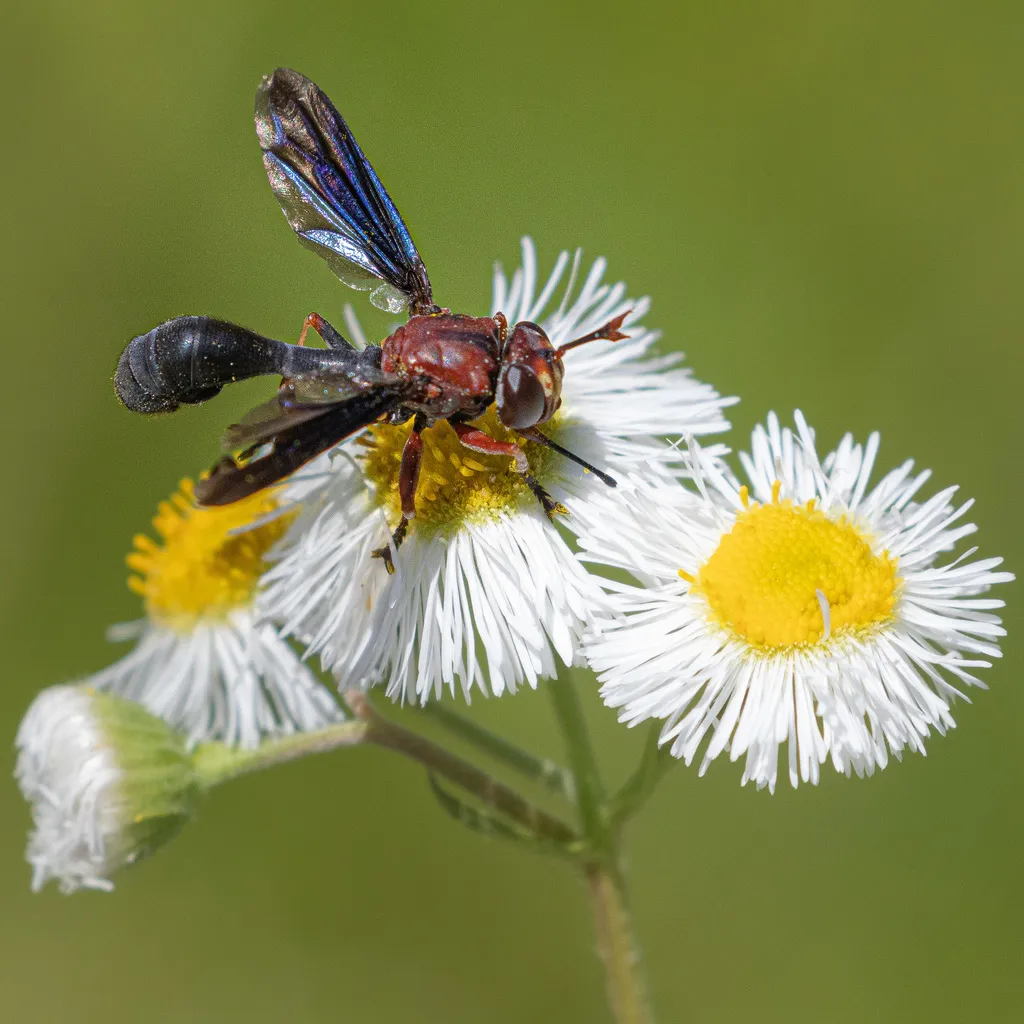
Photo credits: Contributed by Aaron Schusteff; Additional contributions by zdanko
Frequently Asked Questions About Physocephala floridana
What is Physocephala floridana?
Physocephala floridana is a species in the family Conopidae, within the order Diptera.
How do you identify Physocephala floridana?
The detailed original species description of P. floridana appears on pg. 214 of Camras (1957), and keys including this species appear at the end of the references by Camras (1957,1996). It is closest in form to P. tibialis but has a distinctive gestalt within the genus arising from its: 1) robust chunkiness; 2) unusually deep-black, often bluish-glossy, wing infuscation; and 3) unusual coloration...its dark black contrasting with deep red on significant portions of the thorax, head, and legs (mainly tibiae in the latter). Note, in particular, that the color pattern on the frons can vary significantly...from having a moderately-wide T-shaped marking (black medially surrounded by white... which is the common pattern in many other Physocephala species) to, more often, having the medial stripe much wider (sometimes filling the entire frons) and being reddish (or mottled black & red). This is unique in our area (i.e north of Mesoamerica)...the posts below illustrate some of the variation:
Where is Physocephala floridana found?
Range: s.e. US (FL, GA, LA) (Note: There are a number of BugGuide posts from eastern Texas, as well as some far to the north of Floida between Philadelphia and Rhode Island.)