
Physocephala burgessi
This record describes Physocephala burgessi (species). Recorded family: Conopidae. Recorded order: Diptera.
Identification and Appearance
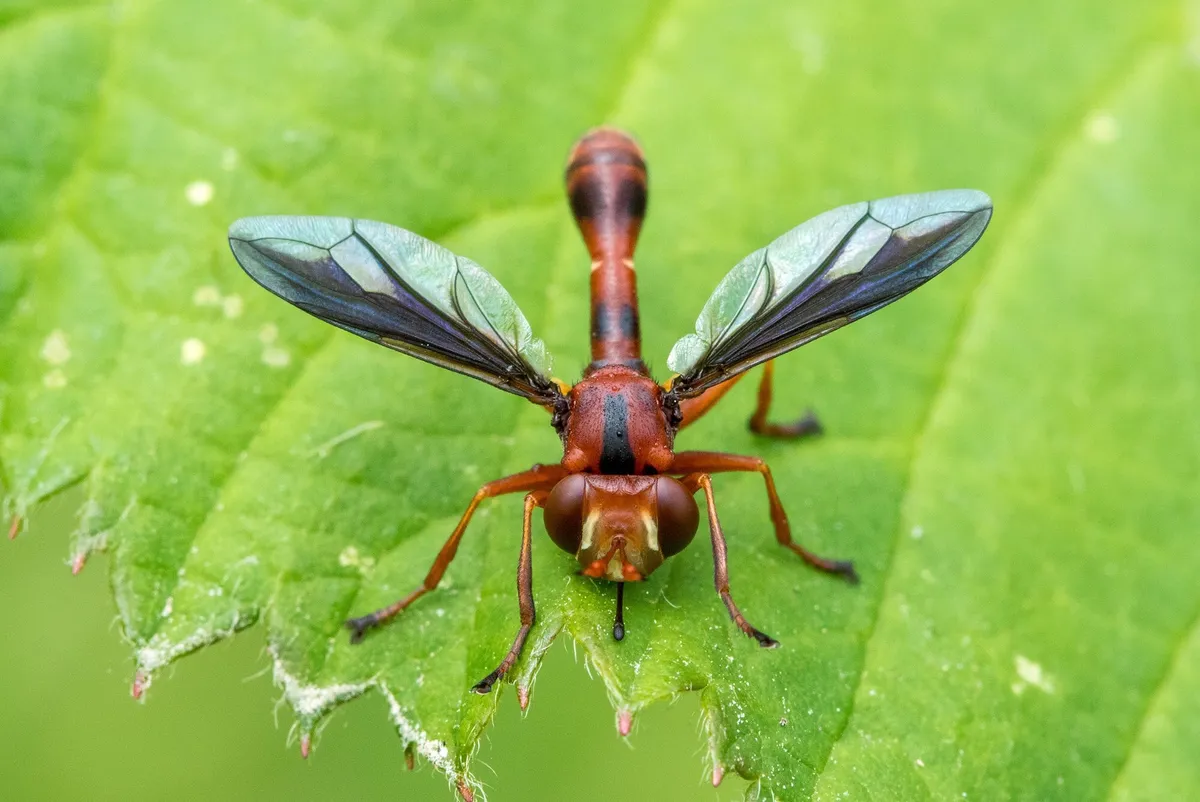
| Feature | Description |
|---|---|
| Additional details | Our only (almost) entirely red species. Flies in western half of U.S. and Canada. |
| Head | Head: Entire face and frons yellowish, including facial grooves. Cheeks reddish. Top of head (vertex) reddish-yellow. There is a light reddish-brown (rarely blackish) medial stripe from top of head to antenna bases, where it forks and continues a short ways down sides of facial ridges. No stripe around eyes. Proboscis short, brownish-red, tip black. Antenna: Red, the 1st segment very short (barely 1/3 x 2nd segment). |
| Thorax | Thorax: Red with a wide median brown stripe from base to center of thorax. Obscure black areas around wing bases and end of thorax. |
| Legs | Legs: Mostly red. Front coxae blackened in front. Shins (tibiae) base half yellowish, rest red. Feet darker red. Claws dark. |
| Wings | Wings: Upper half of wings dark. Small hyaline area in R5, along 4th long. vein. Lower wings hyaline, except for streak in discal cell along 5th vein. Halters yellow, base of stem brown. |
| Abdomen | Abdomen: Red, can have darker shading on sides of segment 2 (petiole) and 3. May have very narrow yellow transverse stripe on segments 1 and 2. Top of last 2 segments may have a very light yellow dusting. Female pad (theca) on underside of segment 5 very small, dark red. Williston's original 1882 description, as Conops burgessi , can be read online here . Holotype female #02402 from California deposited at the California Academy of Sciences as Physocephala brevirostris Van Duzee Type by Williston adult #MCZT_440 In Museum of Comparative Zoology, Osten Sacken Collection, Harvard - location unknown as P. burgessi . Cotypes male and female, 16 from Colorado; Mendocino, California (Snow Entomological Collections, Lawrence, Kansas); location of others unknown. Camras collection of 28 Physocephala burgessi donated to the Field Museum of Natural History, Chicago, Ill. |
Wikipedia reference for Physocephala burgessi: http://en.wikipedia.org/wiki/Physocephala_burgessi.
Classification
Habitat and Range
Geographic Range
California to Texas, north to western Canada (Alberta to B.C.)
Seasonal Activity
Flight time: June to August
Diet and Behavior
Diet: Food: Parasites of wasps and bees, especially the American Bumblebee Bombus pensylvanicus . Also parasitizes Bumblebee Bombus sonorus in California.
About Flies: the wider group
Order-level background for Diptera, the group containing Physocephala burgessi. Species-specific details appear above.
Group overview
Diptera includes over 150,000 described species of flies, mosquitoes, and midges. Mosquitoes are the deadliest animal on Earth (CDC). Malaria alone causes ~249 million cases and over 608,000 deaths annually, mostly children under 5 (WHO). Vector-borne diseases account for over 17% of all infectious diseases, causing 700,000+ deaths per year.
Ecological role of the group
Despite their disease impact, flies are critical decomposers and pollinators. Hoverflies alone pollinate hundreds of crop and wildflower species. Flies are also the primary food source for many birds, bats, and fish. Forensic entomology relies heavily on fly species for crime scene analysis.
Economic and practical significance of the group
In the U.S., vector-borne disease cases tripled between 2004-2016, with over 640,000 cases reported in that period (CDC). Tickborne diseases doubled from 22,000 to 48,000 annual reports. Globally, mosquito-borne diseases cost billions in healthcare and lost productivity.
Recorded sources for this group: WHO, CDC, PNAS. Imported estimates may describe particular regions or reporting periods.
Photos of Physocephala burgessi (3)
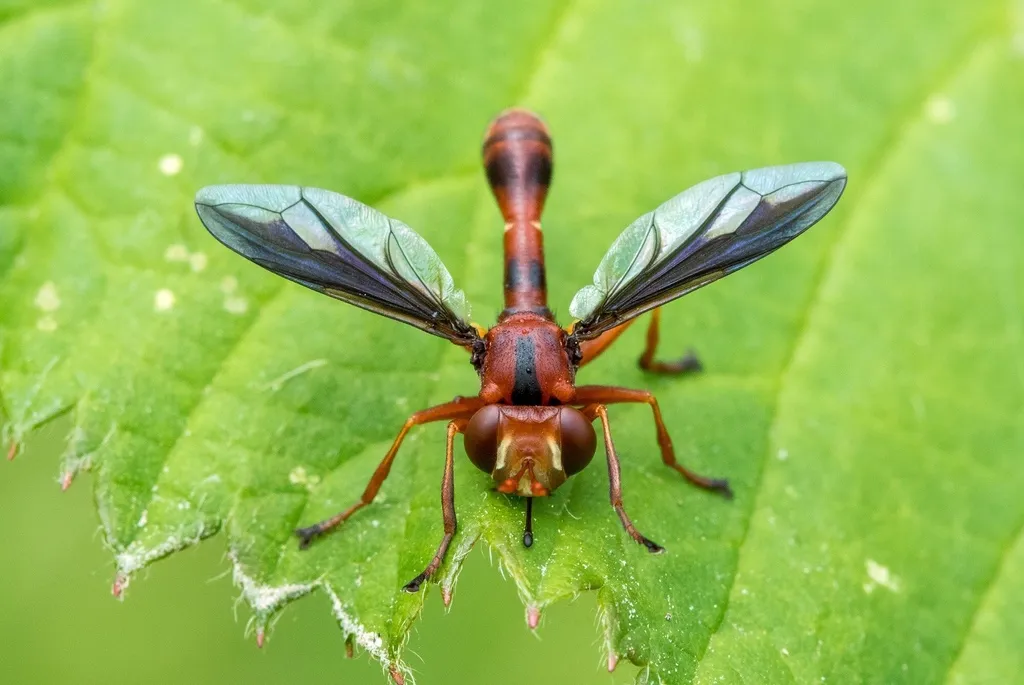
Photo credits: Contributed by Hartmut Wisch; Additional contributions by Beatriz Moisset , Aaron Schusteff
Frequently Asked Questions About Physocephala burgessi
What is Physocephala burgessi?
Physocephala burgessi is a species in the family Conopidae, within the order Diptera.
How big is Physocephala burgessi?
10-11 mm
How do you identify Physocephala burgessi?
| Feature | Description |
|---|---|
| Additional details | Our only (almost) entirely red species. Flies in western half of U.S. and Canada. |
| Head | Head: Entire face and frons yellowish, including facial grooves. Cheeks reddish. Top of head (vertex) reddish-yellow. There is a light reddish-brown (rarely blackish) medial stripe from top of head to antenna bases, where it forks and continues a short ways down sides of facial ridges. No stripe around eyes. Proboscis short, brownish-red, tip black. Antenna: Red, the 1st segment very short (barely 1/3 x 2nd segment). |
| Thorax | Thorax: Red with a wide median brown stripe from base to center of thorax. Obscure black areas around wing bases and end of thorax. |
| Legs | Legs: Mostly red. Front coxae blackened in front. Shins (tibiae) base half yellowish, rest red. Feet darker red. Claws dark. |
| Wings | Wings: Upper half of wings dark. Small hyaline area in R5, along 4th long. vein. Lower wings hyaline, except for streak in discal cell along 5th vein. Halters yellow, base of stem brown. |
| Abdomen | Abdomen: Red, can have darker shading on sides of segment 2 (petiole) and 3. May have very narrow yellow transverse stripe on segments 1 and 2. Top of last 2 segments may have a very light yellow dusting. Female pad (theca) on underside of segment 5 very small, dark red. |
Where is Physocephala burgessi found?
Range: California to Texas, north to western Canada (Alberta to B.C.)
What does Physocephala burgessi eat?
The diet of the Physocephala burgessi includes Food: Parasites of wasps and bees, especially the American Bumblebee Bombus pensylvanicus . Also parasitizes Bumblebee Bombus sonorus in California..
When is Physocephala burgessi active?
Physocephala burgessi: seasonal activity - Flight time: June to August.