
Physocephala marginata
This record describes Physocephala marginata (species). Recorded family: Conopidae. Recorded order: Diptera.
Identification and Appearance
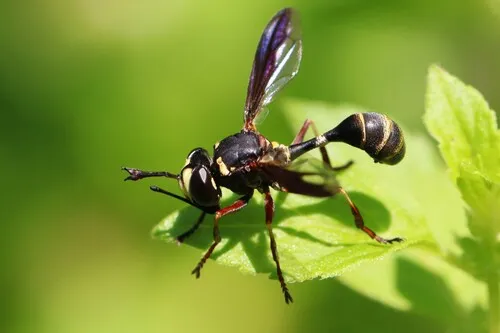
| Feature | Description |
|---|---|
| Additional details | Some salient characters of typical P. marginata are: Wings: Discal cell (mostly) hyaline. The sliver-thin costal cell (along leading edge of wing) often equally as dark as adjacent marginal cells. |
| Thorax | Thorax: Black overall, dorsum with two conspicuously wide, yellow-to-whitish, dusted dashes on the humeri (shoulder pads). Scutellum a clear red. Pleura (=sides of thorax) with a sometimes subtle dusty-whitish marking...triangular below and narrowly linear above...located below wing bases and above the middle leg (see this curated image ). |
| Head | Head: Cheeks with a pale yellowish central area surrounded by dark brown forward and rear borders. Vertex black or brownish black (though described as reddish by Van Duzee for his two synonymized taxa from North Dakota). Facial grooves dark. (Note: The facial grooves are located within the downward V shaped ridges below the antennae and above mouthparts. They should not be confused with the black linear extensions of the medial line of the frons, which forks at the base of the antennae and continues a short ways down along the outer edges of the facial ridges. See here for labelled image illustrating these details.) Physocephala marginata has two main color forms: a dark form that predominates mainly to the east of Texas, where the larger cohort of the species is found; and a rufous color form that predominates from Texas to North Dakota and westward, where the species is more sparsely distributed and can be easily confused with its western congener P. texana (which is itself a rufous-colored species). dark form: rufous form: Intermediates also exist: The original combination, Conops marginatus , per the descriptions in Williston(1882) and Say(1823 were based on eastern material and refer to the dark form; whereas the descriptions of Van Duzee (see links under Synonyms at top of this page) were based on material from North Dakota, and refer to the rufous form. |
Wikipedia reference for Physocephala marginata: http://en.wikipedia.org/wiki/Physocephala_marginata.
Classification
Habitat and Range
Geographic Range
British Columbia to New Hampshire, s. to Calif. and Florida . Also known from southern Ontario and Quebec.
About Flies: the wider group
Order-level background for Diptera, the group containing Physocephala marginata. Species-specific details appear above.
Group overview
Diptera includes over 150,000 described species of flies, mosquitoes, and midges. Mosquitoes are the deadliest animal on Earth (CDC). Malaria alone causes ~249 million cases and over 608,000 deaths annually, mostly children under 5 (WHO). Vector-borne diseases account for over 17% of all infectious diseases, causing 700,000+ deaths per year.
Ecological role of the group
Despite their disease impact, flies are critical decomposers and pollinators. Hoverflies alone pollinate hundreds of crop and wildflower species. Flies are also the primary food source for many birds, bats, and fish. Forensic entomology relies heavily on fly species for crime scene analysis.
Economic and practical significance of the group
In the U.S., vector-borne disease cases tripled between 2004-2016, with over 640,000 cases reported in that period (CDC). Tickborne diseases doubled from 22,000 to 48,000 annual reports. Globally, mosquito-borne diseases cost billions in healthcare and lost productivity.
Recorded sources for this group: WHO, CDC, PNAS. Imported estimates may describe particular regions or reporting periods.
Photos of Physocephala marginata (3)
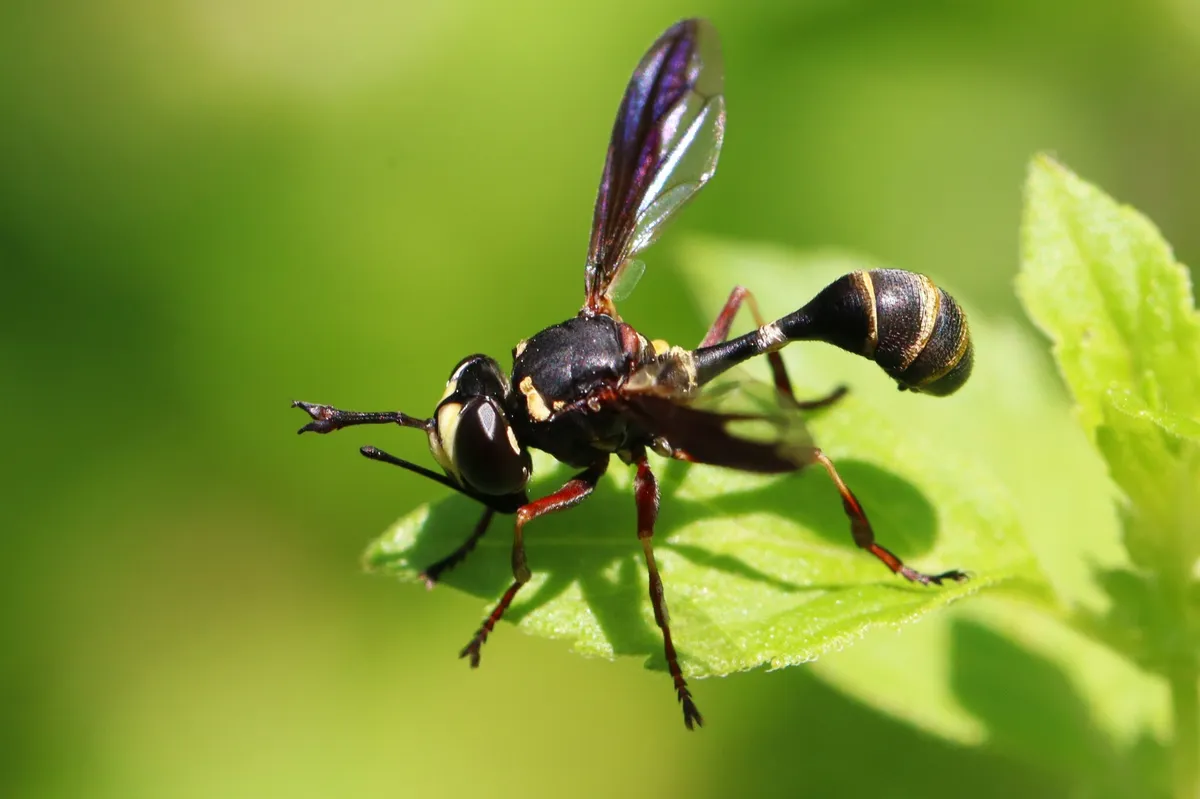
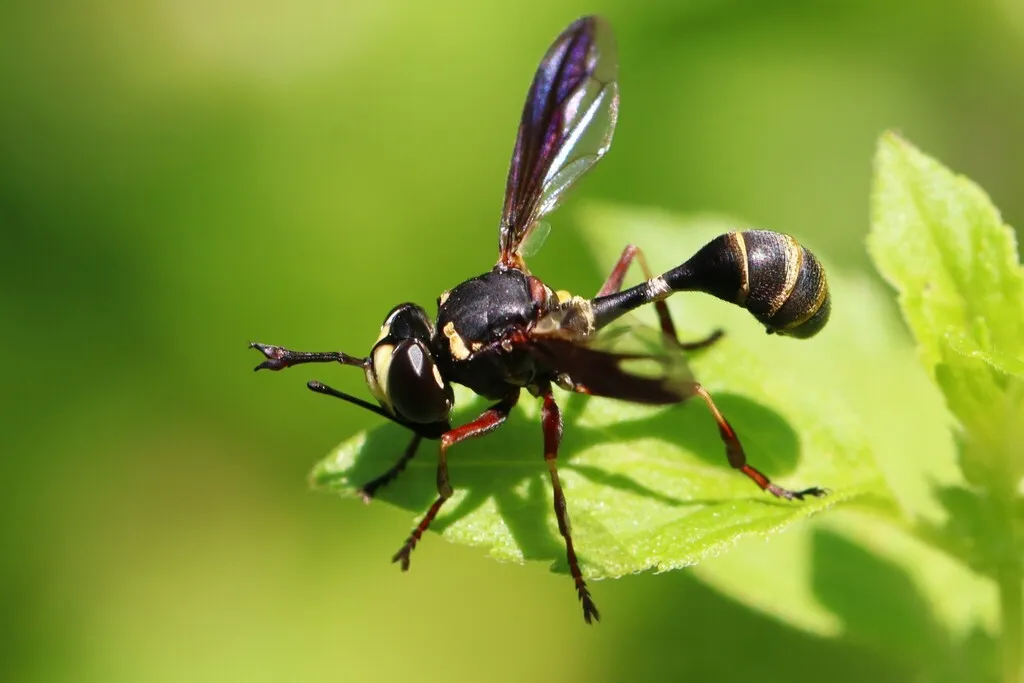
Photo credits: Contributed by Aaron Schusteff
Frequently Asked Questions About Physocephala marginata
What is Physocephala marginata?
Physocephala marginata is a species in the family Conopidae, within the order Diptera.
How do you identify Physocephala marginata?
| Feature | Description |
|---|---|
| Additional details | Some salient characters of typical P. marginata are: Wings: Discal cell (mostly) hyaline. The sliver-thin costal cell (along leading edge of wing) often equally as dark as adjacent marginal cells. |
| Thorax | Thorax: Black overall, dorsum with two conspicuously wide, yellow-to-whitish, dusted dashes on the humeri (shoulder pads). Scutellum a clear red. Pleura (=sides of thorax) with a sometimes subtle dusty-whitish marking...triangular below and narrowly linear above...located below wing bases and above the middle leg (see this curated image ). |
| Head | Head: Cheeks with a pale yellowish central area surrounded by dark brown forward and rear borders. Vertex black or brownish black (though described as reddish by Van Duzee for his two synonymized taxa from North Dakota). Facial grooves dark. (Note: The facial grooves are located within the downward V shaped ridges below the antennae and above mouthparts. They should not be confused with the black linear extensions of the medial line of the frons, which forks at the base of the antennae and continues a short ways down along the outer edges of the facial ridges. See here for labelled image illustrating these details.) |
Where is Physocephala marginata found?
Range: British Columbia to New Hampshire, s. to Calif. and Florida . Also known from southern Ontario and Quebec.