
Green Fool Grasshopper
Acrolophitus hirtipes
This record describes Acrolophitus hirtipes (species). Recorded family: Acrididae. Recorded order: Orthoptera.
Identification and Appearance
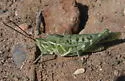
| Feature | Description |
|---|---|
| Additional details | Green, rarely brown, often with cream to pinking mottling. |
| Head | Head pointed. |
| Antennae | Antennae sword-shaped and reddish to nearly black. |
| Pronotum | Pronotum with a prominent smooth rounded crest. |
| Wings | Wings greenish yellow toward the base, and with a broad black cross-band. A novel almost bizarre-looking species that always gets attention when seen. It looks in some ways a lot like a Band-winged Grasshopper. When it flies, the black-banded yellow wings are noticeable, and the hind legs tend to dangle awkwardly downward. |
Classification
- Kingdom
- Animalia
- Phylum
- Arthropoda
- Class
- Insecta
- Order
- Orthoptera (Grasshoppers, Crickets, Katydids)
- Suborder
- Caelifera
- Family
- Acrididae (Short-horned Grasshoppers)
- Subfamily
- Gomphocerinae
- Genus
- Acrolophitus (Point-head Grasshoppers)
Imported taxonomy record. Source availability varies; see the source references and editorial policy below.
Habitat and Range
Habitat
Grasslands, primarily short grasslands, often along roadsides or on hillsides in areas where vegetation is sparse. Always strongly associated with specific host plants.
Geographic Range
Primarily Great Plains from southern Canada to northeastern Mexico; west to Rio Grande Valley in central New Mexico.
Seasonal Activity
Adults mostly in late spring and early summer, but in favorable seasons and habitats some may live until freezing weather in autumn.
Diet and Behavior
Diet: Primarily feeds on Mentzelia species (Loasaceae), and often abundant where colonies of these plants are found. Also sometimes associated with members of family Boranginaceae (includes "Hydrophyllaceae") such as Coldenia, Tiquillia, Nama, Phacelia, Lappula etc. Also, very fond of Phylla (Verbenaceae), and will congregate in numbers on these plants if they are available, but "Fogfruit" only rarely occurs in the right habitat (sometimes around ephemeral fresh water pools in the middle of grasslands). Has been reported to feed occasionally on plants in additional families, though these are probably not regular host plants: Asteraceae, Brassicaceae, Fabaceae, Poaceae, etc., and will also sometimes eat dead insects.
Life History
Eggs laid primarily in early summer, hatch in early spring or (perhaps in south) late autumn, with nymphs in spring or even late winter.
Additional species information
Species notes from the sources
Etymology: The name " uniformis " was applied to almost uniformly green specimens, the coloring that prevails northward from Colorado and Kansas. The name " variegatus " was applied to specimens strongly mottled with pale color, the coloring that prevails southward.
About Grasshoppers, Crickets, Katydids: the wider group
Order-level background for Orthoptera, the group containing Acrolophitus hirtipes. Species-specific details appear above.
Group overview
Orthoptera includes ~28,000 described species of grasshoppers, crickets, and katydids. Desert locusts can form swarms covering 460 square miles containing up to 80 million individuals per square kilometer.
Ecological role of the group
Grasshoppers and crickets are a primary food source for birds, reptiles, and small mammals. Cricket farming is a growing industry - crickets require 12× less feed than cattle to produce the same amount of protein, using 2,000× less water.
Economic and practical significance of the group
A single large locust swarm can consume the same amount of food in one day as 35,000 people. The 2019-2021 East Africa locust crisis affected food security for 42 million people across multiple countries. Global crop losses from locusts can reach billions annually.
Recorded sources for this group: FAO, UN World Food Programme, research publications. Imported estimates may describe particular regions or reporting periods.
Photos of Green Fool Grasshopper (5)
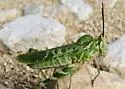
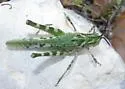
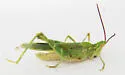
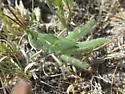
Photo credits: Contributed by David J. Ferguson
Frequently Asked Questions About Green Fool Grasshopper
What is Green Fool Grasshopper?
Green Fool Grasshopper (Acrolophitus hirtipes) is a species in the family Acrididae, within the order Orthoptera.
How big is Green Fool Grasshopper?
25-42 mm males 32-51 mm females
How do you identify Green Fool Grasshopper?
| Feature | Description |
|---|---|
| Additional details | Green, rarely brown, often with cream to pinking mottling. |
| Head | Head pointed. |
| Antennae | Antennae sword-shaped and reddish to nearly black. |
| Pronotum | Pronotum with a prominent smooth rounded crest. |
| Wings | Wings greenish yellow toward the base, and with a broad black cross-band. |
Where is Green Fool Grasshopper found?
| Feature | Details |
|---|---|
| Habitat | Grasslands, primarily short grasslands, often along roadsides or on hillsides in areas where vegetation is sparse. Always strongly associated with specific host plants. |
| Range | Primarily Great Plains from southern Canada to northeastern Mexico; west to Rio Grande Valley in central New Mexico. |
What does Green Fool Grasshopper eat?
The diet of the Green Fool Grasshopper includes Primarily feeds on Mentzelia species (Loasaceae), and often abundant where colonies of these plants are found. Also sometimes associated with members of family Boranginaceae (includes Hydrophyllaceae) such as Coldenia, Tiquillia, Nama, Phacelia, Lappula etc. Also, very fond of Phylla (Verbenaceae), and will congregate in numbers on these plants if they are available, but Fogfruit only rarely occurs in the right habitat (sometimes around ephemeral fresh water pools in the middle of grasslands). Has been reported to feed occasionally on plants in additional families, though these are probably not regular host plants: Asteraceae, Brassicaceae, Fabaceae, Poaceae, etc., and will also sometimes eat dead insects..
When is Green Fool Grasshopper active?
Green Fool Grasshopper: seasonal activity - Adults mostly in late spring and early summer, but in favorable seasons and habitats some may live until freezing weather in autumn..
What is the life cycle of a Green Fool Grasshopper?
Eggs laid primarily in early summer, hatch in early spring or (perhaps in south) late autumn, with nymphs in spring or even late winter.