
Slender Range Grasshopper
Acantherus piperatus
This record describes Acantherus piperatus (species). Recorded family: Acrididae. Recorded order: Orthoptera.
Identification and Appearance
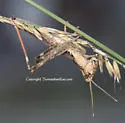
| Feature | Description |
|---|---|
| Additional details | A relatively slender species resembling other toothpick grasshoppers in shape, with subdued often finely mottled gray or brown coloring that blends with surroundings, often quite dark and occasionally nearly black. Often with top half of entire insecte darker than lower half; or often with wings and hind legs darker than remainder of insect. Some individuals, mostly male, will show a contrasting pale whitish or yellowish mid-stripe down the back. Prosternum (between base of front legs) triangular elevated in middle. |
| Antennae | Antennae relatively broad and flattened with white tips. Usually with a pale wide border at the lower edge of the lateral lobes of the pronotum. |
| Wings | Wings are fully developed and the insects can fly, but rarely do. Hind wings are yellowish toward base, and darker smokey apically. Hind legs are generally held splayed to the side somewhat, and knee usually black or nearly so. Hind tibiae red or at least reddish, changing to black toward base and narrowerly ringed with whitish near the base. Resembles in appearance some species of the Asian genus Phlaeoba relatively closely. A very shy species, difficult to observe and photograph. It will dive into cover of thicker, usually spiny vegetation with the slightest disturbance. |
Classification
- Kingdom
- Animalia
- Phylum
- Arthropoda
- Class
- Insecta
- Order
- Orthoptera (Grasshoppers, Crickets, Katydids)
- Suborder
- Caelifera
- Family
- Acrididae (Short-horned Grasshoppers)
- Subfamily
- Gomphocerinae
- Genus
- Acantherus
Imported taxonomy record. Source availability varies; see the source references and editorial policy below.
Habitat and Range
Habitat
Mostly broken terrain in desert grassland or scrub vegetation; Favors clumps of Vine (Bush) Muhly ( Muhlenbergia porteri ) and similar grasses, especially when the grass is growing among spiny shrubs, cacti, yuccas, etc.
Geographic Range
From Trans-Pecos TX, cent. NM, & se. AZ, southward into northern Mexico
Seasonal Activity
Adults summer to autumn
Diet and Behavior
Diet: Probably grasses.
Life History
Overwinters as eggs, hatches in spring or early summer.
About Grasshoppers, Crickets, Katydids: the wider group
Order-level background for Orthoptera, the group containing Acantherus piperatus. Species-specific details appear above.
Group overview
Orthoptera includes ~28,000 described species of grasshoppers, crickets, and katydids. Desert locusts can form swarms covering 460 square miles containing up to 80 million individuals per square kilometer.
Ecological role of the group
Grasshoppers and crickets are a primary food source for birds, reptiles, and small mammals. Cricket farming is a growing industry - crickets require 12× less feed than cattle to produce the same amount of protein, using 2,000× less water.
Economic and practical significance of the group
A single large locust swarm can consume the same amount of food in one day as 35,000 people. The 2019-2021 East Africa locust crisis affected food security for 42 million people across multiple countries. Global crop losses from locusts can reach billions annually.
Recorded sources for this group: FAO, UN World Food Programme, research publications. Imported estimates may describe particular regions or reporting periods.
Photos of Slender Range Grasshopper (5)
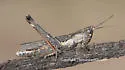
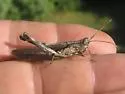
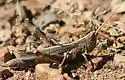
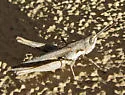
Photo credits: Contributed by Eric R. Eaton; Additional contributions by David Ferguson
Frequently Asked Questions About Slender Range Grasshopper
What is Slender Range Grasshopper?
Slender Range Grasshopper (Acantherus piperatus) is a species in the family Acrididae, within the order Orthoptera.
How do you identify Slender Range Grasshopper?
| Feature | Description |
|---|---|
| Additional details | A relatively slender species resembling other toothpick grasshoppers in shape, with subdued often finely mottled gray or brown coloring that blends with surroundings, often quite dark and occasionally nearly black. Often with top half of entire insecte darker than lower half; or often with wings and hind legs darker than remainder of insect. Some individuals, mostly male, will show a contrasting pale whitish or yellowish mid-stripe down the back. Prosternum (between base of front legs) triangular elevated in middle. |
| Antennae | Antennae relatively broad and flattened with white tips. Usually with a pale wide border at the lower edge of the lateral lobes of the pronotum. |
| Wings | Wings are fully developed and the insects can fly, but rarely do. Hind wings are yellowish toward base, and darker smokey apically. Hind legs are generally held splayed to the side somewhat, and knee usually black or nearly so. Hind tibiae red or at least reddish, changing to black toward base and narrowerly ringed with whitish near the base. |
Where is Slender Range Grasshopper found?
| Feature | Details |
|---|---|
| Habitat | Mostly broken terrain in desert grassland or scrub vegetation; Favors clumps of Vine (Bush) Muhly ( Muhlenbergia porteri ) and similar grasses, especially when the grass is growing among spiny shrubs, cacti, yuccas, etc. |
| Range | From Trans-Pecos TX, cent. NM, & se. AZ, southward into northern Mexico |
What does Slender Range Grasshopper eat?
The diet of the Slender Range Grasshopper includes Probably grasses..
When is Slender Range Grasshopper active?
Slender Range Grasshopper: seasonal activity - Adults summer to autumn.
What is the life cycle of a Slender Range Grasshopper?
Overwinters as eggs, hatches in spring or early summer.