
Wheeler's Blue-winged Grasshopper
Leprus wheeleri
This record describes Leprus wheeleri (species). Recorded family: Acrididae. Recorded order: Orthoptera.
Identification and Appearance
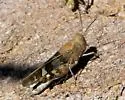
Large robust grasshopper with large head, Tegmina with well defined wide cross bands and usually two pale lines running along top edges when folded. Wings yellow to light blue (usually greenish) with a curved dark band (no spur) along outer margin. The species varies somewhat regionally. Those from the south in Mexico often have extremely large heads and relatively short wings. Those from the Colorado Plateaus probably have the bluest wings on average. Those from the southern Great Plains tend to be very large and more slender looking due to smaller (still big) heads and longer wings, and usually have yellow wings and often yellowish hind tibiae. See comments under Leprus intermedius . A powerful but nearly silent flier, often difficult to approach. This is one of those species that can in some areas be rare or apparently absent for many years, and then all of the sudden will be extremely abundant for a year or several. This is particularly true in the north of its range (as in Utah and Colorado). In parts of w. Texas, New Mexico and Arizona, it is often one of the most common and prominent Band-wing Grasshoppers of the later part of the season. In evening this species is sometimes attracted to lights in large numbers, and seems to be capable of flying long distances to reach them.
Classification
- Kingdom
- Animalia
- Phylum
- Arthropoda
- Class
- Insecta
- Order
- Orthoptera (Grasshoppers, Crickets, Katydids)
- Suborder
- Caelifera
- Family
- Acrididae (Short-horned Grasshoppers)
- Subfamily
- Oedipodinae
- Tribe
- Hippiscini
- Genus
- Leprus
Imported taxonomy record. Source availability varies; see the source references and editorial policy below.
Habitat and Range
Habitat
Mostly on hot exposed gravelly slopes in hilly terrain, with at least some mixed grass and herb cover, in desert and grasslands.
Geographic Range
from the south base of the Tavaputs Plateau in e. Utah / w. Colorado, the Arkansas Valley in se. Colorado, extreme sw. Kansas, w. Oklahoma Panhandle, Texas Panhandle, and central Texas, southward across much of Arizona (not in westernmost), all of New Mexico, and w. Texas to central Mexico.
Seasonal Activity
Adults late spring to frost, but most common in late summer and early autumn.
Diet and Behavior
Diet: Not well documented, but probably mostly mixed herbaceous plants. Exhibits some carnivorous tendencies and will scavenge dead arthropods.
Life History
Overwinters as eggs.
Additional species information
Species notes from the sources
Etymology: "Wheeler's BLUE-winged Grasshopper" is not an entirely accurate common name, since east of the Rockies and Pecos River, the wings of this species are actually usually yellow, with shades of green and especially blue commonly seen only further west. The species was probably described originally from southeastern Colorado, where the wings are usually yellow.
About Grasshoppers, Crickets, Katydids: the wider group
Order-level background for Orthoptera, the group containing Leprus wheeleri. Species-specific details appear above.
Group overview
Orthoptera includes ~28,000 described species of grasshoppers, crickets, and katydids. Desert locusts can form swarms covering 460 square miles containing up to 80 million individuals per square kilometer.
Ecological role of the group
Grasshoppers and crickets are a primary food source for birds, reptiles, and small mammals. Cricket farming is a growing industry - crickets require 12× less feed than cattle to produce the same amount of protein, using 2,000× less water.
Economic and practical significance of the group
A single large locust swarm can consume the same amount of food in one day as 35,000 people. The 2019-2021 East Africa locust crisis affected food security for 42 million people across multiple countries. Global crop losses from locusts can reach billions annually.
Recorded sources for this group: FAO, UN World Food Programme, research publications. Imported estimates may describe particular regions or reporting periods.
Photos of Wheeler's Blue-winged Grasshopper (5)
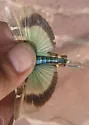
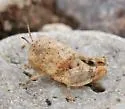
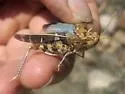
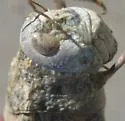
Photo credits: Contributed by Eric R. Eaton; Additional contributions by David Ferguson
Frequently Asked Questions About Wheeler's Blue-winged Grasshopper
What is Wheeler's Blue-winged Grasshopper?
Wheeler's Blue-winged Grasshopper (Leprus wheeleri) is a species in the family Acrididae, within the order Orthoptera.
How do you identify Wheeler's Blue-winged Grasshopper?
Large robust grasshopper with large head, Tegmina with well defined wide cross bands and usually two pale lines running along top edges when folded. Wings yellow to light blue (usually greenish) with a curved dark band (no spur) along outer margin. The species varies somewhat regionally. Those from the south in Mexico often have extremely large heads and relatively short wings. Those from the Colorado Plateaus probably have the bluest wings on average. Those from the southern Great Plains tend to be very large and more slender looking due to smaller (still big) heads and longer wings, and usually have yellow wings and often yellowish hind tibiae. See comments under Leprus intermedius .
Where is Wheeler's Blue-winged Grasshopper found?
| Feature | Details |
|---|---|
| Habitat | Mostly on hot exposed gravelly slopes in hilly terrain, with at least some mixed grass and herb cover, in desert and grasslands. |
| Range | from the south base of the Tavaputs Plateau in e. Utah / w. Colorado, the Arkansas Valley in se. Colorado, extreme sw. Kansas, w. Oklahoma Panhandle, Texas Panhandle, and central Texas, southward across much of Arizona (not in westernmost), all of New Mexico, and w. Texas to central Mexico. |
What does Wheeler's Blue-winged Grasshopper eat?
The diet of the Wheeler's Blue-winged Grasshopper includes Not well documented, but probably mostly mixed herbaceous plants. Exhibits some carnivorous tendencies and will scavenge dead arthropods..
When is Wheeler's Blue-winged Grasshopper active?
Wheeler's Blue-winged Grasshopper: seasonal activity - Adults late spring to frost, but most common in late summer and early autumn..
What is the life cycle of a Wheeler's Blue-winged Grasshopper?
Overwinters as eggs.