
Nevada Point-Head Grasshopper
Acrolophitus nevadensis
This record describes Acrolophitus nevadensis (species). Recorded family: Acrididae. Recorded order: Orthoptera.
Identification and Appearance
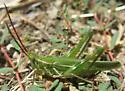
Similar to A. hirtipes , except with no crest on pronotum, smaller in size, and occuring further west (not known to overlap in distribution). A. pulchellus is very similar, except with more extensive pale markings, and found further north in Idaho. Has been treated as a regional variant or synonym of the same species, but this is a more stocky insect with proportionately larger pronotum. It is generally treated as distinct. Behavior is more similar to a Bandwing Grasshopper than to most other Slantface species. This is an alert insect that is fairly difficult to follow and catch. When flushed, specimens will typically fly up and then horizantally for some distance, and are often difficult to visually keep track of among the other (often abundant) yellow-winged species that fly up with it. There seems to be a very faint ticking sould produced when these fly, but this needs verification, as it is difficult to sort out various insect sounds that are occuring all at once. Similar sound has been noticed from other Acrolophitus species (except A. hirtipes ).
Classification
- Kingdom
- Animalia
- Phylum
- Arthropoda
- Class
- Insecta
- Order
- Orthoptera (Grasshoppers, Crickets, Katydids)
- Suborder
- Caelifera
- Family
- Acrididae (Short-horned Grasshoppers)
- Subfamily
- Gomphocerinae
- Genus
- Acrolophitus (Point-head Grasshoppers)
Imported taxonomy record. Source availability varies; see the source references and editorial policy below.
Habitat and Range
Habitat
Has been found in grassland, open Pinon-Juniper, and sandhills environments. Little is known of it's needs or habits.
Geographic Range
west central New Mexico, west across northern Arizona into eastern Nevada, and north into Utah and northwestern Colorado. Very rarely encountered, and known from few widely scattered locations. Likely more common than realized, but a better understanding of host preferences and habits is needed.
Diet and Behavior
Diet: Not definitely documented. Has been listed as associated with several plant species ( Lappula coronata, Actinidia richardsonii, Artemisia frigida, Gutierrezia sp., Bouteloua sp.), but these are unlikely to all really be food plants. Likely (based on close relatives' choices) the prefered host plants will be small shrubby or herbaceous Asteraceae, Loacaceae or Boraginaceae. Of those listed, Actinidia or Lappula seem the most likely candidates, but these plants are so generally distributed and common as to make one wonder why the insects would not be more commonly found.
Life History
Eggs overwinter in soil, hatch in spring, and mature in late June or July. Adults mostly gone before September.
About Grasshoppers, Crickets, Katydids: the wider group
Order-level background for Orthoptera, the group containing Acrolophitus nevadensis. Species-specific details appear above.
Group overview
Orthoptera includes ~28,000 described species of grasshoppers, crickets, and katydids. Desert locusts can form swarms covering 460 square miles containing up to 80 million individuals per square kilometer.
Ecological role of the group
Grasshoppers and crickets are a primary food source for birds, reptiles, and small mammals. Cricket farming is a growing industry - crickets require 12× less feed than cattle to produce the same amount of protein, using 2,000× less water.
Economic and practical significance of the group
A single large locust swarm can consume the same amount of food in one day as 35,000 people. The 2019-2021 East Africa locust crisis affected food security for 42 million people across multiple countries. Global crop losses from locusts can reach billions annually.
Recorded sources for this group: FAO, UN World Food Programme, research publications. Imported estimates may describe particular regions or reporting periods.
Photos of Nevada Point-Head Grasshopper (5)
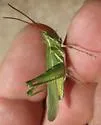
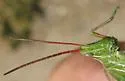
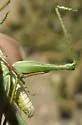
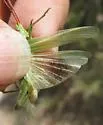
Photo credits: Contributed by David J. Ferguson
Frequently Asked Questions About Nevada Point-Head Grasshopper
What is Nevada Point-Head Grasshopper?
Nevada Point-Head Grasshopper (Acrolophitus nevadensis) is a species in the family Acrididae, within the order Orthoptera.
How do you identify Nevada Point-Head Grasshopper?
Similar to A. hirtipes , except with no crest on pronotum, smaller in size, and occuring further west (not known to overlap in distribution). A. pulchellus is very similar, except with more extensive pale markings, and found further north in Idaho. Has been treated as a regional variant or synonym of the same species, but this is a more stocky insect with proportionately larger pronotum. It is generally treated as distinct.
Where is Nevada Point-Head Grasshopper found?
| Feature | Details |
|---|---|
| Habitat | Has been found in grassland, open Pinon-Juniper, and sandhills environments. Little is known of it's needs or habits. |
| Range | west central New Mexico, west across northern Arizona into eastern Nevada, and north into Utah and northwestern Colorado. Very rarely encountered, and known from few widely scattered locations. Likely more common than realized, but a better understanding of host preferences and habits is needed. |
What does Nevada Point-Head Grasshopper eat?
The diet of the Nevada Point-Head Grasshopper includes Not definitely documented. Has been listed as associated with several plant species ( Lappula coronata, Actinidia richardsonii, Artemisia frigida, Gutierrezia sp., Bouteloua sp.), but these are unlikely to all really be food plants. Likely (based on close relatives' choices) the prefered host plants will be small shrubby or herbaceous Asteraceae, Loacaceae or Boraginaceae. Of those listed, Actinidia or Lappula seem the most likely candidates, but these plants are so generally distributed and common as to make one wonder why the insects would not be more commonly found..
What is the life cycle of a Nevada Point-Head Grasshopper?
Eggs overwinter in soil, hatch in spring, and mature in late June or July. Adults mostly gone before September.