
Saussure's Blue-winged Grasshopper
Leprus intermedius
This record describes Leprus intermedius (species). Recorded family: Acrididae. Recorded order: Orthoptera.
Identification and Appearance
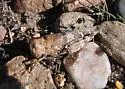
Stocky grasshopper with varied coloring in shades of browns and grays (sometimes nearly black). The tegmina are crossed by well defined dark bands, and there are usually two pale lines along their top angles when folded. The wings are usually bright blue, or in some far southwestern areas bright blue-green or green. It is crossed by a broad black curving band near the outer edge, but there is no spur extending inward from this. In some small areas (s. Nevada, ne. Arizona, n. Baja) the black band may cover most of the wing. The hind tibia is blue or sometimes green in green-winged individuals. Leprus wheeleri is the only other species likely to be confused with it. In L. intermedius the wings are more strongly pigmented, the sides of the pronotum widen downward, and the underside of the body usually has strong blue pigmenting along the grooves and depressions. The top of the abdomen is usually rich deep blue. In the usually larger L. wheeleri the wings are more translucent, lighter in color, and range from yellow to pale blue in color, with greenish being most common except on the Great Plains (where yellow is most common). The dark band across the wings is usually narrower and also less strongly pigmented. The hind tibiae are lighter in color too, and vary from yellow to blue, but are most often pale blueish. The sides of the pronotum have the front and back margins nearly parallel, sometimes even slightly narrower at the bottom. Habitat is another clue. L. wheeleri favors open rolling or slightly broken country, often in hilly plains, valleys, or on the bajadas at the base of cliffs and mountains, and it favors gravelly ground. L. intermedius favors rocky slopes, often very steep. L. wheeleri can be very difficult to catch and often flies long distances, while L. intermedius tends to make short flights and to stick fairly closely to it's steep habitats, with females often just hopping like little toads, and not even flying.
Classification
- Kingdom
- Animalia
- Phylum
- Arthropoda
- Class
- Insecta
- Order
- Orthoptera (Grasshoppers, Crickets, Katydids)
- Suborder
- Caelifera
- Family
- Acrididae (Short-horned Grasshoppers)
- Subfamily
- Oedipodinae
- Tribe
- Hippiscini
- Genus
- Leprus
Imported taxonomy record. Source availability varies; see the source references and editorial policy below.
Habitat and Range
Geographic Range
Southwest US and northern Mexico. From central Colorado to west Texas (clipping the tip of the OK Panhandle), and west to the Sierra Nevada in northern California and the Pacific coast in southern California. The distribution in Mexico is poorly documented, but south at least to southern Coahuila, Durango, Sinaloa, and into Baja California Sur.
Seasonal Activity
Adults are seen mostly mid summer to late fall, occasionally as early as late June.
Diet and Behavior
Diet: Poorly documented, but probably mixed plants. These will scavenge dead arthropods, and have been known to eat each other in captivity.
Life History
Overwinters as eggs.
About Grasshoppers, Crickets, Katydids: the wider group
Order-level background for Orthoptera, the group containing Leprus intermedius. Species-specific details appear above.
Group overview
Orthoptera includes ~28,000 described species of grasshoppers, crickets, and katydids. Desert locusts can form swarms covering 460 square miles containing up to 80 million individuals per square kilometer.
Ecological role of the group
Grasshoppers and crickets are a primary food source for birds, reptiles, and small mammals. Cricket farming is a growing industry - crickets require 12× less feed than cattle to produce the same amount of protein, using 2,000× less water.
Economic and practical significance of the group
A single large locust swarm can consume the same amount of food in one day as 35,000 people. The 2019-2021 East Africa locust crisis affected food security for 42 million people across multiple countries. Global crop losses from locusts can reach billions annually.
Recorded sources for this group: FAO, UN World Food Programme, research publications. Imported estimates may describe particular regions or reporting periods.
Photos of Saussure's Blue-winged Grasshopper (5)
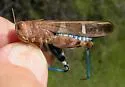
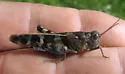
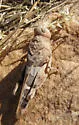
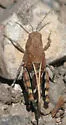
Photo credits: Contributed by Tom Bentley; Additional contributions by David Ferguson
Frequently Asked Questions About Saussure's Blue-winged Grasshopper
What is Saussure's Blue-winged Grasshopper?
Saussure's Blue-winged Grasshopper (Leprus intermedius) is a species in the family Acrididae, within the order Orthoptera.
How do you identify Saussure's Blue-winged Grasshopper?
Stocky grasshopper with varied coloring in shades of browns and grays (sometimes nearly black). The tegmina are crossed by well defined dark bands, and there are usually two pale lines along their top angles when folded. The wings are usually bright blue, or in some far southwestern areas bright blue-green or green. It is crossed by a broad black curving band near the outer edge, but there is no spur extending inward from this. In some small areas (s. Nevada, ne. Arizona, n. Baja) the black band may cover most of the wing. The hind tibia is blue or sometimes green in green-winged individuals. Leprus wheeleri is the only other species likely to be confused with it. In L. intermedius the wings are more strongly pigmented, the sides of the pronotum widen downward, and the underside of the body usually has strong blue pigmenting along the grooves and depressions. The top of the abdomen is usually rich deep blue. In the usually larger L. wheeleri the wings are more translucent, lighter in color, and range from yellow to pale blue in color, with greenish being most common except on the Great Plains (where yellow is most common). The dark band across the wings is usually narrower and also less strongly pigmented. The hind tibiae are lighter in color too, and vary from yellow to blue, but are most often pale blueish. The sides of the pronotum have the front and back margins nearly parallel, sometimes even slightly narrower at the bottom. Habitat is another clue. L. wheeleri favors open rolling or slightly broken country, often in hilly plains, valleys, or on the bajadas at the base of cliffs and mountains, and it favors gravelly ground. L. intermedius favors rocky slopes, often very steep. L. wheeleri can be very difficult to catch and often flies long distances, while L. intermedius tends to make short flights and to stick fairly closely to it's steep habitats, with females often just hopping like little toads, and not even flying.
Where is Saussure's Blue-winged Grasshopper found?
Range: Southwest US and northern Mexico. From central Colorado to west Texas (clipping the tip of the OK Panhandle), and west to the Sierra Nevada in northern California and the Pacific coast in southern California. The distribution in Mexico is poorly documented, but south at least to southern Coahuila, Durango, Sinaloa, and into Baja California Sur.
What does Saussure's Blue-winged Grasshopper eat?
The diet of the Saussure's Blue-winged Grasshopper includes Poorly documented, but probably mixed plants. These will scavenge dead arthropods, and have been known to eat each other in captivity..
When is Saussure's Blue-winged Grasshopper active?
Saussure's Blue-winged Grasshopper: seasonal activity - Adults are seen mostly mid summer to late fall, occasionally as early as late June..
What is the life cycle of a Saussure's Blue-winged Grasshopper?
Overwinters as eggs.