
Family Underwing, Tiger, Tussock, and Allied Moths (Noctuidae)
Noctuidae is a family in the order Lepidoptera. Browse 2,425 named species recorded in this family, or open an individual profile for its available identification and natural-history information.
Species in Noctuidae (2,425)
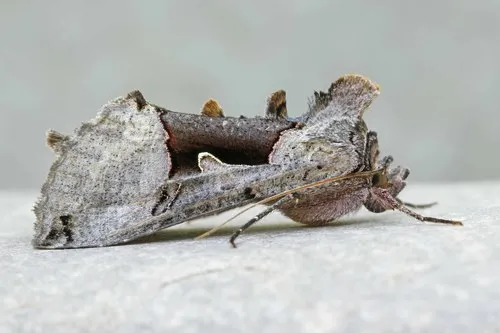
Large Looper Moth - Hodges#8923
Autographa ampla
Identification: Adults - forewing gray with dark brown or black apical dash and sharply-defined blackish or dark reddish-brown lower median area; stigma white, diagonal, U-shaped, forming upper border of median patch; small pinkish patch distal to re
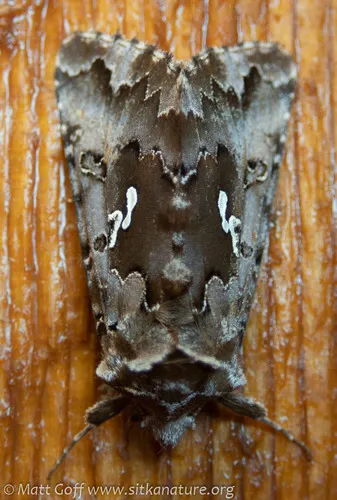
Autographa corusca - Hodges#8918
Autographa corusca
Autographa corusca - Hodges#8918 (Autographa corusca) is a species in the family Noctuidae, commonly known as owlet moths, belonging to the order Lepidoptera (Butterflies and Moths). It is classified within the subfamily Plusiinae, tribe Plusiini, su
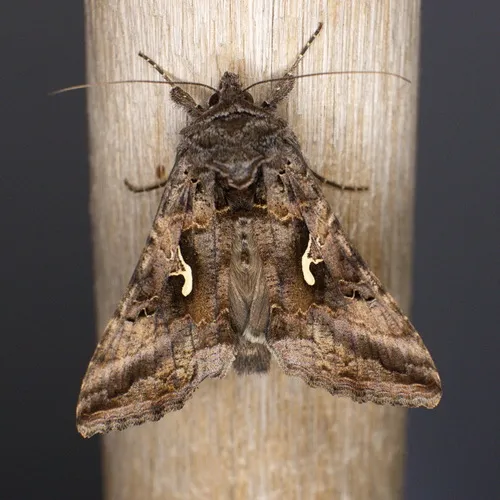
Silver Y
Autographa gamma
Wingspan 35-40 mm. It has a distinctive unbroken metallic silver 'Y' mark on the brown and grey marbled forewing, which sometimes has a purple tinge. The adults can be found from spring through till late autumn, and can be seen by day as well as at n
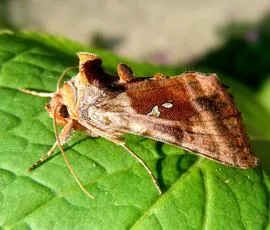
Plain Golden Y
Autographa jota
Wingspan 35-40 mm. Similar in appearance to the Beautiful Golden Y this moth has a plainer, more brick-red appearance, with fewer less-distinct metallic markings. The species inhabits gardens, waste ground, and woodland areas. This species is on the
Autographa labrosa - Hodges#8920
Autographa labrosa
Identification: Similar to Autographa corusca. The species overlap only in Mendocino county, California, where they can be difficult to distinguish. A. corusca generally has a more mottled appearance. The two species can normally be separated by r
Wavy Chestnut Y - Hodges#8912
Autographa mappa
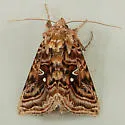
Identification: Adults - forewing chestnut brown with numerous wavy bands and lines of darker brown and black in very distinctive pattern; scattered silver gold metallic scales in lower parts of AM and PM lines, as well as along basal line and outlin
Beautiful Golden Y
Autographa pulchrina
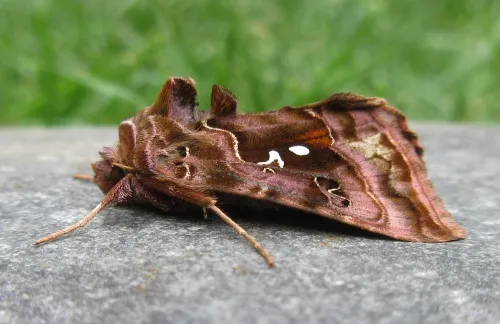
Wingspan 35-40 mm. Similar to the plain Golden 'Y', but with richer maroon colouring in the wings. Similar to the plain Golden 'Y', but with richer colouring in the wings and a more obvious kidney-spot - usually outlined. The species inhabits gardens
Rubida Looper Moth - Hodges#8909
Autographa rubidus
Identification: The following information is from the ( E.H. Strickland Entomological Museum ). A medium-size (3.5 cm wingspan) moth with dark rusty red-brown forewings with a dark violet tint. The area inside the antemedian line and in the apical an
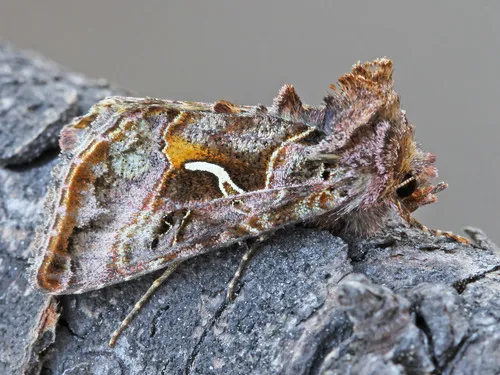
Autographa sansoni - Hodges#8910
Autographa sansoni
Autographa sansoni - Hodges#8910 (Autographa sansoni) is a species in the family Noctuidae, commonly known as owlet moths, belonging to the order Lepidoptera (Butterflies and Moths). It is classified within the subfamily Plusiinae, tribe Plusiini, su
Autographa speciosa - Hodges#8919
Autographa speciosa
Autographa speciosa - Hodges#8919 (Autographa speciosa) is a species in the family Noctuidae, commonly known as owlet moths, belonging to the order Lepidoptera (Butterflies and Moths). It is classified within the subfamily Plusiinae, tribe Plusiini,
White Y Mark - Hodges#8921
Autographa v-alba
Identification: Forewings are iridescent pale violet grey and dark slate grey. The stigma is a small, silvery white v shape.
Bean-leaf Skeletonizer Moth - Hodges#8891
Autoplusia egena
Identification: Ground light brown, dark reddish-brown with coppery iridescence between AM & PM ● Coppery iridescent patch below PM, both extending to apex ● Orbicular spot, ovate and reniform oblong, faint ● ST black, bidentate ● HW dull fuscous, li
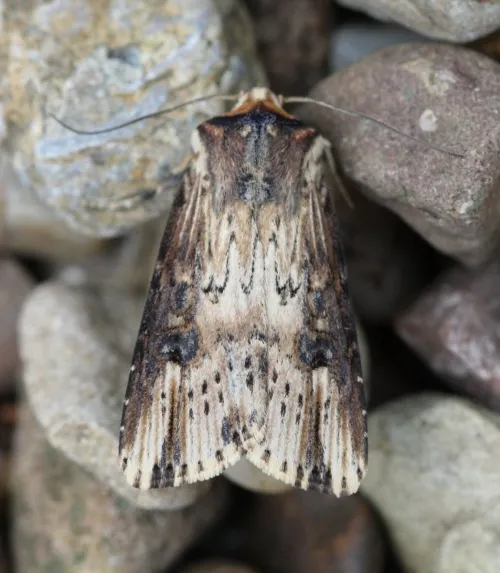
The Flame
Axylia putris
Wingspan 27-32 mm. The adults rest with the wings wrapped around the body and closely resemble a broken piece of twig. It inhabits woodland fringes, hedgerows and suburban habitats. Flies mainly in June and July, sometimes with a partial second gener
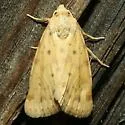
Azenia implora - Hodges#9729
Azenia implora
Identification: Forewing is pale lemon-yellow and hindwings are white. Two prominent dots parallel and just inside of inner margin of forewing.
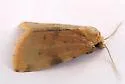
Azenia procida - Hodges#9726.1
Azenia procida
Identification: Adult : Azenia procida occurs in two color forms, one yellow and the other a dull yellowish brown. It differs from Azenia edentata in that the FW has larger, more diffuse dark spots, the outer margin of the frontal process is evenly c
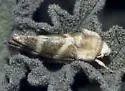
"Azenia" prov. pl. virida - Hodges#9728
Azenia-prov-pl virida
Identification: Barnes & McDunnough original description as Stiriodes virida is online in the print references below. Poole states "The most significant maculation are thick, prominent white lines for the antemedial, postmedial, and subterminal lines
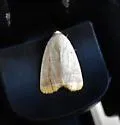
Bagisara albicosta - Hodges#9174
Bagisara albicosta
Identification: Apparently the only member of the genus with am. line angled outwardly from the coastal margin.
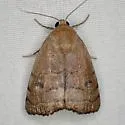
Bagisara brouana - Hodges#9176.1
Bagisara brouana
Identification: Images at MPG considered by Louisiana to be a "Species of Greatest Conservation Need" (SGCN)
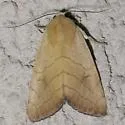
Bagisara buxea - Hodges#9172
Bagisara buxea
Identification: Genitalia: Larva: mottled green and white. ( 3 )
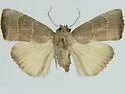
Bagisara pacifica - Hodges#9170
Bagisara pacifica
Identification: Schaus (1911) original description is online in print references. 48 *The subterminal line curved at costa and straight to tornus.
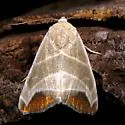
Bagisara praecelsa - Hodges#9175.1
Bagisara praecelsa
Identification: Distinctive FW pattern; long, shaggy vestiture on the femora and tibiae.
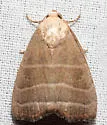
Straight Lined Mallow Moth - Hodges#9169
Bagisara rectifascia
Identification: Adult: forewing have no darkening at the reniform spot and no noticeable dark shading of the three lines; outer margin rounded; male foretibia and forefemur without black-tipped scale tufts.
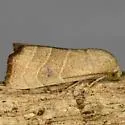
Wavy Lined Mallow Moth - Hodges#9168
Bagisara repanda
Identification: Adult: forewing shows darkening at the reniform spot and also some dark shading of the three lines; outer margin slightly angulate (not smoothly rounded); male foretibia and forefemur with large dense black-tipped scale tufts
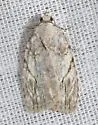
White-blotched Balsa - Hodges#9664
Balsa labecula
Identification: Specimen identified by DNA analysis: Genitalia: ♀ ♂
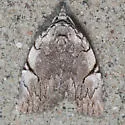
Many-dotted Appleworm - Hodges#9662
Balsa malana
Identification: Adult - forewing gray, darker in median, but paler in basal and subterminal areas and along costal edge; antemedial line broad zig-zag across wing; double postmedial line distinct only at costal edge, with inner part of double line lo
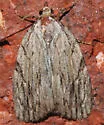
Three-lined Balsa - Hodges#9663
Balsa tristrigella
Identification: forewing light gray, shading to brownish in distal third; several thin black lines run longitudinally along wing, becoming thicker in distal half; Antemedial (AM) line short, distinct only near the costa; Postmedial (PM) line double,
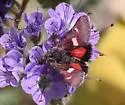
Baptarma felicita - Hodges#11061
Baptarma felicita
Identification: Head, thorax and abdomen black, the vestiture with an admixture of yellow and scarlet hair that gives the effect of a wash or film of these tints. Primaries blackish with a wash of carmine, terminal space a little grayish powdered. Th
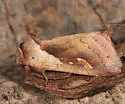
Pickerelweed Borer Moth - Hodges#9526
Bellura densa
Identification: Brown/tan forewings. Reniform spot partly filled with orange.
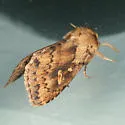
Black-tailed Diver - Hodges#9523.1
Bellura vulnifica
Identification: Forewing has dark strongly scalloped postmedial line. ( 3 ) Identified by Don Lafontaine
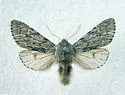
Brachionycha borealis - Hodges#10011
Brachionycha borealis
Identification: The original description as Asteroscopus borealis Smith, is available online in the print references below. The typical form has medium gray forewings, and the dark form is heavily shaded with black. Rarely collected possibly due to t
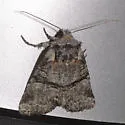
Brachylomia cascadia - Hodges#9995.2
Brachylomia cascadia
Identification: Photo determined by Don Lafontaine .
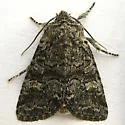
Brachylomia curvifascia - Hodges#9996
Brachylomia curvifascia
Identification: The original description as Dryobota curvifascia Smith, is available online in the print references below. Specimen identified by DNA analysis (BOLD)
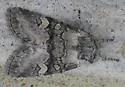
Black-disk Sallow Moth - Hodges#9999
Brachylomia discinigra
Identification: Peppery gray FW has darker median area and mottled white basal patch. Double AM & PM are filled with pale gray. Kinked blackish median band is conspicuous. Faint gray spots are outlined whitish.
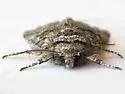
Brachylomia sierra - Hodges#9997.1
Brachylomia sierra
Identification: Specimen identified by DNA analysis (BOLD) ( 4 )
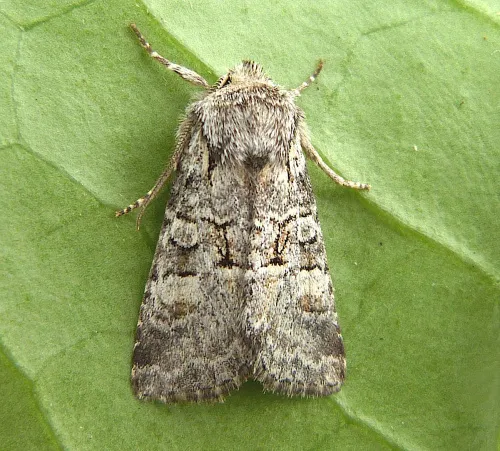
Minor Shoulder-knot
Brachylomia viminalis
Wingspan 29-34 mm. There is a range of colour forms, with the paler individuals generally occurring further south. This species prefers damp woodland, heaths and fens. Flying in July and August, the moths are readily attracted to light. The larvae fe
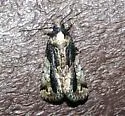
Bryolymnia anthracitaria - Hodges#9686.1
Bryolymnia anthracitaria
Identification: Bryolymnia anthracitaria is easily distinguished from the other members of the genus by the wide black basal patch, and the oblong black patch covering the middle of the outer half of the forewing.
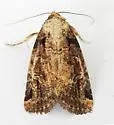
Bryolymnia ensina - Hodges#9683
Bryolymnia ensina
Identification: Follow revision in Lafontaineet al. (2010) in references below. The original description as Oligia ensina Barnes is available online in the print references below. Dark basal patch does not extend to inner margin. Subterminal area wit
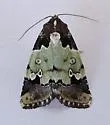
Bryolymnia marti - Hodges#9685.1
Bryolymnia marti
Identification: Holland original description is available online.
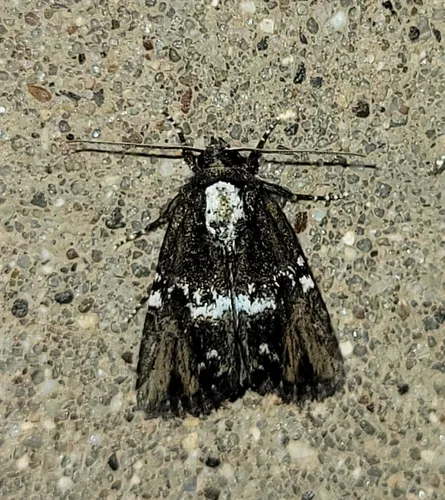
Half-banded Bryolymnia - Hodges#9686
Bryolymnia semifascia
Identification: Adult - forewing dark brown with irregular white patch half-way along inner margin, usually extending about half-way across wing (amount of white is variable, ranging from none to completely crossing the wing); black streak runs on ei
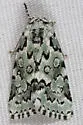
Bryolymnia viridata - Hodges#9296
Bryolymnia viridata
Identification: Lafontaine, Walsh, & Holland revised description is in PDF. Specimens identified by DNA analysis:
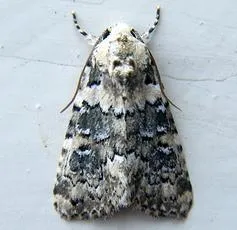
Marbled Beauty
Bryophila domestica
Wingspan 20-25 mm. Showing a good example of protective camouflage. Occurs in a range of habitats, including suburbia. This species rests by day on stone walls and rocks. The flight time is during July and August, and the adults, which vary somewhat
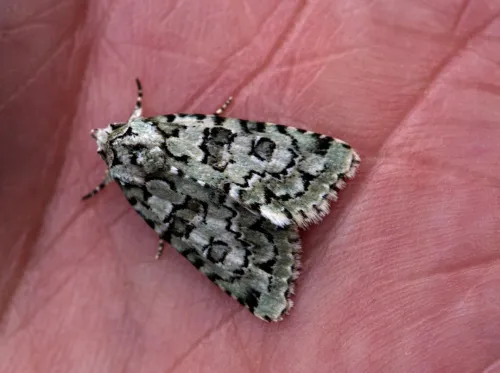
Marbled Green
Bryopsis muralis
Wingspan 27 to 34 mm. As the Common Name suggests, the species has a mottled green appearance which provides camouflage when at rest on lichen, however the patterning can be quite variable. This is a rare species in our area, and a photograph is requ
Silver-spotted Fern Moth - Hodges#9633
Callopistria cordata
Identification: forewing orange or reddish-brown, mottled with yellow, and having two large silvery-white spots near the middle or the wing, plus a line of several smaller spots in the subterminal area; small yellowish patch at apex hindwing pale gra
Callopistria jamaicensis - Hodges#9630.1
Callopistria jamaicensis
Identification: Specimen identified by DNA analysis (BOLD).
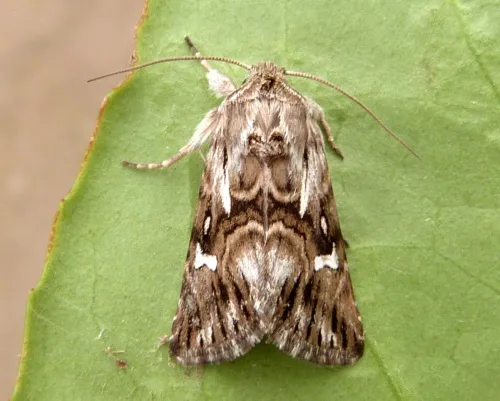
Toadflax Brocade
Calophasia lunula
It has two generations, sometimes overlapping, from May to August, and migrants sometimes appear away from the main stronghold in July and August. The larvae, which feed on Toadflax and related species (Linaria spp.), are very colourful, but well cam
Curved Halter Moth - Hodges#9059
Capis curvata
Identification: Adult: forewing chocolate brown except for a pale whitish tip, separated from the remainder of the wing by a gently curved line A rare species, threatened or endangered in several parts of its range.
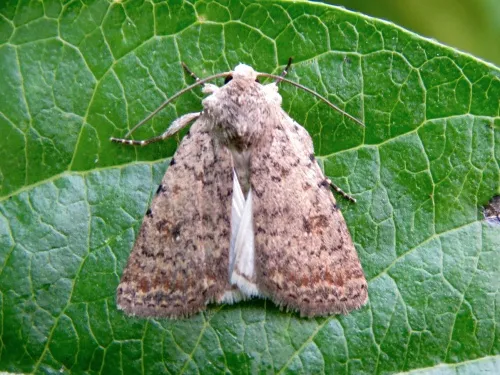
Pale Mottled Willow
Caradrina clavipalpis
Wingspan 26-35 mm. This moth shows a distinct mottling to the forewing, with several dark dots along the leading edge, and very white hind wings. It flies mainly between July and September, but can be found earlier or later in the year. The caterpill
Rare Sand Quaker - Hodges#9654
Caradrina meralis
Identification: Adult: forewing medium gray with darker gray reniform and orbicular spots; lines either very faint or not visible; may have darker shading in subterminal area, with pale ST line running through it. A distinctive element in most indivi
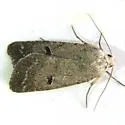
Caradrina mona - Hodges#9658
Caradrina mona
Identification: Barnes & McDunnough (1912) description of the adult is available to read online in the print references below. Crumb (1956) described the larva. ( 3 )
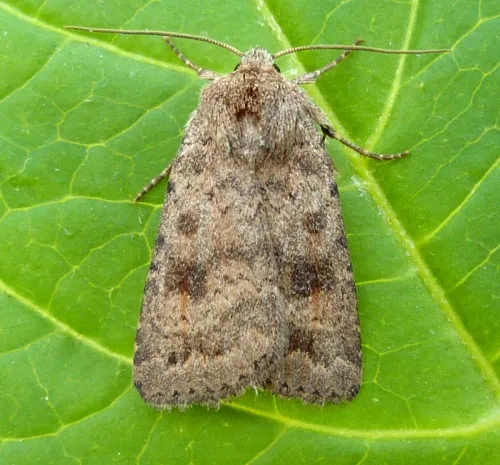
Mottled Rustic
Caradrina morpheus
Wingspan 32-38 mm. Although superficially similar to several related species, this moth always shows a distinctly large and dark reniform stigma and is fairly broad-winged. It occupies a range of habitats including suburban areas It flies from June t
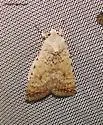
Speckled Rustic - Hodges#9657
Caradrina multifera
Identification: Adult: forewing pale gray with black zigzag lines, sometimes broken into dots; reniform spot black with white dots around perimeter; orbicular spot a black dot; subterminal line sometimes edged with reddish; darker shading beyond ST l
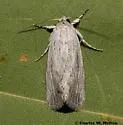
Fine-lined Sallow - Hodges#10033
Catabena lineolata
Identification: Adult: forewing light gray with brownish cast, marked with very fine black and white lengthwise streaks; ends of AM and PM lines generally visible at costa but otherwise obscure; terminal line composed of blackish dashes; fringe dark
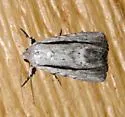
Catabenoides terminellus - Hodges#10037
Catabenoides terminellus
At BOLD there are specimens listed in two BINS for Catabenoides terminellus, BOLD:AAB4195 and BOLD:ABW8287. Barcode separates the two by slightly over 3%. Specimens cannot currently be placed to BIN using observable external characteristics and it do
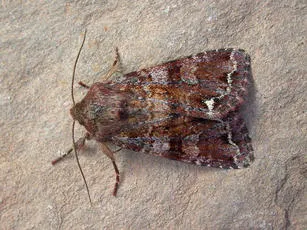
Broom Moth
Ceramica pisi
Wingspan 32-37 mm. A very variable species, with the ground colour varying between greyish brown to a dark chestnut colour, and the intensity of the markings varying too. Late May to Early August when it can be attracted to light. The distinctive bro
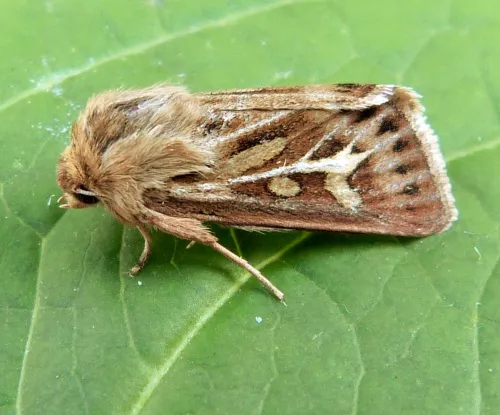
Antler Moth
Cerapteryx graminis
Wingspan 27-39 mm. A very distinctively marked moth. The adults fly from June to September, and fly during the day as well as at night, when they come to light. The larvae feed on various types of grasses, sometimes abundantly, and the species is wel
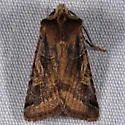
Cerastis cornuta - Hodges#10995
Cerastis cornuta
Identification: Adult distinguished from the very similar Cerastis robertsoni by differences in genitalia: in males of cornuta , the vesica is straight beyond the basal turn; in females of cornuta , the corpus bursae is constricted posteriorly, the a
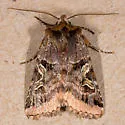
Enigmatic Dart - Hodges#10995.2
Cerastis enigmatica
Identification: Adult: forewing reddish-brown with pale yellowish-red subterminal area; orbicular and reniform spots fused together to form a large white-rimmed V-shaped spot; dark brown patches border three sides of fused spot; fringe pinkish; thora
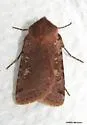
Fish's Dart - Hodges#10997
Cerastis fishii
Identification: Adult: forewing reddish-brown with dark AM and PM lines, and pale subterminal line; reniform and orbicular spots contain contrasting black-and-white markings; prominent black subapical spot along costa just inside subterminal line; te
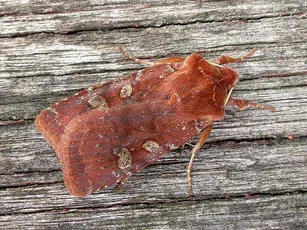
White-marked
Cerastis leucographa
Wingspan 34 to 38 mm. The wing has a bright oval and a distinct kidney mark, both creamy white in colour. Occurs in scattered well wooded localities. Sometimes visits Willow flowers. One of the early spring species, flying in March and April, it can
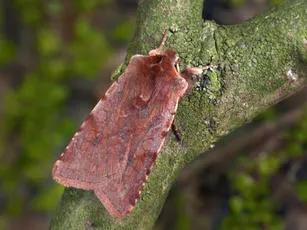
Red Chestnut
Cerastis rubricosa
Wingspan 32 to 38 mm. The ground colour is a uniform rich pale or dark reddish brown or purplish brown. The markings are often quite pale. Occupying mainly woodland in the south, and wet moorland in the north. This is a spring flying species, appeari
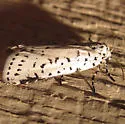
Cerathosia tricolor - Hodges#9064
Cerathosia tricolor
Identification: The fore wings are pure white, spotted with black, the hind wings are pale yellow. uncommon and local
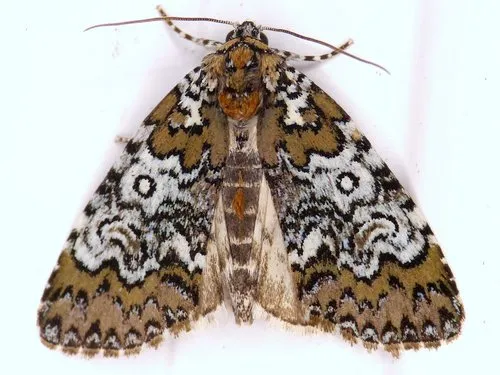
Owl-eyed Bird Dropping Moth - Hodges#9061
Cerma cora
Identification: forewing basal and subterminal areas olive green with wavy black lines; median area white with wavy/jagged black lines and prominent white orbicular spot (in moths at rest, the two orbicular spots and jagged lines between them give th
Waxed Sallow Moth - Hodges#9948
Chaetaglaea cerata
Identification: Pale grayish tan FW has whitish veins. Gently curved AM & PM are edged pale yellow. Slightly darker orbicular and reniform spots have pale outlines. Reniform spot has tiny black dot in inner half.
Silky Sallow - Hodges#9950
Chaetaglaea sericea
Identification: Resembles Waxed Sallow, but darker FW is marked with distinct whitish veins. A wide yellow streak extends along inner margin.
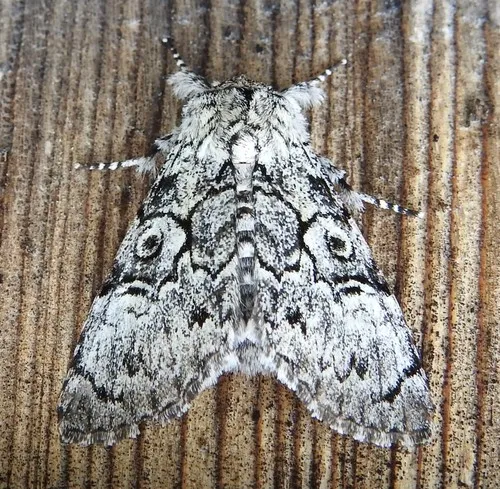
The Laugher - Hodges#9189
Charadra deridens
Identification: Adult: forewing pale gray, heavily shaded with darker gray; antemedial (AM) line black, sometimes clearly edged in white; postmedial (PM) line black, scalloped, and edged in white; AM and PM lines connected about halfway down the wing
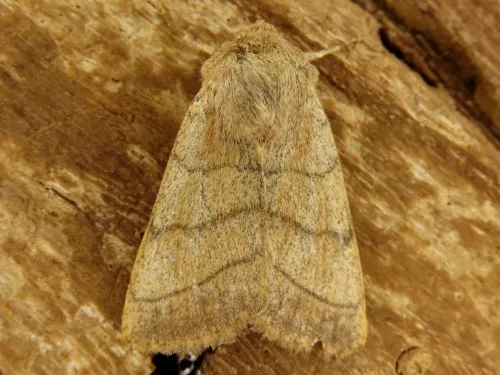
Treble Lines
Charanyca trigrammica
Wingspan 35-40 mm. As the name suggests, the buff wings are crossed by three distinctively shaped lines. A species of woodland fringes, hedgerows and commons. Flies from May to July and is readily attracted to sugar and light. The nocturnal larvae fe
Cherokeea attakullakulla - Hodges#9454.7
Cherokeea attakullakulla
Identification: See original description in print references below. Rarely comes to lights.
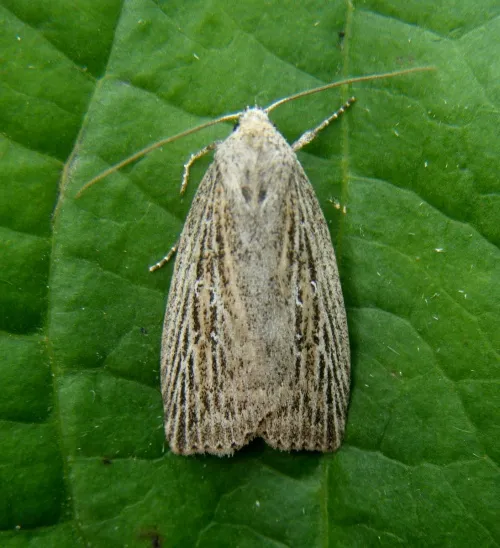
Silky Wainscot
Chilodes maritima
Wingspan 29 to 36 mm. A rather unusual species, which has a number of distinctive forms, and can resemble some of the Pyralidae. It may be found in reedbeds containing Common Reed. It is readily attracted to light and flies from June to August. The l
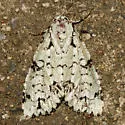
Chloronycta tybo - Hodges#9283
Chloronycta tybo
Identification: Powell & Opler (2009) stated the reniform and orbicular spots both are outlined in black. ( 3 )
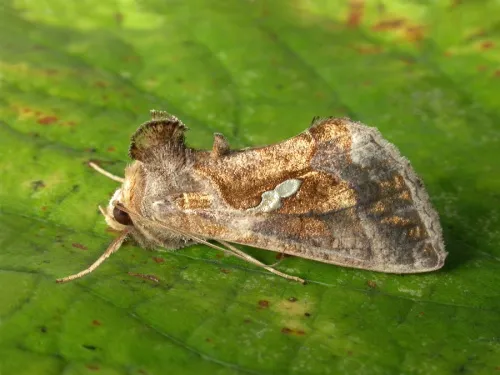
Golden Twin-spot
Chrysodeixis chalcites
An immigrant species that is usually found near to the coast. The most typical time of occurrence is between September and November, when moths are sometimes found at light-traps. On the continent, the caterpillars feed on such plants as chrysanthemu
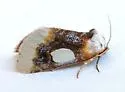
Chrysoecia gladiola - Hodges#9763
Chrysoecia gladiola
Identification: Forewing, at base, beyond subterminal line and a large oval patch in the center below costa, creamy-white. Remainder of wing dark olive green -brown, with an admixture of violet and paler olive green and yellow scales. Ordinary lines
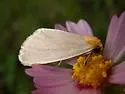
Chrysoecia thoracica - Hodges#9774
Chrysoecia thoracica
Identification: The original description as Eulithosia thoracica Edwards, is available online using the link in the print preferences below.
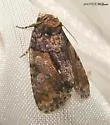
Cloaked Marvel - Hodges#9556
Chytonix palliatricula
Identification: Two forms, one with the large white patch covering most of the forewing, and the other without it. The form with the large white patch is less common. Specimen identified by DNA analysis: The form without the large white patch is ver
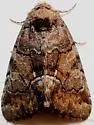
Barrens Marvel - Hodges#9557
Chytonix sensilis
Identification: Very similar to Chytonix palliatricula . See here for an explanation of the differences. Genitalia: Chytonix sensilis is reported by several states to be declining in population and a species of concern.
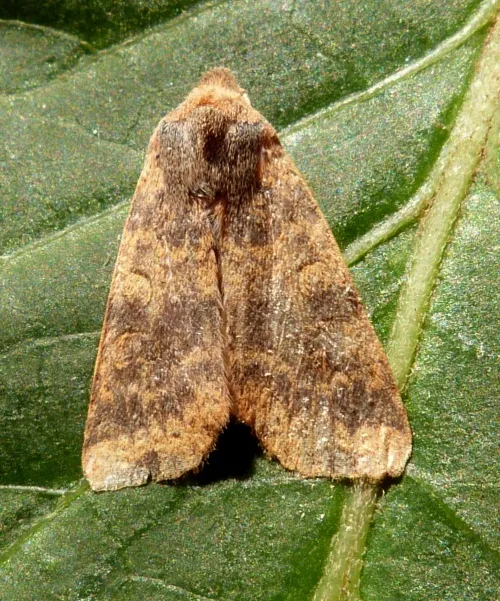
Dusky-lemon Sallow
Cirrhia gilvago
Wingspan 32-38 mm. The forewing in a very pale orangey yellow with various markings of pale brown and pinks. Broadleaved woodland, hedges, parks and gardens. It flies from late August to October, and is attracted to sugar as well as light. The larvae
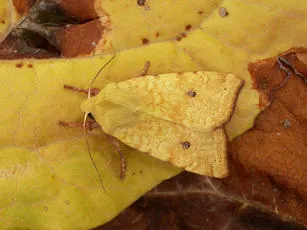
The Sallow
Cirrhia icteritia
Wingspan 27-35 mm. It is quite variable, with the relatively frequent ab. flavescens having the darker markings almost absent. Occupying damp woodland, heathland and marshy places. Like many of its congeners, it flies in the Autumn, in September and
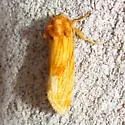
Cirrhophanus pretiosa - Hodges#9766.1
Cirrhophanus pretiosa
Cirrhophanus pretiosa - Hodges#9766.1 (Cirrhophanus pretiosa) is a species in the family Noctuidae, commonly known as owlet moths, belonging to the order Lepidoptera (Butterflies and Moths). It is classified within the subfamily Stiriinae, tribe Stir
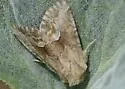
Cobalos angelicus - Hodges#9423
Cobalos angelicus
Cobalos angelicus - Hodges#9423 (Cobalos angelicus) is a species in the family Noctuidae, commonly known as owlet moths, belonging to the order Lepidoptera (Butterflies and Moths). It is classified within the subfamily Noctuinae, tribe Apameini, supe
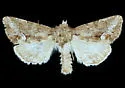
Cobalos franciscanus - Hodges#9424
Cobalos franciscanus
Identification: Specimen determined by DNA analysis (BOLD). ( 3 )
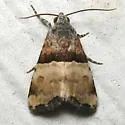
Cobubatha dividua - Hodges#9018
Cobubatha dividua
Identification: Adult: forewing mostly dark in basal third, mostly pale tan in distal two-thirds; AM line dark grayish-brown, its distal margin fairly straight, it's basal margin irregular/jagged; fringe black; hindwing uniformly brownish-gray.
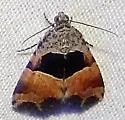
Cobubatha megaplaga - Hodges#9019.2
Cobubatha megaplaga
Identification: The original description as Eustrotia megaplaga , Dyar, is available online using the link in the print preferences below. - Hindwing is a powdery gray-brown with darker veins. Fringe and and terminal line are darker. (Dyar)
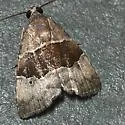
Cobubatha nr. hippotes - Hodges#9019
Cobubatha nr-hippotes
"931278 Cobubatha hippotes – This species was described from Guatemala in 1889. It was reported as C. hippotes in the Noctuidae MONA check list (Franclemont and Todd 1983), but the species recorded in Texas is now known to be an undescribed species r
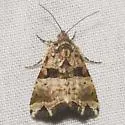
Cobubatha numa - Hodges#9013
Cobubatha numa
Identification: Species page created based on this image determined by Ed Knudson, Texas Lepidoptera Survey, Houston:
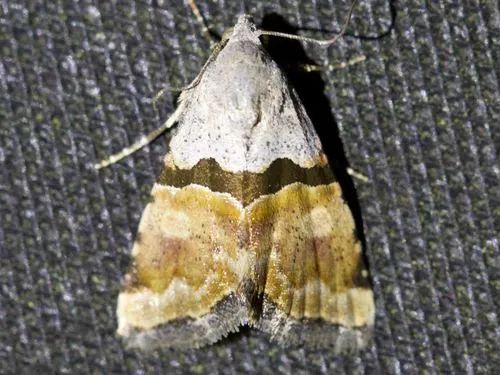
Cobubatha orthozona - Hodges#9017
Cobubatha orthozona
This is the most common species of the genus in Texas. ( 3 )
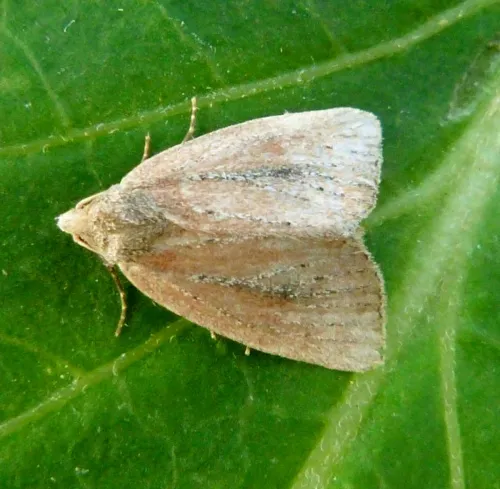
Small Rufous
Coenobia rufa
Wingspan 22 to 25 mm. A small plain looking rufous coloured moth with quite a pointed shaped head which seems to be rather tucked downwards. The species occupies fens, marshes and bogs. Only occasionally attracted to light, the flight period is July
Blueberry Dart - Hodges#10988
Coenophila opacifrons
Identification: Adult: forewing brownish-gray with dark toothed PM line and dark scalloped AM line; reniform and orbicular spots filled with ground color, and joined by dark line or patch (sometimes faint and/or partial); dark patch on basal side of
Concana mundissima - Hodges#8562
Concana mundissima
Identification: The original description of Concana mundissima Walker, is available online at the link in the print references below. -
Concana mundissima of authors - Hodges#8562.1
Concana mundissima-of-authors
Concana mundissima of authors, not Walker, [1858] is an undescribed species from Texas, Don Lafontaine (pers. comm., 11/13/2020).
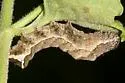
Boneset Groundling - Hodges#9702
Condica albigera
Can be extremely common in southern Texas. Larvae are often parasitized by braconid wasps.
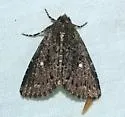
Condica albolabes - Hodges#9695
Condica albolabes
Identification: From The Canadian Entomologist Volume XII : "Fore wings uniform glistening blackish fuscous with all the lines obsolete except the subterminal, which is represented by a row of white dots, relieved by black scales. The seven white dot
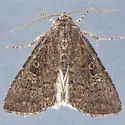
Condica andrena - Hodges#9707
Condica andrena
Identification: See detailed description at Nearctica .
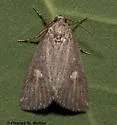
Condica begallo - Hodges#9709
Condica begallo
Identification: The original description as Catabena begallo Barnes is available at the link in the print references below. - Determined by Noel McFarland.
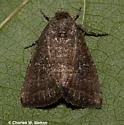
Condica charada - Hodges#9704
Condica charada
Identification: Forewing is uniform medium gray with most maculation obscure; PM line is a lighter band accented by obscure set of dark gray and white dots on outer side and series of similarly obscure gray lunules on inner side; ST line is lighter l
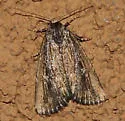
Condica discistriga - Hodges#9692
Condica discistriga
Identification: Adult: forewing dull yellowish-brown to reddish-brown with diffuse gray shading in median and terminal areas, especially along veins, giving a streaked appearance; PM line faint, scalloped, with dark dots at points of scallops; renifo
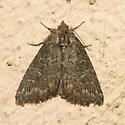
Condica mersa - Hodges#9694
Condica mersa
Identification: "This species can be identified by its streaky dark brown-gray forewing with pale filling of the lower reniform spot" ( 3 ) . This species is apparently quite rare in collections ( 3 ) , ( 5 ) .
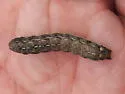
Mobile Groundling - Hodges#9693
Condica mobilis
Identification: Adult: forewing orangish to reddish-brown with dull brownish lines and mottling; bottom of reniform spot white; AM line scalloped; subterminal line jagged, irregular; hindwing whitish with grayish-brown border. [adapted from descripti
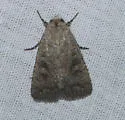
Condica morsa - Hodges#9712
Condica morsa
Condica morsa - Hodges#9712 (Condica morsa) is a species in the family Noctuidae, commonly known as owlet moths, belonging to the order Lepidoptera (Butterflies and Moths). It is classified within the subfamily Condicinae, tribe Condicini, superfamil
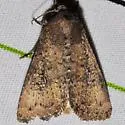
The Cobbler - Hodges#9699
Condica sutor
Identification: Adult - forewing brown, shiny, with vague broken pattern; PM line a double series of dark dots followed by a series of white dots; terminal line a series of white dots; reniform spot outline whitish, inconspicuous; lower end of renifo
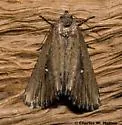
Condica temecula - Hodges#9691
Condica temecula
Identification: Forewing is uniform dark red-brown and appears somewhat glossy compared to Condica discistriga .
Dusky Groundling Moth - Hodges#9696
Condica vecors
Identification: Adult: forewing mottled dark brown and black; no strong pattern; PM and terminal lines represented by whitish dots; claviform spot black; lower half of reniform spot white; pale brown spot in middle of dark brown subterminal area; hin