
Alkali Grasshopper
Trimerotropis salina
This record describes Trimerotropis salina (species). Recorded family: Acrididae. Recorded order: Orthoptera.
Identification and Appearance
Classification
- Kingdom
- Animalia
- Phylum
- Arthropoda
- Class
- Insecta
- Order
- Orthoptera (Grasshoppers, Crickets, Katydids)
- Suborder
- Caelifera
- Family
- Acrididae (Short-horned Grasshoppers)
- Subfamily
- Oedipodinae
- Tribe
- Trimerotropini
- Genus
- Trimerotropis
Imported taxonomy record. Source availability varies; see the source references and editorial policy below.
Habitat and Range
Habitat
Usually barren salt or alkali encrusted flats, lake margins, seeps, etc. often where water sits temporarily, where the ground is muddy, but where surface crust is dry and cracked most of the time. Often associated with plants such as Iodine Bush, Pickle Weed, Salt Grass, Alkali Sacaton, Greasewood, etc.
Geographic Range
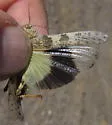
In it's typical form with a wide wing band, found east of the Continental Divide on the Great Plains and western Prairies from Alberta to Manitoba and Minnesota southward to Texas and New Mexico, and perhaps into northern Mexico. (Or, according to Otte - 1984 - perhaps only south from Nebraska and Wyoming). In the Rio Grande drainage in s. Colorado and n. New Mexico, the wing band becomes narrower, but otherwise the insects are the same. Populations usually with the wing band reduced or absent occur in the Great Basin between the Sierra Nevada and Rockies and from Oregon and probably Idaho to southern Nevada and southeastern California. They may represent a distinct species, but probably not. There seems to be a large break in the distribution in the region of the Colorado Plateaus and Wyoming Basin, but the species may be present in those areas, simply having been confused with T. pallidipennis and/or T. diversellus .
Diet and Behavior
Life History
Overwinters as eggs. Adults mostly about June or July to early autumn.
Additional species information
Species notes from the sources
Etymology: Is similar to and closely related to T. pallidipennis , which has caused confusion in the literature both as to where it is found, and as to how to define it. Generally it is considered to range north into Canada, but in his 1984 book, Otte considered all material north from South Dakota northward to be referable to T. diversellus , a related smaller species described from a different habitat in the Yellowstone area. In 1985 Vickery and Kevan recognized T. diversellus in the original restricted sense, and recognized T. salina as the wide-ranging species of the plains and prairies. Habitat should prove useful in sorting them out, but this information is often not recorded with museum specimens. Photographers and naturalists can be a big help in sorting out which species is where. As it is, northern Great Plains specimens "look" more like T. salina , but in reality the picture there may be more complicated than any publication has indicated. The name T. schaefferi has been given to specimens from along the Gulf Coast in Texas, and is usually listed as a distinct species. T. schaefferi seems to represent merely an optimum larger than average expression of T. salina , with the tegminal cross bands more contrasting than average, and with the dark cross band of the hind wing wider than average. It seems likely that it is not a distinct species at all.
About Grasshoppers, Crickets, Katydids: the wider group
Order-level background for Orthoptera, the group containing Trimerotropis salina. Species-specific details appear above.
Group overview
Orthoptera includes ~28,000 described species of grasshoppers, crickets, and katydids. Desert locusts can form swarms covering 460 square miles containing up to 80 million individuals per square kilometer.
Ecological role of the group
Grasshoppers and crickets are a primary food source for birds, reptiles, and small mammals. Cricket farming is a growing industry - crickets require 12× less feed than cattle to produce the same amount of protein, using 2,000× less water.
Economic and practical significance of the group
A single large locust swarm can consume the same amount of food in one day as 35,000 people. The 2019-2021 East Africa locust crisis affected food security for 42 million people across multiple countries. Global crop losses from locusts can reach billions annually.
Recorded sources for this group: FAO, UN World Food Programme, research publications. Imported estimates may describe particular regions or reporting periods.
Photos of Alkali Grasshopper (5)
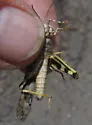
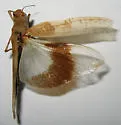
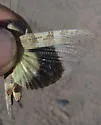
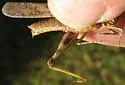
Photo credits: Contributed by David J. Ferguson; Additional contributions by Mike Quinn
Frequently Asked Questions About Alkali Grasshopper
How big is Alkali Grasshopper?
males 23 - 45 mm females 32 - 56 mm largest specimens in s.e. Colorado and w. Kansas; smallest in s. Canada, Oregon, and n. California.
Where is Alkali Grasshopper found?
| Feature | Details |
|---|---|
| Habitat | Usually barren salt or alkali encrusted flats, lake margins, seeps, etc. often where water sits temporarily, where the ground is muddy, but where surface crust is dry and cracked most of the time. Often associated with plants such as Iodine Bush, Pickle Weed, Salt Grass, Alkali Sacaton, Greasewood, etc. |
| Range | In it's typical form with a wide wing band, found east of the Continental Divide on the Great Plains and western Prairies from Alberta to Manitoba and Minnesota southward to Texas and New Mexico, and perhaps into northern Mexico. (Or, according to Otte - 1984 - perhaps only south from Nebraska and Wyoming). In the Rio Grande drainage in s. Colorado and n. New Mexico, the wing band becomes narrower, but otherwise the insects are the same. Populations usually with the wing band reduced or absent occur in the Great Basin between the Sierra Nevada and Rockies and from Oregon and probably Idaho to southern Nevada and southeastern California. They may represent a distinct species, but probably not. There seems to be a large break in the distribution in the region of the Colorado Plateaus and Wyoming Basin, but the species may be present in those areas, simply having been confused with T. pallidipennis and/or T. diversellus . |
What is the life cycle of a Alkali Grasshopper?
Overwinters as eggs. Adults mostly about June or July to early autumn.