
Timema ritense
This record describes Timema ritense (species). Recorded family: Timematidae. Recorded order: Phasmida.
Identification and Appearance
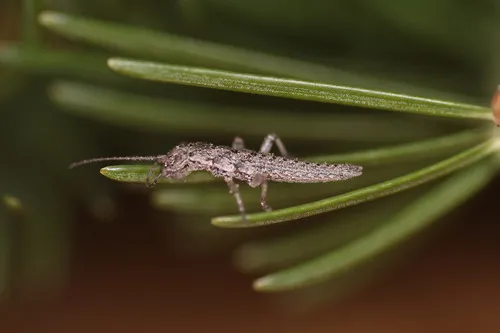
Male with terminalia in dorsal view as in Fig. 2 here from Tinkham(1942) . Strongly mottled with reddish-brown; legs and cerci also mottled; underside pale with reddish-brown mottling as on dorsum but with paired indistinct lateral lines. Female with 10th (i.e. terminal) tergite nearly truncate apically, and supra-anal plate broad.
Wikipedia reference for Timema ritense: http://en.wikipedia.org/wiki/Timema_ritense.
Classification
- Kingdom
- Animalia
- Phylum
- Arthropoda
- Class
- Insecta
- Order
- Phasmida (Walkingsticks)
- Family
- Timematidae
- Genus
- Timema
Imported taxonomy record. Source availability varies; see the source references and editorial policy below.
Habitat and Range
Habitat
Mountain juniper woodlands
Geographic Range
Mountains of south central Arizona (e.g Santa Rita Mnts, Santa Catalina Mnts).
Diet and Behavior
Diet: Recorded host plant is Alligator Juniper ( Juniperus deppeana ).
Additional species information
Species notes from the sources
Etymology: Named for type locality in the Santa Rita Mountains (at the old lookout on the summit of Mt. Wrightson...see here ).
About Walkingsticks: the wider group
Order-level background for Phasmida, the group containing Timema ritense. Species-specific details appear above.
Group overview
Phasmida (stick insects and leaf insects) includes ~3,000 described species. The longest insect ever discovered is a stick insect - Phryganistria chinensis Zhao - measuring 64 cm (25.2 inches) found in China in 2016.
Ecological role of the group
Many stick insect species can reproduce without mating (parthenogenesis) - entire populations can consist of only females. Their eggs often mimic plant seeds and are dispersed by ants, which carry them to their nests.
Economic and practical significance of the group
Stick insects are among the most popular pet insects worldwide. The Indian stick insect (Carausius morosus) is widely used in schools and laboratories for biology education and genetic research.
Recorded sources for this group: Guinness World Records, entomology research. Imported estimates may describe particular regions or reporting periods.
Frequently Asked Questions About Timema ritense
What is Timema ritense?
Timema ritense is a species in the family Timematidae, within the order Phasmida.
How do you identify Timema ritense?
Male with terminalia in dorsal view as in Fig. 2 here from Tinkham(1942) . Strongly mottled with reddish-brown; legs and cerci also mottled; underside pale with reddish-brown mottling as on dorsum but with paired indistinct lateral lines. Female with 10th (i.e. terminal) tergite nearly truncate apically, and supra-anal plate broad.
Where is Timema ritense found?
| Feature | Details |
|---|---|
| Habitat | Mountain juniper woodlands |
| Range | Mountains of south central Arizona (e.g Santa Rita Mnts, Santa Catalina Mnts). |
What does Timema ritense eat?
The diet of the Timema ritense includes Recorded host plant is Alligator Juniper ( Juniperus deppeana )..