
Timema cristinae
This record describes Timema cristinae (species). Recorded family: Timematidae. Recorded order: Phasmida.
Identification and Appearance
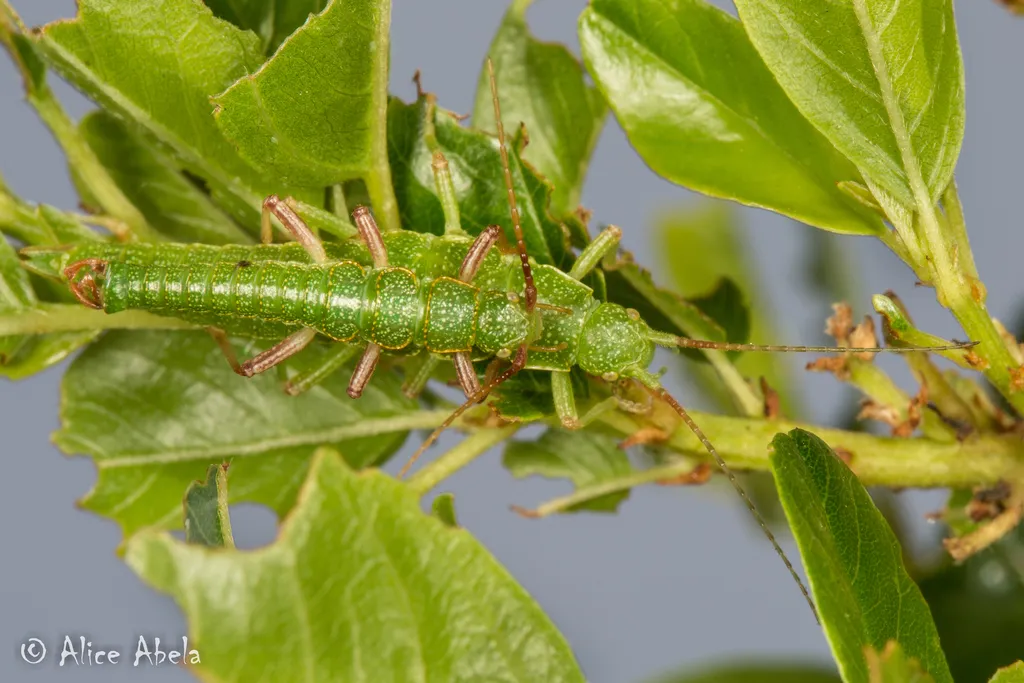
This species comes in a number of color morphs, and also striped or unstriped patterns. Male terminalia are similar to that of T. californicum , except the sinistral cercus is abruptly widened near its base in T. cristinae . This is probably the most thoroughly studied species of Timema , due largely to the work of Cristina Sandoval and other researchers she has collaborated with and/or inspired over the years.
Wikipedia reference for Timema cristinae: http://en.wikipedia.org/wiki/Timema_cristinae.
Classification
- Kingdom
- Animalia
- Phylum
- Arthropoda
- Class
- Insecta
- Order
- Phasmida (Walkingsticks)
- Family
- Timematidae
- Genus
- Timema
Imported taxonomy record. Source availability varies; see the source references and editorial policy below.
Habitat and Range
Habitat
On foliage, twigs, or branches of host shrubs in coastal chaparral habitat...or on the ground, where they sometimes shelter or drop to upon disturbance. Green morphs tend to rest on leaves; brown to gray morphs on stems, branches or ground. Unstriped morphs are usually associated with broad-leaved host plants (e.g. ceanothus); striped morphs are usually associated with host plants having needle-like leaves (e.g. chamise). Coloration, stripes, and other markings serve as camouflage, and are adaptations driven by selection pressure due to predation by visually-oriented birds and lizards. For interesting details, see Sandoval (1994), Sandoval & Crespi (2008), and this course handout & worksheet ...and other papers cited below under "Print References".
Geographic Range
Range is centered in the Santa Ynez Mountains of Santa Barbara County, CA...from the Figueroa Mountain area in the northwest, to the mountains near Santa Barbara on the east.
Diet and Behavior
Diet: Principle host plants are Adenostoma fasciculatum and Ceanothus spinosus , but it's also been recorded feeding on Heteromeles arbutifolia , Cercocarpus betuloides , Pickeringia montana , Quercus agrifolia , and Peonia californica . It has been observed (not necessarily feeding) on other oaks, and on Arctostaphylos glauca , Ribes malvaceum and Fraxinus dipetala .
Additional species information
Species notes from the sources
Etymology: Named in honor of UCSB Timema expert Cristina Sandoval, who discovered this species in the mountain chaparral above Santa Barbara as a graduate student, and has been researching it and other Timema for decades since (see article here ).
About Walkingsticks: the wider group
Order-level background for Phasmida, the group containing Timema cristinae. Species-specific details appear above.
Group overview
Phasmida (stick insects and leaf insects) includes ~3,000 described species. The longest insect ever discovered is a stick insect - Phryganistria chinensis Zhao - measuring 64 cm (25.2 inches) found in China in 2016.
Ecological role of the group
Many stick insect species can reproduce without mating (parthenogenesis) - entire populations can consist of only females. Their eggs often mimic plant seeds and are dispersed by ants, which carry them to their nests.
Economic and practical significance of the group
Stick insects are among the most popular pet insects worldwide. The Indian stick insect (Carausius morosus) is widely used in schools and laboratories for biology education and genetic research.
Recorded sources for this group: Guinness World Records, entomology research. Imported estimates may describe particular regions or reporting periods.
Photos of Timema cristinae (3)
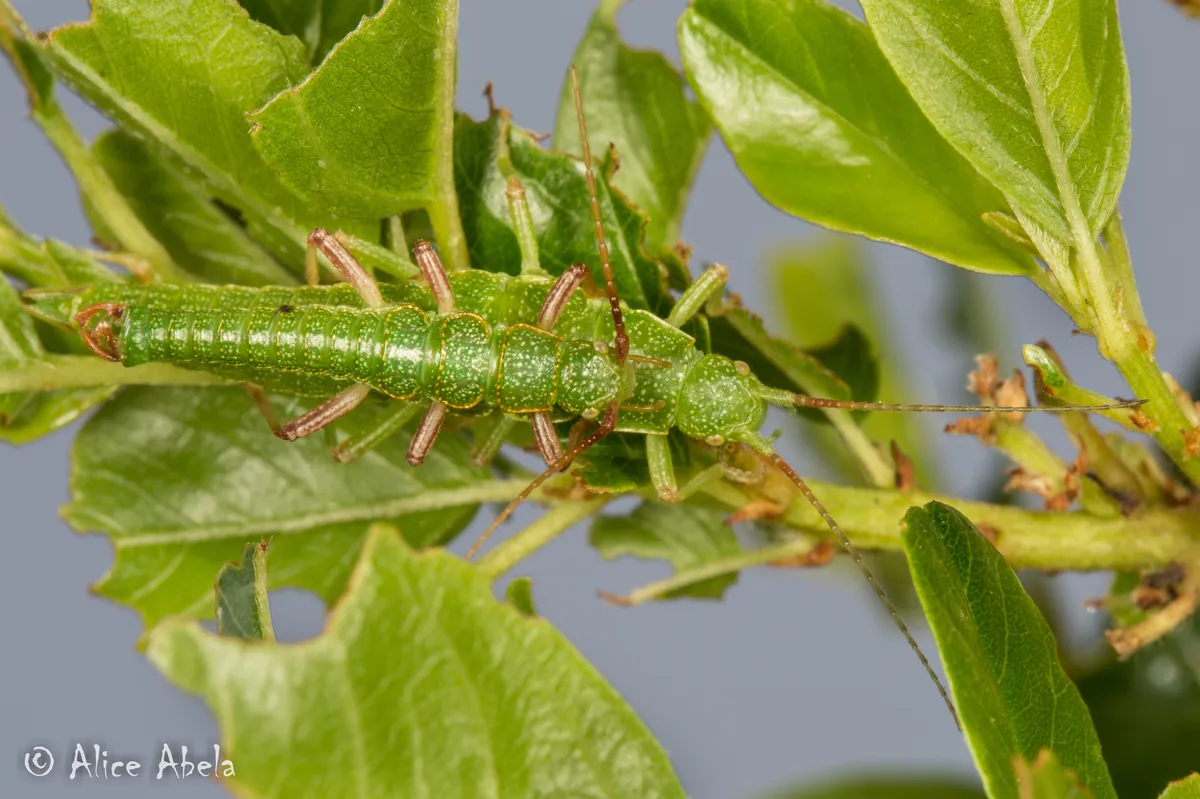
Photo credits: Contributed by Aaron Schusteff
Frequently Asked Questions About Timema cristinae
What is Timema cristinae?
Timema cristinae is a species in the family Timematidae, within the order Phasmida.
How do you identify Timema cristinae?
This species comes in a number of color morphs, and also striped or unstriped patterns. Male terminalia are similar to that of T. californicum , except the sinistral cercus is abruptly widened near its base in T. cristinae .
Where is Timema cristinae found?
| Feature | Details |
|---|---|
| Habitat | On foliage, twigs, or branches of host shrubs in coastal chaparral habitat...or on the ground, where they sometimes shelter or drop to upon disturbance. Green morphs tend to rest on leaves; brown to gray morphs on stems, branches or ground. Unstriped morphs are usually associated with broad-leaved host plants (e.g. ceanothus); striped morphs are usually associated with host plants having needle-like leaves (e.g. chamise). Coloration, stripes, and other markings serve as camouflage, and are adaptations driven by selection pressure due to predation by visually-oriented birds and lizards. For interesting details, see Sandoval (1994), Sandoval & Crespi (2008), and this course handout & worksheet ...and other papers cited below under Print References. |
| Range | Range is centered in the Santa Ynez Mountains of Santa Barbara County, CA...from the Figueroa Mountain area in the northwest, to the mountains near Santa Barbara on the east. |
What does Timema cristinae eat?
The diet of the Timema cristinae includes Principle host plants are Adenostoma fasciculatum and Ceanothus spinosus , but it's also been recorded feeding on Heteromeles arbutifolia , Cercocarpus betuloides , Pickeringia montana , Quercus agrifolia , and Peonia californica . It has been observed (not necessarily feeding) on other oaks, and on Arctostaphylos glauca , Ribes malvaceum and Fraxinus dipetala ..