
Timema genevievae
This record describes Timema genevievae (species). Recorded family: Timematidae. Recorded order: Phasmida.
Identification and Appearance
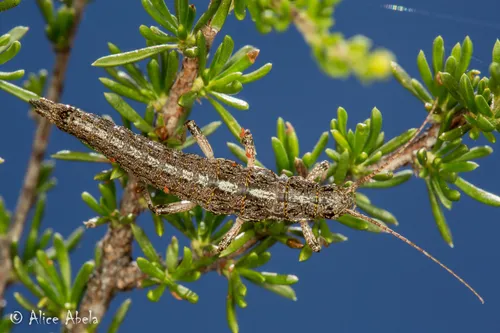
Light to dark gray (sometimes nearly blackish ) with a mottled pattern. Terminal (10th) tergite slightly emarginate. Eyes are more produced (i.e. bulging outwards) than in most other Timema species. All individuals are female (it's a parthenogenetic species). This was the first parthenogenetic (i.e. entirely female) Timema species discovered. Usually adult Timema are found in pairs, with a male riding atop a female (mate-guarding). When this species was first discovered, repeated searches yielded only females. When individuals were captured for lab study they laid eggs. And when the eggs hatched and were reared they all turned out to be self-fertile females which also produced female offspring, with no males present. Four other parthenogenic species of Timema have since been discovered. Because of this Timema have become very useful model organisms for study of various aspects of asexuality and sexuality in evolutionary biology.
Wikipedia reference for Timema genevievae: http://en.wikipedia.org/wiki/Timema_genevievae.
Classification
- Kingdom
- Animalia
- Phylum
- Arthropoda
- Class
- Insecta
- Order
- Phasmida (Walkingsticks)
- Family
- Timematidae
- Genus
- Timema
Imported taxonomy record. Source availability varies; see the source references and editorial policy below.
Habitat and Range
Habitat
Canyons in fairly arid, chamise-dominated, chaparral. Curiously, all known occurrences are in areas with serpentinite substrates. No reason is known for this association. Update 4/16/18: BugGuide contributor and National Park Service biologist Paul Johnson found T. genevievae on rhyolite-derived soils...see here .
Geographic Range
Currently known populations are patchily distributed in the Inner Coast Ranges of central California. They occur north, east, and south of the San Francisco Bay area (i.e. in eastern Lake County; eastern Alameda; western Stanislaus Counties; and San Benito Co.).
Diet and Behavior
Diet: At present, chamise ( Adenostoma fasciculatum ) appears to be the exclusive host plant. Although initially discovered on mountain mahogony ( Cercocarpus betuloides ) and buckbrush ( Ceanothus cuneatus ), captive larvae fed only on chamise when all three plants were offered. Timema genevievae has also been observed on oak ( Quercus spp. ).
Additional species information
Species notes from the sources
Etymology: From Rentz(1978): "This species is named in honor of Ms. Genevieve Prlain in recognition of her interest in the bionomics of the species."
About Walkingsticks: the wider group
Order-level background for Phasmida, the group containing Timema genevievae. Species-specific details appear above.
Group overview
Phasmida (stick insects and leaf insects) includes ~3,000 described species. The longest insect ever discovered is a stick insect - Phryganistria chinensis Zhao - measuring 64 cm (25.2 inches) found in China in 2016.
Ecological role of the group
Many stick insect species can reproduce without mating (parthenogenesis) - entire populations can consist of only females. Their eggs often mimic plant seeds and are dispersed by ants, which carry them to their nests.
Economic and practical significance of the group
Stick insects are among the most popular pet insects worldwide. The Indian stick insect (Carausius morosus) is widely used in schools and laboratories for biology education and genetic research.
Recorded sources for this group: Guinness World Records, entomology research. Imported estimates may describe particular regions or reporting periods.
Photos of Timema genevievae (2)
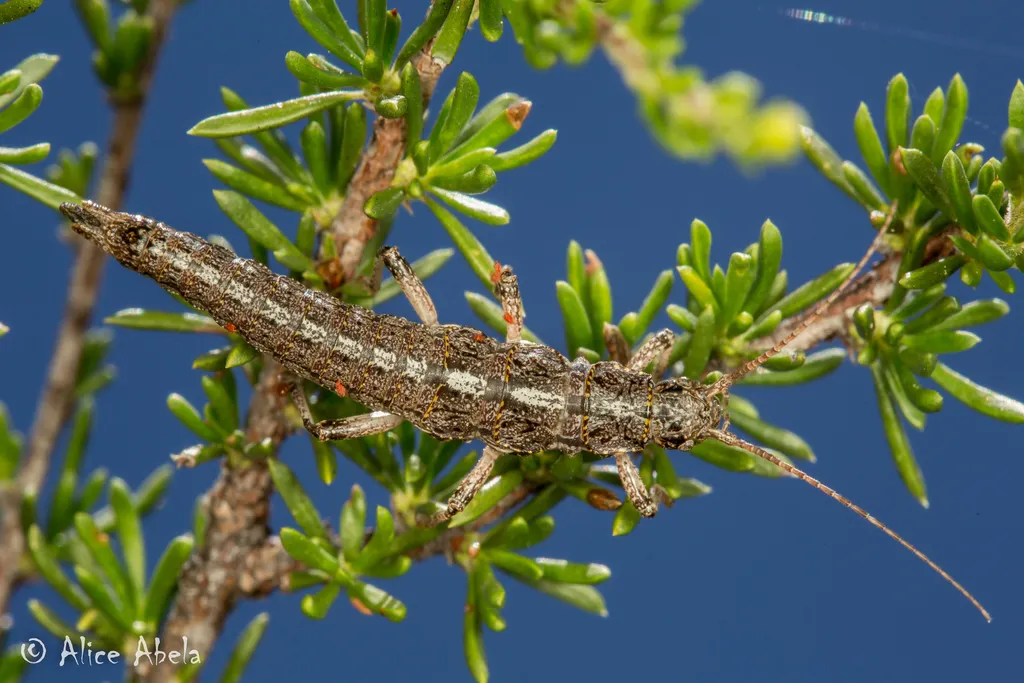
Photo credits: Contributed by Aaron Schusteff
Frequently Asked Questions About Timema genevievae
What is Timema genevievae?
Timema genevievae is a species in the family Timematidae, within the order Phasmida.
How do you identify Timema genevievae?
Light to dark gray (sometimes nearly blackish ) with a mottled pattern. Terminal (10th) tergite slightly emarginate. Eyes are more produced (i.e. bulging outwards) than in most other Timema species. All individuals are female (it's a parthenogenetic species).
Where is Timema genevievae found?
| Feature | Details |
|---|---|
| Habitat | Canyons in fairly arid, chamise-dominated, chaparral. Curiously, all known occurrences are in areas with serpentinite substrates. No reason is known for this association. Update 4/16/18: BugGuide contributor and National Park Service biologist Paul Johnson found T. genevievae on rhyolite-derived soils...see here . |
| Range | Currently known populations are patchily distributed in the Inner Coast Ranges of central California. They occur north, east, and south of the San Francisco Bay area (i.e. in eastern Lake County; eastern Alameda; western Stanislaus Counties; and San Benito Co.). |
What does Timema genevievae eat?
The diet of the Timema genevievae includes At present, chamise ( Adenostoma fasciculatum ) appears to be the exclusive host plant. Although initially discovered on mountain mahogony ( Cercocarpus betuloides ) and buckbrush ( Ceanothus cuneatus ), captive larvae fed only on chamise when all three plants were offered. Timema genevievae has also been observed on oak ( Quercus spp. )..