
Ruddy Copper - Hodges#4257
Lycaena rubida
This record describes Lycaena rubida (species). Recorded family: Lycaenidae. Recorded order: Lepidoptera.
Identification and Appearance
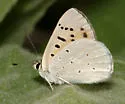
Perhaps the brightest orange species of Copper. Males are almost solid orange above, with a metallic sheen that may look purplish or red at certain angles. The females have a more average brownish pattern above with varying amounts of orange (depending somewhat on where they are found). The underside is nearly white, with the dark spots on the hind wing small and often reduced to the point of being nearly invisible. The orange submarginal line on the under hind wing is usually faint and thin, or more often totally absent. On the under front wing, there is only one row of dark marginal spots (double in several other species of Lycaena ), and usually there are only the three of these closest to the lower margin (or the others are much fainter). The lowermost of the postmedian row of dark spots (second row in from the outer margin) is ofset toward the outer margin from the spots above it (only true in a few other species that look quite different). The closest relative is the Blue Copper - Lycaena heteronea , in which the pattern below is the same, but males are blue instead of orange above, and the more similar females are grayish rather than brownish and have at least some hint of blue coloring above on the body and wings. In black and white photos the two species are pretty much identical, but in color there is rarely a problem except with some old and faded females.
Classification
- Kingdom
- Animalia
- Phylum
- Arthropoda
- Class
- Insecta
- Order
- Lepidoptera (Butterflies and Moths)
- Superfamily
- Papilionoidea
- Family
- Lycaenidae (Blues, Coppers, Hairstreaks, Harvesters)
- Subfamily
- Lycaeninae
- Genus
- Lycaena
Imported taxonomy record. Source availability varies; see the source references and editorial policy below.
Additional species information
Species notes from the sources
Etymology: The ending of a species name usually matches the gender of the genus name - sometimes it doesn't happen, and sometimes is debated by experts for some time.
About Butterflies and Moths: the wider group
Order-level background for Lepidoptera, the group containing Lycaena rubida. Species-specific details appear above.
Group overview
Lepidoptera includes approximately 180,000 described species of butterflies and moths. Moths outnumber butterflies roughly 10:1. The monarch butterfly's eastern population has declined by more than 80% since the mid-1990s, and the western population by over 95% since the 1980s. The IUCN lists the migratory monarch as Vulnerable.
Ecological role of the group
Butterflies and moths are essential indicators of ecosystem health. As caterpillars, they are a primary food source for birds - a single nest of blue tit chicks requires ~10,000 caterpillars. Adult moths pollinate many night-blooming plants.
Economic and practical significance of the group
Lepidoptera are critical pollinators. In Europe, grassland butterfly species have declined by almost 50% since the early 1990s. In the UK, three-quarters of butterflies are in decline. In the U.S., five butterfly species have gone extinct since 1950, with 29 listed as endangered.
Recorded sources for this group: IUCN Red List, Xerces Society, USFWS, PNAS, WWF. Imported estimates may describe particular regions or reporting periods.
Photos of Ruddy Copper - Hodges#4257 (5)
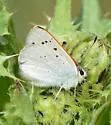
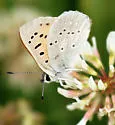
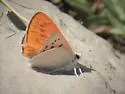
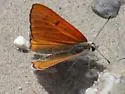
Photo credits: Contributed by tom murray; Additional contributions by Steve Nanz , Nick Block , David Ferguson