
Dorcas Copper - Hodges#4261
Lycaena dorcas
This record describes Lycaena dorcas (species). Recorded family: Lycaenidae. Recorded order: Lepidoptera.
Identification and Appearance
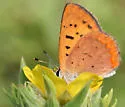
Distinguished from the similar Purplish Copper ( L. helloides ) by the reduced orange band on the edge of the hindwing upperside (vs. extensive orange band in Purplish Copper), the brownish-orange underside of the wings (vs. grayish-yellow in Purplish Copper), and geographic range (see maps in links listed under Internet References below). Bog Coppers ( Lycaena epixanthe ) may sometimes fly in the same areas, but the upper sides look plainer with fewer dark spots in males and usually less orange coloring (if any) in females. The undersides are yellowish to whitish and not orangey as in L. dorcas & L. helloides . Lilac-bordered Coppers ( Lycaena nivalis ) have the lower hind wing yellowish toward the base and pinkish or purplish on the outer half, not orange. Above they look very similar to Dorcas and especially to Purplish Coppers. The distinctions of Lycaena dorcas from closely similar Lycaena helloides have been (and remain) problematic. The two species are very closely related and very similar. Traditionally only populations from boreal regions and from the Upper Midwest have been included within L. dorcas , but more recent treatments also include Dasiphora / Potentilla feeding populations from the Rocky Mountains. This leaves the status of other mountain populations from further west a bit shaky as well. Some authors would include all as one adaptable and wide-ranging species, while others favor splitting the group into several species. The Cinquefoil feeding populations from the Rocky Mountain region may end up being separated as the species Lycaena florus , and populations from the far east in Canada have been separated out as L. dospassosi . [And, other segregate species have been proposed.] Currently, Rocky Mountain populations are included under Lycaena dorcas in the ' Butterflies of America ' web site and in Johathan Pelhams ' Catalogue of the Butterflies of the United States and Canada '.
Classification
- Kingdom
- Animalia
- Phylum
- Arthropoda
- Class
- Insecta
- Order
- Lepidoptera (Butterflies and Moths)
- Superfamily
- Papilionoidea
- Family
- Lycaenidae (Blues, Coppers, Hairstreaks, Harvesters)
- Subfamily
- Lycaeninae
- Genus
- Lycaena
Imported taxonomy record. Source availability varies; see the source references and editorial policy below.
Habitat and Range
Habitat
Primarily moist meadows and boggy areas where host plants are found.
Geographic Range
Depends on how the species is defined. Traditionally Boreal North America from Alaska, across Canada, to New Brunswick and Maine (with some breaks). With the inclusion of Rocky Mountain populations the range is expanded south through Montana, Wyoming, Idaho, Utah, and Colorado into Arizona and New Mexico. [and perhaps into Oregon?]
Seasonal Activity
Apparently usually (if not always) single-brooded (??), flying in summer. Mostly July or August, sometimes into September.
Diet and Behavior
Diet: Larvae feed on Shrubby Cinquefoil ( Dasiphora fruticosa [aka. Potentilla fruticosa ]) and other Cinquefoils ( Potentilla species) - family Rosaceae. In the Rocky Mountains there are reports of Whortleberry/Blueberry as larval hosts ( Vaccinium species) - family Ericaceae, but many if not most populations of these butterflies are strongly associated with Cinquefoils. Adults also nectar at Cinquefoil flowers, but will visit many other species of flowers when available (often Composites - family Asteraceae).
About Butterflies and Moths: the wider group
Order-level background for Lepidoptera, the group containing Lycaena dorcas. Species-specific details appear above.
Group overview
Lepidoptera includes approximately 180,000 described species of butterflies and moths. Moths outnumber butterflies roughly 10:1. The monarch butterfly's eastern population has declined by more than 80% since the mid-1990s, and the western population by over 95% since the 1980s. The IUCN lists the migratory monarch as Vulnerable.
Ecological role of the group
Butterflies and moths are essential indicators of ecosystem health. As caterpillars, they are a primary food source for birds - a single nest of blue tit chicks requires ~10,000 caterpillars. Adult moths pollinate many night-blooming plants.
Economic and practical significance of the group
Lepidoptera are critical pollinators. In Europe, grassland butterfly species have declined by almost 50% since the early 1990s. In the UK, three-quarters of butterflies are in decline. In the U.S., five butterfly species have gone extinct since 1950, with 29 listed as endangered.
Recorded sources for this group: IUCN Red List, Xerces Society, USFWS, PNAS, WWF. Imported estimates may describe particular regions or reporting periods.
Photos of Dorcas Copper - Hodges#4261 (5)
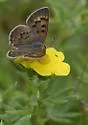
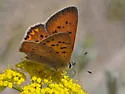
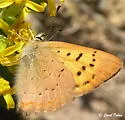
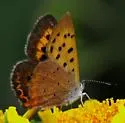
Photo credits: Contributed by Robin McLeod; Additional contributions by Steve Nanz , Nick Block , David Ferguson
Frequently Asked Questions About Dorcas Copper - Hodges#4261
What is Dorcas Copper - Hodges#4261?
Dorcas Copper - Hodges#4261 (Lycaena dorcas) is a species in the family Lycaenidae, within the order Lepidoptera.
How do you identify Dorcas Copper - Hodges#4261?
Distinguished from the similar Purplish Copper ( L. helloides ) by the reduced orange band on the edge of the hindwing upperside (vs. extensive orange band in Purplish Copper), the brownish-orange underside of the wings (vs. grayish-yellow in Purplish Copper), and geographic range (see maps in links listed under Internet References below). Bog Coppers ( Lycaena epixanthe ) may sometimes fly in the same areas, but the upper sides look plainer with fewer dark spots in males and usually less orange coloring (if any) in females. The undersides are yellowish to whitish and not orangey as in L. dorcas & L. helloides . Lilac-bordered Coppers ( Lycaena nivalis ) have the lower hind wing yellowish toward the base and pinkish or purplish on the outer half, not orange. Above they look very similar to Dorcas and especially to Purplish Coppers.
Where is Dorcas Copper - Hodges#4261 found?
| Feature | Details |
|---|---|
| Habitat | Primarily moist meadows and boggy areas where host plants are found. |
| Range | Depends on how the species is defined. Traditionally Boreal North America from Alaska, across Canada, to New Brunswick and Maine (with some breaks). With the inclusion of Rocky Mountain populations the range is expanded south through Montana, Wyoming, Idaho, Utah, and Colorado into Arizona and New Mexico. [and perhaps into Oregon?] |
What does Dorcas Copper - Hodges#4261 eat?
The diet of the Dorcas Copper - Hodges#4261 includes Larvae feed on Shrubby Cinquefoil ( Dasiphora fruticosa [aka. Potentilla fruticosa ]) and other Cinquefoils ( Potentilla species) - family Rosaceae. In the Rocky Mountains there are reports of Whortleberry/Blueberry as larval hosts ( Vaccinium species) - family Ericaceae, but many if not most populations of these butterflies are strongly associated with Cinquefoils. Adults also nectar at Cinquefoil flowers, but will visit many other species of flowers when available (often Composites - family Asteraceae)..
When is Dorcas Copper - Hodges#4261 active?
Dorcas Copper - Hodges#4261: seasonal activity - Apparently usually (if not always) single-brooded (??), flying in summer. Mostly July or August, sometimes into September..