
Bronze Copper - Hodges#4256
Lycaena hyllus
This record describes Lycaena hyllus (species). Recorded family: Lycaenidae. Recorded order: Lepidoptera.
Identification and Appearance
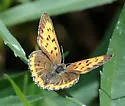
One of the easiest Coppers to recognize. Size is large for a Copper. Underside of all wings is scattered with prominent small rounded black spots. Front wings below are light orange, paler toward the margins; hind wings below are pale gray (nearly white) with a broad orange band near the margin. The upper sides of hind wings on both males and females are dark dull brownish with the same wide orange submarginal band as below strongly developed. Above, males are entirely dark, and when fresh have a reflective brassy sheen (looks purple from some angles). Females have the front wings above light brownish orange with prominent black spots and a wide dark outer borders. On both surfaces, the lowermost black pair of spots (may be fused into one elongate spot) in the postmedian series on the front wings is usually distinctly offset toward the base as compared to spots above it (occasionally almost in line).
Classification
- Kingdom
- Animalia
- Phylum
- Arthropoda
- Class
- Insecta
- Order
- Lepidoptera (Butterflies and Moths)
- Superfamily
- Papilionoidea
- Family
- Lycaenidae (Blues, Coppers, Hairstreaks, Harvesters)
- Subfamily
- Lycaeninae
- Genus
- Lycaena
Imported taxonomy record. Source availability varies; see the source references and editorial policy below.
Habitat and Range
Habitat
Moist open sunny areas, often low-lying pockets, near water, where larval host plants, Docks and/or Knotweeds ( Rumex and Polygonum species) are common.
Geographic Range
Widespread from the east base of the Rocky Mountains, to the Atlantic across southern Canada and the United States. Mostly absent from southern/coastal regions from North Carolina to Texas. Also recorded from lower elevations along the Pacific Slope of the Rockies in Utah, Colorado, Wyoming, Idaho, and Montana.
Seasonal Activity
Through most of range there are two adult flights, one in late spring/early summer and one in late summer/autumn. In coolest northern areas there may be only one flight, in summer. In mildest southern areas there are three flights, roughly in spring, summer, and autumn.
Diet and Behavior
Diet: plants in the Buckwheat family (Polygonaceae) - Rumex and Polygonum
Life History
Ovipositing, egg, and larva photos - Butterflies of America Larva, pupa and adult photos - Butterflies of America Larva; larva; pupa;
Additional species information
Species notes from the sources
Etymology: The proper name for this butterfly is debated. The name hyllus is the older name, but it was originally described as from Smyrna, Turkey, meaning it can not be the same species as found in North America (out species is not found there, and no similar species native to Turkey is found also in North America). The name Lycaena thoe was given to a North American insect originally, and was used for many years for out insects. However, the name L. hyllus was occasionally thought perhaps the same, and F. Martin Brown and W.D. Field "officially" replaced the name L. thoe with the name L. hyllus in 1970. Since that time the name L. hyllus has been more often (though not always used), and this use has been considered to be incorrect, improper, and "illegal" by several authors. In 2010, Calhoun reinforced the American usage of the name hyllus by designating a "neotype" to define (or redefine) the name Papilio hyllus ; using a female specimen collected in Brooklyn, New York. This is the usage followed by most current authors, but it may yet be overturned, and the name Lycaena thoe may eventually become the "winner" in this debate. European authors consider the name Papilio hyllus Cramer, to be an invalid (preoccupied) name, and a synonym of the Eurasian species Lycaena thersamon (Esper), 1784 [but, preoccupied by what?].
About Butterflies and Moths: the wider group
Order-level background for Lepidoptera, the group containing Lycaena hyllus. Species-specific details appear above.
Group overview
Lepidoptera includes approximately 180,000 described species of butterflies and moths. Moths outnumber butterflies roughly 10:1. The monarch butterfly's eastern population has declined by more than 80% since the mid-1990s, and the western population by over 95% since the 1980s. The IUCN lists the migratory monarch as Vulnerable.
Ecological role of the group
Butterflies and moths are essential indicators of ecosystem health. As caterpillars, they are a primary food source for birds - a single nest of blue tit chicks requires ~10,000 caterpillars. Adult moths pollinate many night-blooming plants.
Economic and practical significance of the group
Lepidoptera are critical pollinators. In Europe, grassland butterfly species have declined by almost 50% since the early 1990s. In the UK, three-quarters of butterflies are in decline. In the U.S., five butterfly species have gone extinct since 1950, with 29 listed as endangered.
Recorded sources for this group: IUCN Red List, Xerces Society, USFWS, PNAS, WWF. Imported estimates may describe particular regions or reporting periods.
Photos of Bronze Copper - Hodges#4256 (5)
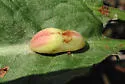
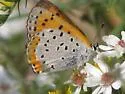
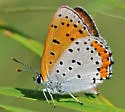
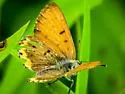
Photo credits: Contributed by Troy Bartlett; Additional contributions by Hannah Nendick-Mason , Robin McLeod , David Ferguson , Robert Lord Zimlich , marcie oconnor
Frequently Asked Questions About Bronze Copper - Hodges#4256
What is Bronze Copper - Hodges#4256?
Bronze Copper - Hodges#4256 (Lycaena hyllus) is a species in the family Lycaenidae, within the order Lepidoptera.
How do you identify Bronze Copper - Hodges#4256?
One of the easiest Coppers to recognize. Size is large for a Copper. Underside of all wings is scattered with prominent small rounded black spots. Front wings below are light orange, paler toward the margins; hind wings below are pale gray (nearly white) with a broad orange band near the margin. The upper sides of hind wings on both males and females are dark dull brownish with the same wide orange submarginal band as below strongly developed. Above, males are entirely dark, and when fresh have a reflective brassy sheen (looks purple from some angles). Females have the front wings above light brownish orange with prominent black spots and a wide dark outer borders. On both surfaces, the lowermost black pair of spots (may be fused into one elongate spot) in the postmedian series on the front wings is usually distinctly offset toward the base as compared to spots above it (occasionally almost in line).
Where is Bronze Copper - Hodges#4256 found?
| Feature | Details |
|---|---|
| Habitat | Moist open sunny areas, often low-lying pockets, near water, where larval host plants, Docks and/or Knotweeds ( Rumex and Polygonum species) are common. |
| Range | Widespread from the east base of the Rocky Mountains, to the Atlantic across southern Canada and the United States. Mostly absent from southern/coastal regions from North Carolina to Texas. Also recorded from lower elevations along the Pacific Slope of the Rockies in Utah, Colorado, Wyoming, Idaho, and Montana. |
What does Bronze Copper - Hodges#4256 eat?
The diet of the Bronze Copper - Hodges#4256 includes plants in the Buckwheat family (Polygonaceae) - Rumex and Polygonum.
When is Bronze Copper - Hodges#4256 active?
Bronze Copper - Hodges#4256: seasonal activity - Through most of range there are two adult flights, one in late spring/early summer and one in late summer/autumn. In coolest northern areas there may be only one flight, in summer. In mildest southern areas there are three flights, roughly in spring, summer, and autumn..
What is the life cycle of a Bronze Copper - Hodges#4256?
Ovipositing, egg, and larva photos - Butterflies of America Larva, pupa and adult photos - Butterflies of America Larva; larva; pupa;