
Carolina Satyr - Hodges#4575
Hermeuptychia sosybius
This record describes Hermeuptychia sosybius (species). Recorded family: Nymphalidae. Recorded order: Lepidoptera.
Identification and Appearance
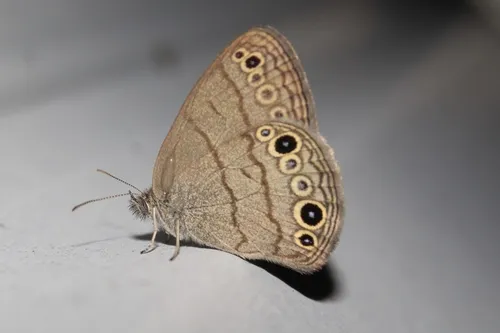
Adult: While still alive, eyes gray with vertical stripes. Wings dull brown with no eyespots on upperside. Underside of wings have a dark dash in the middle of each wing (may be faint), and a series of yellow-rimmed eyespots along the edge, with darkened ones not more than twice as large as lighter ones; only one eyespot on underside of forewing is darker and usually larger than the other spots; on hind wing usually at least one (an upper one) touches marginal dark lines, and innermost marginal dark line may be somewhat zig-zag. In Little Wood Satyr - Megisto cymela , when still alive eyes are black. Upper side of wings with dark eyespots. Underside with dark dash in middle of wings most often missing; dark eyespots often more than twice as large as lighter ones (which may be deformed); front wing with two or more eyespots enlarged and dark (lower one(s) may be hidden from view); hind wing usually with no eyespots touching innermost marginal dark line, which is not zig-zag (if an eyespot does touch, it is usually a lower one). See also Identification under Intricate Satyr ( Hermeuptychia intricata ) for distinguishing from Intricate Satyr. See also notes under South Texas Satyr ( Hermeuptychia hermybius ) for distinguishing from that species.
Classification
- Kingdom
- Animalia
- Phylum
- Arthropoda
- Class
- Insecta
- Order
- Lepidoptera (Butterflies and Moths)
- Superfamily
- Papilionoidea
- Family
- Nymphalidae (Brush-footed Butterflies)
- Subfamily
- Satyrinae
- Tribe
- Satyrini
- Genus
- Hermeuptychia (Hermeuptychia Satyrs)
Imported taxonomy record. Source availability varies; see the source references and editorial policy below.
Habitat and Range
Habitat
Grassy places, woodlands, forest edges, shaded lawns.
Geographic Range
se US - Map (MPG) Southern New Jersey south along the Atlantic Coast to southern Florida; west to southeast Kansas, central Oklahoma, and central Texas.
Seasonal Activity
mostly Apr-Oct (MPG)
Diet and Behavior
Diet: Larvae feed on grasses; recorded from Broadleaf Carpet Grass ( Axonopus compressus ), Centipede Grass ( Eremochloa ophiuroides ), Bosc's Panicgrass ( Dichanthelium boscii ), Variable Panicgrass ( Dichanthelium commutatum ), Openflower Rosette Grass ( Dichanthelium laxiflorum ), Heller's Rosette Grass ( Dichanthelium oligosanthes ), and Wooly Rosette Grass ( Dichanthelium scabrisculum ) ; females in captivity have oviposited on St. Augustine Grass ( Stenotaphrum secundatum ) and Kentucky Bluegrass ( Poa pratensis ) Adults feed on tree sap and rotting fruit but, on rare occasions, will nectar on flowers.
Life History
Three generations per year in northern part of range; more than three farther south. Larvae overwinter on hostplants as larvae and pupate in late winter.
About Butterflies and Moths: the wider group
Order-level background for Lepidoptera, the group containing Hermeuptychia sosybius. Species-specific details appear above.
Group overview
Lepidoptera includes approximately 180,000 described species of butterflies and moths. Moths outnumber butterflies roughly 10:1. The monarch butterfly's eastern population has declined by more than 80% since the mid-1990s, and the western population by over 95% since the 1980s. The IUCN lists the migratory monarch as Vulnerable.
Ecological role of the group
Butterflies and moths are essential indicators of ecosystem health. As caterpillars, they are a primary food source for birds - a single nest of blue tit chicks requires ~10,000 caterpillars. Adult moths pollinate many night-blooming plants.
Economic and practical significance of the group
Lepidoptera are critical pollinators. In Europe, grassland butterfly species have declined by almost 50% since the early 1990s. In the UK, three-quarters of butterflies are in decline. In the U.S., five butterfly species have gone extinct since 1950, with 29 listed as endangered.
Recorded sources for this group: IUCN Red List, Xerces Society, USFWS, PNAS, WWF. Imported estimates may describe particular regions or reporting periods.
Photos of Carolina Satyr - Hodges#4575 (2)
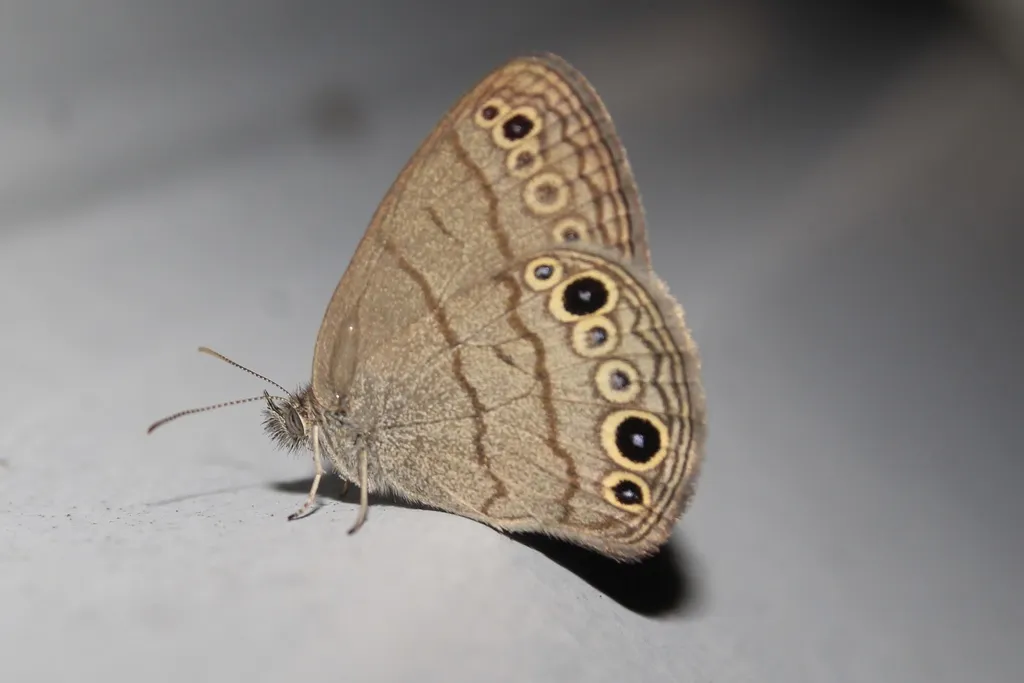
Photo credits: Contributed by Hannah Nendick-Mason; Additional contributions by cotinis , Robin McLeod , Mike Quinn , Maury Heiman , Nick Block , David Ferguson , Robert Lord Zimlich , Tom Austin
Frequently Asked Questions About Carolina Satyr - Hodges#4575
What is Carolina Satyr - Hodges#4575?
Carolina Satyr - Hodges#4575 (Hermeuptychia sosybius) is a species in the family Nymphalidae, within the order Lepidoptera.
How big is Carolina Satyr - Hodges#4575?
wingspan 32-38 mm
How do you identify Carolina Satyr - Hodges#4575?
Adult: While still alive, eyes gray with vertical stripes. Wings dull brown with no eyespots on upperside. Underside of wings have a dark dash in the middle of each wing (may be faint), and a series of yellow-rimmed eyespots along the edge, with darkened ones not more than twice as large as lighter ones; only one eyespot on underside of forewing is darker and usually larger than the other spots; on hind wing usually at least one (an upper one) touches marginal dark lines, and innermost marginal dark line may be somewhat zig-zag. In Little Wood Satyr - Megisto cymela , when still alive eyes are black. Upper side of wings with dark eyespots. Underside with dark dash in middle of wings most often missing; dark eyespots often more than twice as large as lighter ones (which may be deformed); front wing with two or more eyespots enlarged and dark (lower one(s) may be hidden from view); hind wing usually with no eyespots touching innermost marginal dark line, which is not zig-zag (if an eyespot does touch, it is usually a lower one). See also Identification under Intricate Satyr ( Hermeuptychia intricata ) for distinguishing from Intricate Satyr. See also notes under South Texas Satyr ( Hermeuptychia hermybius ) for distinguishing from that species.
Where is Carolina Satyr - Hodges#4575 found?
| Feature | Details |
|---|---|
| Habitat | Grassy places, woodlands, forest edges, shaded lawns. |
| Range | se US - Map (MPG) Southern New Jersey south along the Atlantic Coast to southern Florida; west to southeast Kansas, central Oklahoma, and central Texas. |
What does Carolina Satyr - Hodges#4575 eat?
The diet of the Carolina Satyr - Hodges#4575 includes Larvae feed on grasses; recorded from Broadleaf Carpet Grass ( Axonopus compressus ), Centipede Grass ( Eremochloa ophiuroides ), Bosc's Panicgrass ( Dichanthelium boscii ), Variable Panicgrass ( Dichanthelium commutatum ), Openflower Rosette Grass ( Dichanthelium laxiflorum ), Heller's Rosette Grass ( Dichanthelium oligosanthes ), and Wooly Rosette Grass ( Dichanthelium scabrisculum ) ; females in captivity have oviposited on St. Augustine Grass ( Stenotaphrum secundatum ) and Kentucky Bluegrass ( Poa pratensis ) Adults feed on tree sap and rotting fruit but, on rare occasions, will nectar on flowers..
When is Carolina Satyr - Hodges#4575 active?
Carolina Satyr - Hodges#4575: seasonal activity - mostly Apr-Oct (MPG).
What is the life cycle of a Carolina Satyr - Hodges#4575?
Three generations per year in northern part of range; more than three farther south. Larvae overwinter on hostplants as larvae and pupate in late winter.