
High Plains Grasshopper
Dissosteira longipennis
This record describes Dissosteira longipennis (species). Recorded family: Acrididae. Recorded order: Orthoptera.
Identification and Appearance
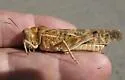
| Feature | Description |
|---|---|
| Additional details | A large relatively slender Grasshopper, very like Dissosteira carolina , except with base of wings transparent bluish in color, and outer margin not yellowish, but rather clear to translucent white. |
| Body | Body and tegmina usually with more contrasting pattern of dark spots. Hind tibiae usually rich yellow (mostly duller and most often browner in D. carolina ). |
| Pronotum | Pronotum with crest somewhat higher. |
| Head | Head proportionately larger. Very young nymphs of Dissosteira carolina have hind tibiae and often hind femora black, while those of D. longipennis do not. Older nymphs differ in same ways as adults (except for wings, which aren't yet developed). Also. very similar to D. spurcata , but that somewhat smaller species has the wings pale translucent whitish to yellowish with a narrow dark border (sometimes faint), and occurs west of the Rocky Mountains. Tends to hover in air and have a somewhat dancing butterfly-like flight, often producing a very faint clicking crepitation during displays. However, when disturbed it is a powerful long-distance flier. It can be very wary, difficult to approach, and very difficult to catch. It tends to occur in habitats away from people, and is much less often encountered than the Carolina Grasshopper (which often occurs even in urban surroundings). When it is encountered, it is often overlooked due to its resemblance to the much more common Carolina Grasshopper (with which it often occurs). Outbreaks of huge numbers have occurred in past (though not in recent decades), and during those times this species has been considered economically damaging. When outbreaks occur there is some tendency to form migratory swarms. However, this abundance is the exception, and normally this is an uncommon species. It has been quite rare in most of its range since the early 1980's, but seems to be becoming more common again in se. Colorado and sw. Kansas in recent years. There is a tendency toward what is apparently a migratory phase in this species, in which individuals differ somewhat in proportions from the more normal individuals. Particularly, these seem to have porportionately larger heads and longer wings, and they tend to occur mostly in populations that are reaching high densities. Is attracted to lights at night, sometimes in great numbers. |
Classification
- Kingdom
- Animalia
- Phylum
- Arthropoda
- Class
- Insecta
- Order
- Orthoptera (Grasshoppers, Crickets, Katydids)
- Suborder
- Caelifera
- Family
- Acrididae (Short-horned Grasshoppers)
- Subfamily
- Oedipodinae
- Tribe
- Trimerotropini
- Genus
- Dissosteira
Imported taxonomy record. Source availability varies; see the source references and editorial policy below.
Habitat and Range
Habitat
Prefers undisturbed areas in short grassland with large areas of bare, often sandy soil. When abundant, becomes a bit less discriminating as to habitat preference, and it may be found along roadside, in cultivated areas (especially fallow), and in other grassland environments.
Geographic Range
Apparently always present from w. Nebraska and se. Wyoming south into nw. Texas and e. New Mexico. Most common in eastern Colorado and western Kansas. However, in some years it is very abundant, and seems to spread further north, east and south, and has been found in Iowa, South Dakota, Montana, south Texas, etc. Whether it really periodically expands its range, or just occurs in low enough numbers as not to be noticed, is uncertain.
Diet and Behavior
Diet: Grasses
Life History
Overwinters as eggs laid in soil, with adults maturing in late spring or early summer, with some surviving until freezing weather.
About Grasshoppers, Crickets, Katydids: the wider group
Order-level background for Orthoptera, the group containing Dissosteira longipennis. Species-specific details appear above.
Group overview
Orthoptera includes ~28,000 described species of grasshoppers, crickets, and katydids. Desert locusts can form swarms covering 460 square miles containing up to 80 million individuals per square kilometer.
Ecological role of the group
Grasshoppers and crickets are a primary food source for birds, reptiles, and small mammals. Cricket farming is a growing industry - crickets require 12× less feed than cattle to produce the same amount of protein, using 2,000× less water.
Economic and practical significance of the group
A single large locust swarm can consume the same amount of food in one day as 35,000 people. The 2019-2021 East Africa locust crisis affected food security for 42 million people across multiple countries. Global crop losses from locusts can reach billions annually.
Recorded sources for this group: FAO, UN World Food Programme, research publications. Imported estimates may describe particular regions or reporting periods.
Photos of High Plains Grasshopper (5)
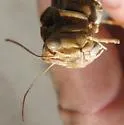
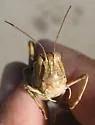
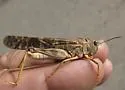
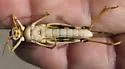
Photo credits: Contributed by David J. Ferguson; Additional contributions by Tyler Hedlund
Frequently Asked Questions About High Plains Grasshopper
What is High Plains Grasshopper?
High Plains Grasshopper (Dissosteira longipennis) is a species in the family Acrididae, within the order Orthoptera.
How do you identify High Plains Grasshopper?
| Feature | Description |
|---|---|
| Additional details | A large relatively slender Grasshopper, very like Dissosteira carolina , except with base of wings transparent bluish in color, and outer margin not yellowish, but rather clear to translucent white. |
| Body | Body and tegmina usually with more contrasting pattern of dark spots. Hind tibiae usually rich yellow (mostly duller and most often browner in D. carolina ). |
| Pronotum | Pronotum with crest somewhat higher. |
| Head | Head proportionately larger. Very young nymphs of Dissosteira carolina have hind tibiae and often hind femora black, while those of D. longipennis do not. Older nymphs differ in same ways as adults (except for wings, which aren't yet developed). Also. very similar to D. spurcata , but that somewhat smaller species has the wings pale translucent whitish to yellowish with a narrow dark border (sometimes faint), and occurs west of the Rocky Mountains. |
Where is High Plains Grasshopper found?
| Feature | Details |
|---|---|
| Habitat | Prefers undisturbed areas in short grassland with large areas of bare, often sandy soil. When abundant, becomes a bit less discriminating as to habitat preference, and it may be found along roadside, in cultivated areas (especially fallow), and in other grassland environments. |
| Range | Apparently always present from w. Nebraska and se. Wyoming south into nw. Texas and e. New Mexico. Most common in eastern Colorado and western Kansas. However, in some years it is very abundant, and seems to spread further north, east and south, and has been found in Iowa, South Dakota, Montana, south Texas, etc. Whether it really periodically expands its range, or just occurs in low enough numbers as not to be noticed, is uncertain. |
What does High Plains Grasshopper eat?
The diet of the High Plains Grasshopper includes Grasses.
What is the life cycle of a High Plains Grasshopper?
Overwinters as eggs laid in soil, with adults maturing in late spring or early summer, with some surviving until freezing weather.