
Mexican Dichroplus
Dichroplus notatus
This record describes Dichroplus notatus (species). Recorded family: Acrididae. Recorded order: Orthoptera.
Identification and Appearance
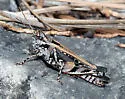
| Feature | Description |
|---|---|
| Wings | Wings fully developed and reach to near or past hind femora when folded. Similar to Melanoplus and Aidemona , but with distinctive color pattern. Usually with tops of folded tegmina and pronotum paler than dark sides and with dark mark running along top middle of pronotum (wide on prozona and narrow on metazona) that continues a short distance onto folded tegmina and also forward onto head between eyes. |
| Antennae | Antennae relatively light in color, often matching light color of top of body or somewhat more reddish. Femora usually all similar in color to top of body, with prominent dark cross bands (diagonal on outer face of hind femora), with knees of hind legs entirely dark (nearly black), and inner and lower sides of hind femora most often reddish. Hind tibiae grayish blue. |
| Eyes | Eyes (when living) fairly dark with sharp horizontal line (light above and dark below) crossing near middle. In Aidemona the dark marking on top is missing or less pronounced and quite different; and, the line through the eyes is curved and not horizontal (distinctly lower in front than in back). Front and middle femora are usually dotted with dark, and hind femora most often appear to have pale diagonal marks on a darker (but still fairly light) background, and often are nearly plain or dotted with dark instead. Also the body is stouter in proportions with the hind femora less slender. Melanoplus are so varied it is difficult to compare all in a small space, but none share the same pattern. Based upon 18 specimens collected at two sites in southeastern Arizona during 2009 and 2010, Dichroplus notatus is added to the orthopteran fauna of the United States. (Behrstock & Sullivan 2011) |
Classification
- Kingdom
- Animalia
- Phylum
- Arthropoda
- Class
- Insecta
- Order
- Orthoptera (Grasshoppers, Crickets, Katydids)
- Suborder
- Caelifera
- Family
- Acrididae (Short-horned Grasshoppers)
- Subfamily
- Melanoplinae
- Tribe
- Dichroplini
- Genus
- Dichroplus
Imported taxonomy record. Source availability varies; see the source references and editorial policy below.
Habitat and Range
Geographic Range
Huachuca Mtns, se. AZ / Mex. (Behrstock & Sullivan 2011)
Seasonal Activity
July (Behrstock & Sullivan 2011)
Additional species information
Species notes from the sources
Etymology: It has been suggested that this species does not belong to the genus Dichroplus , but it is placed there currently. D. notatus is very similar in appearance to the genus Baeacris .
About Grasshoppers, Crickets, Katydids: the wider group
Order-level background for Orthoptera, the group containing Dichroplus notatus. Species-specific details appear above.
Group overview
Orthoptera includes ~28,000 described species of grasshoppers, crickets, and katydids. Desert locusts can form swarms covering 460 square miles containing up to 80 million individuals per square kilometer.
Ecological role of the group
Grasshoppers and crickets are a primary food source for birds, reptiles, and small mammals. Cricket farming is a growing industry - crickets require 12× less feed than cattle to produce the same amount of protein, using 2,000× less water.
Economic and practical significance of the group
A single large locust swarm can consume the same amount of food in one day as 35,000 people. The 2019-2021 East Africa locust crisis affected food security for 42 million people across multiple countries. Global crop losses from locusts can reach billions annually.
Recorded sources for this group: FAO, UN World Food Programme, research publications. Imported estimates may describe particular regions or reporting periods.
Photos of Mexican Dichroplus (5)
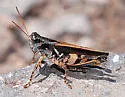
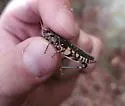
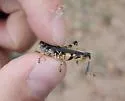
Photo credits: Contributed by David J. Ferguson; Additional contributions by Mike Quinn
Frequently Asked Questions About Mexican Dichroplus
What is Mexican Dichroplus?
Mexican Dichroplus (Dichroplus notatus) is a species in the family Acrididae, within the order Orthoptera.
How big is Mexican Dichroplus?
males about 13 mm females about 18 mm
How do you identify Mexican Dichroplus?
| Feature | Description |
|---|---|
| Wings | Wings fully developed and reach to near or past hind femora when folded. Similar to Melanoplus and Aidemona , but with distinctive color pattern. Usually with tops of folded tegmina and pronotum paler than dark sides and with dark mark running along top middle of pronotum (wide on prozona and narrow on metazona) that continues a short distance onto folded tegmina and also forward onto head between eyes. |
| Antennae | Antennae relatively light in color, often matching light color of top of body or somewhat more reddish. Femora usually all similar in color to top of body, with prominent dark cross bands (diagonal on outer face of hind femora), with knees of hind legs entirely dark (nearly black), and inner and lower sides of hind femora most often reddish. Hind tibiae grayish blue. |
| Eyes | Eyes (when living) fairly dark with sharp horizontal line (light above and dark below) crossing near middle. In Aidemona the dark marking on top is missing or less pronounced and quite different; and, the line through the eyes is curved and not horizontal (distinctly lower in front than in back). Front and middle femora are usually dotted with dark, and hind femora most often appear to have pale diagonal marks on a darker (but still fairly light) background, and often are nearly plain or dotted with dark instead. Also the body is stouter in proportions with the hind femora less slender. Melanoplus are so varied it is difficult to compare all in a small space, but none share the same pattern. |
Where is Mexican Dichroplus found?
Range: Huachuca Mtns, se. AZ / Mex. (Behrstock & Sullivan 2011)
When is Mexican Dichroplus active?
Mexican Dichroplus: seasonal activity - July (Behrstock & Sullivan 2011).