
Green-striped Grasshopper
Chortophaga viridifasciata
This record describes Chortophaga viridifasciata (species). Recorded family: Acrididae. Recorded order: Orthoptera.
Identification and Appearance
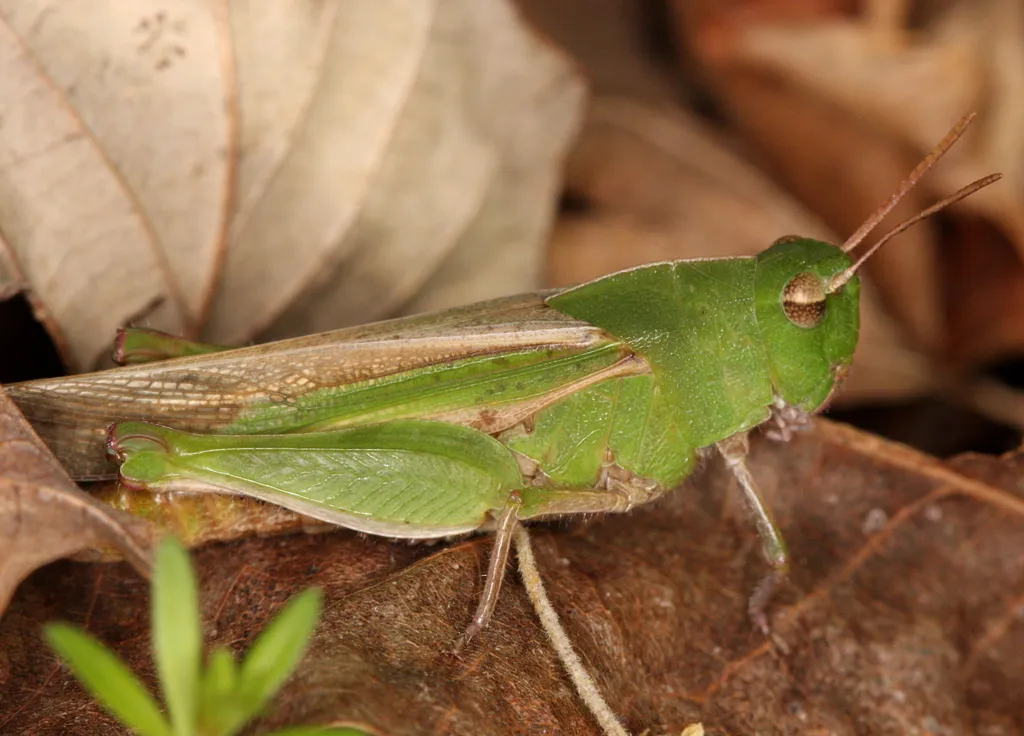
Green and brown phases. Females usually green, males usually brown. Wings faint yellow when spread, smoky brown to nearly black towards tip. Strong pronotal ridge. Green (or brown) stripe near the border of front wings. Southern and summer individuals are more strongly patterned, often with dark bars across part of front wings and on top of hind femora, and with the dark coloring on the hind wings more developed. Southern populations have been separated as a species C. australior , but are treated as a weakly differentiated subspecies here, since there is no possible way to draw a line between the intergrading southern and northern populations. Inland from the coastal plain in the southeastern states, assignment of individuals to one or the other subspecies is somewhat arbitrary, where individuals in the same populations can look like either subspecies, or intermediate in character. Generally, in most species with long wings, the instars can be told by looking at the wing pads. Counting antennal segments can work too, but if you don't already have a reference, you won't know how many segments are in the antennae of each instar without actually rearing them and checking for yourself. I could look up what is average, but it varies a lot from species to species. Anyway, the younger they are, the fewer the antenna segments. Species with short wings go through roughly the same development of the wings, but so much reduced in size that it is difficult to make much use of the wings unless you already are familiar with the development of the species. I think the upward flip at the 4th instar is pretty universal though. And, of course, it is useless to look at wing development on wingless species. Males and sometimes females crepitate with a continuous buzz, but not during every flight, and the sound is relatively faint.
Wikipedia reference for Chortophaga viridifasciata: http://en.wikipedia.org/wiki/Chortophaga_viridifasciata.
Classification
- Kingdom
- Animalia
- Phylum
- Arthropoda
- Class
- Insecta
- Order
- Orthoptera (Grasshoppers, Crickets, Katydids)
- Suborder
- Caelifera
- Family
- Acrididae (Short-horned Grasshoppers)
- Subfamily
- Oedipodinae
- Tribe
- Chortophagini
- Genus
- Chortophaga
Imported taxonomy record. Source availability varies; see the source references and editorial policy below.
Habitat and Range
Habitat
Relatively moist and sunny areas of short grass. Often found abundantly in hay meadows, along roadsides, and in grassy low lying areas. Can be found in most any sunny grassy area in East, but restricted to limited moist habitats in West.
Geographic Range
British Columbia to Atlantic Coast and south (mostly only east of the Rockies) to the Gulf Coast and through eastern Mexico to at at least Costa Rica. Limited to isolated colonies in far west, often associated with irrigation and agriculture (such as in Idaho, Utah, and western Colorado), and perhaps was introduced there.
Seasonal Activity
Adults in spring and early summer in North. Southward multiple-brooded with adults from end of winter to begining of winter, and in far south may be found year-round.
Diet and Behavior
Diet: Grasses, some forbs.
About Grasshoppers, Crickets, Katydids: the wider group
Order-level background for Orthoptera, the group containing Chortophaga viridifasciata. Species-specific details appear above.
Group overview
Orthoptera includes ~28,000 described species of grasshoppers, crickets, and katydids. Desert locusts can form swarms covering 460 square miles containing up to 80 million individuals per square kilometer.
Ecological role of the group
Grasshoppers and crickets are a primary food source for birds, reptiles, and small mammals. Cricket farming is a growing industry - crickets require 12× less feed than cattle to produce the same amount of protein, using 2,000× less water.
Economic and practical significance of the group
A single large locust swarm can consume the same amount of food in one day as 35,000 people. The 2019-2021 East Africa locust crisis affected food security for 42 million people across multiple countries. Global crop losses from locusts can reach billions annually.
Recorded sources for this group: FAO, UN World Food Programme, research publications. Imported estimates may describe particular regions or reporting periods.
Photos of Green-striped Grasshopper (2)
Photo credits: Contributed by Cotinis; Additional contributions by john and jane balaban , David Ferguson , metrioptera
Frequently Asked Questions About Green-striped Grasshopper
What is Green-striped Grasshopper?
Green-striped Grasshopper (Chortophaga viridifasciata) is a species in the family Acrididae, within the order Orthoptera.
How big is Green-striped Grasshopper?
23-38 mm (males 23-30, females 28-38)
How do you identify Green-striped Grasshopper?
Green and brown phases. Females usually green, males usually brown. Wings faint yellow when spread, smoky brown to nearly black towards tip. Strong pronotal ridge. Green (or brown) stripe near the border of front wings. Southern and summer individuals are more strongly patterned, often with dark bars across part of front wings and on top of hind femora, and with the dark coloring on the hind wings more developed. Southern populations have been separated as a species C. australior , but are treated as a weakly differentiated subspecies here, since there is no possible way to draw a line between the intergrading southern and northern populations. Inland from the coastal plain in the southeastern states, assignment of individuals to one or the other subspecies is somewhat arbitrary, where individuals in the same populations can look like either subspecies, or intermediate in character.
Where is Green-striped Grasshopper found?
| Feature | Details |
|---|---|
| Habitat | Relatively moist and sunny areas of short grass. Often found abundantly in hay meadows, along roadsides, and in grassy low lying areas. Can be found in most any sunny grassy area in East, but restricted to limited moist habitats in West. |
| Range | British Columbia to Atlantic Coast and south (mostly only east of the Rockies) to the Gulf Coast and through eastern Mexico to at at least Costa Rica. Limited to isolated colonies in far west, often associated with irrigation and agriculture (such as in Idaho, Utah, and western Colorado), and perhaps was introduced there. |
What does Green-striped Grasshopper eat?
The diet of the Green-striped Grasshopper includes Grasses, some forbs..
When is Green-striped Grasshopper active?
Green-striped Grasshopper: seasonal activity - Adults in spring and early summer in North. Southward multiple-brooded with adults from end of winter to begining of winter, and in far south may be found year-round..