
Robust Crayfish
Cambarus robustus
This record describes Cambarus robustus (species). Recorded family: Cambaridae. Recorded order: Decapoda.
Identification and Appearance
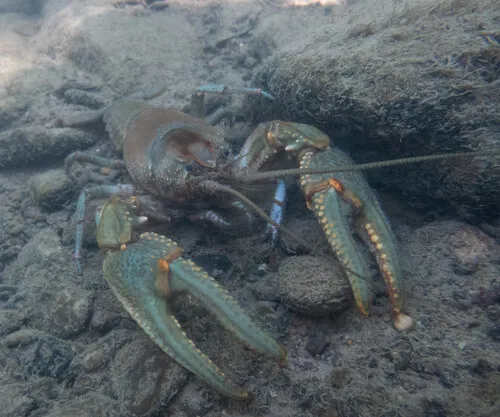
Body shape: very large animal; dorsoventrally flattened; wide carapace Coloration: shades of brown and red with black, orange, and yellow highlights; cream underside; mottled or bearing saddle pattern Spines: cervical spines or tubercles may be present or absent; cephalic spine or tubercle present; branchiostegal spine present; no marginal spines Rostrum: margins straight and converging but not thickened; triangularly tapered at rostrum (may be curved margins) Areola: medium, bearing approx. 5-6 punctations across narrowest part Chelae: smooth and very robust; possessing double row of tubercles on mesial margin of palm; well-developed dorsolatitudinal ridges on fingers; may be gap between fingers Other characteristics: - small eye; acute suborbital angle - form I male gonopod: terminal elements similar in length; corneous central projection bearing subapical notch; mesial process inflated at base and tapering distally; cephalic margin sloping at an angle
Classification
- Kingdom
- Animalia
- Phylum
- Arthropoda
- Class
- Malacostraca
- Order
- Decapoda (Crabs, Crayfishes, Lobsters, Prawns, and Shrimp)
- Superfamily
- Astacoidea
- Family
- Cambaridae
- Genus
- Cambarus
Imported taxonomy record. Source availability varies; see the source references and editorial policy below.
Habitat and Range
Habitat
“streams” (Hobbs Jr., 1989) “pool and riffle areas of small to large streams, especially latter, under rocks” (Bouchard, 1974)
Geographic Range
“Ontario and New York, to Illinois, and southward to Tennessee, North Carolina, and Virginia. Its presence in New England east of the Hudson River is believed to have resulted from introductions…” (Hobbs Jr., 1989)
Seasonal Activity
Present year round; Breeds in spring, late summer/early fall
About Crabs, Crayfishes, Lobsters, Prawns, and Shrimp: the wider group
Order-level background for Decapoda, the group containing Cambarus robustus. Species-specific details appear above.
Group overview
Decapoda includes ~15,000 described species of crabs, lobsters, shrimp, and crayfish. Although primarily marine and freshwater, some species like hermit crabs and coconut crabs are fully terrestrial.
Ecological role of the group
Crayfish are keystone species in freshwater ecosystems, influencing water clarity, sediment dynamics, and plant communities. Hermit crabs play vital roles in nutrient cycling on tropical islands.
Economic and practical significance of the group
The global shrimp industry alone is worth over $45 billion annually. Crayfish are important aquaculture species and invasive crayfish cause ecological damage estimated in the hundreds of millions annually in Europe and North America.
Recorded sources for this group: FAO fisheries statistics, freshwater ecology. Imported estimates may describe particular regions or reporting periods.
Photos of Robust Crayfish (2)
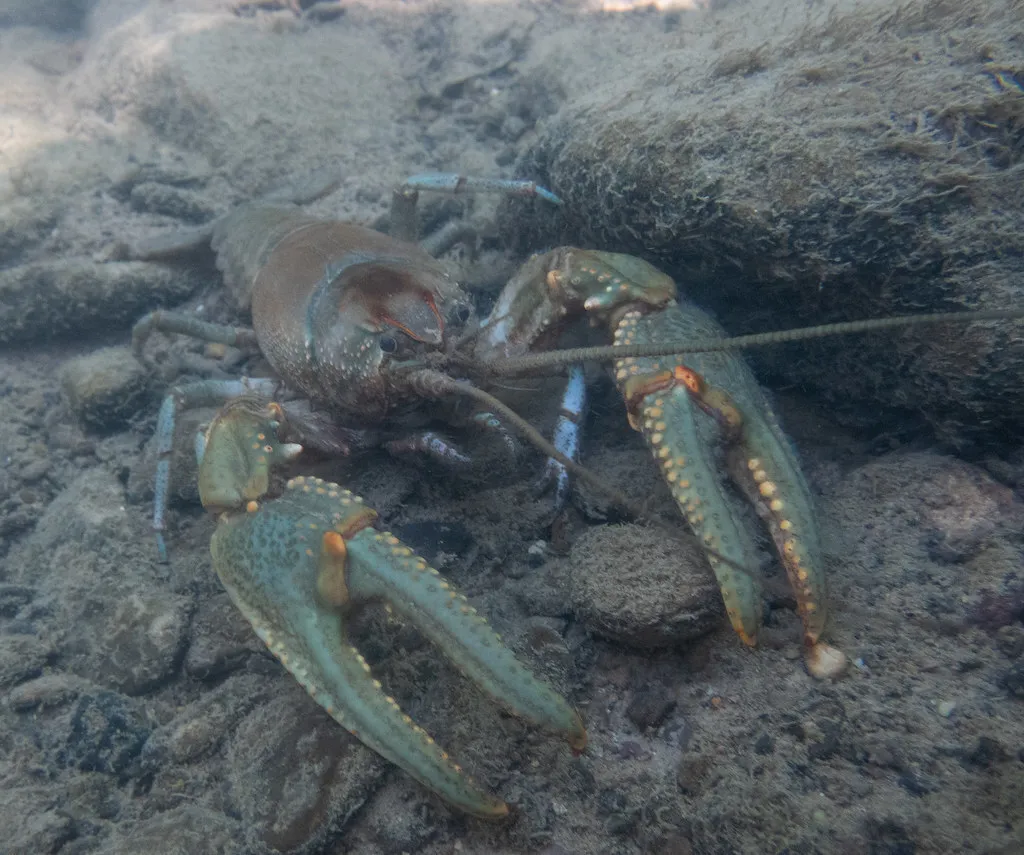
Photo credits: Contributed by Jason D. Roberts
Frequently Asked Questions About Robust Crayfish
What is Robust Crayfish?
Robust Crayfish (Cambarus robustus) is a species in the family Cambaridae, within the order Decapoda.
How do you identify Robust Crayfish?
Body shape: very large animal; dorsoventrally flattened; wide carapace Coloration: shades of brown and red with black, orange, and yellow highlights; cream underside; mottled or bearing saddle pattern Spines: cervical spines or tubercles may be present or absent; cephalic spine or tubercle present; branchiostegal spine present; no marginal spines Rostrum: margins straight and converging but not thickened; triangularly tapered at rostrum (may be curved margins) Areola: medium, bearing approx. 5-6 punctations across narrowest part Chelae: smooth and very robust; possessing double row of tubercles on mesial margin of palm; well-developed dorsolatitudinal ridges on fingers; may be gap between fingers Other characteristics: - small eye; acute suborbital angle - form I male gonopod: terminal elements similar in length; corneous central projection bearing subapical notch; mesial process inflated at base and tapering distally; cephalic margin sloping at an angle
Where is Robust Crayfish found?
| Feature | Details |
|---|---|
| Habitat | streams (Hobbs Jr., 1989) pool and riffle areas of small to large streams, especially latter, under rocks (Bouchard, 1974) |
| Range | Ontario and New York, to Illinois, and southward to Tennessee, North Carolina, and Virginia. Its presence in New England east of the Hudson River is believed to have resulted from introductions… (Hobbs Jr., 1989) |
When is Robust Crayfish active?
Robust Crayfish: seasonal activity - Present year round; Breeds in spring, late summer/early fall.