
Devil Crayfish
Cambarus diogenes
This record describes Cambarus diogenes (species). Recorded family: Cambaridae. Recorded order: Decapoda.
Identification and Appearance
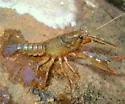
Body shape: carapace vaulted Coloration: reddish-brown or grayish with bright or pastel shades of red and blue along margins and crevices Spines: lacking marginal, cephalic; cervical spines present in juveniles, but not adults Rostrum: wide and squarish but with converging margins, somewhat long; concave; small pinched acumen Areola: linear (or nearly so), or obliterated (closed) Chelae: robust; strong dorsolatitudinal ridges; having broad shallow curved excision in proximal half of movable dactyl; large tubercle about midway on mesial margin of fixed finger (in adults); palm has two lateral rows of tubercles, and a third dorsally from base of palm diagonally to base of dactyl Other characteristics: - eyes well developed - form I male gonopod: corneous central projection somewhat rounded and not bearing subapical notch; central projection longer than mesial process; mesial process inflated and bulbous at base, tapering distally (See Illustration [Hobbs Jr., 1989]) Considered an almost certain species complex in need of revision.
Classification
- Kingdom
- Animalia
- Phylum
- Arthropoda
- Class
- Malacostraca
- Order
- Decapoda (Crabs, Crayfishes, Lobsters, Prawns, and Shrimp)
- Superfamily
- Astacoidea
- Family
- Cambaridae
- Genus
- Cambarus
Imported taxonomy record. Source availability varies; see the source references and editorial policy below.
Habitat and Range
Habitat
"Burrows (primary burrower); often found in ponds or streams in the spring season." (Hobbs Jr., 1989) “Primary burrower along water courses and in low swampy areas. Adults, and especially juveniles, also collected in epigean bodies of water” (Bouchard 1974)
Geographic Range
"Very widespread east of the Rockies and south of the Great Lakes, except peninsular Florida and the Alleghenies; not reported northeast of New Jersey in the East and east of western Pennsylvania in the Mississippi drainage system." (Hobbs Jr., 1989) “throughout Cumberlands (Kentucky, Virginia, Tennessee, Georgia, Alabama), avoiding areas of high gradient” (Bouchard, 1974)
Seasonal Activity
Year round
Diet and Behavior
Life History
“amplexus in fall; spring brooding” (NHP ICAS 1999)
About Crabs, Crayfishes, Lobsters, Prawns, and Shrimp: the wider group
Order-level background for Decapoda, the group containing Cambarus diogenes. Species-specific details appear above.
Group overview
Decapoda includes ~15,000 described species of crabs, lobsters, shrimp, and crayfish. Although primarily marine and freshwater, some species like hermit crabs and coconut crabs are fully terrestrial.
Ecological role of the group
Crayfish are keystone species in freshwater ecosystems, influencing water clarity, sediment dynamics, and plant communities. Hermit crabs play vital roles in nutrient cycling on tropical islands.
Economic and practical significance of the group
The global shrimp industry alone is worth over $45 billion annually. Crayfish are important aquaculture species and invasive crayfish cause ecological damage estimated in the hundreds of millions annually in Europe and North America.
Recorded sources for this group: FAO fisheries statistics, freshwater ecology. Imported estimates may describe particular regions or reporting periods.
Photos of Devil Crayfish (5)
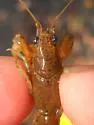
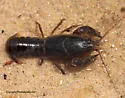
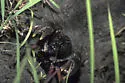
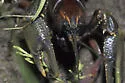
Photo credits: Contributed by Jason D. Roberts
Frequently Asked Questions About Devil Crayfish
What is Devil Crayfish?
Devil Crayfish (Cambarus diogenes) is a species in the family Cambaridae, within the order Decapoda.
How big is Devil Crayfish?
Maximum size is a total carapace length (CPL) of 61 mm (2.38 in.) However, adults range from approx CPL 40mm to 61mm - Juveniles are CPL less than 40mm (1.56 in.)
How do you identify Devil Crayfish?
Body shape: carapace vaulted Coloration: reddish-brown or grayish with bright or pastel shades of red and blue along margins and crevices Spines: lacking marginal, cephalic; cervical spines present in juveniles, but not adults Rostrum: wide and squarish but with converging margins, somewhat long; concave; small pinched acumen Areola: linear (or nearly so), or obliterated (closed) Chelae: robust; strong dorsolatitudinal ridges; having broad shallow curved excision in proximal half of movable dactyl; large tubercle about midway on mesial margin of fixed finger (in adults); palm has two lateral rows of tubercles, and a third dorsally from base of palm diagonally to base of dactyl Other characteristics: - eyes well developed - form I male gonopod: corneous central projection somewhat rounded and not bearing subapical notch; central projection longer than mesial process; mesial process inflated and bulbous at base, tapering distally (See Illustration [Hobbs Jr., 1989])
Where is Devil Crayfish found?
| Feature | Details |
|---|---|
| Habitat | Burrows (primary burrower); often found in ponds or streams in the spring season. (Hobbs Jr., 1989) Primary burrower along water courses and in low swampy areas. Adults, and especially juveniles, also collected in epigean bodies of water (Bouchard 1974) |
| Range | Very widespread east of the Rockies and south of the Great Lakes, except peninsular Florida and the Alleghenies; not reported northeast of New Jersey in the East and east of western Pennsylvania in the Mississippi drainage system. (Hobbs Jr., 1989) throughout Cumberlands (Kentucky, Virginia, Tennessee, Georgia, Alabama), avoiding areas of high gradient (Bouchard, 1974) |
When is Devil Crayfish active?
Devil Crayfish: seasonal activity - Year round.
What is the life cycle of a Devil Crayfish?
amplexus in fall; spring brooding (NHP ICAS 1999)