
Calico Crayfish
Faxonius immunis
This record describes Faxonius immunis (species). Recorded family: Cambaridae. Recorded order: Decapoda.
Identification and Appearance
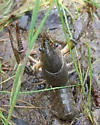
Rostrum acuminate, acarinate and with converging margins lacking marginal spines or shoulders; cervical spines present; areola narrow with 2-3 punctations in narrowest part; male with hooks on ischia of 3rd pereiopods; male first pleopod terminating in 2 subparallel elements less than 25% length of pleopod, curved throughout length but distal 1/3 more pronounced so that apices of both elements directed at about 90 degrees to main axis of pleopod (Page, 1985). [LENGTH: to 50 TCL; to 95 TL] [WIDTH: to 25] (MFG) O. immunis have characteristically long, slender chelae with a very splotchy coloration, but these features are a bit difficult to use as diagnostic characters without a few reference specimens. The easiest way to distinguish between O. immunis and O. virilis is the notch near the base of the dactyl, or 'thumb' of the cheliped-- O. immunis has it, O. virilis does not. (MFG)
Classification
- Kingdom
- Animalia
- Phylum
- Arthropoda
- Class
- Malacostraca
- Order
- Decapoda (Crabs, Crayfishes, Lobsters, Prawns, and Shrimp)
- Superfamily
- Astacoidea
- Family
- Cambaridae
- Genus
- Faxonius
Imported taxonomy record. Source availability varies; see the source references and editorial policy below.
Habitat and Range
Habitat
Lentic environments; Ponds, roadside ditches, and sluggish streams.
Geographic Range
O. immunis has a widespread North American native range from southern Quebec, Canada and New England westward across the upper Midwest to Wyoming and eastern Colorado and the Dakotas and south to extreme northwestern Tennessee (Hobbs, 1989; Pflieger, 1996). Montana's eastern plains populations are the furthest reported western extent this species ranges.
Diet and Behavior
Diet: This species is an omnivorous detritivore and a scavenger, feeding by shredding large pieces of organic materials and shredding them up.
About Crabs, Crayfishes, Lobsters, Prawns, and Shrimp: the wider group
Order-level background for Decapoda, the group containing Faxonius immunis. Species-specific details appear above.
Group overview
Decapoda includes ~15,000 described species of crabs, lobsters, shrimp, and crayfish. Although primarily marine and freshwater, some species like hermit crabs and coconut crabs are fully terrestrial.
Ecological role of the group
Crayfish are keystone species in freshwater ecosystems, influencing water clarity, sediment dynamics, and plant communities. Hermit crabs play vital roles in nutrient cycling on tropical islands.
Economic and practical significance of the group
The global shrimp industry alone is worth over $45 billion annually. Crayfish are important aquaculture species and invasive crayfish cause ecological damage estimated in the hundreds of millions annually in Europe and North America.
Recorded sources for this group: FAO fisheries statistics, freshwater ecology. Imported estimates may describe particular regions or reporting periods.
Photos of Calico Crayfish (2)
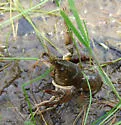
Photo credits: Contributed by Jason D. Roberts
Frequently Asked Questions About Calico Crayfish
What is Calico Crayfish?
Calico Crayfish (Faxonius immunis) is a species in the family Cambaridae, within the order Decapoda.
How do you identify Calico Crayfish?
Rostrum acuminate, acarinate and with converging margins lacking marginal spines or shoulders; cervical spines present; areola narrow with 2-3 punctations in narrowest part; male with hooks on ischia of 3rd pereiopods; male first pleopod terminating in 2 subparallel elements less than 25% length of pleopod, curved throughout length but distal 1/3 more pronounced so that apices of both elements directed at about 90 degrees to main axis of pleopod (Page, 1985). [LENGTH: to 50 TCL; to 95 TL] [WIDTH: to 25] (MFG) O. immunis have characteristically long, slender chelae with a very splotchy coloration, but these features are a bit difficult to use as diagnostic characters without a few reference specimens. The easiest way to distinguish between O. immunis and O. virilis is the notch near the base of the dactyl, or 'thumb' of the cheliped-- O. immunis has it, O. virilis does not. (MFG)
Where is Calico Crayfish found?
| Feature | Details |
|---|---|
| Habitat | Lentic environments; Ponds, roadside ditches, and sluggish streams. |
| Range | O. immunis has a widespread North American native range from southern Quebec, Canada and New England westward across the upper Midwest to Wyoming and eastern Colorado and the Dakotas and south to extreme northwestern Tennessee (Hobbs, 1989; Pflieger, 1996). Montana's eastern plains populations are the furthest reported western extent this species ranges. |
What does Calico Crayfish eat?
The diet of the Calico Crayfish includes This species is an omnivorous detritivore and a scavenger, feeding by shredding large pieces of organic materials and shredding them up..