
Cambarus bartonii
This record describes Cambarus bartonii (species). Recorded family: Cambaridae. Recorded order: Decapoda.
Identification and Appearance
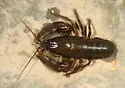
Body shape: slightly dorsoventrally flattened Coloration: variable but many dark in color (shades of brown), mostly solid coloration but some with saddle pattern and mottling Spines: cervical spines absent but may be cervical tubercle(s); branchiostegal spines weak (if present); cephalic spine or tubercle absent Rostrum: short, blunt, with parallel margins; no marginal spines; acumen small (barely recognizable); corneous tubercle at apex; rounded or squared in shape; possibly excavate or ladel-like dorsally Areola: open, medium in width Chelae: generally smooth and large; with one row of 5-7 tubercles along mesial margin of palm; moderately developed dorsolongitudinal ridges on fingers; slight pinch both dorsally and ventrally at base of fixed finger; absense of setae between fingers; fingers gaping in large adults (particularly form I males) Other characteristics: - eyes somewhat small; suborbital angle acute or nearly so; tuberculate carapace - form I male gonopod: terminal elements short; corneous central projection truncated and with subapical notch; mesial process and central projections with space between them (shaped like crescent wrench); mesial process bulbous and tapering to point A species complex containing multiple proposed subspecies (C. b. bartonii, C. b. cavatus, C. b. carnirostris); wide variation in characteristics;
Classification
- Kingdom
- Animalia
- Phylum
- Arthropoda
- Class
- Malacostraca
- Order
- Decapoda (Crabs, Crayfishes, Lobsters, Prawns, and Shrimp)
- Superfamily
- Astacoidea
- Family
- Cambaridae
- Genus
- Cambarus
Imported taxonomy record. Source availability varies; see the source references and editorial policy below.
Habitat and Range
Habitat
“mostly lotic habitats, but occasionally frequenting ponds and often burrowing along streams and in seepage areas” (Hobbs Jr., 1989) “small to medium size Blue Ridge streams (…up to 1,180 meters elevation)…” (Williams & Bivens, 1996) “Waters ranging from springs to medium sized streams and lentic environments. More common in springs and smaller streams. Troglophile. Tertiary burrower.” (Bouchard, 1974)
Geographic Range
“New Brunswick, Canada, to northern Georgia, and eastern parts of Kentucky and Tennessee to the Atlantic Ocean; restricted to the mountains and foothills in South Carolina and Georgia” (Hobbs Jr., 1989) “Blue ridge, Ridge, and Valley provinces, Tennessee” (Williams & Bivens, 1996)
Seasonal Activity
Present year round; Breeds in late summer & fall
About Crabs, Crayfishes, Lobsters, Prawns, and Shrimp: the wider group
Order-level background for Decapoda, the group containing Cambarus bartonii. Species-specific details appear above.
Group overview
Decapoda includes ~15,000 described species of crabs, lobsters, shrimp, and crayfish. Although primarily marine and freshwater, some species like hermit crabs and coconut crabs are fully terrestrial.
Ecological role of the group
Crayfish are keystone species in freshwater ecosystems, influencing water clarity, sediment dynamics, and plant communities. Hermit crabs play vital roles in nutrient cycling on tropical islands.
Economic and practical significance of the group
The global shrimp industry alone is worth over $45 billion annually. Crayfish are important aquaculture species and invasive crayfish cause ecological damage estimated in the hundreds of millions annually in Europe and North America.
Recorded sources for this group: FAO fisheries statistics, freshwater ecology. Imported estimates may describe particular regions or reporting periods.
Photos of Cambarus bartonii (4)
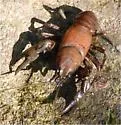
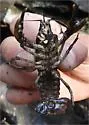
Photo credits: Contributed by Jason D. Roberts
Frequently Asked Questions About Cambarus bartonii
What is Cambarus bartonii?
Cambarus bartonii is a species in the family Cambaridae, within the order Decapoda.
How do you identify Cambarus bartonii?
Body shape: slightly dorsoventrally flattened Coloration: variable but many dark in color (shades of brown), mostly solid coloration but some with saddle pattern and mottling Spines: cervical spines absent but may be cervical tubercle(s); branchiostegal spines weak (if present); cephalic spine or tubercle absent Rostrum: short, blunt, with parallel margins; no marginal spines; acumen small (barely recognizable); corneous tubercle at apex; rounded or squared in shape; possibly excavate or ladel-like dorsally Areola: open, medium in width Chelae: generally smooth and large; with one row of 5-7 tubercles along mesial margin of palm; moderately developed dorsolongitudinal ridges on fingers; slight pinch both dorsally and ventrally at base of fixed finger; absense of setae between fingers; fingers gaping in large adults (particularly form I males) Other characteristics: - eyes somewhat small; suborbital angle acute or nearly so; tuberculate carapace - form I male gonopod: terminal elements short; corneous central projection truncated and with subapical notch; mesial process and central projections with space between them (shaped like crescent wrench); mesial process bulbous and tapering to point
Where is Cambarus bartonii found?
| Feature | Details |
|---|---|
| Habitat | mostly lotic habitats, but occasionally frequenting ponds and often burrowing along streams and in seepage areas (Hobbs Jr., 1989) small to medium size Blue Ridge streams (…up to 1,180 meters elevation)… (Williams & Bivens, 1996) Waters ranging from springs to medium sized streams and lentic environments. More common in springs and smaller streams. Troglophile. Tertiary burrower. (Bouchard, 1974) |
| Range | New Brunswick, Canada, to northern Georgia, and eastern parts of Kentucky and Tennessee to the Atlantic Ocean; restricted to the mountains and foothills in South Carolina and Georgia (Hobbs Jr., 1989) Blue ridge, Ridge, and Valley provinces, Tennessee (Williams & Bivens, 1996) |
When is Cambarus bartonii active?
Cambarus bartonii: seasonal activity - Present year round; Breeds in late summer & fall.