
Hebard's Blue-winged Desert Grasshopper
Anconia hebardi
This record describes Anconia hebardi (species). Recorded family: Acrididae. Recorded order: Orthoptera.
Identification and Appearance
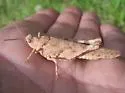
Slender active species of desert with relatively plain gray to brown coloring, with usually some inconspicuous small dark markings but no obvious dark bands across tegmina. Hind wings clear with distinct blue color toward base and no dark band. Very similar to Trimerotropis , but head proportionately somewhat smaller than any species in that genus. Pronotum with median carina distinctly present but low. Inner side of hind femur is largely black with two pale cross bands in apical half. Hind tibiae yellowish to grayish, often with ill-defined darker grayish to bluish bands . Apparently silent in flight, though males have been reported to produce a buzzing sound as they land (not detectable by David and Bryce Ferguson). Females are much larger than males. Similar species that might be found with it do not have blue wings, and often produce distinct buzzing or crackling sounds when flying. There are bluish-winged species of Trimerotropis from outside of the range of Anconia hebardi that could be confused with it, but they do not occur together. This is a less unique insect as compared to Anconia integra , being similar to that species in many traits, but also rather closely similar to the genus Trimerotropis in many characteristics. It behaves rather similarly to Trimerotropis pallidipennis , which is roughly similar in size, and occurs with it, but they are colored quite differently. Considered to be a rare species, but probably it is quite common and generally distributed in suitable habitats. It's early season of occurrence probably adds to it rarely being found and collected. Also, it is a very inconspicuous insect that seems to fly silently, with wings of a color very difficult to see and follow, and body coloration that renders it almost invisible when sitting on the ground. When found, it actually seems to occur rather abundantly. These seem to be insects of bare ground, rarely taking shelter in shrubs (contrary to Anconia integra , which often does). However, it seems that it will take shelter in shrubbery as night time approaches, and perhaps it feeds there at night (?)
Classification
- Kingdom
- Animalia
- Phylum
- Arthropoda
- Class
- Insecta
- Order
- Orthoptera (Grasshoppers, Crickets, Katydids)
- Suborder
- Caelifera
- Family
- Acrididae (Short-horned Grasshoppers)
- Subfamily
- Oedipodinae
- Tribe
- Trimerotropini
- Genus
- Anconia
Imported taxonomy record. Source availability varies; see the source references and editorial policy below.
Habitat and Range
Habitat
Stable silt to fine sand "adobe" areas in Chihuahuan Desert scrub with some low relief. It has been found in association with Honey Mesquite and Saltbush. Seems to favor barren areas, somewhat alkaline. Tends to congregate on raised areas of bare cemented silt or clay soil (often this is where soil had accumulated in Mesquite bushes which have long since died and gone, leaving humps of hard ground). Also, seems to favor gravelly patches such as sides of old gravel roads, small washes, etc.
Geographic Range
Known from south-central New Mexico, western Trans-Pecos Texas, and Chihuahua.
Diet and Behavior
Diet: Undocumented, but Saltbush ( Atriplex ) has been suggested.
Life History
Eggs apparently hatch in late summer or autumn. Overwinters as nymphs, with adults in late winter and spring (primarily April or May), mostly gone by sometime in June, but occasional individuals survive longer.
About Grasshoppers, Crickets, Katydids: the wider group
Order-level background for Orthoptera, the group containing Anconia hebardi. Species-specific details appear above.
Group overview
Orthoptera includes ~28,000 described species of grasshoppers, crickets, and katydids. Desert locusts can form swarms covering 460 square miles containing up to 80 million individuals per square kilometer.
Ecological role of the group
Grasshoppers and crickets are a primary food source for birds, reptiles, and small mammals. Cricket farming is a growing industry - crickets require 12× less feed than cattle to produce the same amount of protein, using 2,000× less water.
Economic and practical significance of the group
A single large locust swarm can consume the same amount of food in one day as 35,000 people. The 2019-2021 East Africa locust crisis affected food security for 42 million people across multiple countries. Global crop losses from locusts can reach billions annually.
Recorded sources for this group: FAO, UN World Food Programme, research publications. Imported estimates may describe particular regions or reporting periods.
Photos of Hebard's Blue-winged Desert Grasshopper (5)
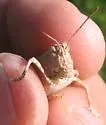
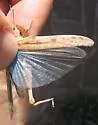
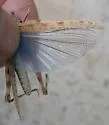
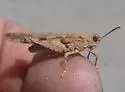
Photo credits: Contributed by David J. Ferguson
Frequently Asked Questions About Hebard's Blue-winged Desert Grasshopper
What is Hebard's Blue-winged Desert Grasshopper?
Hebard's Blue-winged Desert Grasshopper (Anconia hebardi) is a species in the family Acrididae, within the order Orthoptera.
How do you identify Hebard's Blue-winged Desert Grasshopper?
Slender active species of desert with relatively plain gray to brown coloring, with usually some inconspicuous small dark markings but no obvious dark bands across tegmina. Hind wings clear with distinct blue color toward base and no dark band. Very similar to Trimerotropis , but head proportionately somewhat smaller than any species in that genus. Pronotum with median carina distinctly present but low. Inner side of hind femur is largely black with two pale cross bands in apical half. Hind tibiae yellowish to grayish, often with ill-defined darker grayish to bluish bands . Apparently silent in flight, though males have been reported to produce a buzzing sound as they land (not detectable by David and Bryce Ferguson). Females are much larger than males. Similar species that might be found with it do not have blue wings, and often produce distinct buzzing or crackling sounds when flying. There are bluish-winged species of Trimerotropis from outside of the range of Anconia hebardi that could be confused with it, but they do not occur together. This is a less unique insect as compared to Anconia integra , being similar to that species in many traits, but also rather closely similar to the genus Trimerotropis in many characteristics. It behaves rather similarly to Trimerotropis pallidipennis , which is roughly similar in size, and occurs with it, but they are colored quite differently.
Where is Hebard's Blue-winged Desert Grasshopper found?
| Feature | Details |
|---|---|
| Habitat | Stable silt to fine sand adobe areas in Chihuahuan Desert scrub with some low relief. It has been found in association with Honey Mesquite and Saltbush. Seems to favor barren areas, somewhat alkaline. Tends to congregate on raised areas of bare cemented silt or clay soil (often this is where soil had accumulated in Mesquite bushes which have long since died and gone, leaving humps of hard ground). Also, seems to favor gravelly patches such as sides of old gravel roads, small washes, etc. |
| Range | Known from south-central New Mexico, western Trans-Pecos Texas, and Chihuahua. |
What does Hebard's Blue-winged Desert Grasshopper eat?
The diet of the Hebard's Blue-winged Desert Grasshopper includes Undocumented, but Saltbush ( Atriplex ) has been suggested..
What is the life cycle of a Hebard's Blue-winged Desert Grasshopper?
Eggs apparently hatch in late summer or autumn. Overwinters as nymphs, with adults in late winter and spring (primarily April or May), mostly gone by sometime in June, but occasional individuals survive longer.