
Family Vespidae
Vespidae is a family in the order Hymenoptera. Browse 210 named species recorded in this family, or open an individual profile for its available identification and natural-history information.
Guides
Species in Vespidae (210)
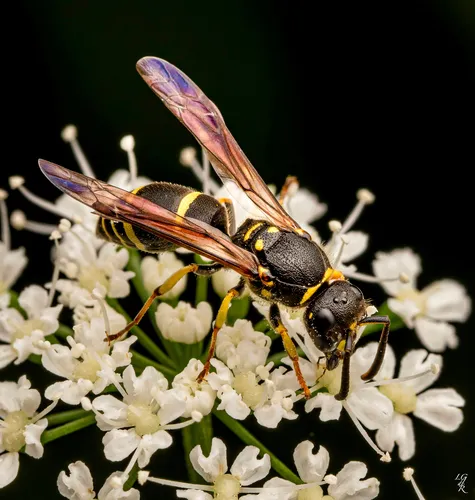
Ancistrocerus adiabatus
Ancistrocerus adiabatus
Identification: It always has a full yellow stripe on metanotum, rather than two spots as in A. catskill . It is also distinctly more slender, with urotergite I almost as long as broad. (Richard Vernier, 30.vii.2010)
Ancistrocerus bustamente
Ancistrocerus bustamente
Identification: A member of the catskill -group and very similar to catskill except for sternum 2, which rises up vertically for a short distance at the base, forming a right angle with the remainder of the sternum. This is usually very difficult to
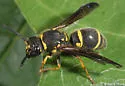
Ancistrocerus campestris
Ancistrocerus campestris
Identification: per Dr. Matthias Buck, the "smiling face" on scutellum and metanotum combined with the shape of the apical band on tergite 1 makes A. campestris fairly distinctive. Ancistrocerus lutonidus is similar but the spots on the scutellum are
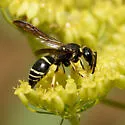
Ancistrocerus capra
Ancistrocerus capra
Identification: The strongly impressed notauli (paired lines or grooves on the mesoscutum that subdivide the sclerite into a median midlobe and lateral lobes) and the dark metanotum separate this species from other members of the genus.
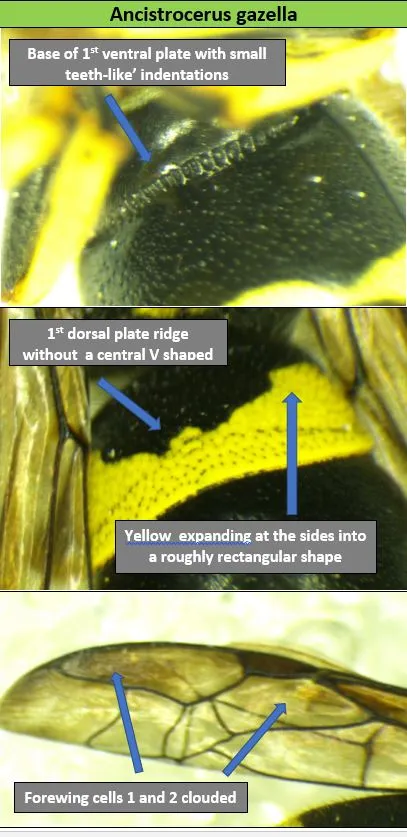
Ancistrocerus gazella
Ancistrocerus gazella
Ancistrocerus gazella has black and yellow markings typical of this family. Very similar in appearance to Ancistrocerus parietum and detailed examination is needed for a safe identification. See the ID Aid below. Unless identified by a recognised exp
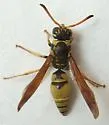
Ancistrocerus lineativentris
Ancistrocerus lineativentris
Identification: Similar to A. tuberculocephalus but lacking tubercle between ocelli.
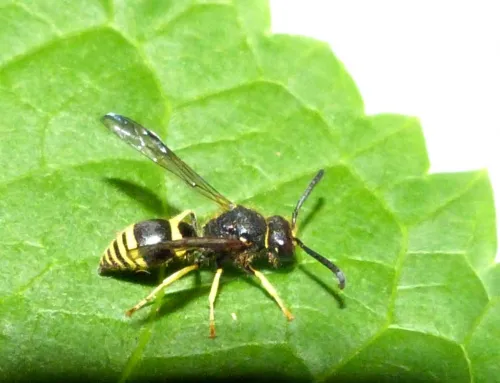
Wall Mason Wasp
Ancistrocerus parietum
Females vary from 10 to 13mm, males are slightly smaller and reach a bodily length of 8 to 11mm. Ancistrocerus parietum , A. gazella and A. quadratus are all very similar and hard to separate without detailed examination. The basic colour is black, w
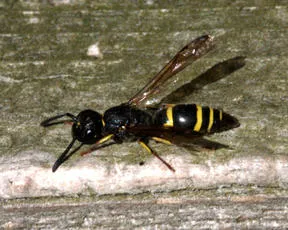
Ancistrocerus trifasciatus
Ancistrocerus trifasciatus
This mason wasp has brown tarsi and a black face with yellow dot. There are other very similar species in this genus which means that detailed examination of an actual specimen is generally needed to identify the exact species. A red box around the i
Mexican Honey Wasp
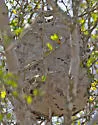
Brachygastra mellifica
Identification: Det. K. Wolgemuth, 2017 One of the very few insects other than bees to produce and store honey. "They are docile a lot, but then they can explode, attacking en masse." (Joan Strassmann, pers. comm. to MAQ) nests can be surprisingly la
Okinawa Mud Wasp
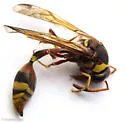
Delta esuriens
Identification: D. higletti rendalli can also be yellow-marked; however, such individuals lack yellow on the metanotum earliest record in our area: FL 2011 (BG data)
Delta higletti
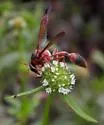
Delta higletti
In Florida this is an introduced species first reported in 1981, originating in Africa (perhaps via Jamaica, as it was found there in 1979).
Arctic Aerial Yellowjacket
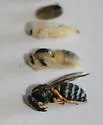
Dolichovespula albida
Identification: Queen (♀♀) Worker (♀) Male (♂) The markings of D. albida are very akin to those of D. norvegicoides apart from being ivory instead of yellow.
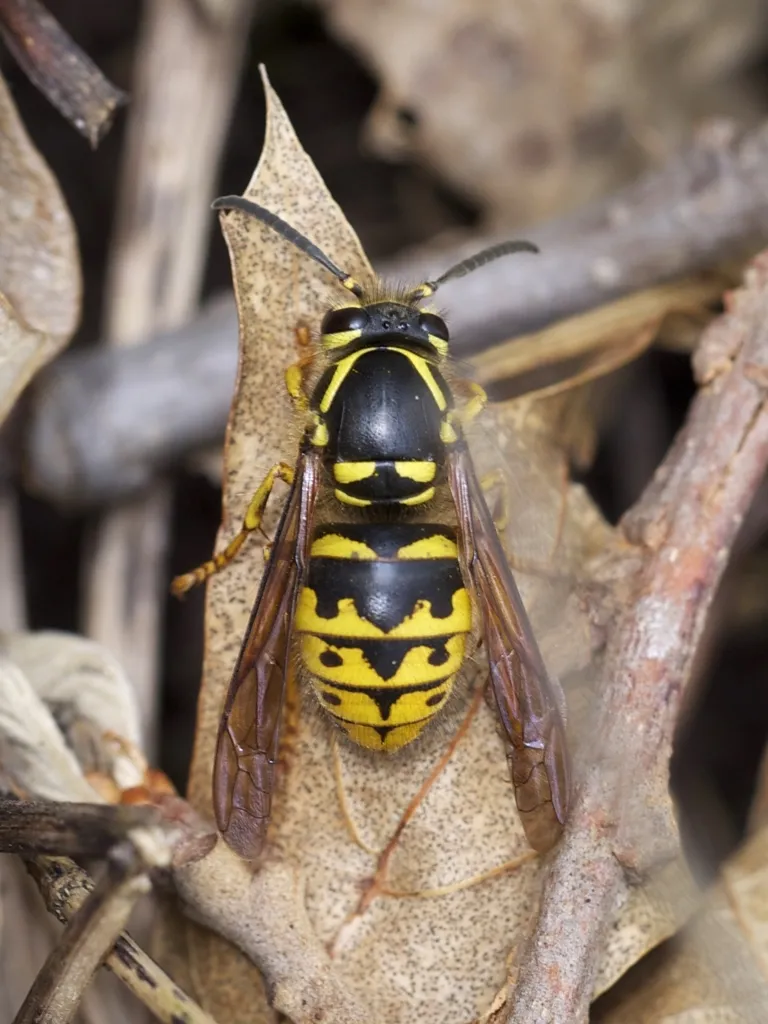
Common Aerial Yellowjacket
Dolichovespula arenaria
Identification: Queen (♀♀) Worker (♀) Male (♂) They have mostly aerial nests, from a few centimeters above ground to the tops or trees, or houses or sheds. But in some cases they build nests under rocks or even underground.
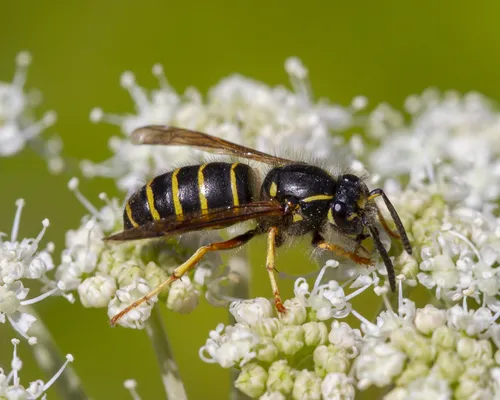
Northern Aerial Yellowjacket
Dolichovespula norvegicoides
Identification: Key to eastern Nearctic Dolichovespula species in the Identification Atlas of the Vespidae of the Northeastern Nearctic Region . Key to Nearctic Vespinae genera in the Identification Atlas of the Vespidae of the Northeastern Nearctic
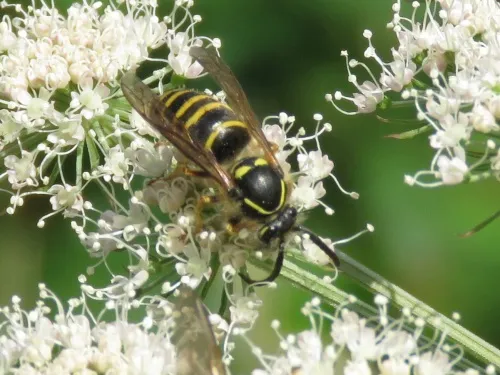
Dolichovespula saxonica
Dolichovespula saxonica
It is a very close relative of Dolichovespula norwegica but lacks the pair of red spots on the second gastral tergum (but note, these markings are also absent in some specimens of Dolichovespula norwegica). Unless identified by a recognised expert, a
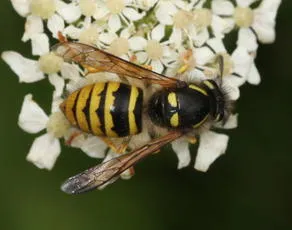
Tree Wasp
Dolichovespula sylvestris
Length 22 mm. The face of this species is usually clear yellow with one dot. Antennae yellow right at the base. Thorax with hairs at the sides and two yellow spots at the rear. Can be very aggressive. It builds its nest in trees and bushes as well as
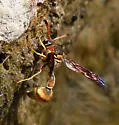
Eumenes americanus
Eumenes americanus
Identification: E. americanus is separable from E. smithii mainly by the male genitalia. In terms of color, may be similar to some variants of E. smithii (mostly from Mexico and further South), with black marks more developed mainly on the lateral fa
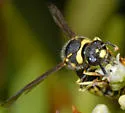
Eumenes consobrinus
Eumenes consobrinus
Identification: Shares with E. bollii the evenly rounded anterior edge of the pronotum, without a transverse carina. E. consobrinus is distinguished by a black scape (seldom with a basal yellow spot) and hairs on scape longer than 1 mid-ocellus diame
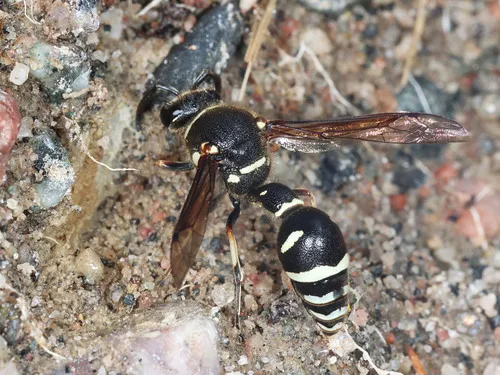
Cross Potter Wasp
Eumenes crucifera
Identification: E. crucifera can be identified based on long and golden body pubescence; clypeal punctation; black integument with varying yellow marks; T2 wide, with lateral margins strongly concave; and mainly by posterior face of propodeum weakly
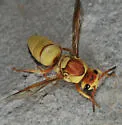
Euodynerus annulatus
Euodynerus annulatus
Identification: Compared to E. hidalgo it has a less angulate propodeum and it lacks the reflexed, lamellate margins of terga 2 and 3. It has two yellow spots on the scutellum, something not found in E. hidalgo . (Comment by Matthias Buck).
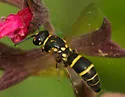
Euodynerus barberi
Euodynerus barberi
Identification: Distinctive within its genus: slender form, propodeum with strong dorsolateral carina. Scutum with a pair of comma-shaped spots, scutellum with paired spots, metanotum black.
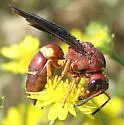
Euodynerus crypticus
Euodynerus crypticus
Identification: Distinguished from all other species in the northeast by the lack of any black on the scapes and pedicels, lack of black on the pronotum, and scutellum with an uninterrupted ferruginous spot. The females in particular tend to only hav
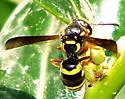
Euodynerus fedoris
Euodynerus fedoris
Identification: Characters that separate this species from E. blakeanus are mentioned here
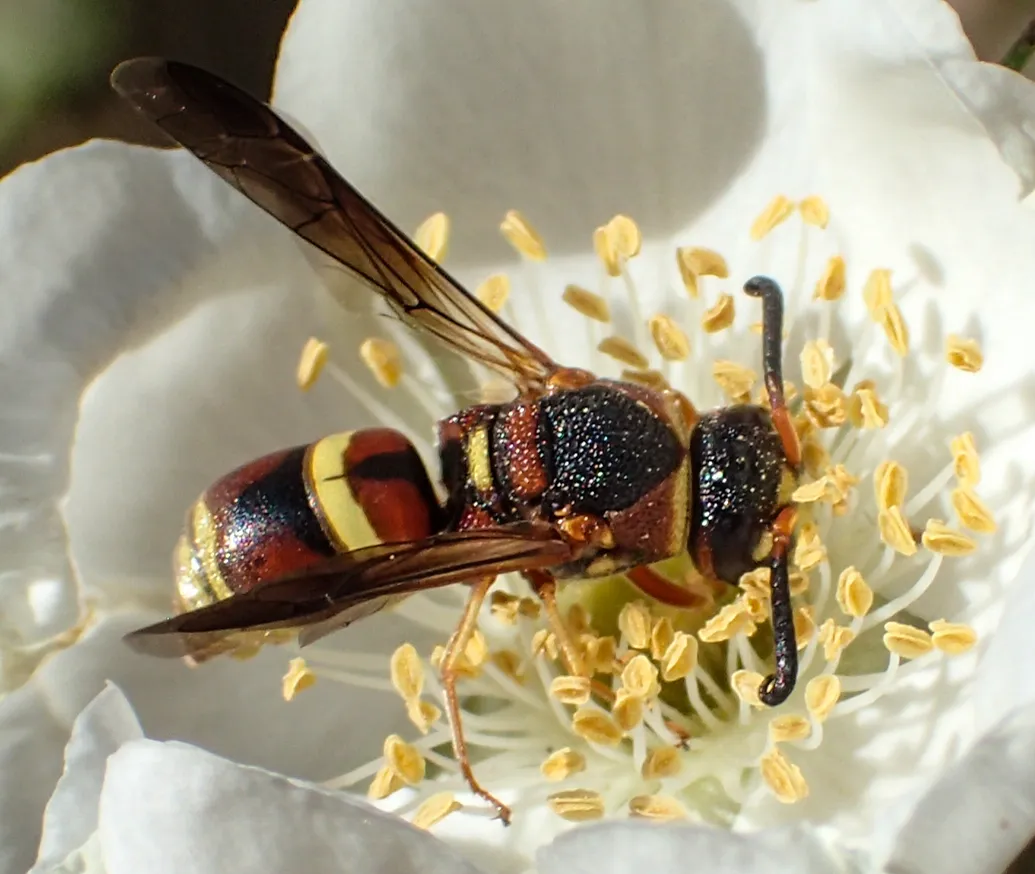
Euodynerus hidalgo
Euodynerus hidalgo
Identification: Thin, lamellate, reflexed hind margins of 2nd and 3rd tergites is diagnostic for this species. The amount of black is highly variable in this species and other vespids. The eastern subspecies (boreoorientalis) is mainly black. Some sp
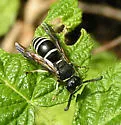
Black-and-White Mason Wasp
Euodynerus leucomelas
Identification: It has a white band on the metanotum and a black scutellum
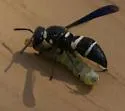
Euodynerus megaera
Euodynerus megaera
Identification: The female of the similar species schwarzi differs from megaera in having white tibial stripes, although schwarzi males are difficult to separate from megaera males because the latter can also have white tibial stripes.
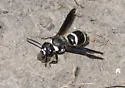
Euodynerus schwarzi
Euodynerus schwarzi
Identification: The female differs from Euodynerus megaera because of the white stripe on the tibiae. Males of E. schwarzi are difficult to separate from E. megaera .
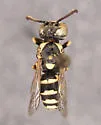
Euparagia scutellaris
Euparagia scutellaris
Constructs nests in the ground with a curved turret at the surface
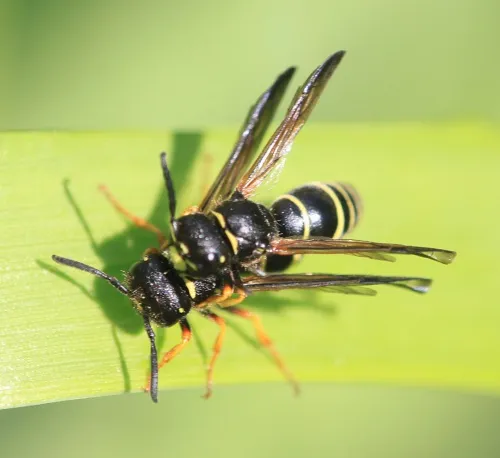
Gymnomerus laevipes
Gymnomerus laevipes
12-15mm. Black with yellow markings and with a conspicuous box-shaped head. The abdomen has a yellow band across the base of each tergite. The thorax is black except for a yellow collar behind the head. The head is black except for two small yellow s
Leptochilus bellulus
Leptochilus bellulus
Identification: Characteristic are the isolated white spots on tergum 2.
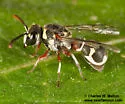
Maricopodynerus optimus
Maricopodynerus optimus
"There are at least eight species in California. Optimus is not known from the state." - Matthias Buck
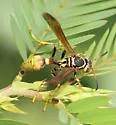
Western Paper Wasp
Mischocyttarus flavitarsis
Identification: A primarily black-and-yellow species with additional ferruginous markings. This species can be separated from the similar M. navajo by the typically lighter yellow brown wings (in all but one form), occasionally ferruginous T1 (especi
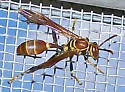
Mexican Paper Wasp
Mischocyttarus mexicanus
Identification: A red to dark-brown species with yellow markings. This species is readily distinguished among the genus by its eastern range and ferruginous ground color. The only other species in the genus within our area with a ferruginous ground c
Navajo Paper Wasp
Mischocyttarus navajo
Identification: A primarily black-and-yellow species with restricted ferruginous markings. This species can be separated from the similar and more variable M. flavitarsis by the combination of its darker wings, consistently black T1, and larger size.
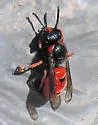
Odynerus cinnabarinus
Odynerus cinnabarinus
Identification: ♂ ♀ Males are similar to those of O. margaretellus but have more extensive red coloration (notably on the pronotum), shorter pubescence, and less strongly rolled antennae.
Pachodynerus californicus
Pachodynerus californicus
Identification: Terga 1 and 2 with apical white band, following terga entirely black. Pale markings white, not yellow as in P. guadulpensis , which also occurs in California.
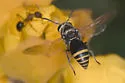
Keyhole Wasp
Pachodynerus nasidens
Identification: Not readily distinguishable from P. pulverulentus , with which it co-occurs in TX & AZ. Separating the two requires comparison of the density of punctation on the second segment of the abdomen ( P. nasidens has punctation throughout t
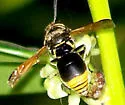
Pachodynerus pulverulentus
Pachodynerus pulverulentus
Identification: Not readily distinguishable from P. nasidens with which it co-occurs in Texas and Arizona. Separating the two requires comparison of the density of punctation on the second segment of the abdomen ( P. pulverulentus has punctation rest
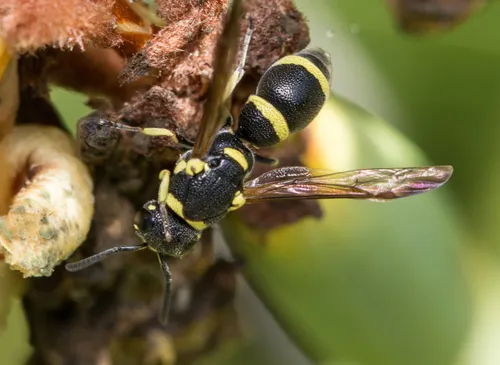
Parancistrocerus declivatus
Parancistrocerus declivatus
Identification: Only first two terga with yellow bands. Sternum 2 strongly angled at base.
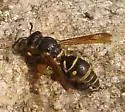
Parancistrocerus leionotus
Parancistrocerus leionotus
Identification: Diagnostic characters include well developed yellow spots on terga 1 and 2, yellow bands on terga 1-4, and well developed yellow vertical bands on the propodeum. ( P. vagus is similar but usually lacks the propodeal bands). This speci
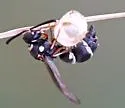
Parancistrocerus minimoferus
Parancistrocerus minimoferus
Identification: Apical margin of tergum 3 thickened at middle, with white band restricted to thickened section.
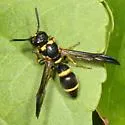
Parancistrocerus perennis
Parancistrocerus perennis
Identification: Abdomen with two yellow bands only. Some have red on tergum 1:
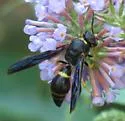
Parazumia symmorpha
Parazumia symmorpha
Identification: Slender first metasomal segment which lacks the carina of Ancistrocerus . The translucent, reflexed, lamellate hind margin of terga 2 and 3 is not visible here (similar to Euodynerus hidalgo which has a very broad segment 1 (comment b
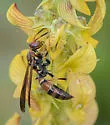
Bahamian Paper Wasp
Polistes bahamensis
Identification: As typical of members of the subgenus Polistes (Aphanilopterus) , the first metasomal segment is slender and slightly elongate, and the antennae are dark with contrasting orange tips. The species has a yellow spot on the mesopleuron,
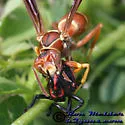
Polistes bellicosus
Polistes bellicosus
Identification: Variation: "Individuals with spotted tergum 2 (and sometimes following) are fairly common at the western edge of the range in central and southcentral Texas." ( 3 ) "Their range apparently does not overlap with red forms of aurifer bu
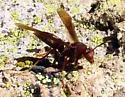
Neotropical Red Paper Wasp
Polistes canadensis
Identification: Very similar to P. major castaneicolor but has the first metasomal segment narrower (in dorsal view)
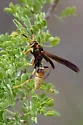
Comanche Paper Wasp
Polistes comanchus
Identification: A bright species of Polistes (Aphanilopterus) with a red-and-black thorax and an extensively yellow abdomen. P. c. comanchus has a black scutellum and extensively red T2 segment of the abdomen. Range: e. NM, TX P. c. navajoe has a red
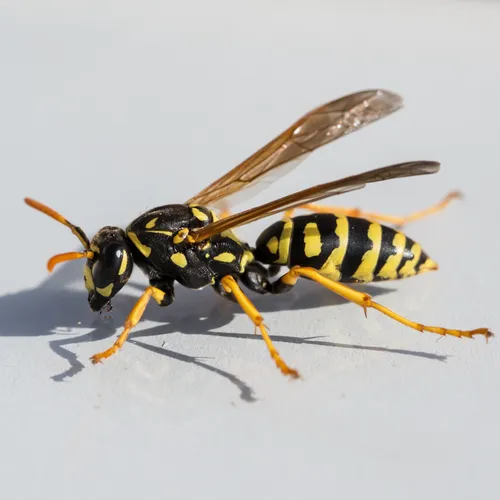
European Paper Wasp
Polistes dominula
The appearance falls between that of a true social (yellowjacket) wasp and a mason wasp, with males having the hooked antennal tips of mason wasps. However, the behaviour is social with differentiated workers serving a single queen, though queens, wo
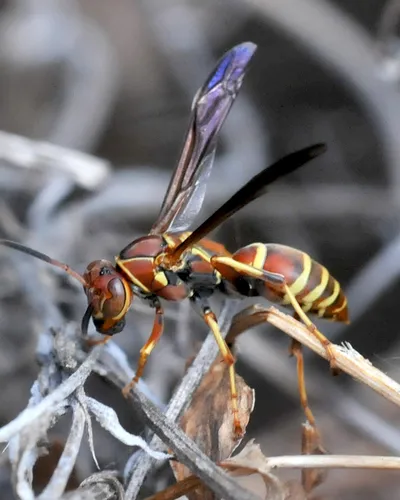
Hunter's Little Paper Wasp
Polistes dorsalis
Identification: P. dorsalis dorsalis - Propodeum usually with two stripes; abdomen yellow-striped and lacking spots. ♀ ♂ P. dorsalis californicus - Propodeum with two stripes; abdomen with yellow spots fused with the stripes, essentially forming broa
Kaibab Paper Wasp
Polistes kaibabensis
Identification: Distinctive: a brown wasp with contrastingly coloured antennae and yellow on abdominal segments 3 or 4 to 6.
Pseudodynerus quadrisectus
Pseudodynerus quadrisectus
Identification: Note two white bands on abdomen, very short petiole between thorax and abdomen, not long, as in Eumenes .
Pseudomasaris basirufus
Pseudomasaris basirufus
Identification: Characteristic markings on clypeus but not on frons ( vs white spot on both frons & clypeus in P. maculifrons ) Males are more easily told apart by their antennae, and most reliably by the distance between the eyes on the vertex: nea
Pseudomasaris coquilletti
Pseudomasaris coquilletti
Identification: In females, the yellow of upper orbits are produced toward ocelli (not so in the similar zonalis ); humeri are more rounded than in zonalis (which have humeri with an obtuse anterior ridge): Antennal segments VI-VII in males are widen
Pseudomasaris edwardsii
Pseudomasaris edwardsii
Identification: Females have a swelling on the anterior side of mesotibia (reduced/absent in some individuals): Males have unique antennae, and a slight swelling on frons: description (Bradley 1922)
Pseudomasaris macswaini
Pseudomasaris macswaini
Identification: Similar to P. edwardsii , but females have yellow spot above the tegula and antennae all black except small yellow spots on scape; in males, antennae mostly black and not concave below
Pseudomasaris marginalis
Pseudomasaris marginalis
Identification: Head and thorax with long, black hairs. Black with whitish yellow markings, otherwise mostly black; clypeus, scape, most of the thorax, and abdomen ventrally are black. Has a lamellate propodeum (rather than dentate as in the somewhat
Pseudomasaris texanus
Pseudomasaris texanus
Identification: see Males and females: apex of fore femur, and bases of mid and hind tibiae without yellow spots. Males: eyes separated at the narrowest by about one posterior ocellar diameter.
Pseudomasaris vespoides
Pseudomasaris vespoides
Identification: Males: Probably the most common species of Pseudomasaris .
Pseudomasaris wheeleri
Pseudomasaris wheeleri
Identification: Black, with sulphur-yellow markings, more extensive in southern specimens; mesonotum with two complete or interrupted longitudinal stripes (thoracic and abdominal pattern superficially resembles that of Vespula sulphurea - HW).
Pseudomasaris zonalis
Pseudomasaris zonalis
Identification: Females: Color is black and sulphur-yellow (whitish in some forms, especially in the northeastern part of its range), frons with a pale spot above clypeus (may be missing in some specimens). P. zonalis can be recognized by humeri with
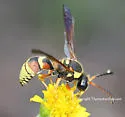
Pterocheilus denticulatus
Pterocheilus denticulatus
Identification: Tergum 2 with a pair of scar-like longitudinal spots. Male with ventrally notched mid femur and apically expanded hind femur.
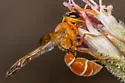
Pterocheilus diversicolor
Pterocheilus diversicolor
Identification: Among members of Micropterocheilus (originally described as a subgenus, later elevated to genus in Bohart(1999) but currently treated as a subgenus on BugGuide), Bohart states that for species P. diversicolor : "the orange and white m
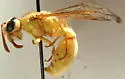
Pterocheilus pimorum
Pterocheilus pimorum
Identification: Body almost entirely yellow with blackish or reddish markings
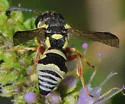
Stenodynerus toas
Stenodynerus toas
Identification: For genus - row of pits under T1 margin For species group - presence of humeral carina Female: Lunate white mark on base of clypeus, white spots of base of mandible, hind margin of pronotum black, pair of spots on T2, apical rim of T2
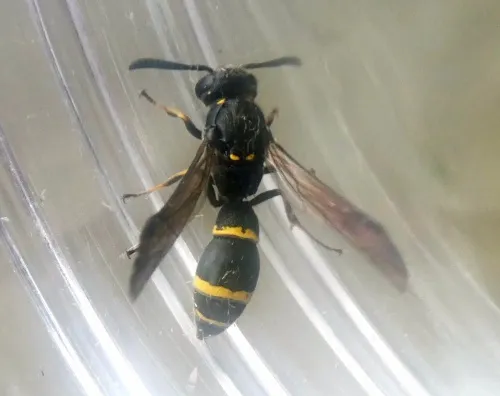
Symmorphus bifasciatus
Symmorphus bifasciatus
This species has a black and yellow banded abdomen. Adults seem to prefer damp places, often near streams and ditches, and their flight paths are associated with patches of foliage in full sunlight. May to October; but mainly from June to August, wit
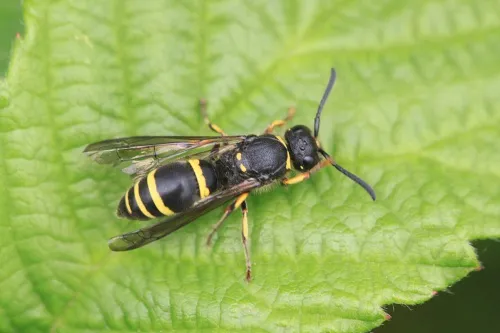
Symmorphus gracilis
Symmorphus gracilis
This black and yellow banded wasp is very similar to Symmorphus crassicornis and expert help is needed with identification. Adults seem to prefer damp places, often near streams and ditches and their flight paths are associated with patches of foliag
Symmorphus projectus
Symmorphus projectus
Identification: Has more projecting (name!) pronotal angles than other congeners
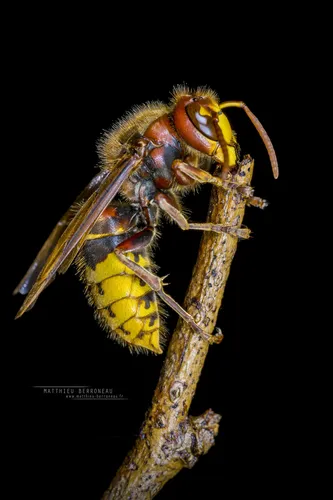
Hornet
Vespa crabro
Size 25 to 35 mm. The hornet is an impressive insect and is Britain's largest social wasp. Queens (reproductive females) are larger than the males and workers (non-reproductive females). The thorax area is brown and it has alternating bright orange-y
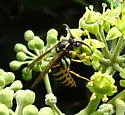
Forest Yellowjacket
Vespula acadica
Identification: Key to eastern Nearctic Vespula species in the Identification Atlas of the Vespidae of the Northeastern Nearctic Region . Key to Nearctic Vespinae genera in the Identification Atlas of the Vespidae of the Northeastern Nearctic Region
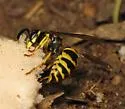
American Yellowjacket
Vespula alascensis
Identification: Key to eastern Nearctic Vespula species in the Identification Atlas of the Vespidae of the Northeastern Nearctic Region . Key to Nearctic Vespinae genera in the Identification Atlas of the Vespidae of the Northeastern Nearctic Region
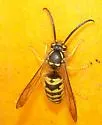
Downy Yellowjacket
Vespula flavopilosa
Identification: Queen (♀♀) Worker (♀) Male (♂) Workers usually have a large amount of yellow throughout the thorax and abdomen, but melanic (dark) and xanthic (yellow) forms may occur: This very yellow (xanthic) male has proved difficuilt to ID to sp
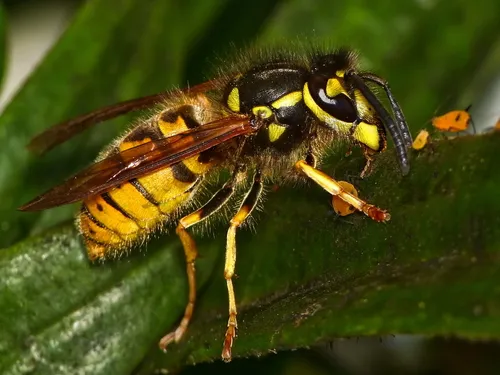
German Wasp
Vespula germanica
Very similar in appearance to the Common Wasp, though very slightly bigger. The best way of telling them apart is by looking at the face - there are usually three small black spots (rarely one). The top spot may be merged into a vertical bar. It is n
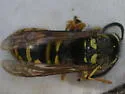
American Cuckoo Yellowjacket
Vespula infernalis
Identification: Key to eastern Nearctic Vespula species in the Identification Atlas of the Vespidae of the Northeastern Nearctic Region (as V. austriaca ). Key to Nearctic Vespinae genera in the Identification Atlas of the Vespidae of the Northeaster
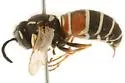
American Red-banded Yellowjacket
Vespula intermedia
Identification: Key to eastern Nearctic Vespula species in the Identification Atlas of the Vespidae of the Northeastern Nearctic Region . Key to Nearctic Vespinae genera in the Identification Atlas of the Vespidae of the Northeastern Nearctic Region
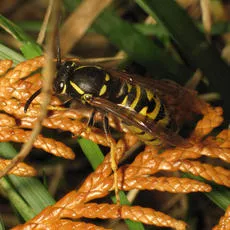
Red Wasp
Vespula rufa
Vespula rufa usually has rufous markings on the first and second abdominal segments (coupled with the pattern of black markings) and these are diagnostic of the species. Widespread and fairly frequent in Britain. No additional images available for th
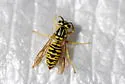
California Yellowjacket
Vespula sulphurea
Identification: Key to eastern Nearctic Vespula species in the Identification Atlas of the Vespidae of the Northeastern Nearctic Region . Key to Nearctic Vespinae genera in the Identification Atlas of the Vespidae of the Northeastern Nearctic Region
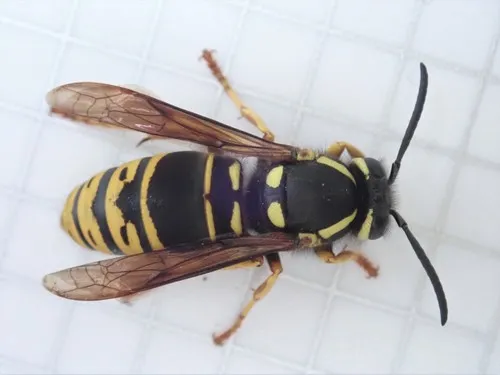
Widow Yellowjacket
Vespula vidua
Identification: Key to eastern Nearctic Vespula species in the Identification Atlas of the Vespidae of the Northeastern Nearctic Region . Key to Nearctic Vespinae genera in the Identification Atlas of the Vespidae of the Northeastern Nearctic Region
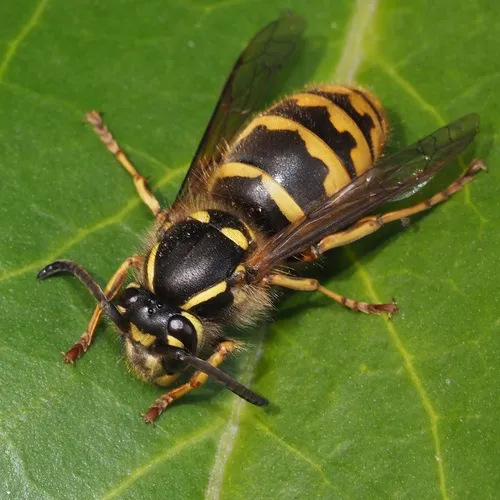
Common Wasp
Vespula vulgaris
About 2 cm long, they have bright yellow and black bands along the body, with an obvious 'waist' between the thorax and abdomen. They also have two pairs of wings and fairly long, robust antennae. The sting is located at the tip of the abdomen. The q
Zethus miscogaster
Zethus miscogaster
Identification: Stem of second segment of metasoma longer than that of first
Ancistrocerus albolacteus
Ancistrocerus albolacteus
Ancistrocerus albophaleratus
Ancistrocerus albophaleratus
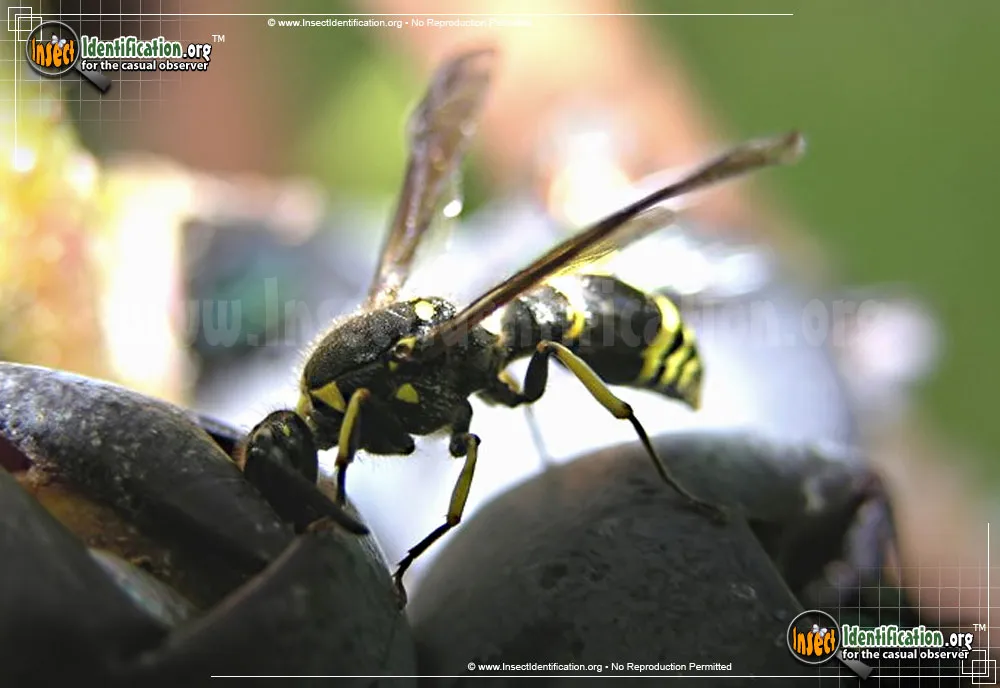
Potter Wasp
Ancistrocerus antilope
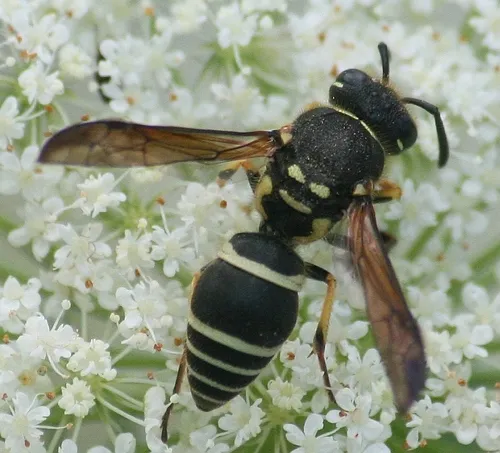
Ancistrocerus catskill
Ancistrocerus catskill
Ancistrocerus lutonidus
Ancistrocerus lutonidus
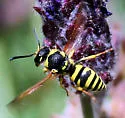
Ancistrocerus spilogaster
Ancistrocerus spilogaster
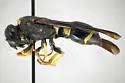
Ancistrocerus spinolae
Ancistrocerus spinolae
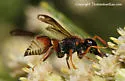
Ancistrocerus tuberculocephalus
Ancistrocerus tuberculocephalus
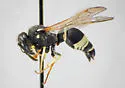
Ancistrocerus undescribed species A
Ancistrocerus undescribed-a
Ancistrocerus undescribed species B
Ancistrocerus undescribed-b
Ancistrocerus unifasciatus
Ancistrocerus unifasciatus
Ancistrocerus waldenii
Ancistrocerus waldenii
Cephalodynerus deformiceps
Cephalodynerus deformiceps
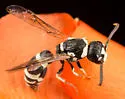
Cephalodynerus russipes
Cephalodynerus russipes
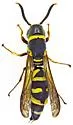
Cephalodynerus unicornis
Cephalodynerus unicornis
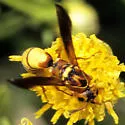
Dolichodynerus tanynotus
Dolichodynerus tanynotus
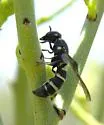
Dolichodynerus turgiceps
Dolichodynerus turgiceps
Dolichodynerus vandykei
Dolichodynerus vandykei
Rocky Mountain Aerial Yellowjacket
Dolichovespula alpicola
Parasitic Aerial Yellowjacket
Dolichovespula arctica
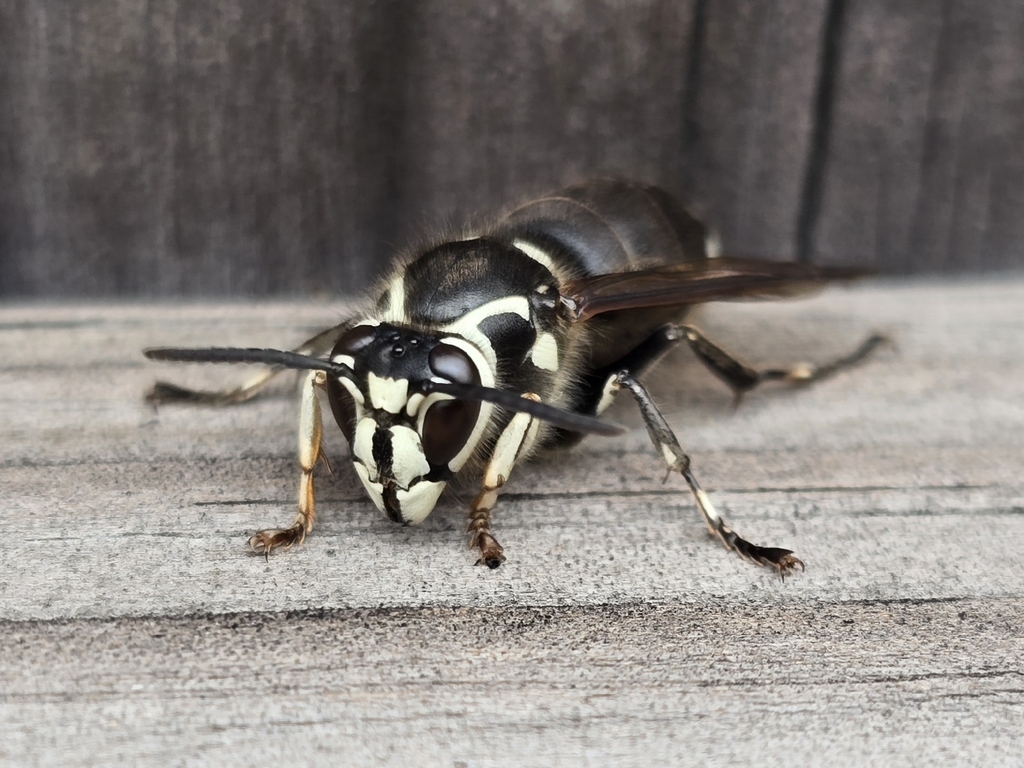
Bald-faced Hornet
Dolichovespula maculata
(c) Ken Clark, some rights reserved (CC BY)