
Gymnomerus laevipes
This record describes Gymnomerus laevipes (species). Recorded family: Vespidae. Recorded order: Hymenoptera.
Identification and Appearance
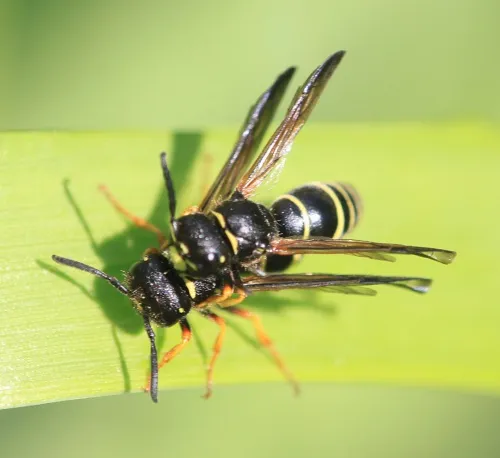
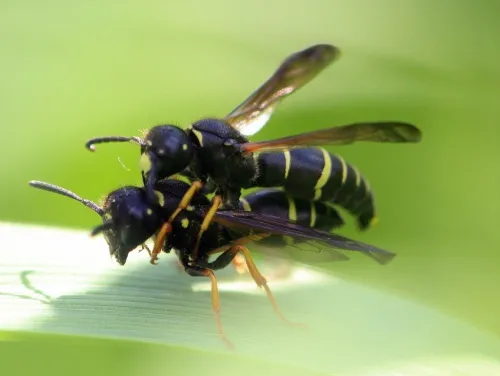
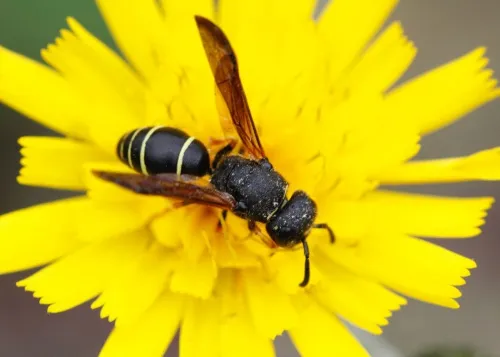
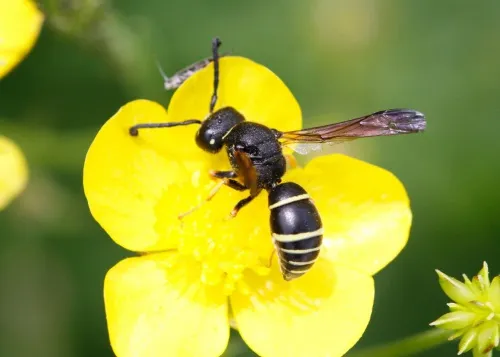
12-15mm. Black with yellow markings and with a conspicuous box-shaped head. The abdomen has a yellow band across the base of each tergite. The thorax is black except for a yellow collar behind the head. The head is black except for two small yellow spots behind the eyes. Females (dark faces) have a deep semicircular notch on the lower edge of the yellow clypeus. One of many similar black and yellow striped wasps. Care is needed with identification and expert help should be sought if possible. Resembes Odynerus spinipes which has a less square head, a more hairy thorax and a straight front edge to the pronotum. Found in a wide variety of open habitats, associated with its nesting and feeding sites and prey habitats. Recorded from May until September, with males mostly found from late May and June, and females during June and July. Preys on weevil larvae of the genera Hypera (Curculionidae). A tube-dweller forming a series of 4 to 12 linearly arranged cells separated by clay partitions in hollow plant stems, e.g. bramble, burdock, elder and thistles. An egg is laid in the cell before about 20 weevil larvae are added. Distributed from Cornwall to Kent and north to Nottinghamshire and East Norfolk, with an isolated record from Westmorland. Lack of records since 1970 indicates that this species has recently undergone a significant decline, especially in the northern part of its range.
Classification
- Kingdom
- Animalia
- Phylum
- Arthropoda
- Class
- Insecta
- Order
- Hymenoptera
- Family
- Vespidae
- Genus
- Gymnomerus
Imported taxonomy record. Source availability varies; see the source references and editorial policy below.
Habitat and Range
Habitat
Found in a wide variety of open habitats, associated with its nesting and feeding sites and prey habitats.
Seasonal Activity
Recorded from May until September, with males mostly found from late May and June, and females during June and July.
Diet and Behavior
Life History
Preys on weevil larvae of the genera Hypera (Curculionidae). A tube-dweller forming a series of 4 to 12 linearly arranged cells separated by clay partitions in hollow plant stems, e.g. bramble, burdock, elder and thistles. An egg is laid in the cell before about 20 weevil larvae are added.
Additional species information
Recorded status
Distributed from Cornwall to Kent and north to Nottinghamshire and East Norfolk, with an isolated record from Westmorland. Lack of records since 1970 indicates that this species has recently undergone a significant decline, especially in the northern part of its range.
About Flies: the wider group
Order-level background for Hymenoptera, the group containing Gymnomerus laevipes. Species-specific details appear above.
Group overview
Hymenoptera includes over 150,000 described species of ants, bees, wasps, and sawflies. Earth harbors approximately 20 quadrillion (20×10^15) ants, with a combined biomass of ~12 megatons of dry carbon - exceeding the combined biomass of all wild birds and mammals (PNAS, 2022).
Ecological role of the group
About 35% of the world's food crops depend on animal pollinators. The chocolate industry, valued at over $100 billion, depends on pollinating flies and midges. Ants are the dominant soil engineers in most terrestrial ecosystems, turning more soil than earthworms in many habitats.
Economic and practical significance of the group
Pollinators contribute $235-577 billion worth of annual global food production (FAO). In the U.S., bee pollination alone benefits crops valued at $18 billion annually, and honey bees are responsible for $5.4 billion in agricultural productivity. Between April 2023-2024, 55.1% of managed honey bee colonies were lost. The U.S. bee population dropped from 5 million to 2.5 million.
Recorded sources for this group: FAO, USDA, EPA, PNAS (2022), US Fish & Wildlife Service. Imported estimates may describe particular regions or reporting periods.
Photos of Gymnomerus laevipes (4)
Frequently Asked Questions About Gymnomerus laevipes
What is Gymnomerus laevipes?
Gymnomerus laevipes is a species in the family Vespidae, within the order Hymenoptera.
How do you identify Gymnomerus laevipes?
and expert help should be sought if possible.
Where is Gymnomerus laevipes found?
Habitat: Found in a wide variety of open habitats, associated with its nesting and feeding sites and prey habitats.
When is Gymnomerus laevipes active?
Gymnomerus laevipes: seasonal activity - Recorded from May until September, with males mostly found from late May and June, and females during June and July..
What is the life cycle of a Gymnomerus laevipes?
Preys on weevil larvae of the genera Hypera (Curculionidae). A tube-dweller forming a series of 4 to 12 linearly arranged cells separated by clay partitions in hollow plant stems, e.g. bramble, burdock, elder and thistles. An egg is laid in the cell before about 20 weevil larvae are added.