
Family Longhorn Beetles (Cerambycidae)
Cerambycidae is a family in the order Coleoptera. Browse 935 named species recorded in this family, or open an individual profile for its available identification and natural-history information.
Species in Cerambycidae (935)
Poplar-gall Saperda
Saperda inornata
Identification: typically has vague lateral stripes of thickened pubescence on the pronotum
Red-edged Saperda
Saperda lateralis
Identification: elytra dark gray to blackish with deep surface punctures and orangish-red stripes along lateral and (usually) medial margins; most specimens have no oblique reddish bands on elytra, but some may have 1-3 bands mimic of Lycid beetles
Alder Borer
Saperda obliqua
Identification: elytra brown, punctate, with darker oblique depressions and sharply pointed tips comes to lights
Woodbine Borer
Saperda puncticollis
Identification: yellow-margined elytra and four black spots on top of the the yellow pronotum are unique. Woodbine is another name for virginia creeper ( Parthenocissus quinquefolia ).
Elm Borer
Saperda tridentata
Identification: Elytra covered with powdery/pearly-gray to medium gray pubescence; orangish or reddish stripe along lateral margin, and 3 bands of same color across each elytron; basal band extends inward at right-angles to margin for short distance,
Scaphinus muticus
Scaphinus muticus
Identification: Distinctive form--prothorax widest at the middle, short antennae. Looks almost like a dung beetle, but antennae not clubbed .
Semanotus japonicus 0
Semanotus japonicus
Identification: adult habitus: preserved specimens ♂♀ ● live photo
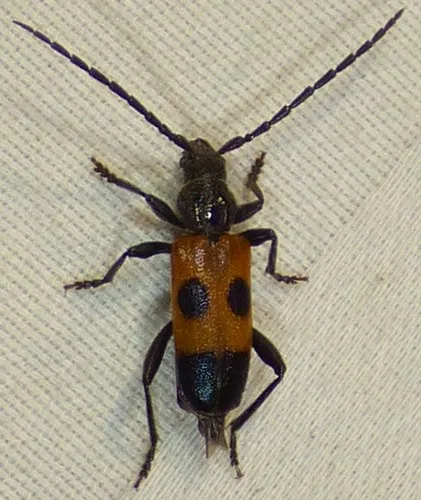
Cedar Tree Borer
Semanotus ligneus
Semanotus ligneus is a species of beetle in the family Cerambycidae.
Flat Oak Borer
Smodicum cucujiforme
Identification: Det. E.G. Riley, 2010 common , comes to lights ; often infests stored lumber, larvae continue to feed after the wood is in use
Smodicum texanum
Smodicum texanum
Identification: Characters cited by Knull for separating texanum are difficult to interpret in material from southern Texas, it appears that texanum differs from cucujiforme only by its slightly paler coloration, more lightly pubescent dorsum, and mi
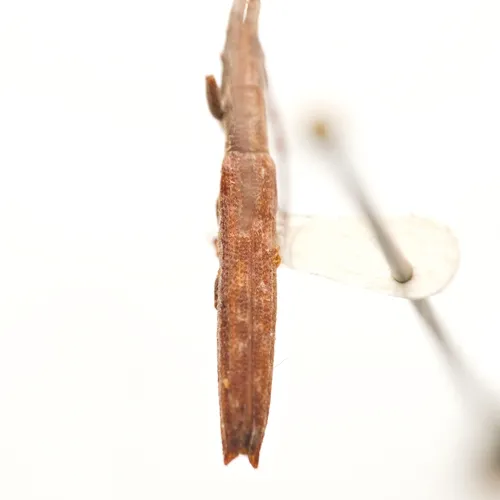
Spalacopsis suffusa 0
Spalacopsis suffusa
Spalacopsis suffusa is a species of beetle in the family Cerambycidae. It was first described by Newman in 1842.
Spalacopsis texana
Spalacopsis texana
Penrose swept numerous spmns from grasses and understory vegetation at Welder Wildlife Refuge in May and beat a mating pair from Baccharis at that site in Oct.
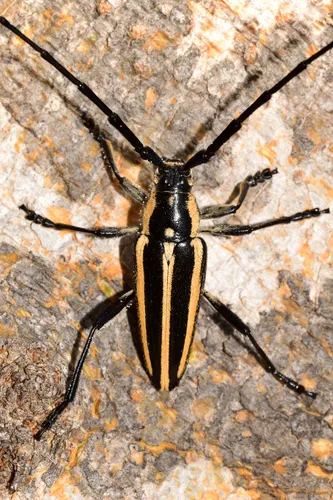
Sphaenothecus trilineatus
Sphaenothecus trilineatus
This species was not recognized as part of the United States longhorn beetle fauna until reported from Brownsville by Chemsak and Noguera. They mention the single Texas record in a paragraph discussion but not in the “Material Examined” section of th
Sphaerion exutum
Sphaerion exutum
This tropical species was first recorded from the U.S. on the basis of eight specimens collected on dead ebony at Bentsen-Rio Grande Valley State Park in May, 1972 and May, 1973 (Giesbert and Hovore 1976). An additional male specimen was taken at tha
Sphenostethus taslei
Sphenostethus taslei
Identification: denticulate elytral tips + smooth pronotal margins are diagnostic may be all black or with paler elytra & femora
Stenaspis solitaria
Stenaspis solitaria
Identification: occasionally with prominent amounts of red: They love to fly around on hot days. Not common in so. TX but somewhat common in the Big Bend area and extremely common in so. AZ (Dan Heffern, pers. comm.)
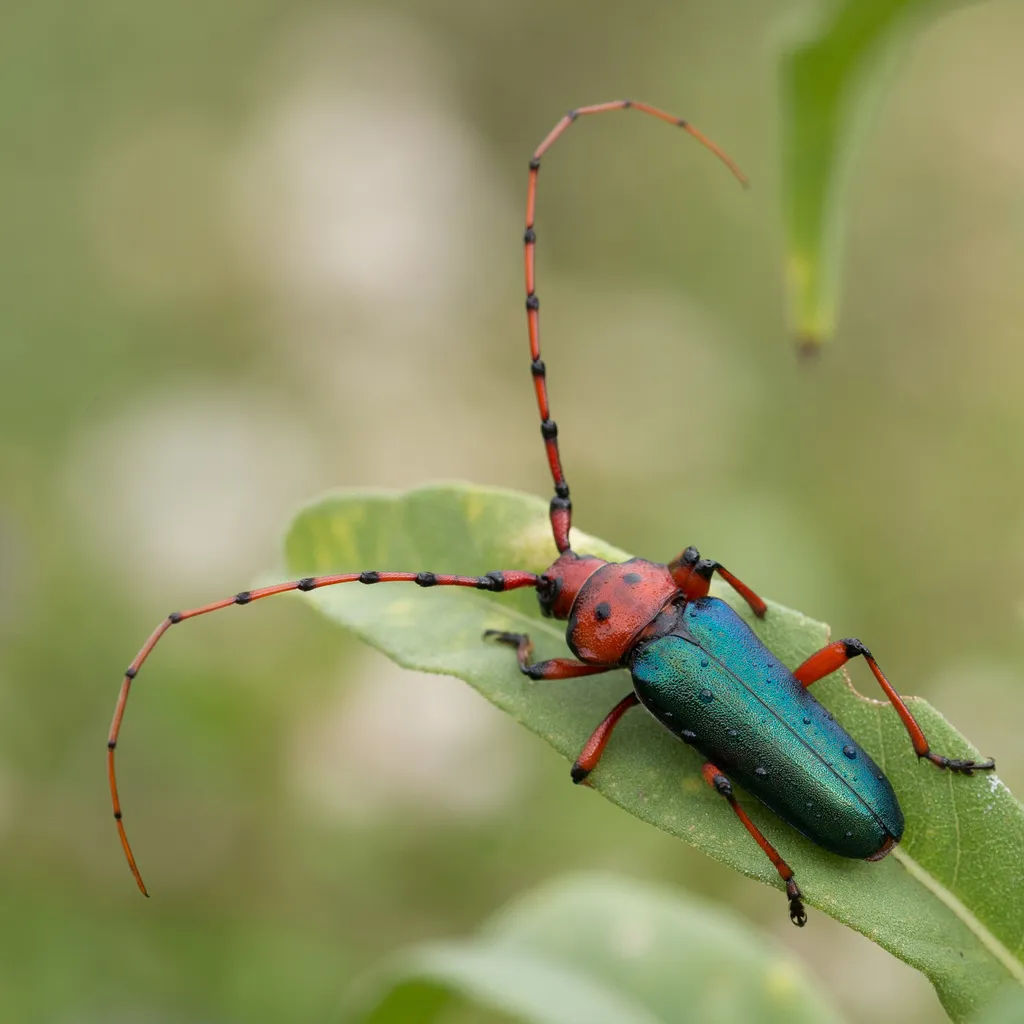
Stenaspis verticalis
Stenaspis verticalis
Stenaspis verticalis is a species of beetle in the Cerambycidae family. It was described by Audinet-Serville in 1834.
Stenelytrana gigas
Stenelytrana gigas
Effective mimic of a Tarantula Hawk wasp. Will occasionally appear at lights as well as bait. Strong, agile flyer, difficult to capture without using bait or lights.
Stenelytrana splendens 0
Stenelytrana splendens
Type: a female, Globe, ARIZONA, D. K. Duncan, collector
Stenhomalus taiwanus
Stenhomalus taiwanus
Identification: note long setae on the third and fourth antennomeres Det. V. Belov, 2017 intercepted many times in US East Coast ports since 1995, first collected in the wild in 2009 in AL
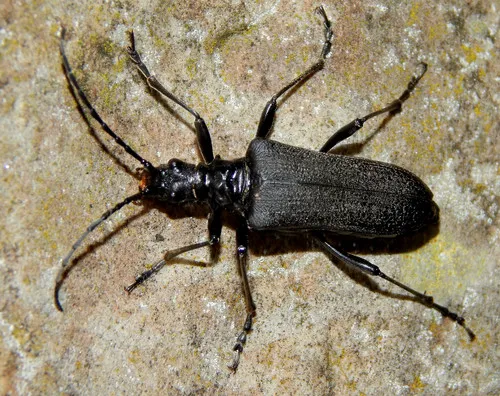
Stenocorus cylindricollis
Stenocorus cylindricollis
Stenocorus cylindricollis is a species of beetle from family Cerambycidae. The species are either black or brown coloured.
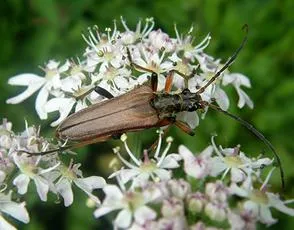
Stenocorus meridianus
Stenocorus meridianus
This is a large beetle reaching up to 25 mm in length and is a clumsy flier. The colour is variable from a uniform dull yellow through to almost black. It is to be found around the margins of wooded areas, where the adult beetles frequent flowers and
Stenocorus vestitus
Stenocorus vestitus
Identification: Tips of elytra rounded as opposed to truncate in the otherwise similar S. nubifer (LeConte 1859)
Stenosphenus dolosus
Stenosphenus dolosus
Identification: Det. M. A. Quinn, 2013 mostly coll'ed beating, sweeping or via traps as this sp. very rarely comes to lights ( 4 )
Stenosphenus lugens
Stenosphenus lugens
Identification: Narrower than S. notatus ; the elytra have the punctures arranged in three longitudinal bands; a narrow one at the suture, and two almost confluent on the disc; from the punctures proceed coarse pale hairs; the intervening spaces are
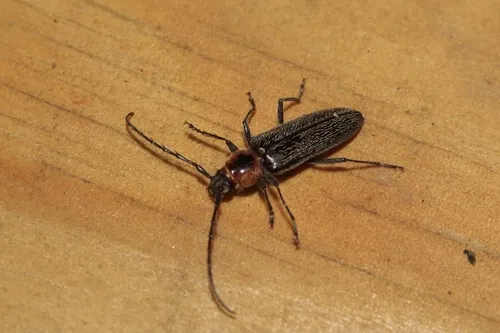
Stenosphenus notatus
Stenosphenus notatus
Stenosphenus notatus is a species of beetle in the family Cerambycidae. It was described by Olivier in 1795. Larvae of the species breed in dead limbs of Carya species, and occasionally Celtis.
Stenosphenus sobrius
Stenosphenus sobrius
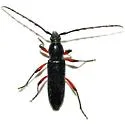
Identification: generally has red legs Det. Salvador Vitanza, 2023
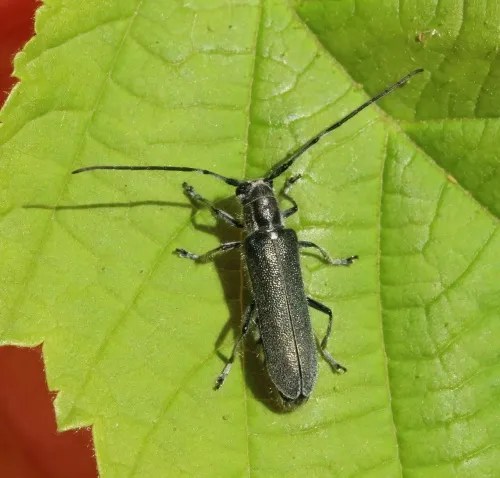
Lime Beetle
Stenostola dubia
This longhorn measures about 15mm in length. It is uniformly grey-black in colour, sometimes slightly bronzy and with punctured elytra. Good photographs required. This species is rare in our area so it is best to retain a specimen until identificatio
Stenurella melanura
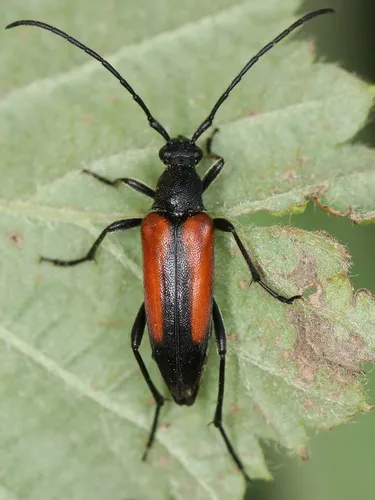
Stenurella melanura
A small (6 to 10 mm) longhorn beetle. The elytra appears a golden tawny brown fading to black, all other parts including head and legs are black. Well wooded areas, parks and meadows where they will visit a range of flowering plants. Larvae bore long
Sternidius alpha
Sternidius alpha
Identification: color pattern highly variable ; may be a complex of species One of the most common eastern lamiines ; common at lights
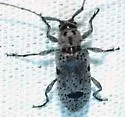
Sternidius imitans
Sternidius imitans
Type Locality: Davis Mountains, Jeff Davis Co., TX; June 13, 1935; Knull.
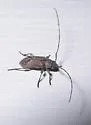
Sternidius misellus
Sternidius misellus
Identification: Nearly indistinguishable from some forms of S. alpha comes to lights
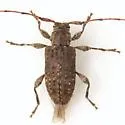
Sternidius punctatus
Sternidius punctatus
Identification: elytral pattern variable common ; attracted to UV lights
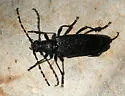
Red-shouldered Pine Borer
Stictoleptura canadensis
The normal colouration of S. c. canadensis is with banded antennae (male and female). Rarely the antennae are all black.… --Chris Majka, 31.i.2013
Stictoleptura rubra
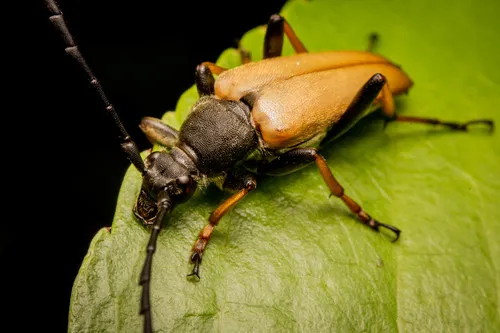
Stictoleptura rubra
Sometimes known as the Red Longhorn Beetle from the colour of the female. Length up to 19 mm. The species is striking to look at the female being uniformly red-brown in colour; males having pale ochre coloured elytra and black head and thorax. Juveni
Strangalepta abbreviata
Strangalepta abbreviata
Identification: elytra variable, usually striped, but may be all black. Pronotum relatively globose, w/o apical collar (unlike in Pidonia ), which, like the elytra, is weakly punctate, with short pubescence.
Strangalia acuminata
Strangalia acuminata
Identification: antennae, head and prothrorax always black; elytra all black in more southern populations. Extremely slender body makes it recognizable among all-black longhorns.
Strangalia occidentalis
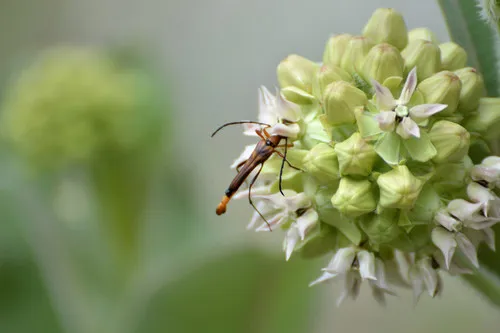
Strangalia occidentalis
Strangalia occidentalis is a species of flower longhorn in the family of beetles known as Cerambycidae. It is found in Central America and North America.
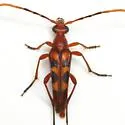
Six-spotted Flower Longhorn Beetle
Strangalia sexnotata
Identification: Less elongated than other members of genus with strong elytral spots. Elytral pubescence "bristly". One form, noted from south-central states, has first few antennomeres black and pale legs. Coastal form from Virginia, etc. has mostly
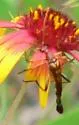
Strangalia virilis
Strangalia virilis
Identification: The strongly inflated last abdominal segment in males, the large size, and distinctive color pattern characterize this species
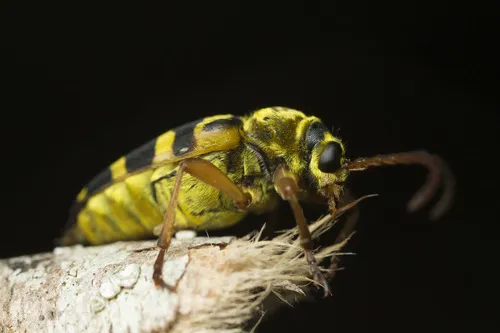
Strophiona laeta
Strophiona laeta
Strophiona laeta is a species of flower longhorn in the family of beetles known as Cerambycidae. It is found in North America.
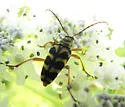
Strophiona nitens
Strophiona nitens
Identification: similar to Typocerus spp., but pronotum strongly constricted towards base and pubescence metallic yellow Det. M. A. Quinn, 2014 attracted to UV lights
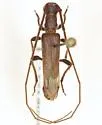
Styloxus oblatipilis
Styloxus oblatipilis
Numerous specimens collected at lights in Bentsen-Rio Grande State Park in late July and early August.
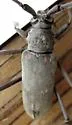
Susuacanga stigmatica
Susuacanga stigmatica
Identification: Det. D. Heffern, 1993 Attracted to lights
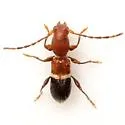
Tetranodus niveicollis
Tetranodus niveicollis
Identification: Antennomeres 3-6 inflated in ♂♂, simple in ♀♀ Schaeffer (1904) reported the species as common near Brownsville, TX, on Vachellia (=Acacia) farnesiana and (less frequently) on Ebenopsis ebano (= Acacia flexicaulis )
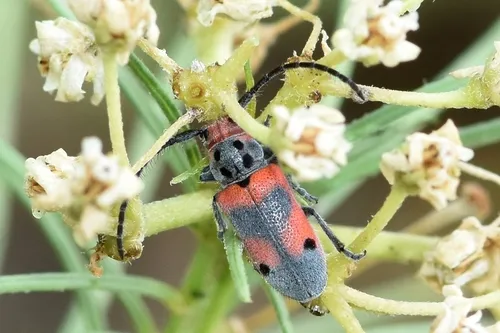
Tetraopes discoideus
Tetraopes discoideus
Tetraopes discoideus is a species of beetle in the family Cerambycidae. It was described by John Lawrence LeConte in 1847. It is known from Mexico and the United States.
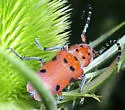
Red-femured Milkweed Borer
Tetraopes femoratus
Identification: edges of mid-pronotal callus sharply defined ; the most variable member of the genus
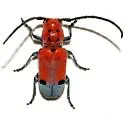
Tetraopes linsleyi
Tetraopes linsleyi
Identification: Det. J. A. Chemsak Obsolete link on patronym (http://museum.unl.edu/research/entomology/workers/GLinsley.htm) replaced with link to a Wikipedia article 8/3/2022.
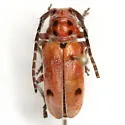
Tetraopes mandibularis
Tetraopes mandibularis
Identification: last antennal segment gradually tapering apically, antennal segments without fringes of very long hairs at apices, mandibles of male with very large, prominent dorsal tubercle extending for about half their lengths, elytra with sutura
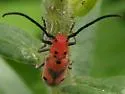
Blackened Milkweed Beetle
Tetraopes melanurus
Identification: Distinctive heavy marks on elytra, in addition to spots. Weak callus on pronotum. Antennae all dark.
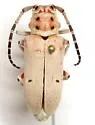
Tetraopes pilosus
Tetraopes pilosus
Identification: Very similar to T. annulatus but the integument including callus completely obscured by dense whitish/yellowish-gray pubescence T. annulatus
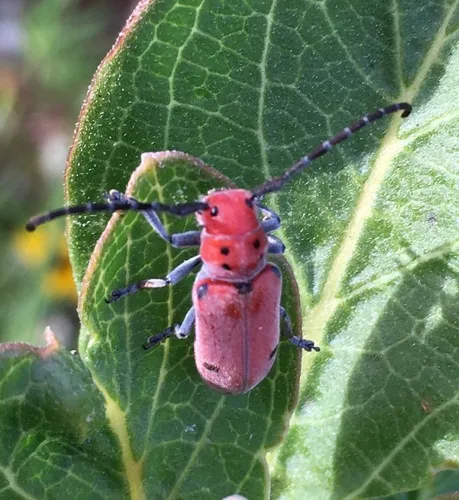
Tetraopes quinquemaculatus
Tetraopes quinquemaculatus
Identification: separated from most other spp. by lack of basal elytral spots; typically has slight dark markings at elytral tips uncommon , considered a "Species of Greatest Conservation Need" in Arkansas
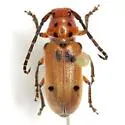
Tetraopes texanus
Tetraopes texanus
Identification: Very long setae at apex of most antennomeres, as long as adjacent antennomeres. Last antennomere abruptly flattened midway and slightly curved. edges of mid-pronotal callus generally not sharply defined Det. M. A. Quinn, 2016 this is
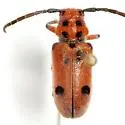
Tetraopes thermophilus
Tetraopes thermophilus
Identification: mid-pronotal callus with sharp, nearly parallel edges antennae without long setae, ant. tips not pointed Det. M. A. Quinn, 2017 Type Locality: Veracruz, Mexico
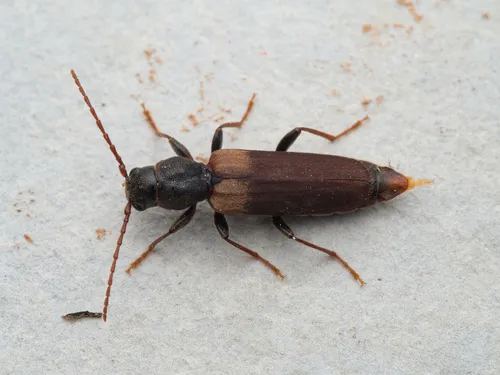
Brown Spruce Longhorn Beetle
Tetropium fuscum
Tetropium fuscum, the brown spruce longhorn beetle, is a species of beetle in the family Cerambycidae. It was described by Johan Christian Fabricius in 1787. Tetropium fuscum is native to Europe and Northern Asia, and has been introduced to Nova Scot
Tetropium sp. A
Tetropium undescribed
Page made to accomodate this distinct but still undescribed species. It represent the "sp. A" in Bousquet & al
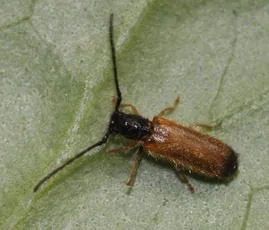
Plum beetle
Tetrops praeustus
A small longhorn beetle to 6 mm with yellowish to tan, black tipped bristly elytra and yellowish legs. Feeds on the twigs and branches of various deciduous trees and bushes. It usually it takes the larvae 1 year to develop into an adult beetle but in
Thryallis undatus
Thryallis undatus
Common in the sabal palm grove. Vogt collected one specimen near Mission, Hidalgo Co., the only Texas specimen collected outside of the palm grove.
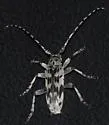
Tigrinestola tigrina
Tigrinestola tigrina
Type Locality: Carr Canyon, Huachuca Mountains, Arizona.
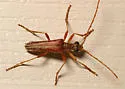
Toxotopsis cinnamopterus
Toxotopsis cinnamopterus
Identification: uniformly brownish, with small vut distinct lteral pronotal tubercles, and rounded elytral apices comes to lights
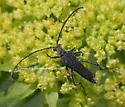
Trachysida aspera
Trachysida aspera
Identification: In T. aspera the whole elytra are dull and the punctures are regular in size, small and very dense. Robert Androw
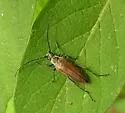
Trachysida mutabilis
Trachysida mutabilis
Identification: In T. mutabilis , the basal part of the elytra are more shining than the apical, and the punctures are larger at the base, with shining spaces between them. ( Robert Androw )
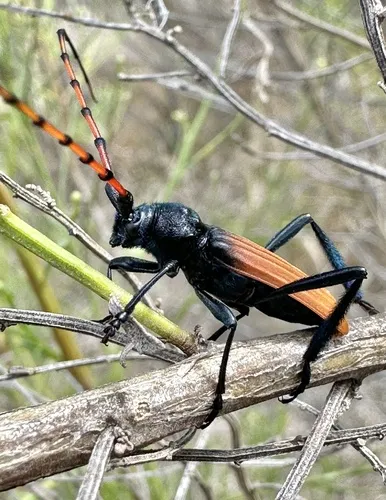
Tragidion annulatum
Tragidion annulatum
Tragidion annulatum is a species of beetle in the Cerambycidae family. It was described by LeConte in 1858.
Tragidion coquus
Tragidion coquus
Identification: amount of orange on the elytra highly variable One hundred and eighty-seven specimens examined from north-central TX ( 4 )
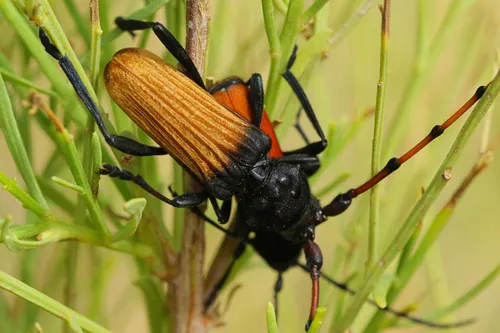
Tragidion deceptum
Tragidion deceptum
Tragidion deceptum is a species of beetle in the Cerambycidae family. It was described by Swift & Ray in 2008. The adult is black with orange-yellow on the whole of the elytra except for the parts nearest the thorax. The insect is native to the south
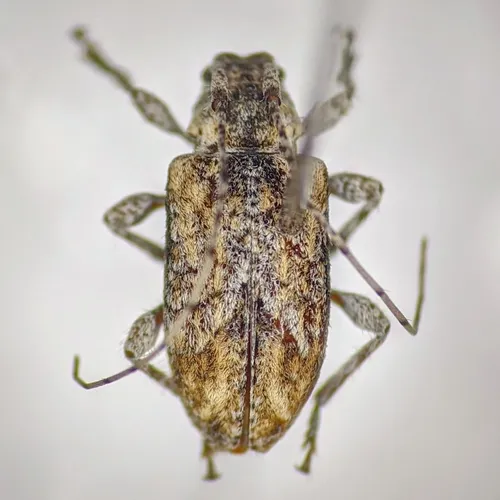
Trichastylopsis albidus
Trichastylopsis albidus
Trichastylopsis albidus is a species of longhorn beetles of the subfamily Lamiinae, and the only species in the genus Trichastylopsis. It was described by LeConte in 1852.
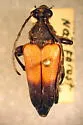
Trigonarthris atrata
Trigonarthris atrata
Identification: more weakly pubescent pronotum , elytral coloration tends to be slightly more reddish-orange, and the body slighly broader , pronotum with distinct angles at middle of side
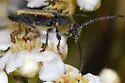
Triodoclytus lanifer
Triodoclytus lanifer
Identification: This specimen has the typical transfer ivory band on the elytra. … Dennis Haines, 23 July, 2008
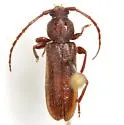
Tylonotus masoni
Tylonotus masoni
very rare sp. , attracted to UV lights Type: female, labeled Edgebrook, Illinois, June 18, in the collection of the author, paratype: female, labeled Edgebrook, Illinois, Aug. 5, E. Liljeblad collector, in the collection of the late Mr. F. R. Mason a
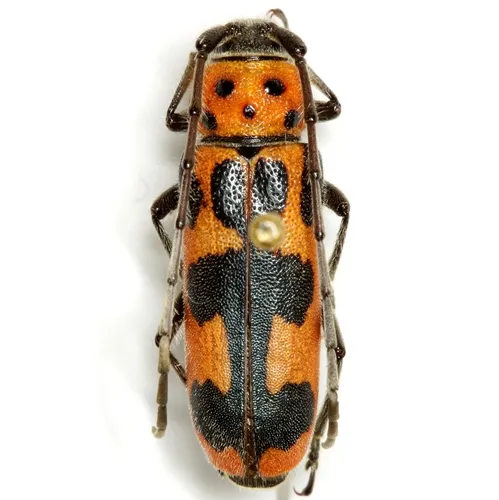
Tylosis jimenezii
Tylosis jimenezii
Tylosis jimenezii is a species of beetle in the Cerambycidae family. It was described by Dugès in 1879.
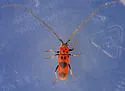
Tylosis maculatus
Tylosis maculatus
Identification: highly variable in size and pattern Type Locality: west of Santa Fé, New Mexico
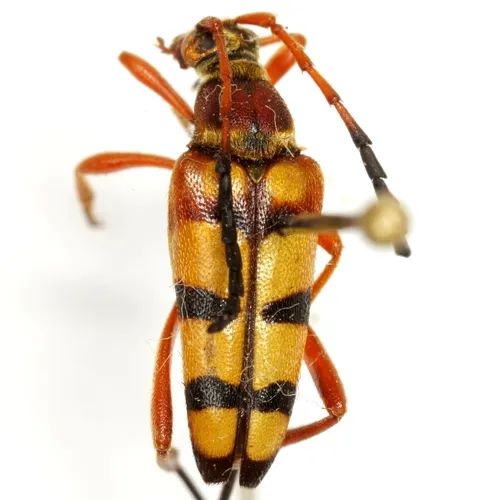
Typocerus balteatus
Typocerus balteatus
Typocerus balteatus is a species of flower longhorn in the beetle family Cerambycidae. It is found in North America.
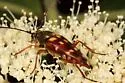
Typocerus deceptus
Typocerus deceptus
Identification: Resembles T. velutina , but pattern on elytra is very weak. (pattern is variable in T. velutina ; T. acuticauda is similar)
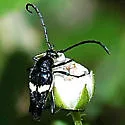
Typocerus fulvocinctus
Typocerus fulvocinctus
Identification: The coarse punctures of pronotum together with black pubescence and [yellow] markings will distinguish this species from any of our described forms. (Knull 1956) Det. Robert Androw, 2020 Type Locality: Sebring, Fla., April, 1954, by L
Typocerus lugubris
Typocerus lugubris
Typocerus lugubris (Typocerus lugubris) is a species in the family Cerambycidae, commonly known as longhorn beetles, belonging to the order Coleoptera (Beetles). It is classified within the subfamily Lepturinae, tribe Lepturini, suborder Polyphaga, s
Zebra Longhorn Beetle
Typocerus zebra
Identification: Pattern distinctive. Small triangular yellow marks at base of elytra.
Urgleptes facetus
Urgleptes facetus
Identification: Dark elytral tips distiguish this species from small individuals of Urgleptes querci .
Urgleptes sandersoni
Urgleptes sandersoni
reared from deadwood from Key Largo about 10 years ago, but has not been formally recorded from the United States (Josef Vlasak, pers. comm.); common in Puerto Rico and other parts of the West Indies. -Robert Androw's comment
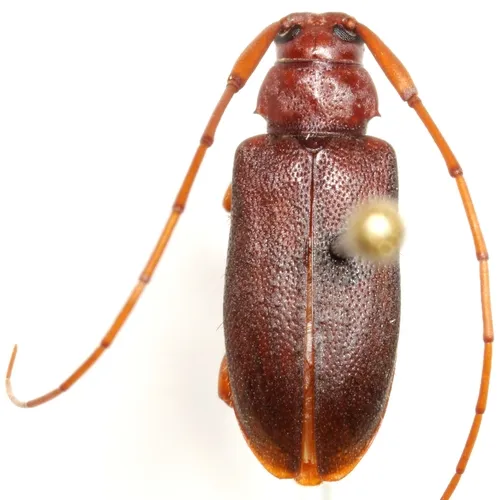
Valenus inornatus
Valenus inornatus
Valenus inornatus is a species of longhorn beetles of the subfamily Lamiinae, and the only species in the genus Valenus. It was described by Casey in 1892.
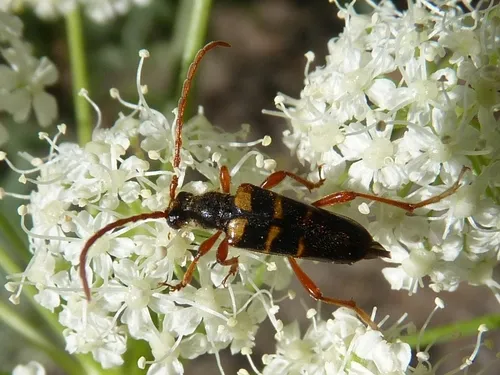
Xestoleptura crassicornis
Xestoleptura crassicornis
Identification: You can tell by the orange antennae and glossy surface of the elytra. The elytra are also a little more parallel-sided. X. crassipes has the antennae black to yellowish-brown, and the elytra duller. … Dennis Haines, 12 August, 2008 -
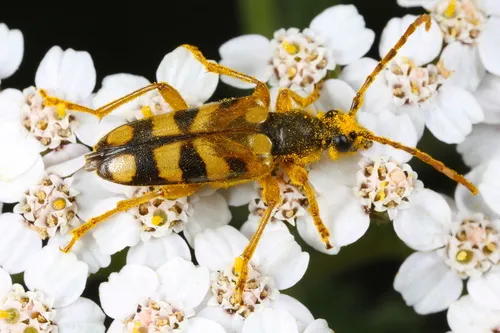
Xestoleptura crassipes
Xestoleptura crassipes
Identification: The single hind tibial spur and the strongly produced basal lobe of the elytra around the scutellum separate it from the similar X. crassicornis . --Bob Androw variable:
Xestoleptura octonotata
Xestoleptura octonotata
Identification: Very long, shining. Elytra dark, each with four spots.
Xylotrechus bowditchi 0
Xylotrechus bowditchi
Identification: habitus photos: X. b. bowditchi ▪ X. b. hoppingi candidate submissions:
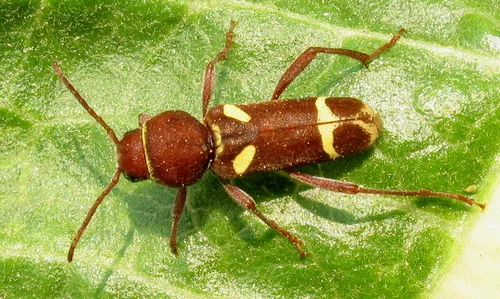
Willow Borer
Xylotrechus insignis
Xylotrechus insignis is a species of beetle in the family Cerambycidae. It was described by John Lawrence LeConte in 1873. Xylotrechus insignis is commonly referred to as a willow borer which means that it drills into trees usually killing or harming
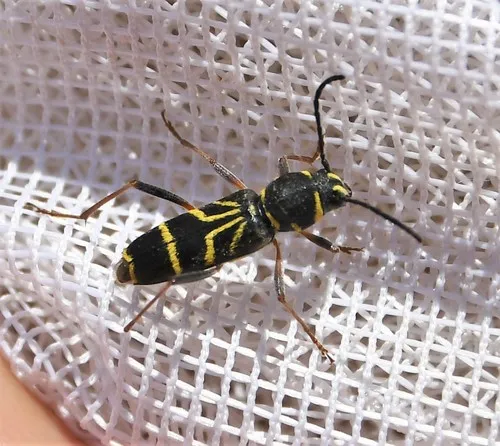
Xylotrechus nitidus
Xylotrechus nitidus
Xylotrechus nitidus is a species of beetle in the family Cerambycidae. It was described by Horn in 1860.
Xylotrechus quercus
Xylotrechus quercus
Type Locality: Miller Canyon, Huachuca Mountains, Cochise Co., Arizona
Xylotrechus robustus
Xylotrechus robustus
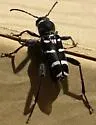
Type locality: "Griffith Mill, Estes Park. Colorado, 7,800 ft."
Arrowhead Borer
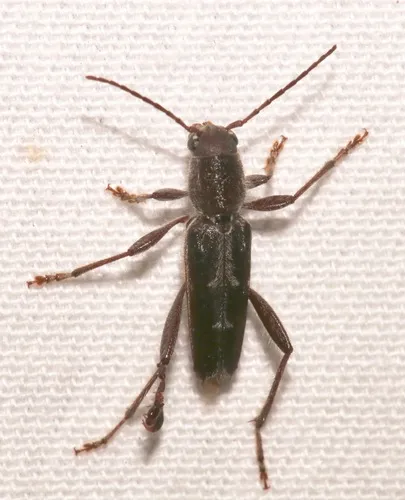
Xylotrechus sagittatus
Identification: Reddish. Pale markings (pubescence) is mainly down midline of elytra. In some (?) specimens, there are arrowhead lines pointing towards head. Det. M. A. Quinn, 2012 occasionally found w/ pseudoscorpions on hind legs:
Zagymnus clerinus
Zagymnus clerinus
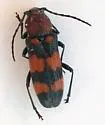
Identification: Orange pattern can be reduced or even absent Populations of Zagymnus clerinus and other Agallissini species can be located by finding their distinctly elliptical exit holes in the dead petioles of Palmetto trees. This has led to the d
Acanthocinus angulosus
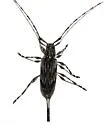
Acanthocinus angulosus
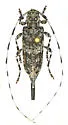
Acanthocinus leechi
Acanthocinus leechi
Acanthocinus obliquus
Acanthocinus obliquus
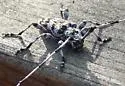
Ponderosa Pine Bark Borer
Acanthocinus princeps
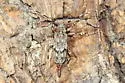
Acanthocinus pusillus
Acanthocinus pusillus
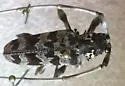
Acanthocinus spectabilis
Acanthocinus spectabilis
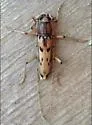
Achryson surinamum
Achryson surinamum
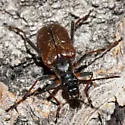
Acmaeops proteus
Acmaeops proteus
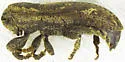
Adetaptera thomasi
Adetaptera thomasi
Aegomorphus arizonicus
Aegomorphus arizonicus
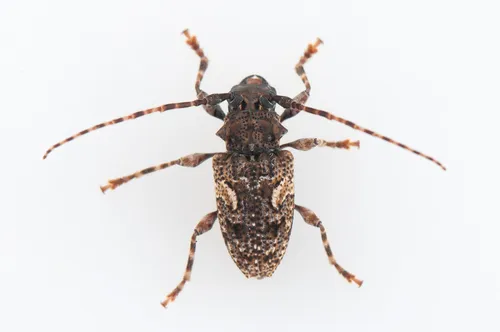
Aegomorphus circumflexus
Aegomorphus circumflexus