
Zagymnus clerinus
This record describes Zagymnus clerinus (species). Recorded family: Cerambycidae. Recorded order: Coleoptera.
Identification and Appearance
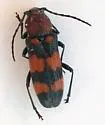
Orange pattern can be reduced or even absent Populations of Zagymnus clerinus and other Agallissini species can be located by finding their distinctly elliptical exit holes in the dead petioles of Palmetto trees. This has led to the discovery of the anthropogenic translocation of the species, as well as Osmopleura chamaeropis , across the East coast of the United States through the shipping of Florida nursery Palmettos for the landscape trade. As a result, Zagymnus clerinus has been able to sucessfully establish populations in native stands of Palmettos in at least SC and TX in recent years. ( 3 )
Classification
- Kingdom
- Animalia
- Phylum
- Arthropoda
- Class
- Insecta
- Order
- Coleoptera (Beetles)
- Suborder
- Polyphaga
- Superfamily
- Chrysomeloidea
- Family
- Cerambycidae (Longhorn Beetles)
- Subfamily
- Cerambycinae
- Tribe
- Agallissini
- Genus
- Zagymnus
Imported taxonomy record. Source availability varies; see the source references and editorial policy below.
Habitat and Range
Habitat
coastal sabal habitats
Geographic Range
coastal s.TX-s.-FL-e.SC / Cuba - Map , most records FL-SC
Seasonal Activity
adults of this uncommon sp. ( 5 ) are active Apr-Jul in FL (BG data)
Diet and Behavior
Diet: Larvae feed and develop inside dead Sabal palmetto and Sabal mexicana petioles.
Life History
Eggs are laid in late summer indiscriminately on the surface or broken tips of Sabal sp. petioles. Larvae feed on the woody longitudinal fibers of the petiole. Larval tunnels are usually 30cm long by 3cm wide and ~1cm deep. Larvae may take a year or more to develop and 2 larvae can develop in each petiole, one on either side of the sagittal plane. Larvae form a pupal chamber and pupate in late spring. Adults exit the petiole by chewing an elliptical hole through the surface that's approximately 10mm by 5mm. ( 3 )
Additional species information
Species notes from the sources
Etymology: Clerid-like
About Primitive Winged Insects: the wider group
Order-level background for Coleoptera, the group containing Zagymnus clerinus. Species-specific details appear above.
Group overview
Coleoptera is the largest order of insects with over 400,000 described species, representing ~25% of all known animal species and ~40% of all insects. In the U.S. alone, nearly 30,000 beetle species have been identified.
Ecological role of the group
Beetles are prominent decomposers, especially in forests, breaking down dead wood and recycling nutrients. As predators, they reduce populations of pest insects. Many species are also important pollinators of flowering plants.
Economic and practical significance of the group
Beetles have major economic significance: leaf beetles (Chrysomelidae) and weevils (Curculionoidea) are among the most destructive agricultural pests globally, costing billions annually, while predatory species like ladybugs provide natural pest control.
Recorded sources for this group: Britannica, Smithsonian, NCSU Entomology. Imported estimates may describe particular regions or reporting periods.
Photos of Zagymnus clerinus (5)
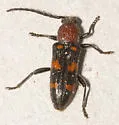
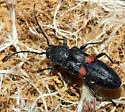
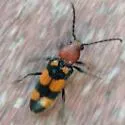
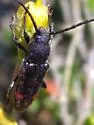
Photo credits: Contributed by Phillip Harpootlian; Additional contributions by Mike Quinn , Tom Austin
Frequently Asked Questions About Zagymnus clerinus
What is Zagymnus clerinus?
Zagymnus clerinus is a species in the family Cerambycidae, within the order Coleoptera.
How big is Zagymnus clerinus?
13-17 mm (FSCA)
How do you identify Zagymnus clerinus?
Orange pattern can be reduced or even absent
Where is Zagymnus clerinus found?
| Feature | Details |
|---|---|
| Habitat | coastal sabal habitats |
| Range | coastal s.TX-s.-FL-e.SC / Cuba - Map , most records FL-SC |
What does Zagymnus clerinus eat?
The diet of the Zagymnus clerinus includes Larvae feed and develop inside dead Sabal palmetto and Sabal mexicana petioles..
When is Zagymnus clerinus active?
Zagymnus clerinus: seasonal activity - adults of this uncommon sp. ( 5 ) are active Apr-Jul in FL (BG data).
What is the life cycle of a Zagymnus clerinus?
Eggs are laid in late summer indiscriminately on the surface or broken tips of Sabal sp. petioles. Larvae feed on the woody longitudinal fibers of the petiole. Larval tunnels are usually 30cm long by 3cm wide and ~1cm deep. Larvae may take a year or more to develop and 2 larvae can develop in each petiole, one on either side of the sagittal plane. Larvae form a pupal chamber and pupate in late spring. Adults exit the petiole by chewing an elliptical hole through the surface that's approximately 10mm by 5mm. ( 3 )